

AI-enabled materials intelligence for lunar regolith: Design, fabrication, and lifecycle management

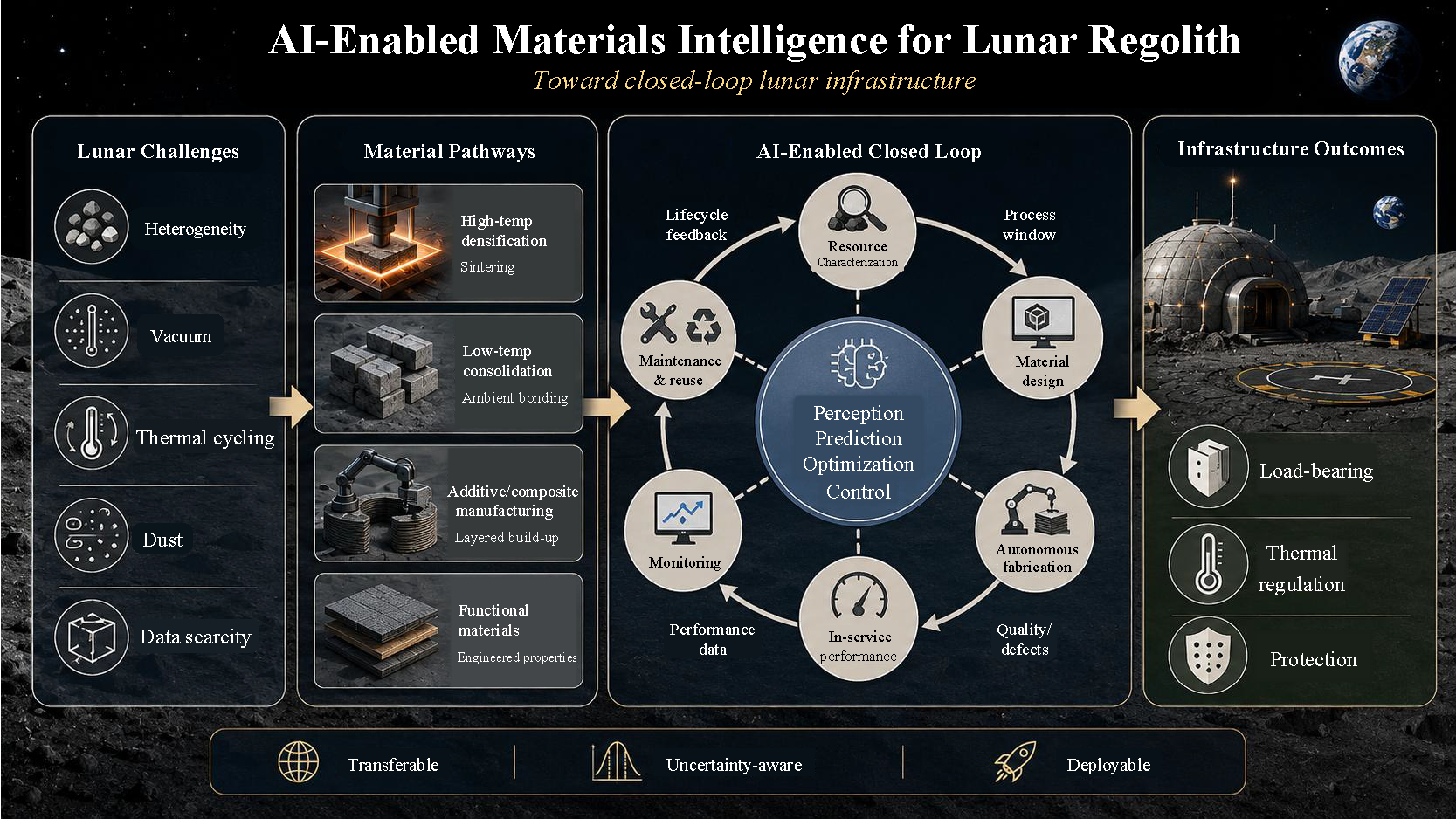
Artificial intelligence (AI) offers a new route to address the heterogeneity, data scarcity, and strongly coupled composition-process-structure-performance relationships of lunar regolith materials. This perspective reframes lunar regolith as a materials-intelligence problem that integrates materials data, physical knowledge, and AI-driven decision-making. Four pathways are examined: high-temperature densification, low-temperature consolidation, additive/composite manufacturing, and functionalized regolith materials. Priority AI interventions include physics-informed process modeling, composition-process-property learning, in-process monitoring, adaptive control, multi-objective design, and lifecycle prognostics for degradation and remaining-life prediction. We further propose an AI-enabled closed-loop framework linking resource characterization, material selection, autonomous fabrication, in-service monitoring, maintenance, and reuse. Future progress requires benchmark datasets, simulant-to-real transfer, uncertainty-aware learning, and closed-loop validation under lunar conditions. The central challenge is not merely to produce stronger regolith materials, but to establish trustworthy and deployable materials intelligence for long-term lunar infrastructure.
- Wang C, Zhang G, Wang Y, Song L. A Review of Lunar Environment and In-Situ Resource Utilization for Achieving Long-Term Lunar Habitation. Galaxies. 2025;13(5):103. doi: 10.3390/galaxies13050103
- MacRobbie CJ, Hoying M. Architecture for a Flexible, Scalable, and Sustainable Lunar Infrastructure. AIAA AVIATION FORUM AND ASCEND 2025. 2025. doi: 10.2514/6.2025-4020
- Pederson F, Ellersick L, Kim H-J. A review of lunar regolith based alkali activated materials and sintered regolith for use as a construction material. Acta Astronaut. 2025;232:502-515. doi: 10.1016/j.actaastro.2025.03.032
- Jiang Y, Zhou Q, Feng Q, Li F, Zhou S. From lunar regolith samples to infrastructure: Insights into in-situ construction technologies on the moon. J Build Eng. 2025;114:114371. doi: 10.1016/j.jobe.2025.114371
- Bao C, Wang Y, Pearce G, Mushtaq RT, Liu M, Zhao P. In-situ additive manufacturing with lunar regolith for lunar base construction: A review. Appl Mater Today. 2024;41:102456. doi: 10.1016/j.apmt.2024.102456
- Sun Y, Ma S, Chen Q, et al. Lunar regolith simulant-derived 3D-printed geopolymers with optimized mechanical and thermal management properties. Compos Part A Appl Sci Manuf. 2025;196:108989. doi: 10.1016/j.compositesa.2025.108989
- Tian Z, Zheng J, Wang H, et al. A space-forged super-thermal insulating material—lunar agglutinates. Commun Mater. 2026;7(1):109. doi: 10.1038/s43246-026-01126-9
- Nie J, Cui Y, Senetakis K, et al. Predicting residual friction angle of lunar regolith based on Chang’e-5 lunar samples. Sci Bull. 2023;68(7):730-739. doi: 10.1016/j.scib.2023.03.019
- Zou Y, Wu H, Chai S, Yang W, Ruan R, Zhao Q. Development and characterization of the PolyU-1 lunar regolith simulant based on Chang’e-5 returned samples. Int J Min Sci Technol. 2024;34(9):1317-1326. doi: 10.1016/j.ijmst.2024.08.006
- Aguiar BA, Nisar A, Thomas T, Zhang C, Agarwal A. In-situ resource utilization of lunar highlands regolith via additive manufacturing using digital light processing. Ceram Int. 2023;49(11, Part A):17283-17295. doi: 10.1016/j.ceramint.2023.02.095
- Butler KT, Davies DW, Cartwright H, Isayev O, Walsh A. Machine learning for molecular and materials science. Nature. 2018;559(7715):547-555. doi: 10.1038/s41586-018-0337-2
- Karniadakis GE, Kevrekidis IG, Lu L, Perdikaris P, Wang S, Yang L. Physics-informed machine learning. Nat Rev Phys. 2021;3(6):422-440. doi: 10.1038/s42254-021-00314-5
- Jiang Y, Li F, Zhou S, Liu L. Investigating the microscopic, mechanical, and thermal properties of vacuum-sintered BH-1 lunar regolith simulant for lunar in-situ construction. Case Stud Constr Mater. 2025;22:e04132. doi: 10.1016/j.cscm.2024.e04132
- Liu J, Cheng H, Liu X, Liang J, Zuo Y, Qiang F. Characteristics of lunar regolith solidified with low binder content: Influencing factors and high-temperature - ultra-low temperature cyclic deterioration behavior. Constr Build Mater. 2025;492:142982. doi: 10.1016/j.conbuildmat.2025.142982
- Malekpour F, Hojjati M. Circular additive manufacturing of recycled PEKK–regolith composites for sacrificial structures in lunar in-situ resource utilization. Compos Part B Eng. 2026;326:114013. doi: 10.1016/j.compositesb.2026.114013
- Xue G, Qiao G. Impacts of thermal activation on lunar regolith simulant-based precursor and resulting geopolymer: Composition, structure, solubility, and reactivity. Cem Concr Compos. 2025;155:105840. doi: 10.1016/j.cemconcomp.2024.105840
- Liu Z, Kwan MP, Jiang W, Liu Y, Cui B. A Lightweight Multi-Scale Fusion Framework for Traffic Vehicle Detection from Satellite Remote Sensing, UAV, and CCTV Imagery. IEEE Trans Geosci Remote Sens. 2026;64:5632717-5632717. doi: 10.1109/TGRS.2026.3713370
- Ostrogovich L, Renga A, Del Prete R, Giannattasio S, Andolfi L, Tomasicchio G. AI-assisted hazard detection for safe lunar landing. Astrodynamics. 2026;10(3):449-464. doi: 10.1007/s42064-025-0288-y