
From AI-generated health information to medication action: Trust, risk recognition, and physician/pharmacist verification among university students

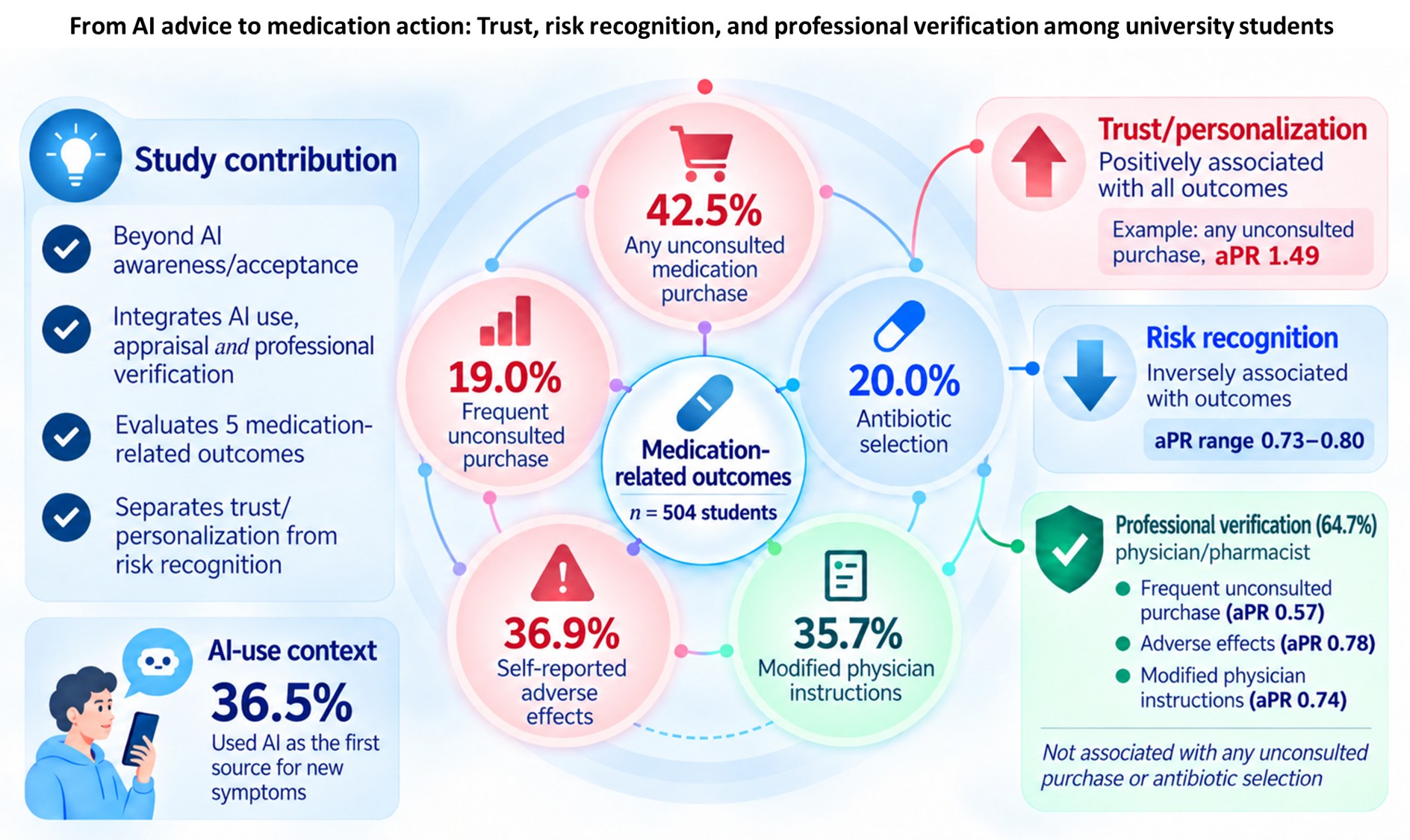
Publicly accessible conversational artificial intelligence (AI) increasingly informs self-care, yet research among university students has primarily examined awareness, acceptance, and information seeking rather than the progression from AI output to medication action and safety experiences. This cross-sectional study examined 504 University of Jordan students who had previously used AI for self-treatment or self-medication. A 39-item questionnaire assessed symptom consultation, professional verification, medication-related behaviors, and self-reported adverse effects. We derived attitudinal domains using exploratory factor analysis, and modified Poisson regression estimated adjusted prevalence ratios (aPRs). AI was the first source consulted for new symptoms by 36.5% of participants; 42.5% reported purchasing medication following AI advice without consulting a physician or pharmacist (19.0% frequently), 20.0% selected antibiotics following AI-generated information or recommendations, 36.9% reported adverse effects following an AI-recommended medication, and 35.7% modified physician instructions because of conflicting AI advice. Per one-standard-deviation increase, trust/personalization was associated with higher prevalence of all five evaluated outcomes, including any unconsulted purchasing (aPR 1.49, 95% confidence interval 1.33–1.66), whereas risk recognition showed consistent inverse associations (aPR range 0.73–0.80). Physician/pharmacist verification, reported by 64.7%, was associated with lower prevalence of frequent unconsulted purchasing (aPR 0.57, 95% confidence interval 0.40–0.83), reported adverse effects (aPR 0.78, 0.64–0.96), and modification of physician instructions (aPR 0.74, 0.60–0.91), but not with any purchasing or antibiotic selection. Cross-sectional self-report precludes causal attribution. By identifying output appraisal and professional verification as distinct correlates of medication action, this study extends adoption-focused research to clinically relevant behaviors.
- Miqdadi AI, Alhalabi MN, Alhadidi M, et al. Attitudes toward seeking professional psychological help, self-stigma of seeking help, and preferences for AI mental health chatbots vs. human counsellors: a mixed methods study. Int J Ment Health Addict. 2025. doi: 10.1007/s11469-025-01595-y
- Thirunavukarasu AJ, Ting DSJ, Elangovan K, Gutierrez L, Tan TF, Ting DSW. Large language models in medicine. Nat Med. 2023;29(8):1930-1940. doi: 10.1038/s41591-023-02448-8
- Khattab MAM, Salameh MI, Selim HFF. Artificial intelligence and its relationship with the future of psychotherapy. In: Sustainable Leadership for Environmental Risk. Springer Nature Switzerland; 2026:13-19. doi: 10.1007/978-3-032-00590-8_2
- Lee P, Bubeck S, Petro J. Benefits, limits, and risks of GPT-4 as an AI chatbot for medicine. N Engl J Med. 2023;388(13):1233-1239. doi: 10.1056/NEJMsr2214184
- Ayo-Ajibola O, Davis RJ, Lin ME, Riddell J, Kravitz RL. Characterizing the adoption and experiences of users of artificial intelligence-generated health information in the United States: cross-sectional questionnaire study. J Med Internet Res. 2024;26:e55138. doi: 10.2196/55138
- Abdelwahed AE, Abd El-Nasser M, Heih OQ, et al. Public attitudes and practices toward using AI chatbots for healthcare assistance: a multinational cross-sectional study. BMC Health Serv Res. 2026;26(1):335. doi: 10.1186/s12913-025-13832-0
- Qin H, Zhu Y, Jiang Y, Luo S, Huang C. Examining the impact of personalization and carefulness in AI-generated health advice: trust, adoption, and insights in online healthcare consultations experiments. Technol Soc. 2024;79:102726. doi: 10.1016/j.techsoc.2024.102726
- Shekar S, Pataranutaporn P, Sarabu C, Cecchi GA, Maes P. People overtrust AI-generated medical advice despite low accuracy. NEJM AI. 2025;2(6). doi: 10.1056/AIoa2300015
- Al-Remawi M, Ali Agha ASA, Al-Akayleh F, Aburub F, Abdel-Rahem RA. Artificial intelligence and machine learning techniques for suicide prediction: integrating dietary patterns and environmental contaminants. Heliyon. 2024;10(24):e40925. doi: 10.1016/j.heliyon.2024.e40925
- Ghunaim L, Ali Agha ASA, Al-Samydai A, Aburjai T. The future of pediatric care: AI and ML as catalysts for change in genetic syndrome management. Jordan Med J. 2024;58(4):510-528. doi: 10.35516/jmj.v58i4.2787
- Al-Akayleh F, Ali Agha ASA. Trust, ethics, and user-centric design in AI-integrated genomics. In: 2024 2nd International Conference on Cyber Resilience (ICCR). IEEE; 2024:1-6. doi: 10.1109/ICCR61006.2024.10532890
- De Busser B, Roth L, De Loof H. The role of large language models in self-care: a study and benchmark on medicines and supplement guidance accuracy. Int J Clin Pharm. 2025;47(4):1001-1010. doi: 10.1007/s11096-024-01839-2
- Draelos RL, Afreen S, Blasko B, et al. Large language models provide unsafe answers to patient-posed medical questions. npj Digit Med. 2026;9(1):241. doi: 10.1038/s41746-026-02428-5
- De Vito A, Geremia N, Bavaro DF, et al. Comparing large language models for antibiotic prescribing in different clinical scenarios: which performs better? Clin Microbiol Infect. 2025;31(8):1336-1342. doi: 10.1016/j.cmi.2025.03.002
- Al-Qerem W, Eberhardt J, Jarab A, et al. Exploring knowledge, attitudes, and practices towards artificial intelligence among health professions’ students in Jordan. BMC Med Inform Decis Mak. 2023;23(1):288. doi: 10.1186/s12911-023-02403-0
- Barakat NA, Akour A, Alkhaldi O, Barakat H, Barakat M. Assessment of the knowledge, attitudes, and practices of pharmacy students toward self-medication using artificial intelligence: a cross-sectional study. BMC Med Educ. 2026. doi: 10.1186/s12909-026-09882-5
- Vasudevan R, Kandasamy G, Venkatesan K, Devanandan P, Al Malh SM, Alasmari LF. Patient trust in AI-generated medication information and the role of clinical pharmacists in preventing medication-related safety risks: a cross-sectional survey. J Patient Saf. 2026. doi: 10.1097/pts.0000000000001546
- Aburub F, Al-Remawi M, Abdel-Rahem RA, Al-Akayleh F, Ali Agha ASA. AI-driven whole-exome sequencing: advancing variant interpretation and precision medicine. In: 2025 1st International Conference on Computational Intelligence Approaches and Applications (ICCIAA). IEEE; 2025:1-5. doi: 10.1109/ICCIAA65327.2025.11013653
- Ghunaim L, Ali Agha ASA, Aburjai T. Integrating artificial intelligence and advanced genomic technologies in unraveling autism spectrum disorder and gastrointestinal comorbidities: a multidisciplinary approach to precision medicine. Jordan J Pharm Sci. 2024;17(3):567-581. doi: 10.35516/jjps.v17i3.2410
- Aburub F, Al-Akayleh F, Abdel-Rahem RA, Al-Remawi M, Ali Agha ASA. AI-driven transcriptomics: advancing gene expression analysis and precision medicine. In: 2025 1st International Conference on Computational Intelligence Approaches and Applications (ICCIAA). IEEE; 2025:1-5. doi: 10.1109/ICCIAA65327.2025.11013076
- Chen SY, Kuo H, Chang SH. Perceptions of ChatGPT in healthcare: usefulness, trust, and risk. Front Public Health. 2024;12:1457131. doi: 10.3389/fpubh.2024.1457131
- Aljalamdeh R, Barakat M, Mosleh R, Abdel-Qader DH. Knowledge, attitude, and practices of self-medication with antibiotics among senior undergraduate pharmacy students: a cross-sectional study in Jordan. SAGE Open Med. 2025;13. doi: 10.1177/20503121251404848
- Behzadifar M, Behzadifar M, Aryankhesal A, et al. Prevalence of self-medication in university students: systematic review and meta-analysis. East Mediterr Health J. 2020;26(7):846-857. doi: 10.26719/emhj.20.052
- Yun HS, Bickmore T. Online health information-seeking in the era of large language models: cross-sectional web-based survey study. J Med Internet Res. 2025;27:e68560. doi: 10.2196/68560
- Alhur A, Alnasser B. Modeling behavioral determinants of following and verifying AI-generated health advice: the roles of eHealth literacy, cognitive load, and technology self-efficacy. JMDH. 2026;19:1-14. doi: 10.2147/jmdh.s582741
- Bean AM, Payne RE, Parsons G, et al. Reliability of LLMs as medical assistants for the general public: a randomized preregistered study. Nat Med. 2026;32(2):609-615. doi: 10.1038/s41591-025-04074-y
- Kopka M, Majeed A, Spinelli G, El-Osta A, Feufel M. The trust in AI-generated health advice (TAIGHA) scale and short version (TAIGHA-S): development and validation study. PLOS Digit Health. 2026;5(7):e0001488. doi: 10.1371/journal.pdig.0001488
- Kim C, Gadgil SU, Lee SI. Transparency of medical artificial intelligence systems. Nat Rev Bioeng. 2026;4(1):11-29. doi: 10.1038/s44222-025-00363-w
- McNamara SL, Yi PH, Lotter W. The clinician-AI interface: intended use and explainability in FDA-cleared AI devices for medical image interpretation. npj Digit Med. 2024;7(1):80. doi: 10.1038/s41746-024-01080-1
- Ning Y, Liu X, Collins GS, et al. An ethics assessment tool for artificial intelligence implementation in healthcare: CARE-AI. Nat Med. 2024;30(11):3038-3039. doi: 10.1038/s41591-024-03310-1
- Harrer S. Attention is not all you need: the complicated case of ethically using large language models in healthcare and medicine. EBioMedicine. 2023;90:104512. doi: 10.1016/j.ebiom.2023.104512
- Sassi Z, Eickmann S, Roller R, et al. Human-centered AI in healthcare: empowering patients and support persons in clinical decision-making. BMC Med Inform Decis Mak. 2025;25(1):431. doi: 10.1186/s12911-025-03298-9
- Yang M, Luo Y, He T, et al. Application of artificial intelligence to measure and predict patient values and preferences: a scoping review. npj Digit Med. 2025;8(1):769. doi: 10.1038/s41746-025-02156-2
- Al-Akayleh F, Al-Remawi M, Ali Agha ASA. AI-driven physical rehabilitation strategies in post-cancer care. In: 2024 2nd International Conference on Cyber Resilience (ICCR). IEEE; 2024:1-6. doi: 10.1109/ICCR61006.2024.10532883
- Aburub F, Ali Agha ASA. AI-driven psychological support and cognitive rehabilitation strategies in post-cancer care. In: 2024 2nd International Conference on Cyber Resilience (ICCR). IEEE; 2024:1-6. doi: 10.1109/ICCR61006.2024.10532962
- Goldberg CB, Adams L, Blumenthal D, et al. To do no harm—and the most good—with AI in health care. Nat Med. 2024;30(3):623-627. doi: 10.1038/s41591-024-02853-7
- van de Sande D, Chung EFF, Oosterhoff J, van Bommel J, Gommers D, van Genderen ME. To warrant clinical adoption AI models require a multi-faceted implementation evaluation. npj Digit Med. 2024;7:58. doi: 10.1038/s41746-024-01064-1
- Al-Akayleh F, Abdel-Rahem RA, Al-Remawi M, Aburub F, Al-Adham IS, Ali Agha ASA. AI-driven tools and methods for wound healing: towards precision wound care and optimized outcomes. In: 2025 1st International Conference on Computational Intelligence Approaches and Applications (ICCIAA). IEEE; 2025:1-5. doi: 10.1109/ICCIAA65327.2025.11013515
- Al-Remawi M, Abdel-Rahem RA, Al-Akayleh F, Aburub F, Ali Agha ASA. Transforming obesity care through artificial intelligence: real-case implementations and personalized solutions. In: 2025 1st International Conference on Computational Intelligence Approaches and Applications (ICCIAA). IEEE; 2025:1-5. doi: 10.1109/ICCIAA65327.2025.11013698
- Meskó B, Topol EJ. The imperative for regulatory oversight of large language models (or generative AI) in healthcare. npj Digit Med. 2023;6(1):120. doi: 10.1038/s41746-023-00873-0