

Cooperative metaheuristic feature selection and out-of-fold weighted ensemble learning for chronic kidney disease prediction from a reduced attribute panel

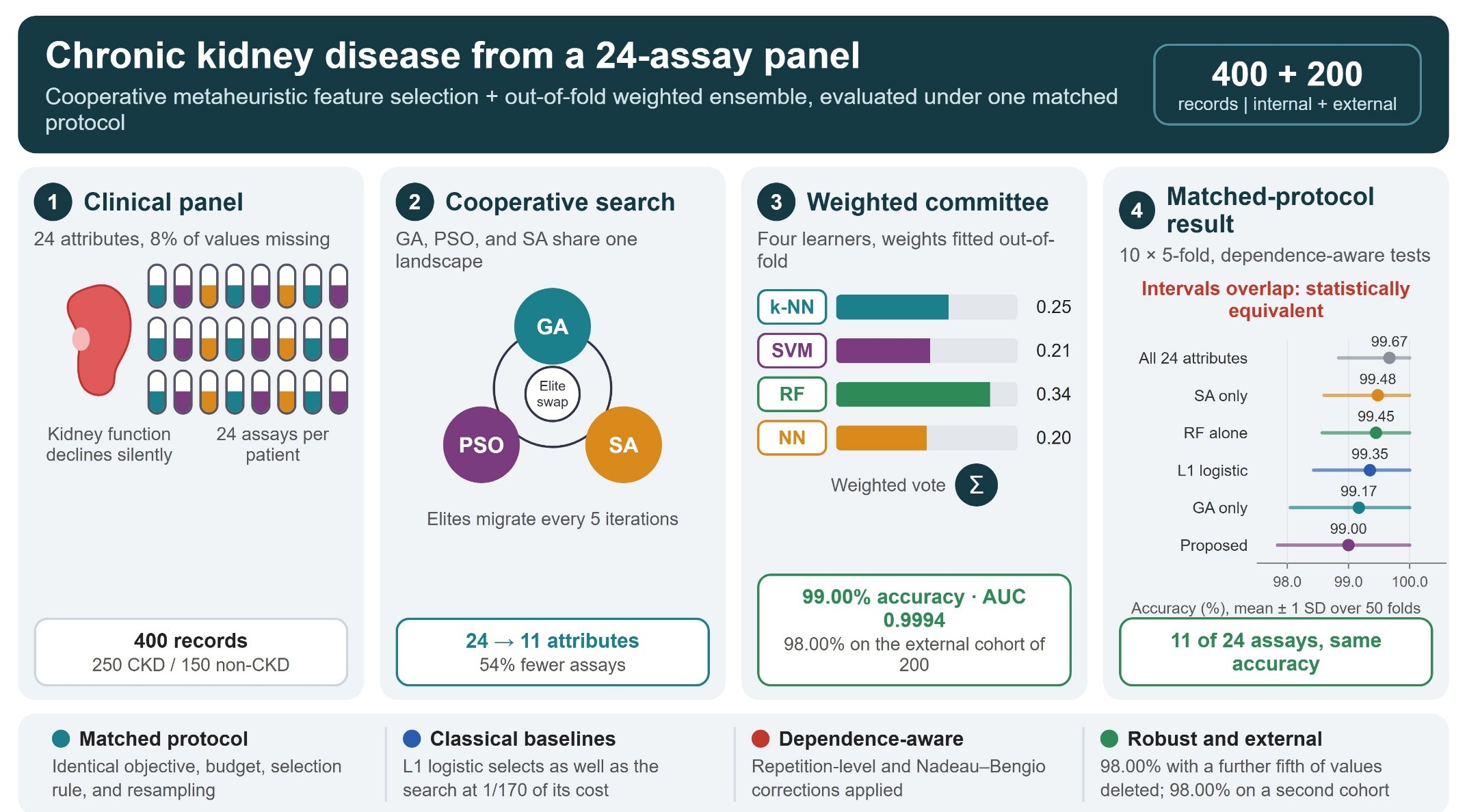
Chronic kidney disease is diagnosed from a broad laboratory panel whose size and composition are open to optimization. This study pairs a cooperative hybrid metaheuristic for attribute selection with a weighted voting ensemble. Genetic, swarm, and annealing sub-populations evolved in parallel over one shared fitness landscape, exchanged elites every five iterations, and were refined by annealing applied as a local search on the incumbent; the attributes retained across the elite band formed the subset, which fed four heterogeneous learners whose probabilities were fused using weights tuned from out-of-fold predictions only. Imputation, search, learners, and weights were confined to the training partition of a 10 times five-fold cross-validation, and every single-operator variant, four classical selectors, and the unreduced panel were evaluated under that identical protocol. The ensemble reached 99.00% accuracy, an area under the curve of 0.9994, and an F-measure of 99.19% from 11 of the 24 attributes, dropping 53% of the assays at a cost of two-thirds of a percentage point that is not statistically significant once the dependence between cross-validation folds is modeled. Accuracy held at 98.00% when a further fifth of all values was deleted, and an independent cohort of 200 records recorded as discretized intervals returned 98.00%. The pipeline is statistically equivalent to the strongest single learner and to the strongest classical selector while using fewer than half the attributes.
- Jadoul M, Aoun M, Masimango Imani M. The major global burden of chronic kidney disease. Lancet Glob Health. 2024;12(3):e342-e343. doi: 10.1016/S2214-109X(24)00050-0
- Wang L, He Y, Han C, et al. Global burden of chronic kidney disease and risk factors, 1990-2021: an update from the Global Burden of Disease Study 2021. Front Public Health. 2025;13:1542329. doi: 10.3389/fpubh.2025.1542329
- Ke C, Liang J, Liu M, Liu S, Wang C. Burden of chronic kidney disease and its risk-attributable burden in 137 low- and middle-income countries, 1990-2019: results from the Global Burden of Disease Study 2019. BMC Nephrol. 2022;23(1):17. doi: 10.1186/s12882-021-02597-3
- Stephan T, Mishra V. A penalty-embedded genetic algorithm for interpretable clinical feature selection in heart disease prediction. Healthc Anal. 2026;9:100458. doi: 10.1016/j.health.2026.100458
- Han F, Chen WT, Ling QH, Han H. Multi-objective particle swarm optimization with adaptive strategies for feature selection. Swarm Evol Comput. 2021;62:100847. doi: 10.1016/j.swevo.2021.100847
- Abdel-Basset M, Sallam KM, Mohamed R, Elgendi I, Munasinghe K, Elkomy OM. An improved binary grey-wolf optimizer with simulated annealing for feature selection. IEEE Access. 2021;9:139792-139822. doi: 10.1109/ACCESS.2021.3117853
- Pashaei E, Pashaei E. Hybrid binary COOT algorithm with simulated annealing for feature selection in high-dimensional microarray data. Neural Comput Appl. 2023;35(1):353-374. doi: 10.1007/s00521-022-07780-7
- Akinola OA, Ezugwu AE, Oyelade ON, Agushaka JO. A hybrid binary dwarf mongoose optimization algorithm with simulated annealing for feature selection on high dimensional multi-class datasets. Sci Rep. 2022;12(1):14945. doi: 10.1038/s41598-022-18993-0
- Bandyopadhyay R, Basu A, Cuevas E, Sarkar R. Harris Hawks optimisation with simulated annealing as a deep feature selection method for screening of COVID-19 CT-scans. Appl Soft Comput. 2021;111:107698. doi: 10.1016/j.asoc.2021.107698
- Chandra TB, Verma K, Singh BK, Jain D, Netam SS. Coronavirus disease (COVID-19) detection in chest X-ray images using majority voting based classifier ensemble. Expert Syst Appl. 2021;165:113909. doi: 10.1016/j.eswa.2020.113909
- Maz YA, Anbar M, Manickam S, Rihan SDA, Alabsi BA, Dorgham OM. Majority voting ensemble classifier for detecting keylogging attack on Internet of Things. IEEE Access. 2024;12:19860-19871. doi: 10.1109/ACCESS.2024.3362232
- Ennaji A, Sabri MA, Aarab A. Ensemble learning with weighted voting classifier for melanoma diagnosis. Multimed Tools Appl. 2025;84(9):6073-6089. doi: 10.1007/s11042-024-19143-6
- Okuboyejo DA, Olugbara OO. Classification of skin lesions using weighted majority voting ensemble deep learning. Algorithms. 2022;15(12):443. doi: 10.3390/a15120443
- Chhabra D, Juneja M, Chutani G. An efficient ensemble-based machine learning approach for predicting chronic kidney disease. Curr Med Imaging. 2024;20:e080523216634. doi: 10.2174/1573405620666230508104538
- Chen H, Huang Y, Chen L. Ensemble machine learning for predicting renal function decline in chronic kidney disease: development and external validation. Front Med. 2025;12:1598065. doi: 10.3389/fmed.2025.1598065
- Al Ghamdi M, Alyahyan S. Enhanced chronic kidney disease detection: a hybrid deep learning framework using clinical biomarkers and ensemble feature engineering with DeepCKD-Net. Appl Sci. 2026;16(6):3024. doi: 10.3390/app16063024
- Venkatesan VK, Ramakrishna MT, Izonin I, Tkachenko R, Havryliuk M. Efficient data preprocessing with ensemble machine learning technique for the early detection of chronic kidney disease. Appl Sci. 2023;13(5):2885. doi: 10.3390/app13052885
- Sengothai R, Sivaraman R. Early prediction of chronic kidney disease via ensemble-deep-learning approach and improved dimensionality reduction approach. Int J Math Oper Res. 2024;28(4):431-454. doi: 10.1504/ijmor.2024.140348
- Dritsas E, Trigka M. Machine learning techniques for chronic kidney disease risk prediction. Big Data Cogn Comput. 2022;6(3):98. doi: 10.3390/bdcc6030098
- Debal DA, Sitote TM. Chronic kidney disease prediction using machine learning techniques. J Big Data. 2022;9(1):109. doi: 10.1186/s40537-022-00657-5
- Arif MS, Rehman AU, Asif D. Explainable machine learning model for chronic kidney disease prediction. Algorithms. 2024;17(10):443. doi: 10.3390/a17100443
- Qureshi M, Azad A, Iftikhar H, Rodrigues PC. Toward explainable precision nephrology: machine learning-based chronic kidney disease prediction. Biomedicines. 2026;14(7):1459. doi: 10.3390/biomedicines14071459
- Taji K, Sohail A, Shahzad T, Shoaib Khan B, Adnan Khan M, Ouahada K. An ensemble hybrid framework: a comparative analysis of metaheuristic algorithms for ensemble hybrid CNN features for plants disease classification. IEEE Access. 2024;12:61886-61906. doi: 10.1109/ACCESS.2024.3389648
- Mandal AK, Nadim M, Saha H, Sultana T, Hossain MD, Huh EN. Feature subset selection for high-dimensional, low sampling size data classification using ensemble feature selection with a wrapper-based search. IEEE Access. 2024;12:62341-62357. doi: 10.1109/ACCESS.2024.3390684
- Feng G. Feature selection algorithm based on optimized genetic algorithm and the application in high-dimensional data processing. PLoS One. 2024;19(5):e0303088. doi: 10.1371/journal.pone.0303088
- Zhou J, Hua Z. A correlation guided genetic algorithm and its application to feature selection. Appl Soft Comput. 2022;123:108964. doi: 10.1016/j.asoc.2022.108964
- Saibene A, Gasparini F. Genetic algorithm for feature selection of EEG heterogeneous data. Expert Syst Appl. 2023;217:119488. doi: 10.1016/j.eswa.2022.119488
- Naskar A, Ghosh S, Kundu M, Sarkar R. Feature selection using guided population based genetic algorithm with modified crossover and parent selection. Appl Soft Comput. 2025;172:112872. doi: 10.1016/j.asoc.2025.112872
- Li AD, Xue B, Zhang M. Improved binary particle swarm optimization for feature selection with new initialization and search space reduction strategies. Appl Soft Comput. 2021;106:107302. doi: 10.1016/j.asoc.2021.107302
- Huang W, Tian H, Wang S, Zhang C, Zhang X. Integration of simulated annealing into pigeon inspired optimizer algorithm for feature selection in network intrusion detection systems. PeerJ Comput Sci. 2024;10:e2176. doi: 10.7717/peerj-cs.2176
- Kiani Sarkaleh M, Azgomi H, Kiani-Sarkaleh A. Breast cancer classification using feature selection via improved simulated annealing and SVM classifier. Diagnostics. 2026;16(4):637. doi: 10.3390/diagnostics16040637
- Sharifai AG, Zainol ZB. Multiple filter-based rankers to guide hybrid grasshopper optimization algorithm and simulated annealing for feature selection with high dimensional multi-class imbalanced datasets. IEEE Access. 2021;9:74127-74142. doi: 10.1109/ACCESS.2021.3081366
- Özkan Y, Özçelik YB, Altan A. Optimization-driven hybrid machine learning framework for brain tumor classification in MRI with metaheuristic feature selection. Diagnostics. 2026;16(5):819. doi: 10.3390/diagnostics16050819
- Alyasiri OM, Cheah YN, Abasi AK, Al-Janabi OM. Wrapper and hybrid feature selection methods using metaheuristic algorithms for English text classification: a systematic review. IEEE Access. 2022;10:39833-39852. doi: 10.1109/ACCESS.2022.3165814
- Chaudhuri A. Search space division method for wrapper feature selection on high-dimensional data classification. Knowl Based Syst. 2024;291:111578. doi: 10.1016/j.knosys.2024.111578
- Guo H, Ma J, Wang R, Zhou Y. Feature library-assisted surrogate model for evolutionary wrapper-based feature selection and classification. Appl Soft Comput. 2023;139:110241. doi: 10.1016/j.asoc.2023.110241
- Chamseddine E, Mansouri N, Soui M, Abed M. Handling class imbalance in COVID-19 chest X-ray images classification: using SMOTE and weighted loss. Appl Soft Comput. 2022;129:109588. doi: 10.1016/j.asoc.2022.109588
- Yang Y, Mirzaei G. Performance analysis of data resampling on class imbalance and classification techniques on multi-omics data for cancer classification. PLoS One. 2024;19(2):e0293607. doi: 10.1371/journal.pone.0293607
- Ebiaredoh-Mienye SA, Swart TG, Esenogho E, Mienye ID. A machine learning method with filter-based feature selection for improved prediction of chronic kidney disease. Bioengineering. 2022;9(8):350. doi: 10.3390/bioengineering9080350
- N Y, Shrinivasacharya P, Naik N. Novel statistically equivalent signature-based hybrid feature selection and ensemble deep learning LSTM and GRU for chronic kidney disease classification. PeerJ Comput Sci. 2024;10:e2467. doi: 10.7717/peerj-cs.2467
- Mandal M, Singh PK, Ijaz MF, Shafi J, Sarkar R. A tri-stage wrapper-filter feature selection framework for disease classification. Sensors. 2021;21(16):5571. doi: 10.3390/s21165571