

Improving mpox identification under imbalanced data using geometric transformation and color augmentation with graph neural networks

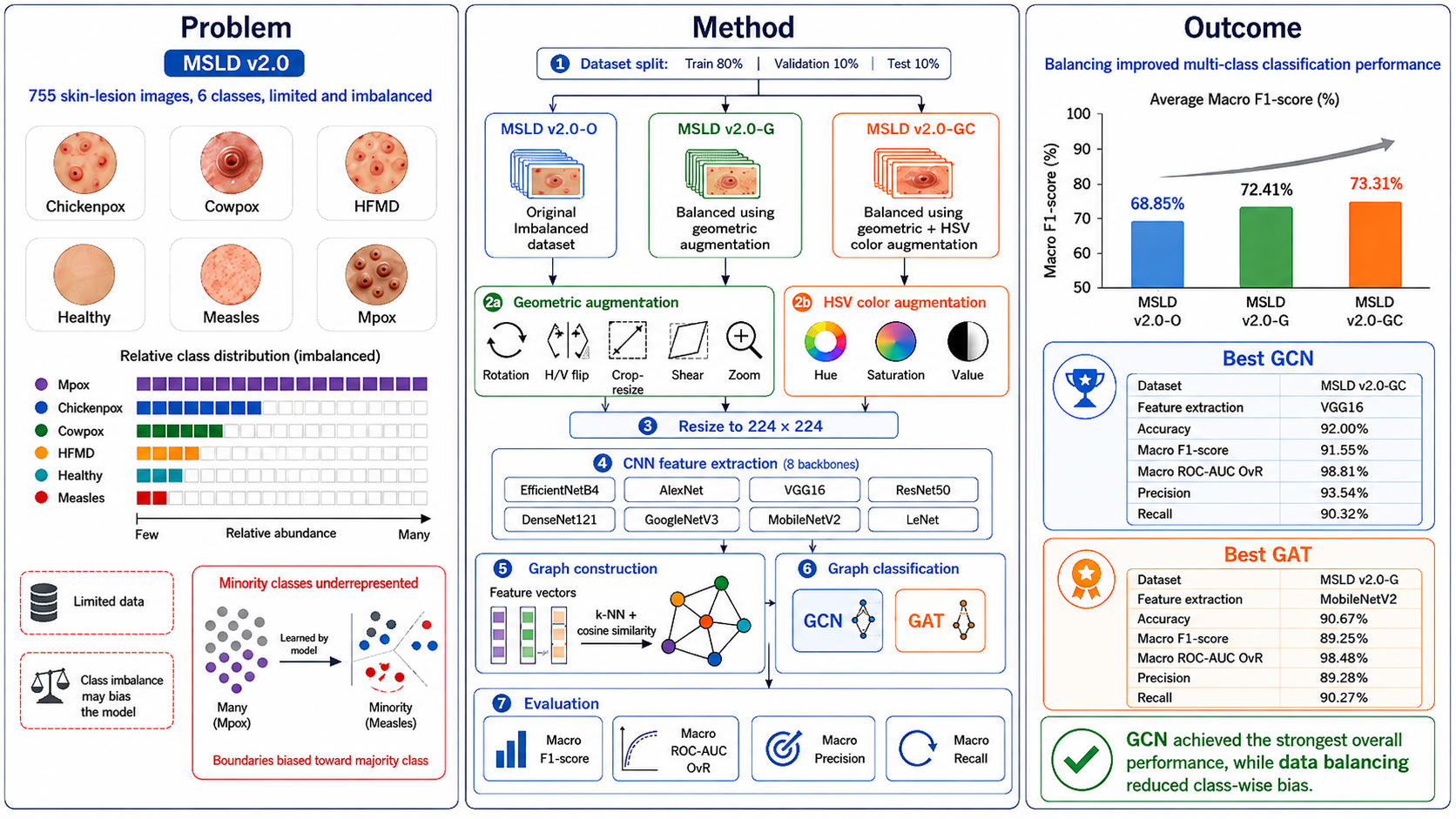
Mpox lesion identification from skin images remains challenging because lesion appearances often overlap with other dermatological diseases and available data are commonly imbalanced. This study proposes a graph-based multi-class classification framework that combines class-balancing augmentation, convolutional neural network (CNN)-based feature extraction, and graph neural classification. Experiments were conducted on the Mpox Skin Lesion Dataset Version 2.0 using three data configurations: (i) the original imbalanced data, (ii) a balanced version generated through geometric transformation augmentation, and (iii) a balanced version generated through combined geometric transformation and color-space augmentation. Image features were extracted using eight CNN backbones (EfficientNetB4, AlexNet, VGG16, ResNet50, DenseNet121, GoogleNetV3/InceptionV3, MobileNetV2, and LeNet), then transformed into graphs by selecting k-nearest-neighbor candidates and retaining edges according to cosine-similarity filtering, and finally classified using graph convolutional networks (GCN) and graph attention networks (GAT). Across 48 model combinations, data balancing improved macro-level performance compared with the original imbalanced setting. The best overall result was achieved by GCN with VGG16 on the geometrically and color-augmented balanced data, reaching 92.00% accuracy, 91.55% macro F1-score, 98.81% macro area under the receiver operating characteristic curve (one-versus-rest), 93.54% macro precision, and 90.32% macro recall. The best GAT result was obtained by MobileNetV2 on the geometrically augmented balanced data, with 90.67% accuracy, 89.25% macro F1-score, 98.48% macro area under the receiver operating characteristic curve (one-versus-rest), 89.28% macro precision, and 90.27% macro recall. Although GCN showed a more consistent empirical performance trend than GAT, the difference was not statistically significant. These findings indicate that integrating balanced augmentation, CNN-derived representations, and graph learning is a promising strategy for mpox lesion identification within the scope of the present experiments; however, broader external validation and explainability-oriented analysis are still required before real-world clinical deployment.
- Ndembi N, Folayan MO, Komakech A, et al. Evolving Epidemiology of Mpox in Africa in 2024. New Engl J Med. 2025;392(7):666-676. doi: 10.1056/NEJMoa2411368
- Wangdi K, Adhikary R, Liu Z, et al. Monkeypox in South Asia: a systematic review. Emerg Microbes Infect. 2025;14(1). doi: 10.1080/22221751.2025.2572677
- Mills MG, Juergens KB, Gov JP, et al. Evaluation and clinical validation of monkeypox (mpox) virus real-time PCR assays. J Clin Virol. 2023;159:105373. doi: 10.1016/j.jcv.2022.105373
- Bunse T, Ziel A, Hagen P, et al. Analytical and clinical evaluation of a novel real-time PCR-based detection kit for Mpox virus. Med Microbiol Immunol. 2024;213(1). doi: 10.1007/s00430-024-00800-4
- Rahi M, Joy S, Sharma A. Public health challenges in the context of the global spread of Mpox infections. Am J Trop Med Hyg. 2023;108(4):641-645. doi: 10.4269/ajtmh.22-0596
- Asif S, Zhao M, Li Y, Tang F, Ur Rehman Khan S, Zhu Y. AI-based approaches for the diagnosis of Mpox: challenges and future prospects. Arch Computat Methods Eng. 2024;31(6):3585-3617. doi: 10.1007/s11831-024-10091-w
- Tsuneki M. Deep learning models in medical image analysis. J Oral Biosci. 2022;64(3):312-320. doi: 10.1016/j.job.2022.03.003
- Kshatri SS, Singh D. Convolutional neural network in medical image analysis: a review. Arch Computat Methods Eng. 2023;30(4):2793-2810. doi: 10.1007/s11831-023-09898-w
- Chlap P, Min H, Vandenberg N, Dowling J, Holloway L, Haworth A. A review of medical image data augmentation techniques for deep learning applications. J Med Imaging Radiat Oncol. 2021;65(5):545-563. doi: 10.1111/1754-9485.13261
- Kurdi SZ. Machine learning–based classification framework for human health care monitoring. Int J Theor Appl Comput Intell. 2026;2026:1-15. doi: 10.65278/IJTACI.2026.1
- Vuran S, Ucan M, Akin M, Kaya M. Multi-Classification of Skin Lesion Images Including Mpox Disease Using Transformer-Based Deep Learning Architectures. Diagnostics. 2025;15(3):374. doi: 10.3390/diagnostics15030374
- Gabriel CIO, Kumar R. An explainable deep learning and machine learning model for Mpox classification using dermatologic images. Digit Transform Soc. 2026;5(3):365-385. doi: 10.1108/DTS-08-2025-0267
- Pal M, Branda F, Alkhedaide AQ, et al. Early detection of human Mpox: A comparative study by using machine learning and deep learning models with ensemble approach. Digit Health. 2025;11. doi: 10.1177/20552076251344135
- Ali SN, Ahmed MT, Jahan T, et al. A web-based mpox skin lesion detection system using state-of-the-art deep learning models considering racial diversity. Biomed Signal Process Control. 2024;98:106742. doi: 10.1016/j.bspc.2024.106742
- Huan E, Dun H. MSMP-net: a multi-scale neural network for end-to-end monkeypox virus skin lesion classification. Appl Sci. 2024;14(20):9390. doi: 10.3390/app14209390
- Elhadidy MS, Elgohr AT, Mousa A, Safwat A, Abdelfatah RI, Kasem HM. Benchmarking pre-trained CNNs and vision transformers for Mpox-related dermatological image classification on MSLD v2. 0. Results Eng. 2025;28:108071. doi: 10.1016/j.rineng.2025.108071
- Duan S, Huang P, Chen M, et al. Semi-supervised classification of fundus images combined with CNN and GCN. J Appl Clin Med Phys. 2022;23(12). doi: 10.1002/acm2.13746
- Shi C, Liao D, Wang L. Hybrid CNN-GCN network for hyperspectral image classification. IEEE J Sel Top Appl Earth Observations Remote Sensing. 2025;18:10530-10546. doi: 10.1109/JSTARS.2025.3548571
- Aboshosha BW, Rehman SU, Mahmoud LN, Sadek I. AI-driven diagnosis of mpox using deep learning models. PLoS ONE. 2026;21(7):e0352161. doi: 10.1371/journal.pone.0352161
- Zhao X, Ma J, Wang L, Zhang Z, Ding Y, Xiao X. A review of hyperspectral image classification based on graph neural networks. Artif Intell Rev. 2025;58(6). doi: 10.1007/s10462-025-11169-y
- Altalhan M, Algarni A, Turki-Hadj Alouane M. Imbalanced data problem in machine learning: A review. IEEE Access. 2025;13:13686-13699. doi: 10.1109/access.2025.3531662
- van Zyl JP, Engelbrecht AP. Analysis of classification metric behaviour under class imbalance. Egypt Inform J. 2025;31:100711. doi: 10.1016/j.eij.2025.100711
- Goceri E. Medical image data augmentation: techniques, comparisons and interpretations. Artif Intell Rev. 2023;56(11):12561-12605. doi: 10.1007/s10462-023-10453-z
- Kumar T, Brennan R, Mileo A, Bendechache M. Image data augmentation approaches: A comprehensive survey and future directions. IEEE Access. 2024;12:187536-187571. doi: 10.1109/ACCESS.2024.3470122
- Sengupta P, Mehta A, Rana PS. Enhancing performance of deep learning models with a novel data augmentation approach. In: 2023 14th International Conference on Computing Communication and Networking Technologies (ICCCNT). New Delhi, India: IEEE; 2023:1-7. doi: 10.1109/icccnt56998.2023.10308298
- Velastegui R, Yang L, Han D. The importance of color spaces for image classification using artificial neural networks: a review. In: Lecture Notes in Computer Science. Cham: Springer International Publishing; 2021:70-83. doi: 10.1007/978-3-030-86960-1_6
- Shuai Z, Xiaolin D, Jing Y, et al. Comparison of different feature extraction methods for applicable automated ICD coding. BMC Med Inform Decis Mak. 2022;22(1). doi: 10.1186/s12911-022-01753-5
- Liu H, Li I, Liang Y, Sun D, Yang Y, Yang H. Research on deep learning model of feature extraction based on convolutional neural network. In: 2024 IEEE 2nd International Conference on Image Processing and Computer Applications (ICIPCA). Shenyang, China: IEEE; 2024:810-816.doi: 10.1109/ICIPCA61593.2024.10709168
- Shabana M, Kumar JP, Masthan K. Image Forgery Detection Using Sobel Edge Detection, Feature Extraction. In: Disruptive Technologies in Computing and Communication Systems. Boca Raton, FL, USA: CRC Press; 2024:253-258. doi: 10.1201/9781032665535-42
- Archana R, Jeevaraj PSE. Deep learning models for digital image processing: a review. Artif Intell Rev. 2024;57(1). doi: 10.1007/s10462-023-10631-z
- Zhao X, Wang L, Zhang Y, Han X, Deveci M, Parmar M. A review of convolutional neural networks in computer vision. Artif Intell Rev. 2024;57(4). doi: 10.1007/s10462-024-10721-6
- Mahmood SH, Farhan AK. An evaluation of convolutional neural network architectures: AlexNet, LetNet, VGG-16, and fingerprint-net for fingerprint classification. In: AIP Conference Proceedings. Vol 3224. AIP Publishing; 2025:030021. doi: 10.1063/5.0255956
- Zhang H, Yang S, Zhang X. Automatic recognition and classification of microalgae using an inception-v3 convolution neural network model. Int J Environ Sci Technol. 2023;21(4):4625-4634. doi: 10.1007/s13762-023-05209-9
- Lachaud G, Conde-Cespedes P, Trocan M. Mathematical Expressiveness of Graph Neural Networks. Mathematics. 2022;10(24):4770. doi: 10.3390/math10244770
- Wu Z, Pan S, Chen F, Long G, Zhang C, Yu PS. A comprehensive survey on graph neural networks. IEEE Trans Neural Netw Learn Syst. 2021;32(1):4-24. doi: 10.1109/TNNLS.2020.2978386
- Parisot S, Ktena SI, Ferrante E, et al. Disease prediction using graph convolutional networks: application to autism spectrum disorder and Alzheimer’s disease. Med Image Anal. 2018;48:117-130. doi: 10.1016/j.media.2018.06.001
- Wang X, Liang Z. Hybrid network model based on 3D convolutional neural network and scalable graph convolutional network for hyperspectral image classification. IET Image Process. 2022;17(1):256-273. doi: 10.1049/ipr2.12632
- Ciano G, Rossi A, Bianchini M, Scarselli F. On inductive–transductive learning with graph neural networks. IEEE Trans Pattern Anal Mach Intell. 2022;44(2):758-769. doi: 10.1109/TPAMI.2021.3054304
- Vrahatis AG, Lazaros K, Kotsiantis S. Graph Attention Networks: A Comprehensive Review of Methods and Applications. Future Internet. 2024;16(9):318. doi: 10.3390/fi16090318
- Sun C, Li C, Lin X, et al. Attention-based graph neural networks: a survey. Artif Intell Rev. 2023;56(S2):2263-2310. doi: 10.1007/s10462-023-10577-2
- Diallo R, Edalo C, Awe OO. Machine learning evaluation of imbalanced health data: a comparative analysis of balanced accuracy, MCC, and F1 score. In: Practical Statistical Learning and Data Science Methods (STEAM-H: Science, Technology, Engineering, Agriculture, Mathematics&Health). Cham, Switzerland: Springer Nature; 2024:283-312. doi: 10.1007/978-3-031-72215-8_12
- Zhou X, Zeng Y, Hao Z, Wang H. A robust graph attention network with dynamic adjusted graph. Eng Appl Artif Intell. 2024;129:107619. doi: 10.1016/j.engappai.2023.107619
- Bello A, Ng SC, Leung MF. Skin Cancer Classification Using Fine-Tuned Transfer Learning of DENSENET-121. Appl Sci. 2024;14(17):7707. doi: 10.3390/app14177707
- Mohammed FA, Tune KK, Assefa BG, Jett M, Muhie S. Medical Image Classifications Using Convolutional Neural Networks: A Survey of Current Methods and Statistical Modeling of the Literature. Mach Learn Knowl Extr. 2024;6(1):699-736. doi: 10.3390/make6010033
- A RS, Chamola V, Hussain Z, Albalwy F, Hussain A. A novel end-to-end deep convolutional neural network based skin lesion classification framework. Expert Syst Appl. 2024;246:123056. doi: 10.1016/j.eswa.2023.123056