

DualPath-CRC: Adaptive Swin Transformer blocks and Attention-Augmented InceptionNeXt for classification of colorectal cancer histopathology

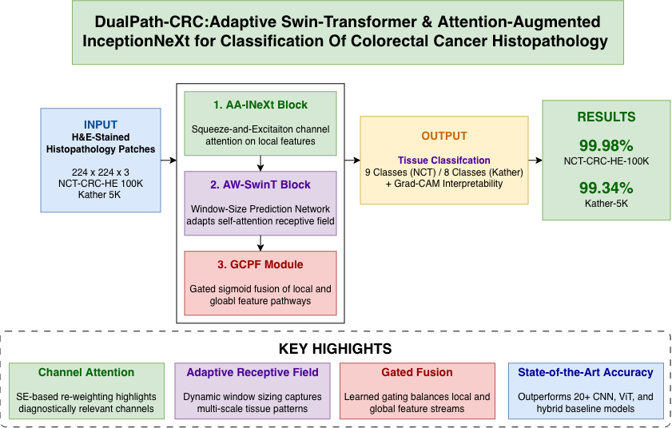
Colorectal cancer (CRC) is the third most common cancer and the second leading cause of cancer-related death worldwide, with about 1.85 million cases and 850,000 deaths annually. While a definitive diagnosis depends on the histopathological examination of hematoxylin and eosin-stained tissue slides, considerable variability remains in slide interpretation among pathologists, and manual examination is time-consuming. These limitations have led to the development of computer-aided methods for analyzing colorectal histopathology slides. Recent hybrid Transformer models often lack adaptive channel re-weighting, use fixed window sizes that may restrict the multi-scale receptive field, or rely on traditional feature-fusion techniques that assume simple element-wise addition. To overcome these shortcomings, DualPath-CRC proposes three architectural innovations: (i) Attention-Augmented InceptionNeXt blocks, which apply sigmoid-based channel attention to multi-branch depthwise convolutions; (ii) Adaptive Window Swin Transformer blocks, in which a Window-Size Prediction Network adaptively controls the receptive field of self-attention; and (iii) a Gated Cross-Pathway Fusion module, which fuses the local and global feature streams through learned sigmoid gating. For the classification of histological tissue patches, DualPath-CRC achieves an accuracy of 99.98% on NCT-CRC-HE-100K and 99.34% on Kather-5K. The regions highlighted by Grad-CAM, Grad-CAM++, and LIME analyses provide qualitative information about which parts of the image are important for the model’s predictions and typically correspond to morphologically relevant tissue areas.
- Pacal I, Attallah O. Hybrid deep learning model for automated colorectal cancer detection using local and global feature extraction. Knowledge-Based Syst. 2025;319:113625. doi: 10.1016/j.knosys.2025.113625
- Bray F, Laversanne M, Sung H, et al. Global cancer statistics 2022: GLOBOCAN estimates of incidence and mortality worldwide for 36 cancers in 185 countries. CA Cancer J Clin. 2024;74(3):229-263. doi: 10.3322/caac.21834
- Siegel RL, Wagle NS, Cercek A, Smith RA, Jemal A. Colorectal cancer statistics, 2023. CA Cancer J Clin. 2023;73(3):233-254. doi: 10.3322/caac.21772
- Kather JN, Weis CA, Bianconi F, et al. Multi-class texture analysis in colorectal cancer histology. Sci Rep. 2016;6:27988. doi: 10.1038/srep27988
- Hu J, Shen L, Sun G. Squeeze-and-excitation networks. In: Proc IEEE/CVF Conf Comput Vis Pattern Recognit (CVPR). 2018:7132-7141. doi: 10.1109/CVPR.2018.00745
- Selvaraju RR, Cogswell M, Das A, Vedantam R, Parikh D, Batra D. Grad-CAM: Visual Explanations from Deep Networks via Gradient-Based Localization. In: 2017 IEEE International Conference on Computer Vision (ICCV). IEEE; 2017:618-626. doi: 10.1109/iccv.2017.74
- Kather JN, Krisam J, Charoentong P, et al. Predicting survival from colorectal cancer histology slides using deep learning: a retrospective multicenter study. PLoS Med. 2019;16(1):e1002730. doi: 10.1371/journal.pmed.1002730
- Shafi ASM, Molla MMI, Jui JJ, Rahman MM. Detection of colon cancer based on microarray dataset using machine learning. SN Appl Sci. 2020;2(7):1243. doi: 10.1007/s42452-020-3051-2
- Alqudah AM, Alqudah A. Improving machine learning recognition of colorectal cancer using 3D GLCM applied to different color spaces. Multimed Tools Appl. 2022;81(8):10839-10860. doi: 10.1007/s11042-022-11946-9
- Rawat W, Wang Z. Deep convolutional neural networks for image classification: a comprehensive review. Neural Comput. 2017;29(9):2352-2449. doi: 10.1162/neco_a_00990
- Sarvamangala DR, Kulkarni RV. Convolutional neural networks in medical image understanding: a survey. Evol Intell. 2022;15(1):1-22. doi: 10.1007/s12065-020-00540-3
- Attallah O. Skin-CAD: explainable deep learning classification of skin cancer from dermoscopic images. Comput Biol Med. 2024;178:108798. doi: 10.1016/j.compbiomed.2024.108798
- Attallah O. CerCan·Net: cervical cancer classification model via multi-layer feature ensembles of lightweight CNNs and transfer learning. Expert Syst Appl. 2023;229:120624. doi: 10.1016/j.eswa.2023.120624
- Attallah O. Lung and colon cancer classification using multiscale deep features integration of compact CNNs. Technologies. 2025;13(2):54. doi: 10.3390/technologies13020054
- Attallah O, Ragab DA. Auto-MyIn: automatic diagnosis of myocardial infarction via multiple GLCMs, CNNs, and SVMs. Biomed Signal Process Control. 2023;80:104273. doi: 10.1016/j.bspc.2022.104273
- Attallah O. Acute lymphocytic leukemia detection and subtype classification via extended wavelet pooling based-CNNs. Image Vis Comput. 2024;147:105064. doi: 10.1016/j.imavis.2024.105064
- Attallah O. GabROP: Gabor wavelets-based CAD for retinopathy of prematurity diagnosis via CNNs. Diagnostics. 2023;13(2):171. doi: 10.3390/diagnostics13020171
- İnce S, Kunduracioglu I, Bayram B, Pacal I. U-Net-based models for precise brain stroke segmentation. Chaos Theory Appl. 2025;7(1):50-60. doi: 10.51537/chaos.1605529
- Paladini E, Vantaggiato E, Bougourzi F, et al. Two ensemble-CNN approaches for colorectal cancer tissue type classification. J Imaging. 2021;7(3):51. doi: 10.3390/jimaging7030051
- Zhou P, Cao Y, Li M, et al. HCCANet: histopathological image grading of colorectal cancer using CNN. Sci Rep. 2022;12(1):15103. doi: 10.1038/s41598-022-18879-1
- Anju TE, Vimala S. Finetuned-VGG16 CNN model for tissue classification of colorectal cancer. In: Raj JS, et al., eds. Intelligent Sustainable Systems. Lecture Notes in Networks and Systems. Vol 665. Springer; 2023:73-84. doi: 10.1007/978-981-99-1726-6_7
- Dosovitskiy A, Beyer L, Kolesnikov A, et al. An Image is Worth 16x16 Words: Transformers for Image Recognition at Scale. arXiv. Preprint posted online 2020. doi: 10.48550/arXiv.2010.11929
- Liu Z, Lin Y, Cao Y, et al. Swin Transformer: hierarchical vision transformer using shifted windows. In: Proc IEEE/CVF Int Conf Comput Vis (ICCV). 2021:9992-10002. doi: 10.1109/ICCV48922.2021.00986
- Zeid MAE, El-Bahnasy K, Abo-Youssef SE. Multiclass Colorectal Cancer Histology Images Classification Using Vision Transformers. In: 2021 Tenth International Conference on Intelligent Computing and Information Systems (ICICIS). IEEE; 2021:224-230. doi: 10.1109/icicis52592.2021.9694125
- Ding M, Qu A, Zhong H, et al. An enhanced vision transformer with wavelet position embedding. Pattern Recognit. 2023;140:109532. doi: 10.1016/j.patcog.2023.109532
- Li M. Transformer-Based Self-Supervised Learning and Distillation for Medical Image Classification: Improving Colorectal Cancer Detection on NCT-CRC-HE-100K with Swin-T V2. In: 2024 3rd International Conference on Cloud Computing, Big Data Application and Software Engineering (CBASE). IEEE; 2024:644-648. doi: 10.1109/cbase64041.2024.10824558
- Reis HC, Turk V. Fusion of transformer attention and CNN features for skin cancer detection. Appl Soft Comput. 2024;164:112013. doi: 10.1016/j.asoc.2024.112013
- Sriwastawa A, Arul Jothi JA. Vision transformer and its variants for image classification in digital breast cancer histopathology. Multimed Tools Appl. 2023;83(13):39731-39753. doi: 10.1007/s11042-023-16954-x
- Martínez-Fernandez E, Rojas-Valenzuela I, Valenzuela O, Rojas I. Computer aided classifier of colorectal cancer on histopathological whole slide images analyzing deep learning architecture parameters. Appl Sci. 2023;13(7):4594. doi: 10.3390/app13074594
- Ghosh S, Bandyopadhyay A, Sahay S, et al. Colorectal histology tumor detection using ensemble deep neural network. Eng Appl Artif Intell. 2021;100:104202. doi: 10.1016/j.engappai.2021.104202
- Abd El-Ghany S, Mahmood MA, Abd El-Aziz AA. Adaptive Dynamic Learning Rate Optimization Technique for Colorectal Cancer Diagnosis Based on Histopathological Image Using EfficientNet-B0 Deep Learning Model. Electronics. 2024;13(16):3126. doi: 10.3390/electronics13163126
- Sharkas M, Attallah O. Color-CADx: a deep learning approach for colorectal cancer classification through triple convolutional neural networks and discrete cosine transform. Sci Rep. 2024;14(1). doi: 10.1038/s41598-024-56820-w
- Pan XL, Hua B, Tong K, et al. EL-CNN: an enhanced lightweight classification for colorectal cancer histopathological images. Biomed Signal Process Control. 2025;100:106933. doi: 10.1016/j.bspc.2024.106933
- Khalid SVM, Deivasigamani S, Rajendran S. An efficient colorectal cancer detection network using atrous convolution with coordinate attention transformer. Sci Rep. 2024;14(1):19109. doi: 10.1038/s41598-024-70117-y
- Chen H, Li C, Li X, et al. IL-MCAM: interactive learning and multi-channel attention for colorectal histopathology classification. Comput Biol Med. 2022;143:105265. doi: 10.1016/j.compbiomed.2022.105265
- Tanveer M, Akram MU, Khan AM. TransNetV: an optimized hybrid model for enhanced colorectal cancer image classification. Biomed Signal Process Control. 2024;96:106579. doi: 10.1016/j.bspc.2024.106579
- Woo S, Park J, Lee JY, Kweon IS. CBAM: convolutional block attention module. In: Proc Eur Conf Comput Vis (ECCV). 2018:3-19. doi: 10.1007/978-3-030-01234-2_1
- Cho K, van Merrienboer B, Gulcehre C, et al. Learning Phrase Representations using RNN Encoder–Decoder for Statistical Machine Translation. In: Proceedings of the 2014 Conference on Empirical Methods in Natural Language Processing (EMNLP). Association for Computational Linguistics; 2014:1724-1734. doi: 10.3115/v1/d14-1179
- Verma R, Kumar N, Patil A, et al. MoNuSAC2020: a multi-organ nuclei segmentation and classification challenge. IEEE Trans Med Imaging. 2021;40(12):3413-3423. doi: 10.1109/TMI.2021.3085712
- Kather JN, Halama N, Marx A. 100,000 Histological images of human colorectal cancer and healthy tissue. Published online April 7, 2018. doi: 10.5281/ZENODO.1214456
- Touvron H, Cord M, Jégou H. DeiT III: revenge of the ViT. In: Avidan S, Brostow G, Cissé M, et al, eds. Computer Vision ¨C ECCV 2022. Cham: Springer; 2022:516-533. doi: 10.1007/978-3-031-20053-3_30