

Knowledge-constrained neural additive modeling for hypoglycemia risk stratification in older adults with type 2 diabetes

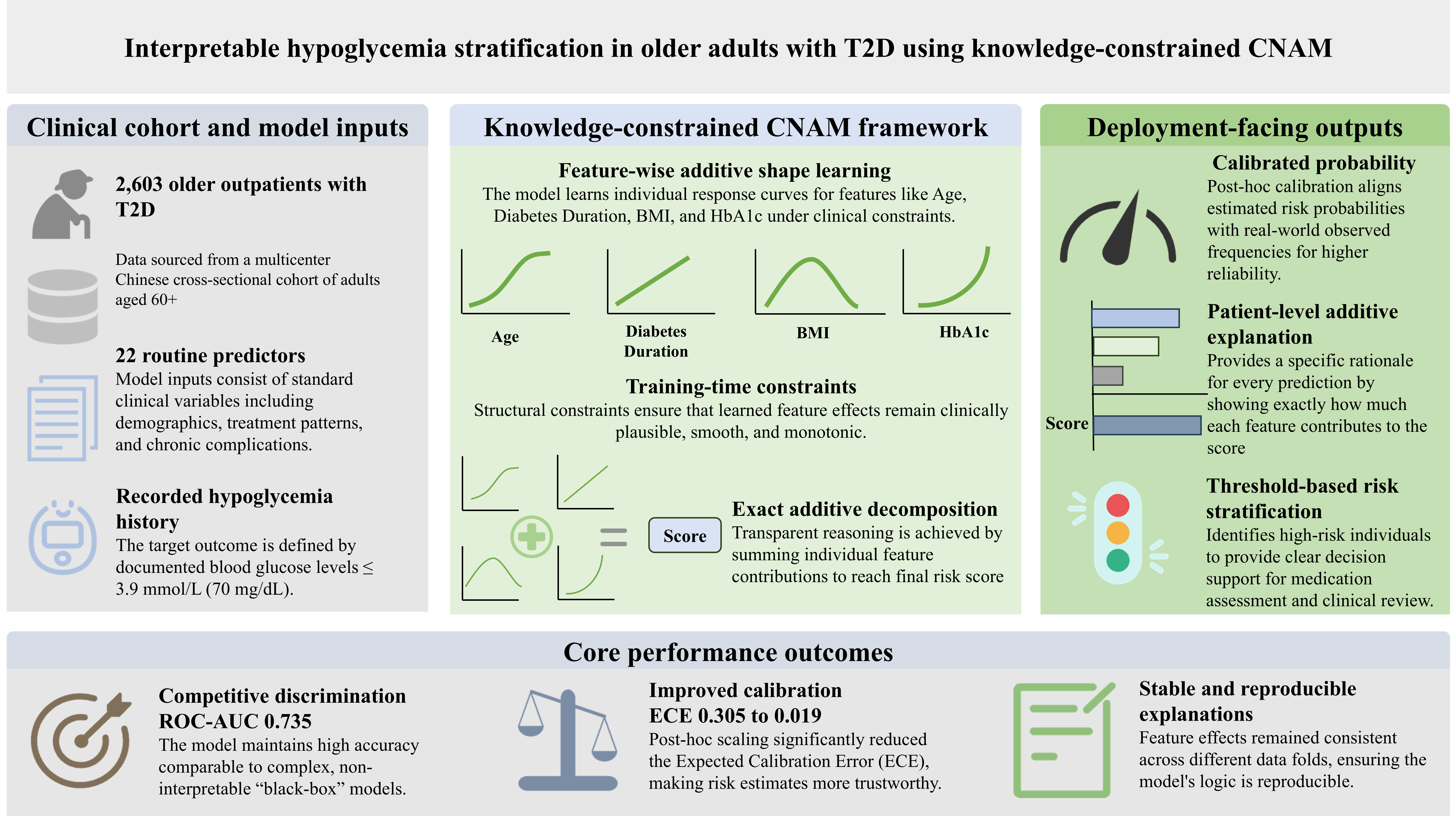
Hypoglycemia remains a major barrier to safe glucose-lowering treatment in older adults with type 2 diabetes, yet clinically relevant models should combine nonlinear expressiveness, transparent feature attribution, and well-calibrated probability estimates. We developed a knowledge-constrained neural additive model (CNAM) for clinically interpretable stratification of recorded hypoglycemia history in older adults with type 2 diabetes within a multicenter cross-sectional outpatient cohort. The model was evaluated with a locked 10% test split, nested cross-validation, probability calibration, threshold-based decision analysis, decision-curve analysis, and explanation-stability assessment. It achieved competitive locked-test discrimination (receiver operating characteristic [ROC]–area under the curve [AUC] = 0.7350; precision–recall [PR]-AUC = 0.4127) and, after sigmoid calibration fitted on pooled development out-of-fold predictions, showed a calibrated Brier score of 0.1136 and an expected calibration error of 0.0189. Additional operating-point analyses showed trade-offs between sensitivity and specificity, and decision-curve analysis indicated broadly similar net-benefit profiles for CNAM and logistic regression across the evaluated threshold range. The monotonicity-constrained parameterization structurally enforces directionally plausible feature effects on selected predictors, with ablation results providing context against unconstrained variants that exhibit nonzero violations. These findings support CNAM as a complementary, interpretable stratification framework for recorded hypoglycemia history rather than as a replacement for established clinical risk scores. External validation, severity-specific outcome capture, and local recalibration remain necessary before broader clinical use.
- ElSayed NA, Aleppo G, Bannuru RR, et al. 6. Glycemic goals and hypoglycemia: Standards of Care in Diabetes—2024. Diabetes Care. 2024;47(suppl 1):S111-S125. doi: 10.2337/dc24-S006
- Ahmad E, Lim S, Lamptey R, Webb DR, Davies MJ. Type 2 diabetes. Lancet. 2022;400(10365):1803-1820. doi: 10.1016/S0140-6736(22)01655-5
- Davies MJ, Lim S, Slater T, et al. Type 2 diabetes mellitus. Nat Rev Dis Primers. 2026;12(1):13. doi: 10.1038/s41572-026-00687-w
- Tan SHC, Loh WJ, Lim SC. Precision medicine in diabetes care. Curr Opin Endocrinol Diabetes Obes. 2025;32(1):12-19. doi: 10.1097/MED.0000000000000894
- Mellor J, Kuznetsov D, Heller S, et al. Risk factors and prediction of hypoglycaemia using the Hypo-RESOLVE cohort: a secondary analysis of pooled data from insulin clinical trials. Diabetologia. 2024;67(9):1873-1885. doi: 10.1007/s00125-024-06177-6
- Shi M, Yang A, Lau ESH, et al. A novel electronic health record-based, machine-learning model to predict severe hypoglycemia leading to hospitalizations in older adults with diabetes: a territory-wide cohort and modeling study. PLoS Med. 2024;21(4):e1004369. doi: 10.1371/journal.pmed.1004369
- Mathioudakis NN, Abusamaan MS, Shakarchi AF, et al. Development and validation of a machine learning model to predict near-term risk of iatrogenic hypoglycemia in hospitalized patients. JAMA Netw Open. 2021;4(1):e2030913. doi: 10.1001/jamanetworkopen.2020.30913
- Kulzer B, Freckmann G, Ziegler R, Schnell O, Glatzer T, Heinemann L. Nocturnal hypoglycemia in the era of continuous glucose monitoring. J Diabetes Sci Technol. 2024;18(5):1052-1060. doi: 10.1177/19322968241267823
- Rudin C. Stop explaining black box machine learning models for high stakes decisions and use interpretable models instead. Nat Mach Intell. 2019;1(5):206-215. doi: 10.1038/s42256-019-0048-x
- Petch J, Di S, Nelson W. Opening the black box: the promise and limitations of explainable machine learning in cardiology. Can J Cardiol. 2022;38(2):204-213. doi: 10.1016/j.cjca.2021.09.004
- Ling S, Zaccardi F, Lawson C, Seidu SI, Davies MJ, Khunti K. Glucose control, sulfonylureas, and insulin treatment in elderly people with type 2 diabetes and risk of severe hypoglycemia and death: an observational study. Diabetes Care. 2021;44(4):915-924. doi: 10.2337/dc20-0876
- Shabestari M, Mehrabbeik A, Barbieri S, Marques- Vidal P, Heshmati-Nasab P, Azizi R. Predictive factors of hypoglycemia in type 2 diabetes: a prospective study using machine learning. Sci Rep. 2025;15(1):18143. doi: 10.1038/s41598-025-03030-7
- Hastie T, Tibshirani R. Generalized additive models. Stat Sci. 1986;1(3):297-310. doi: 10.1214/ss/1177013604
- Agarwal R, Melnick L, Frosst N, et al. Neural additive models: interpretable machine learning with neural nets. In: Proceedings of the 35th International Conference on Neural Information Processing Systems. Curran Associates Inc., Red Hook, NY, USA; 2021;359:4699-4711.
- Nori H, Caruana R, Bu Z, Shen JH, Kulkarni J. Accuracy, interpretability, and differential privacy via explainable boosting. In: Proceedings of the 38th International Conference on Machine Learning. Proceedings of Machine Learning Research; 2021:8227-8237.
- You S, Ding D, Canini K, Pfeifer J, Gupta M. Deep lattice networks and partial monotonic functions. In: Proceedings of the 31st International Conference on Neural Information Processing Systems. Curran Associates Inc., Red Hook, NY, USA; 2017:2981-2989.
- Mariotti E, Moral JMA, Gatt A. Exploring the balance between interpretability and performance with carefully designed constrainable neural additive models. Inf Fusion. 2023;99:101882. doi: 10.1016/j.inffus.2023.101882
- Van Calster B, McLernon DJ, van Smeden M, Wynants L, Steyerberg EW. Calibration: the Achilles heel of predictive analytics. BMC Med. 2019;17(1):230. doi: 10.1186/s12916-019-1466-7
- Collins GS, Moons KGM, Dhiman P, et al. TRIPOD+AI statement: updated guidance for reporting clinical prediction models that use regression or machine learning methods. BMJ. 2024;385:e078378. doi: 10.1136/bmj-2023-078378
- Moons KGM, Damen JAA, Kaul T, et al. PROBAST+AI: an updated quality, risk of bias, and applicability assessment tool for prediction models using regression or artificial intelligence methods. BMJ. 2025;388:e082505. doi: 10.1136/bmj-2024-082505
- Brown KE, Yan C, Li Z, et al. Large language models are less effective at clinical prediction tasks than locally trained machine learning models. J Am Med Inform Assoc. 2025;32(5):811-822. doi: 10.1093/jamia/ocaf038
- Cross JL, Choma MA, Onofrey JA. Bias in medical AI: implications for clinical decision-making. PLoS Digit Health. 2024;3(11):e0000651. doi: 10.1371/journal.pdig.0000651
- Ghassemi M, Oakden-Rayner L, Beam AL. The false hope of current approaches to explainable artificial intelligence in health care. Lancet Digit Health. 2021;3(11):e745-e750. doi: 10.1016/S2589-7500(21)00208-9
- Lu SC, Swisher CL, Chung C, Jaffray D, Sidey-Gibbons C. On the importance of interpretable machine learning predictions to inform clinical decision making in oncology. Front Oncol. 2023;13:1129380. doi: 10.3389/fonc.2023.1129380
- Ganapathi S, Palmer J, Alderman JE, et al. Tackling bias in AI health datasets through the STANDING Together initiative. Nat Med. 2022;28(11):2232-2233. doi: 10.1038/s41591-022-01987-w
- Christiaens A, Sheppard JP. Risks of tight glucose control in older adults: time to focus beyond mortality. Diabetes Care. 2025;48(10):1716-1718. doi: 10.2337/dci25-0068
- Alkabbani W, Maxwell CJ, Marrie RA, et al. Associations of mid- and late-life severe hypoglycemic episodes with incident dementia among patients with type 2 diabetes: a population-based cohort study. Diabetes Care. 2023;46(2):331-340. doi: 10.2337/dc22-1496
- Zhang RT, Liu Y, Sun C, et al. Predicting hypoglycemia in elderly inpatients with type 2 diabetes: the ADOCHBIU model. Front Endocrinol. 2024;15:1366184. doi: 10.3389/fendo.2024.1366184
- Jia H, Zhang J. Machine learning-based prediction of hypoglycemia severity in hospitalized diabetic patients. Front Endocrinol. 2025;16:1634358. doi: 10.3389/fendo.2025.1634358
- Lekadir K, Frangi AF, Porras AR, et al. FUTURE-AI: international consensus guideline for trustworthy and deployable artificial intelligence in healthcare. BMJ. 2025;388:e081554. doi: 10.1136/bmj-2024-081554
- Nguyen AP, Moreno DL, Le-Bel N, Rodríguez Martínez M. MonoNet: enhancing interpretability in neural networks via monotonic features. Bioinform Adv. 2023;3(1):vbad016. doi: 10.1093/bioadv/vbad016
- Richman R, Wüthrich MV. LocalGLMnet: interpretable deep learning for tabular data. Scand Actuar J. 2023;2023(1):71- 95. doi: 10.1080/03461238.2022.2081816
- Kim K, Ha J. GMFLDA: improved prediction of lncRNA-disease association via graph convolutional network. IEEE Access. 2025;13:85330-85341. doi: 10.1109/ACCESS.2025.3568461
- Ha J, Kim K. Neighborhood-regularized matrix factorization for lncRNA-disease association identification. Int J Mol Sci. 2025;26(9):4283. doi: 10.3390/ijms26094283
- Rajpurkar P, Chen E, Banerjee O, Topol EJ. AI in health and medicine. Nat Med. 2022;28(1):31-38. doi: 10.1038/s41591-021-01614-0
- Gichoya JW, Banerjee I, Bhimireddy AR, et al. AI recognition of patient race in medical imaging: a modelling study. Lancet Digit Health. 2022;4(6):e406-e414. doi: 10.1016/S2589-7500(22)00063-2
- Riley RD, Archer L, Snell KIE, et al. Evaluation of clinical prediction models (part 2): how to undertake an external validation study. BMJ. 2024;384:e074820. doi: 10.1136/bmj-2023-074820
- Van Calster B, Collins GS, Vickers AJ, et al. Evaluation of performance measures in predictive artificial intelligence models to support medical decisions: overview and guidance. Lancet Digit Health. 2025;7(12):100916. doi: 10.1016/j.landig.2025.100916
- Lasko TA, Strobl EV, Stead WW. Why do probabilistic clinical models fail to transport between sites. NPJ Digit Med. 2024;7(1):53. doi: 10.1038/s41746-024-01037-4
- Bolt J, Carvalho V, Lin K, Lee SJ, Inglis C. Systematic review of guideline recommendations for older and frail adults with type 2 diabetes mellitus. Age Ageing. 2024;53(11):afae259. doi: 10.1093/ageing/afae259