

Artificial intelligence in healthcare: Transforming services in low-resource settings—Evidence from Bihar, India

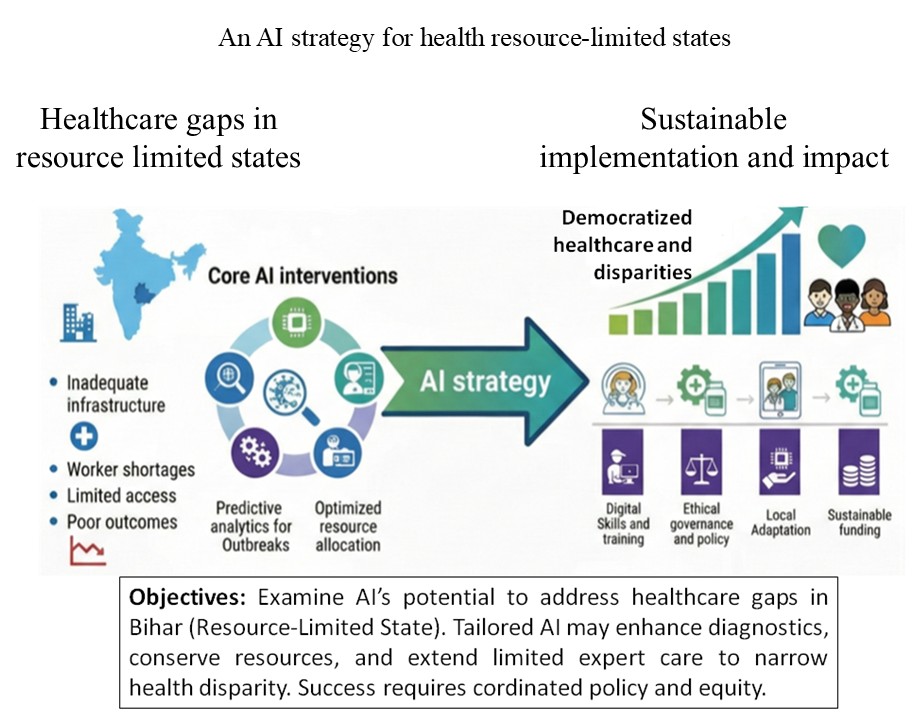
Healthcare systems in low socioeconomic regions struggle with numerous challenges, including inadequate infrastructure, severe shortages of healthcare workers, limited access due to geography, and poor health outcomes. Bihar, a state in eastern India and home to more than 120 million people with nearly one-third living in poverty, exemplifies the urgent need for innovative and scalable healthcare solutions. This review evaluates the potential of artificial intelligence (AI) to address healthcare gaps in resource-constrained settings, using Bihar as a case study, and aims to develop practical AI implementation frameworks with global applicability. The approach combines analysis of Bihar’s healthcare data with an assessment of AI applications in other low-resource settings, focusing on interventions that are both cost-effective and scalable. Findings indicate that AI can address critical gaps in diagnostics, disease surveillance, resource management, and care coordination. Notable applications include AI-based diagnostic imaging, outbreak prediction tools, teleconsultation systems with integrated decision support, and technologies for smarter resource allocation. Effective deployment depends not only on local adaptation and digital skill-building but also on robust ethical oversight and sustained funding. The evidence indicates that well-targeted AI initiatives can democratize healthcare delivery for underserved populations by enhancing diagnostic accuracy, optimizing scarce resources, extending specialist expertise to remote areas, and reducing health disparities. Achieving these outcomes depends on unified efforts across policy-making, technology development, clinical practice, and community engagement, anchored in principles of equity and inclusivity.
- Shadmi E, Chen Y, Dourado I, et al. Health equity and COVID-19: Global perspectives. Int J Equity Health. 2020;19(1):104. doi: 10.1186/s12939-020-01218-z
- Tracking Universal Health Coverage: 2017 Global Monitoring Report; 2017. Available from: https://www.who.int/ publications/i/item/9789241513555 [Last accessed on Nov 30, 2025].
- Marmot M, Friel S, Bell R, Houweling TA, Taylor S. Closing the gap in a generation: Health equity through action on the social determinants of health. Lancet. 2008;372(9650):1661- 1669. doi: 10.1016/s0140-6736(08)61690-6
- Karan A, Negandhi H, Hussain S, et al. Size, composition and distribution of health workforce in India: Why, and where to invest? Hum Resour Health. 2021;19(1):39. doi: 10.1186/s12960-021-00575-2
- Meh C, Sharma A, Ram U, et al. Trends in maternal mortality in India over two decades in nationally representative surveys. BJOG. 2021;129(4):550-561. doi: 10.1111/1471-0528.16888
- India - Household Consumer Expenditure: NSS 68th Round, Schedule 1.0, July 2011 - June 2012 (type 1); 2016. Available from: https://www.icssrdataservice.in/datarepository/index. php/catalog/91 [Last accessed on Nov 30, 2025].
- PCA (ST): Primary Census Abstract Data for Scheduled Tribes, India & States/UTs (District Level) - 2011. Office of the Registrar General & Census Commissioner, Ministry of Home Affairs, Government of India; 2011. Available from: https://censusindia.gov.in/nada/index.php/catalog/5049 [Last accessed on Nov 30, 2025].
- NITI Aayog. Multidimensional Poverty in India since 2005– 06: A Discussion Paper. Government of India; 2024. Available from: https://www.niti.gov.in/sites/default/files/2024-01/ MPI-22_NITI-Aayog20254.pdf [Last accessed on Nov 30, 2025].
- Health Ministry Releases Health Dynamics of India (Infrastructure and Human Resources) 2022-23”; 2024. Available from: https://www.pib.gov.in/Pressreleaseshare. aspx?PRID=2053070®=3&lang=2 [Last accessed on Nov 30, 2025].
- India - Sample Registration System (SRS)-Special Bulletin on Maternal Mortality in India 2018-20. Available from: https:// censusindia.gov.in/nada/index.php/catalog/44379 [Last accessed on Nov 30, 2025].
- National Family Health Survey (NFHS-5) India Report: International Institute for Population Sciences (IIPS). Available from: https://iipsindia.ac.in/content/national-family-health-survey-nfhs-5-india-report [Last accessed on Nov 30, 2025].
- Open Government Data (OGD) Platform India; 2022. Available from: https://data.gov.in [Last accessed on Nov 30, 2025].
- National Health Estimates (2018-19) Released. Available from: https://www.pib.gov.in/www.pib.gov.in/Pressreleaseshare. aspx?PRID=1858770 [Last accessed on Nov 30, 2025].
- NHA: Official Website Ayushman Bharat Digital Mission. Available from: https://abdm.gov.in/ebook [Last accessed on Nov 30, 2025].
- Sousa A, Scheffler RM, Nyoni J, Boerma T. A comprehensive health labour market framework for universal health coverage. Bull World Health Organ. 2013;91(11):892-894. doi: 10.2471/blt.13.118927
- Topol EJ. High-performance medicine: The convergence of human and artificial intelligence. Nat Med. 2019;25(1):44- 56. doi: 10.1038/s41591-018-0300-7
- Esteva A, Kuprel B, Novoa RA, et al. Dermatologist-level classification of skin cancer with deep neural networks. Nature. 2017;542(7639):115-118. doi: 10.1038/nature21056
- Rajkomar A, Dean J, Kohane I. Machine learning in medicine. N Engl J Med. 2019;380(14):1347-1358. doi: 10.1056/NEJMra1814259
- Measuring Digital Development - Facts and Figures 2023; 2023. Available from: https://www.itu.int/pub/D-IND-ICT_ MDD-2023-1 [Last accessed on Nov 30, 2025].
- NHA: Official Website Ayushman Bharat Digital Mission. Available from: https://pmjay.gov.in [Last accessed on Nov 30, 2025].
- Wahl B, Cossy-Gantner A, Germann S, Schwalbe NR. Artificial intelligence (AI) and global health: How can AI contribute to health in resource-poor settings? BMJ Glob Health. 2018;3(4):e000798. doi: 10.1136/bmjgh-2018-000798
- Shachar C, Engel J, Elwyn G. Implications for telehealth in a postpandemic future: Regulatory and privacy issues. JAMA. 2020;323(23):2375-2376. doi: 10.1001/jama.2020.7943
- Qin ZZ, Sander MS, Rai B, et al. Using artificial intelligence to read chest radiographs for tuberculosis detection: A multi-site evaluation of the diagnostic accuracy of three deep learning systems. Sci Rep. 2019;9(1):15000. doi: 10.1038/s41598-019-51503-3
- Murphy K, Habib SS, Zaidi SMA, et al. Computer aided detection of tuberculosis on chest radiographs: An evaluation of the CAD4TB v6 system. Sci Rep. 2020;10(1):5492. doi: 10.1038/s41598-020-62148-y
- Harris M, Qi A, Jeagal L, et al. A systematic review of the diagnostic accuracy of artificial intelligence-based computer programs to analyze chest x-rays for pulmonary tuberculosis. PLoS One. 2019;14(9):e0221339. doi: 10.1371/journal.pone.0221339
- Ting DSW, Cheung CYL, Lim G, et al. Development and validation of a deep learning system for diabetic retinopathy and related eye diseases using retinal images from multiethnic populations with diabetes. JAMA. 2017;318(22):2211-2223. doi: 10.1001/jama.2017.18152
- Leung XY, Islam RM, Adhami M, et al. A systematic review of dengue outbreak prediction models: Current scenario and future directions. PLoS Negl Trop Dis. 2023;17(2):e0010631. doi: 10.1371/journal.pntd.0010631
- Li Y, Kamara F, Zhou G, et al. Data-driven methods for dengue prediction and surveillance using real-world and big data: A systematic review. PLoS Negl Trop Dis. 2022;16(1):e0010056. doi: 10.1371/journal.pntd.0010056
- Liu Y, Jain A, Eng C, et al. A deep learning system for differential diagnosis of skin diseases. Nat Med. 2020;26(6):900-908. doi: 10.1038/s41591-020-0842-3
- Rajalakshmi R, Subashini R, Anjana RM, Mohan V. Automated diabetic retinopathy detection in smartphone-based fundus photography using artificial intelligence. Eye (Lond). 2018;32(6):1138-1144. doi: 10.1038/s41433-018-0064-9
- Sandberg CEJ, Knight SR, Qureshi AU, Pathak S. Using telemedicine to diagnose surgical site infections in low- and middle-income countries: Systematic review. JMIR Mhealth Uhealth. 2019;7(8):e13309. doi: 10.2196/13309
- Ong SQ, Isawasan P, Ngesom AMM, Shahar H, Lasim AM, Nair G. Predicting dengue transmission rates by comparing different machine learning models with vector indices and meteorological data. Sci Rep. 2023;13(1):19129. doi: 10.1038/s41598-023-46342-2
- Baharom M, Ahmad N, Hod R, Abdul Manaf MR. Dengue early warning system as outbreak prediction tool: A systematic review. Risk Manag Healthc Policy. 2022;15:871- 886. doi: 10.2147/RMHP.S345958
- Guo P, Liu T, Zhang Q, et al. Developing a dengue forecast model using machine learning: A case study in China. PLoS Negl Trop Dis. 2017;11(10):e0005973. doi: 10.1371/journal.pntd.0005973
- Mahmoud K, Jaramillo C, Barteit S. Telemedicine in low- and middle-income countries during the COVID-19 pandemic: A scoping review. Front Public Health. 2022;10:914423. doi: 10.3389/fpubh.2022.914423
- Okafor NM, Thompson I, Venkat V, et al. Evaluating the feasibility, adoption, cost-effectiveness, and sustainability of telemedicine interventions in managing COVID-19 within low-and-middle-income countries (LMICs): A systematic review. PLoS Digit Health. 2025;4(4):e0000771. doi: 10.1371/journal.pdig.0000771
- Scott R, Mars M. Telehealth in the developing world: Current status and future prospects. Smart Homecare Technol TeleHealth. 2015:25. doi: 10.2147/shtt.s75184
- Saif‐Ur‐Rahman K, Islam MS, Alaboson J, et al. Artificial intelligence and digital health in improving primary health care service delivery in LMICs: A systematic review. J Evid Based Med. 2023;16(3):303-320. doi: 10.1111/jebm.12547
- Tamrat T, Kachnowski S. Special delivery: An analysis of mHealth in maternal and newborn health programs and their outcomes around the world. Matern Child Health J. 2012;16(5):1092-1101. doi: 10.1007/s10995-011-0836-3
- Lee SH, Nurmatov UB, Nwaru BI, Mukherjee M, Grant L, Pagliari C. Effectiveness of mHealth interventions for maternal, newborn and child health in low-and middle-income countries: Systematic review and meta-analysis. J Glob Health. 2016;6(1):010401. doi: 10.7189/jogh.06.010401
- Watterson JL, Walsh J, Madeka I. Using mHealth to improve usage of antenatal care, postnatal care, and immunization: A systematic review of the literature. Biomed Res Int. 2015;2015:153402. doi: 10.1155/2015/153402
- Katsaliaki K, Mustafee N, Kumar S. A game-based approach towards facilitating decision making for perishable products: An example of blood supply chain. Expert Syst Appl. 2014;41(9):4043-4059. doi: 10.1016/j.eswa.2013.12.038
- Ashok A, Brison M, LeTallec Y. Improving cold chain systems: Challenges and solutions. Vaccine. 2017;35(17):2217-2223. doi: 10.1016/j.vaccine.2016.08.045
- Pambudi NA, Sarifudin A, Gandidi IM, Romadhon R. Vaccine cold chain management and cold storage technology to address the challenges of vaccination programs. Energy Reports. 2022;8:955-972. doi: 10.1016/j.egyr.2021.12.039
- Rautenstrauss M, Martin L, Minner S. Ambulance dispatching during a pandemic: Tradeoffs of categorizing patients and allocating ambulances. Eur J Oper Res. 2023;304(1):239-254. doi: 10.1016/j.ejor.2021.11.051
- Li D, Yang J, Li J, Zhao N, Ju W, Guo M. Agent-basedmodeling and simulation (ABMS) on the influence of adjusting medical service fees on patients’ choice of medical treatment. BMC Health Serv Res. 2023;23(1):928. doi: 10.1186/s12913-023-09933-3
- Davenport T, Kalakota R. The potential for artificial intelligence in healthcare. Future Healthc J. 2019;6(2):94-98. doi: 10.7861/futurehosp.6-2-94
- Nguyen L, Bellucci E, Nguyen LT. Electronic health records implementation: An evaluation of information system impact and contingency factors. Int J Med Inform. 2014;83(11):779-796. doi: 10.1016/j.ijmedinf.2014.06.011
- Sheikhalishahi S, Miotto R, Dudley JT, Lavelli A, Rinaldi F, Osmani V. Natural language processing of clinical notes on chronic diseases: Systematic review. JMIR Med Inform. 2019;7(2):e12239. doi: 10.2196/12239
- Subbaraman R, De Mondesert L, Musiimenta A, et al. Digital adherence technologies for the management of tuberculosis therapy: Mapping the landscape and research priorities. BMJ Glob Health. 2018;3(5):e001018. doi: 10.1136/bmjgh-2018-001018
- Roshanov PS, Fernandes N, Wilczynski JM, et al. Features of effective computerised clinical decision support systems: Meta-regression of 162 randomised trials. BMJ. 2013;346:f657. doi: 10.1136/bmj.f657
- Kwan JL, Lo L, Ferguson J, et al. Computerised clinical decision support systems and absolute improvements in care: Meta-analysis of controlled clinical trials. BMJ. 2020;370:m3216. doi: 10.1136/bmj.m3216
- Sutton RT, Pincock D, Baumgart DC, Sadowski DC, Fedorak RN, Kroeker KI. An overview of clinical decision support systems: Benefits, risks, and strategies for success. NPJ Digit Med. 2020;3:17. doi: 10.1038/s41746-020-0221-y
- Sapci AH, Sapci HA. Artificial intelligence education and tools for medical and health informatics students: Systematic review. JMIR Med Educ. 2020;6(1):e19285. doi: 10.2196/19285
- Panch T, Szolovits P, Atun R. Artificial intelligence, machine learning and health systems. J Glob Health. 2018;8(2):020303. doi: 10.7189/jogh.08.020303
- Hanlon P, Daines L, Campbell C, McKinstry B, Weller D, Pinnock H. Telehealth interventions to support self-management of long-term conditions: A systematic metareview of diabetes, heart failure, asthma, chronic obstructive pulmonary disease, and cancer. J Med Internet Res. 2017;19(5):e172. doi: 10.2196/jmir.6688
- Iribarren SJ, Cato K, Falzon L, Stone PW. What is the economic evidence for mHealth? A systematic review of economic evaluations of mHealth solutions. PLoS One. 2017;12(2):e0170581. doi: 10.1371/journal.pone.0170581
- Abd-Alrazaq AA, Rababeh A, Alajlani M, Bewick BM, Househ M. Effectiveness and safety of using chatbots to improve mental health: Systematic review and meta-analysis. J Med Internet Res. 2020;22(7):e16021. doi: 10.2196/16021
- Laranjo L, Dunn AG, Tong HL, et al. Conversational agents in healthcare: A systematic review. J Am Med Inform Assoc. 2018;25(9):1248-1258. doi: 10.1093/jamia/ocy072
- Torous J, Andersson G, Bertagnoli A, et al. Towards a consensus around standards for smartphone apps and digital mental health. World Psychiatry. 2019;18(1):97-98. doi: 10.1002/wps.20592
- Higgs ES, Goldberg AB, Labrique AB, et al. Understanding the role of mHealth and other media interventions for behavior change to enhance child survival and development in low- and middle-income countries: An evidence review. J Health Commun. 2014;19(Suppl 1):164-189. doi: 10.1080/10810730.2014.929763
- Gurman TA, Rubin SE, Roess AA. Effectiveness of mHealth behavior change communication interventions in developing countries: A systematic review of the literature. J Health Commun. 2012;17(Suppl 1):82-104. doi: 10.1080/10810730.2011.649160
- Orji R, Moffatt K. Persuasive technology for health and wellness: State-of-the-art and emerging trends. Health Informatics J. 2018;24(1):66-91. doi: 10.1177/1460458216650979
- Department of School Education and Literacy. Ministry of Education, GoI. Available from: https://dsel.education.gov. in/en/dsel
- Rao KD, Bhatnagar A, Berman P. So many, yet few: Human resources for health in India. Hum Resour Health. 2012;10:19. doi: 10.1186/1478-4491-10-19
- Kumar GA, Dandona R, Chaman P, Singh P, Dandona L. A population-based study of neonatal mortality and maternal care utilization in the Indian State of Bihar. BMC Pregnancy Childbirth. 2014;14:357. doi: 10.1186/1471-2393-14-357
- World Malaria Report 2023. Available from: https://www.who.int/teams/global-malaria-programme/reports/world-malaria-report-2023 [Last accessed on Nov 30, 2025].
- Bihar - State Program Implementation Plans: National Health Mission. Available from: https://nhm.gov.in/nhm_ live/index4.php?lang=1&level=0&linkid=42&lid=55 [Last accessed on Nov 30, 2025].
- Commission P. Report of the Expert Group to Review the Methodology for Estimation of Poverty. Work Paper; 2011. Available from: https://ideas.repec.org//p/ess/wpaper/ id4531.html [Last accessed on Nov 30, 2025].
- Prinja S, Bahuguna P, Gupta I, Chowdhury S, Trivedi M. Role of insurance in determining utilization of healthcare and financial risk protection in India. PLoS One. 2019;14(2):e0211793. doi: 10.1371/journal.pone.0211793
- Home: National Health Systems Resource Centre. Available from: https://www.nhsrcindia.org [Last accessed on Nov 30, 2025].
- Yu KH, Beam AL, Kohane IS. Artificial intelligence in healthcare. Nat Biomed Eng. 2018;2(10):719-731. doi: 10.1038/s41551-018-0305-z
- Hosny A, Parmar C, Quackenbush J, Schwartz LH, Aerts HJWL. Artificial intelligence in radiology. Nat Rev Cancer. 2018;18(8):500-510. doi: 10.1038/s41568-018-0016-5
- Rajaraman S, Sornapudi S, Kohli M, Antani S. Assessment of an ensemble of machine learning models toward abnormality detection in chest radiographs. Annu Int Conf IEEE Eng Med Biol Soc. 2019;2019:3689-3692. doi: 10.1109/EMBC.2019.8856715
- Ramesh AN, Kambhampati C, Monson JRT, Drew PJ. Artificial intelligence in medicine. Ann R Coll Surg Engl. 2004;86(5):334-338. doi: 10.1308/147870804290
- Brownstein JS, Freifeld CC, Madoff LC. Digital disease detection — Harnessing the Web for public health surveillance. N Engl J Med. 2009;360(21):2153-2157. doi: 10.1056/nejmp0900702
- Raj GM, Dananjayan S, Agarwal N. Inception of the Indian digital health mission: Connecting…the…Dots. Health Care Sci. 2023;2(5):345-351. doi: 10.1002/hcs2.67
- NHA: Official Website Ayushman Bharat Digital Mission. Available from: https://abdm.gov.in [Last accessed on Nov 30, 2025].
- BharatNet. Available from: https://www.pib.gov.in/www. pib.gov.in/Pressreleaseshare.aspx?PRID=2123137 [Last accessed on Nov 30, 2025].
- World Energy Outlook 2022 – Analysis. IEA; 2022. Available from: https://www.iea.org/reports/world-energy-outlook-2022 [Last accessed on Nov 30, 2025].
- Recommendations on Digital Interventions for Health System Strengthening; 2019. Available from: https://www.who.int/ publications/i/item/9789241550505 [Last accessed on Nov 30, 2025].
- Health Department, Government of Bihar. Available from: https://state.bihar.gov.in/health/CitizenHome.html [Last accessed on Nov 30, 2025].
- Home: State Health Society, Bihar. Available from: https:// shs.bihar.gov.in [Last accessed on Nov 30, 2025].
- eSanjeevani. Available from: https://esanjeevani.mohfw.gov. in/# [Last accessed on Nov 30, 2025].
- Schillinger D, Balyan R, Crossley SA, McNamara DS, Liu JY, Karter AJ. Employing computational linguistics techniques to identify limited patient health literacy: Findings from the ECLIPPSE study. Health Serv Res. 2021;56(1):132-144. doi: 10.1111/1475-6773.13560
- Veinot TC, Mitchell H, Ancker JS. Good intentions are not enough: How informatics interventions can worsen inequality. J Am Med Inform Assoc. 2018;25(8):1080-1088. doi: 10.1093/jamia/ocy052
- Global Strategy on Digital Health 2020-2025. Available from: https://www.who.int/publications/i/item/9789240020924 [Last accessed on Nov 30, 2025].
- Digital Implementation Investment Guide (DIIG): Integrating Digital Interventions into Health Programmes; 2020. Available from: https://www.who.int/ publications/i/item/9789240010567 [Last accessed on Nov 30, 2025].
- Kruse CS, Krowski N, Rodriguez B, Tran L, Vela J, Brooks M. Telehealth and patient satisfaction: A systematic review and narrative analysis. BMJ Open. 2017;7(8):e016242. doi: 10.1136/bmjopen-2017-016242
- Drummond MF, Sculpher MJ, Claxton K, Stoddart GL, Torrance GW. Methods for the Economic Evaluation of Health Care Programmes. 4th ed. Oxford: Oxford University Press; 2015.
- Char DS, Shah NH, Magnus D. Implementing machine learning in health care - addressing ethical challenges. N Engl J Med. 2018;378(11):981-983. doi: 10.1056/NEJMp1714229
- Ethics and Governance of Artificial Intelligence for Health; 2021. Available from: https://www.who.int/publications/i/ item/9789240029200 [Last accessed on Nov 30, 2025].
- Gender Gap 2023 - GSMA. Available from: https://www. gsma.com/gender-gap-2023 [Last accessed on Nov 30, 2025]. 94. Tomlinson M, Rotheram-Borus MJ, Swartz L, Tsai AC. Scaling up mHealth: Where is the evidence. PLoS Med. 2013;10(2):e1001382. doi: 10.1371/journal.pmed.1001382
- Guidance on AI and Children: Office of Strategy and Evidence Innocenti. Available from: https://www.unicef. org/innocenti/reports/policy-guidance-ai-children [Last accessed on Nov 30, 2025].
- Sanders EBN, Stappers PJ. Co-creation and the new landscapes of design. CoDesign. 2008;4(1):5-18. doi: 10.1080/15710880701875068
- O’Mara-Eves A, Brunton G, Kavanagh J, Jamal F, Thomas J. Community engagement in public health interventions to reduce health inequalities: Mapping the evidence against policy objectives. Lancet. 2012;380:S59. doi: 10.1016/s0140-6736(13)60415-8.