
Augmented reality in Chinese museums: A case study on visitor experience

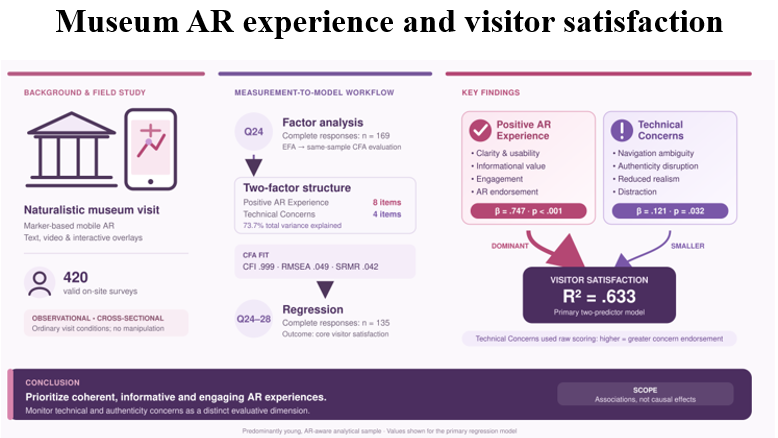
This study examines how visitor satisfaction co-varies with augmented reality (AR)-related evaluations in a Chinese museum context, using Suzhou Museum as a case study. We collected on-site survey data from 420 visitors. Because several questionnaire blocks were path-dependent, we conducted exploratory factor analysis and confirmatory factor analysis using the complete 12-item AR-evaluation block (Q24; n = 169), whereas regression analyses included cases with complete Q24 and six-item satisfaction block responses (Q28; n = 135). The Q24 items supported a two-dimensional structure consisting of positive AR experience and technical concerns. In the conventional ordinary least squares model, positive AR experience showed the dominant positive association with core satisfaction (standardized β = 0.747, p < 0.001), whereas technical concerns showed a smaller positive coefficient under raw scoring (standardized β = 0.121, p = 0.032). However, HC3-robust standard errors and response-pattern sensitivity analyses attenuated the technical concerns estimate, so that it was no longer statistically distinguishable from zero. The study is cross-sectional and supports associations rather than causal effects. The main defensible conclusion is therefore that visitor satisfaction co-varies primarily with a coherent positive AR experience dimension, whereas the concern-related dimension remains measurable but is subject to greater inferential uncertainty in this sample.
- Hsieh T-J, Su Y-H, Lin L-S. Augmented Reality Art Museum Mobile Guide for Enhancing User Experience. IEEE Comput Graph Appl. 2025;45(1):12–27. doi: 10.1109/MCG.2025.3529981
- International Council of Museums (ICOM). Museum definition. 2022. Accessed on December 22, 2024. https://icom.museum/en/resources/standards-guidelines/museum-definition/.
- AlGerafi MAM, Zhou Y, Oubibi M, Wijaya TT. Unlocking the Potential: A Comprehensive Evaluation of Augmented Reality and Virtual Reality in Education. Electronics. 2023;12(18):3953. doi: 10.3390/electronics12183953
- Galani A. Mixed Reality Museum Visits: Using new technologies to support co-visiting for local and remote visitors. Museol Rev. 2003;10:1–15.
- Cobb PJ, Cobb E, Liang J, Kiyama R, Ng J. Theoretical foundations for archaeological pedagogy with digital 3D, virtual, augmented, and mixed reality technologies. J Archaeol Educ. 2024;8(1):1-29.
- Puspasari S, Ermatita S, Zulkardi S. Constructing Smart Digital Media for Museum Education Post Pandemic Recovery: A Review and Recommendation. 2021 International Conference on Informatics, Multimedia, Cyber and Information System (ICIMCIS). 2021; 238–243. doi: 10.1109/ICIMCIS53775.2021.9699345
- Al Subhi N, Bell D, Lashmar P. Location Based Modelling for Heritage Mobile Applications. UKAIS Conference 2015.
- Dong, S. Research on the application of digital media technology in museum exhibition design: A case study of the national museum of Singapore. SHS Web Conf. 2024;181:04031. doi: 10.1051/shsconf/202418104031
- Milgram P, Kishino F. A Taxonomy of Mixed Reality Visual Displays. IEICE Trans Inf. 1994 ;77(12):1321–1329.
- Baashar Y, Alkawsi G, Wan Ahmad WN, Alomari MA, Alhussian H, Tiong SK. Towards Wearable Augmented Reality in Healthcare: A Comparative Survey and Analysis of Head-Mounted Displays. Int J Environ Res Public Health. 2023;20(5):3940. doi: 10.3390/ijerph20053940
- Singh, S. Designing AR Interfaces for Enhanced User Experience. J Adv Scholarly Res Allied Educ. 2024;21(5):96-102. doi: 10.29070/v8dpf082
- Gimeno J, Portalés C, Coma I, Fernández M, Martínez B. Combining traditional and indirect augmented reality for indoor crowded environments. A case study on the Casa Batlló museum. Comput Graph. 2017;69:92–103. doi: 10.1016/j.cag.2017.09.001
- Pedersen I, Gale N, Mirza-Babaei P, Reid S. More than Meets the Eye: The Benefits of Augmented Reality and Holographic Displays for Digital Cultural Heritage. J Comput Cult Herit. 2017;10(2):1-15. doi: 10.1145/3051480
- Fenu C, Pittarello F. Svevo tour: The design and the experimentation of an augmented reality application for engaging visitors of a literary museum. Int J Hum Comput Stud. 2018;114:20–35. doi: 10.1016/j.ijhcs.2018.01.009
- Yoon S, Anderson E, Lin J, Elinich K. How Augmented Reality Enables Conceptual Understanding of Challenging Science Content. J Educ Technol Soc. 2017;20(1):156–168. doi: 10.30191/ETS.201701_20(1).0014
- Roussou M. Immersive Interactive Virtual Reality and Informal Education. In Proceedings of the i3 Spring Days 2000 Workshop on Interactive Learning Environments for Children, Athens, Greece. 2000.
- Litvak E, Kuflik T. Enhancing cultural heritage outdoor experience with augmented-reality smart glasses. Pers Ubiquitous Comput. 2020;24(6):873–886. doi: 10.1007/s00779-020-01366-7
- Tom Dieck MC, Jung TH, Tom Dieck D. Enhancing art gallery visitors’ learning experience using wearable augmented reality: Generic learning outcomes perspective. Curr Issues Tour. 2018;21(17):2014–2034. doi: 10.1080/13683500.2016.1224818
- De Paolis LT, Gatto C, Corchia L, De Luca V. Usability, user experience and mental workload in a mobile Augmented Reality application for digital storytelling in cultural heritage. Virtual Real. 2023;27(2):1117–1143. doi: 10.1007/s10055-022-00712-9
- Poleszak I, Dzieńkowski M. User experience analysis while visiting selected virtual museums. J Comput Sci Inst. 2022;25:384–392. doi: 10.35784/jcsi.3057
- Trunfio M, Campana S. A visitors’ experience model for mixed reality in the museum. Curr Issues Tour. 2020;23(9):1053–1058. doi: 10.1080/13683500.2019.1586847
- Jung T, Tom Dieck MC, Lee H, Chung N. Effects of Virtual Reality and Augmented Reality on Visitor Experiences in Museum. In Information and Communication Technologies in Tourism. Springer, Cham. 2016;621–635. doi: 10.1007/978-3-319-28231-2_45
- Loboda O, Nyhan J, Mahony S, Romano D. Towards evaluating the impact of recommender systems on visitor experience in physical museums. In Proceedings of the 2nd Workshop on Mobile Access to Cultural Heritage (MobileCH 2018) co-located with MobileHCI 2018, Barcelona, Spain. 2018. CEUR Workshop Proc. 2018;2176.
- Hair JF, Babin BJ, Anderson RE, Black WC. Multivariate Data Analysis. 8th edition. Cengage Learning; 2019.
- Kline RB. Principles and Practice of Structural Equation Modeling (4th edition). Guilford Press. 2016.
- Hu L-T, Bentler PM. Cutoff criteria for fit indexes in covariance structure analysis: Conventional criteria versus new alternatives. Struct Equ Modeling. 1999;6(1):1-55. doi: 10.1080/10705519909540118
- MacKinnon JG, White H. Some heteroskedasticity-consistent covariance matrix estimators with improved finite sample properties. J Econom. 1985;29(3): 305-325. doi: 10.1016/0304-4076(85)90158-7
- Meade AW, Craig SB. Identifying careless responses in survey data. Psychol Methods. 2012;17(3):437-455. doi: 10.1037/a0028085