
Machine learning and RSM-based optimization of mechanical properties in MXene-reinforced PLA composites for additive manufacturing applications

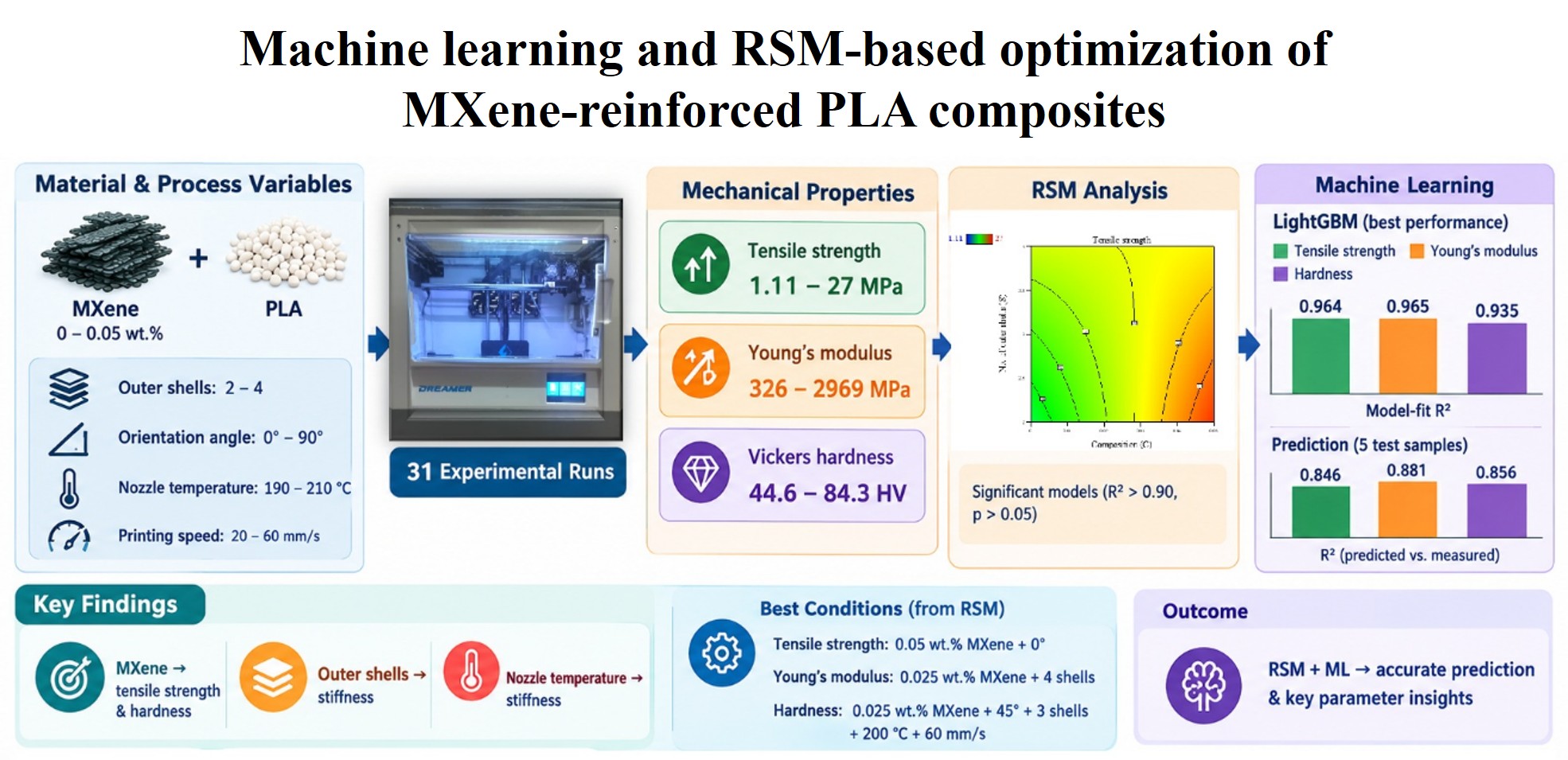
The mechanical properties of fused deposition modeling (FDM)-printed polymer composites depend on both material composition and printing parameters, necessitating systematic optimization and reliable predictive modeling. This study investigates the effects of material composition and process parameters on the mechanical properties of FDM-processed, MXene-reinforced polylactic acid (PLA) composites using response surface methodology (RSM) and machine learning (ML). Thirty-one experimental runs were conducted by varying MXene content (0–0.05 wt.%), outer shells (2–4), orientation angle (0°–90°), nozzle temperature (190 °C–210 °C), and printing speed (20–60 mm/s). Tensile strength, Young’s modulus, and Vickers hardness ranged from 1.11–27.00 MPa, 326–2,969 MPa, and 44.6–84.3 HV, respectively. Maximum tensile strength was obtained at 0.05 wt.% MXene and 0° orientation, whereas Young’s modulus was highest at 0.025 wt.% MXene with four outer shells. The highest hardness of 84.3 HV was obtained at 0.025 wt.% MXene and 45° orientations, with three outer shells, a nozzle temperature of 200 °C, and a printing speed of 60 mm/s. ANOVA indicated that the developed regression models reported R2 values above 0.90 and insignificant lack-of-fit tests (p > 0.05). MXene content affected tensile strength and hardness, while outer shells and nozzle temperature significantly influenced stiffness. Among the evaluated ML models, LightGBM showed the highest model-fit R2 values of 0.964, 0.965, and 0.935 for tensile strength, Young’s modulus, and hardness, respectively. Evaluation using five additional experimentally tested conditions showed reasonable agreement between predicted and measured responses, with R2 values of 0.846, 0.881, and 0.856 for tensile strength, Young’s modulus, and hardness, respectively. SHAP and Pearson analyses further identified the dominant process parameters. These results demonstrate the potential of combining RSM and ML for data-driven analysis and optimization of FDM-processed PLA/MXene composites for potential applications in automotive components, sports equipment, and customized functional parts.
- Oladele IO, Oki VO, Omotosho TF, Adebanjo MB, Ayanleye OT, Adekola SA. Sustainable polymer and polymer-based composite materials for extreme conditions and demanding applications—A review on pushing boundaries in materials science. Next Mater. 2025;8:100775. doi: 10.1016/j.nxmate.2025.100775
- Rahman MM, Islam S, Mubasshira M, et al. Polymer composites in additive manufacturing: Current technologies, applications, and emerging trends. Polymers. 2026;18(2):192. doi: 10.3390/polym18020192
- Jha S, Akula B, Enyioma H, Novak M, Amin V, Liang H. Biodegradable biobased polymers: A review of the state of the art, challenges, and future directions. Polymers. 2024;16(16):2262. doi: 10.3390/polym16162262
- de Azevedo LC, Rovani S, Santos JJ, et al. Biodegradable films derived from corn and potato starch and study of the effect of silicate extracted from sugarcane waste ash. ACS Appl Polym Mater. 2020;2(6):2160-2169. doi: 10.1021/acsapm.0c00124
- Arif U, Haider S, Haider A, et al. Biocompatible polymers and their potential biomedical applications: A review. Curr Pharm Des. 2019;25(34):3608-3619. doi: 10.2174/1381612825999191011105148
- Al-Shalawi FD, Hanim MA, Ariffin MKA, et al. Biodegradable synthetic polymer in orthopaedic application: A review. Mater Today Proc. 2023;74:540-546. doi: 10.1016/j.matpr.2022.12.254
- Kim KW, Lee BH, Kim HJ, Sriroth K, Dorgan JR. Thermal and mechanical properties of cassava and pineapple flours-filled PLA bio-composites. J Therm Anal Calorim. 2012;108(3):1131-1139. doi: 10.1007/s10973-011-1350-y
- Kumar NH, Adarsha H, Keshavamurthy R, Kapilan N. Influence of carbon nano fibre addition on mechanical behaviour of PLA based 3D printed polymer nano composites. J Inst Eng India Ser D. 2024;105(1):33-47. doi: 10.1007/s40033-023-00455-0
- Bhattacharjee SK, Mondal K, Singh A, et al. Impact of nano-silica on thermal, mechanical, and rheological properties of melt-extruded PLA-based nanocomposites. Int J Biol Macromol. 2025;321:146077. doi: 10.1016/j.ijbiomac.2025.146077
- Triveni BV, Lalithamba HS, Rashmi S, Prashanth GK. Green synthesis of graphitic nanofillers and analysis of 3D-printed graphitic nanofiller-reinforced PLA nanocomposites by impedance spectroscopy. J Mater Sci Mater Electron. 2025;36(31):1982. doi: 10.1007/s10854-025-16025-x
- Thirugnanasambandam A, Amith SC, Santhosh S, Mukil T, Harsha R, Dharun NK. Mechanical performance of PLA-MWCNT nanocomposite developed by ecofriendly hybrid filament processing method for fused deposition modeling applications. Polym Compos. 2025;46(17):15584-15597. doi: 10.1002/pc.30141
- Yoon SK, Jang SH, Youk JH, Park NH. Enhanced thermal stability and mechanical properties of PLA nanocomposites reinforced by surface modified halloysite nanotubes. Polym Eng Sci. 2026;66(5):3223-3230. doi: 10.1002/pen.70397
- Ab Ghani NF, Desa MM, Bijarimi M. The evaluation of mechanical properties graphene nanoplatelets reinforced polylactic acid nanocomposites. Mater Today Proc. 2021;42:283-287. doi: 10.1016/j.matpr.2021.01.501
- Ramachandran MG, Rajeswari N. Influence of nano silica on mechanical and tribological properties of additive manufactured PLA bio nanocomposite. Silicon. 2022;14(2):703-709. doi: 10.1007/s12633-020-00878-4
- De Bortoli LS, de Farias R, Mezalira DZ, Schabbach LM, Fredel MC. Functionalized carbon nanotubes for 3D-printed PLA-nanocomposites: Effects on thermal and mechanical properties. Mater Today Commun. 2022;31:103402. doi: 10.1016/j.mtcomm.2022.103402
- Rong C, Su T, Li Z, et al. Elastic properties and tensile strength of 2D Ti3C2Tx MXene monolayers. Nat Commun. 2024;15(1):1566. doi: 10.1038/s41467-024-45657-6
- Vijayananth K, Palaniappan SK, Singh MK, Pudhupalayam Muthukutti G, Mavinkere Rangappa S, Siengchin S. Exploring MXene-polymer composites for mechanical, tribological, and EMI shielding applications. Polym Compos. 2025;46(18):16571-16594. doi: 10.1002/pc.70084
- Farahani RD, Dubé M, Therriault D. Three-dimensional printing of multifunctional nanocomposites: manufacturing techniques and applications. Adv Mater. 2016;28(28):5794-5821. doi: 10.1002/adma.201506215
- Dermanaki Farahani R, Dubé M. Printing polymer nanocomposites and composites in three dimensions. Adv Eng Mater. 2018;20(2):1700539. doi: 10.1002/adem.201700539
- Karuppusamy M, Thirumalaisamy R, Palanisamy S, Nagamalai S, Massoud EES, Ayrilmis N. A review of machine learning applications in polymer composites: advancements, challenges, and future prospects. J Mater Chem A. 2025;13(22):16290-16308. doi: 10.1039/d5ta00982k
- Olhan S, Antil B, Maimí P. Machine learning in next-generation polymer composites: Recent advances and perspectives. Appl Compos Mater. 2026;33(2):54. doi: 10.1007/s10443-025-10437-y
- Chowdary BV, Ali F. Optimisation of surface roughness of FDM fabricated parts: application of definitive screening design and genetic algorithm techniques. Int J Ind Syst Eng. 2025;51(2):206-235. doi: 10.1504/IJISE.2025.148892
- Srinivasan L, Radhakrishnan L, Veeranan E, Mohammad FK, Moinuddin SQ, Altammar H. NSGA-II-based multi-objective optimization of fused filament fabrication process parameters for TPU parts with chemical smoothing. Polymers. 2026;18(3):391. doi: 10.3390/polym18030391
- Islam MR, Karim FE, Uddin MB. Optimizing yarn properties through response surface methodology: Finding the ideal flax and cotton fiber proportion in blended yarns by using design-expert software. SPE Polym. 2024;5(3):412-425. doi: 10.1002/pls2.10133
- Qu DY, Guo FL, Hou WD, Long JF, Li YQ, Fu SY. Cryogenic mechanical properties and liquid oxygen compatibility of MXene/epoxy nanocomposites. Adv Compos Hybrid Mater. 2024;7(5):153. doi: 10.1007/s42114-024-00975-7
- Hu Y, Liu Y, Cui C, et al. Hydroxylated MXene as a nano-binder: Concurrently strengthening interfaces and toughening matrix in carbon fiber/epoxy composites. Compos Sci Technol. 2026;273:111426. doi: 10.1016/j.compscitech.2025.111426
- Palaniyappan S, Sivakumar NK, Dalaq AS. A peanut-hull-PLA based 3D printing filament with antimicrobial effect. J Manuf Process. 2026;160:242-253. doi: 10.1016/j.jmapro.2026.01.064
- Kozień D, Malata K, Krysińska Z, et al. Fabrication and characterization of PLA-based ceramic composite filaments for FDM 3D printing. Crystals. 2026;16(1):46. doi: 10.3390/cryst16010046
- Messaoudi R, Mrani I, Majid F. Processing and characterization of PLA/HA composites reinforced with natural sugarcane powder. BIO Web Conf. 2026;215:02014. doi: 10.1051/bioconf/202621502014
- Liao Y, Liu C, Coppola B, et al. Effect of porosity and crystallinity on 3D printed PLA properties. Polymers. 2019;11(9):1487. doi: 10.3390/polym11091487
- Sapre M, Jatti AV, Khedkar NK, Jatti VS. Mechanical properties of 3D-printed components using fused deposition modeling: Optimization using the desirability approach and machine learning regressor. Appl Syst Innov. 2022;5(6):112. doi: 10.3390/asi5060112
- Sahu SK, Sreekanth PSR. Artificial neural network for prediction of mechanical properties of HDPE based nanodiamond nanocomposite. Polym Korea. 2022;46(5):614-620. doi: 10.7317/pk.2022.46.5.614
- Ghorbal GB, Tricoteaux A, Thuault A, Louis G, Chicot D. Comparison of conventional Knoop and Vickers hardness of ceramic materials. J Eur Ceram Soc. 2017;37(6):2531-2535. doi: 10.1016/j.jeurceramsoc.2017.02.014
- Gaesenngwe G, Danha G, Raghupatruni PVS, Mamvura TA. The significance of coal ball milling model equations in manufacturing industries. Int J Coal Prep Util. Published online January 8, 2026. doi: 10.1080/19392699.2025.2605273
- Boudboud A, Ben Aziz M, Arif S, et al. Optimizing polyphenol oxidases activity of apricot fruits using Box-Behnken design and evaluation of their inhibition by thermal, chemical, and plant extracts treatment. J Food Meas Charact. 2026;20(8):6109-6123. doi: 10.1007/s11694-026-04054-x
- Sundarasetty H, Sahu SK. Tribological behavior of PLA reinforced with boron nitride nanoparticles using Taguchi and machine learning approaches. Results Eng. 2025;26:104772. doi: 10.1016/j.rineng.2025.104772
- Louhichi B, Joy D, Sahu SK, et al. Methods to optimize tribological properties of pineapple leaf fiber epoxy composites. Ind Crops Prod. 2026;242:122865. doi: 10.1016/j.indcrop.2026.122865
- Rahmani S, Belkadi AA, Achour Y, et al. Machine learning models with SHAP for performance prediction of eco-friendly fiber reinforced mortars with glass waste. Sci Rep. 2025;15(1):40973. doi: 10.1038/s41598-025-24781-3
- Harishbabu S, Alrasheedi NH, Louhichi B, Sahu SK, Ma Q. Optimization and prediction of mechanical properties of additively manufactured PLA/GNP composites via response surface methodology and machine learning models. Polymers. 2025;17(21):2894. doi: 10.3390/polym17212894
- Schapire RE. Explaining AdaBoost. In: Schölkopf B, Luo Z, Vovk V, eds. Empirical Inference. Springer; 2013:37-52. doi: 10.1007/978-3-642-41136-6_5
- Rufo DD, Debelee TG, Ibenthal A, Negera WG. Diagnosis of diabetes mellitus using gradient boosting machine (LightGBM). Diagnostics. 2021;11(9):1714. doi: 10.3390/diagnostics11091714
- Guo J, Yun S, Meng Y, et al. Prediction of heating and cooling loads based on light gradient boosting machine algorithms. Build Environ. 2023;236:110252. doi: 10.1016/j.buildenv.2023.110252