
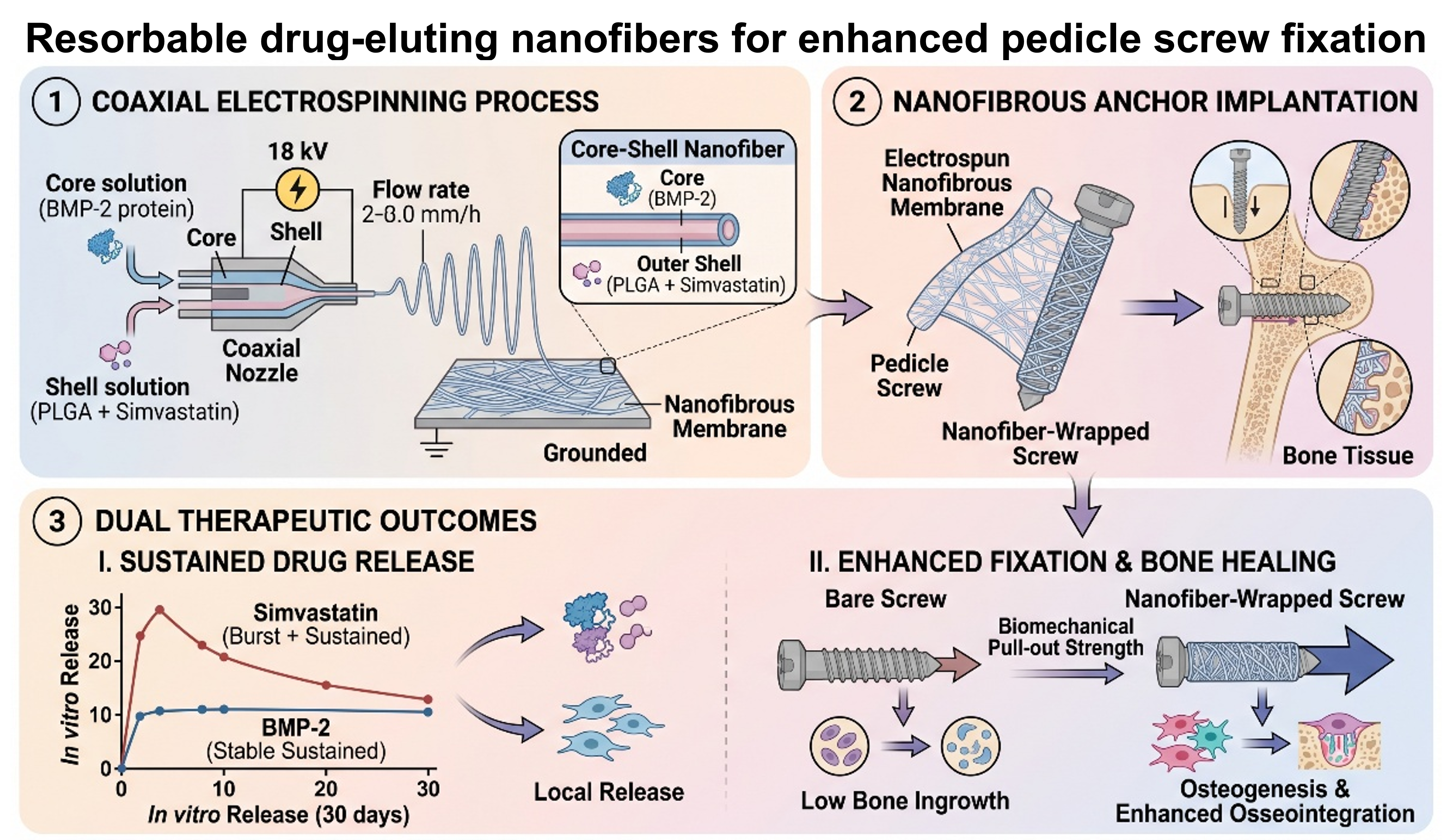
Hybrid resorbable anchors/biomolecule-eluting nanofibers for enhanced pedicle screw fixation

Pedicle screw loosening remains a challenge for surgeons and patients. We propose using hybrid resorbable anchors and drug/biomolecule-eluting nanofibers to enhance the bone fixation of pedicle screws. Polylactide (PLA) anchors with various designs were fabricated using additive manufacturing, while simvastatin- and bone morphogenetic protein-2 (BMP-2)-loaded poly(lactic-co-glycolic acid) (PLGA) nanofibers were prepared through coaxial electrospinning. The effects of PLA anchors and drug/biomolecule-loaded PLGA nanofibrous membranes on improving the pullout strength of pedicle screws from artificial bones were investigated. The in vitro release characteristics of simvastatin and BMP-2 from the nanofibers were evaluated using high-performance liquid chromatography and enzyme-linked immunosorbent assay, while the in vivo elution of simvastatin was assessed in a rabbit model with histological examinations. The results demonstrate that electrospun drug/biomolecule-eluting nanofibers, when wrapped around pedicle screws, enhance the screws’ pullout strength. Additionally, the nanofiber/screw system provides a sustained release of simvastatin and BMP-2 for over 30 days in vitro and 4 weeks in vivo. Histological analysis also confirmed the biocompatibility of nanofibrous anchors. Hybrid resorbable anchors and drug/biomolecule-eluting nanofibers show potential for improving screw fixation and serving as a platform for extended drug delivery.
- Yuan L, Zhang X, Zeng Y, Chen Z, Li W. Incidence, risk, and outcome of pedicle screw loosening in degenerative lumbar scoliosis patients undergoing long-segment fusion. Global Spine J. 2023;13(4):1064-1071. doi: 10.1177/21925682211017477
- Wu Q, Huang J, Cao Y. Risk factors for pedicle screw loosening: a comprehensive review. J Orthop Surg Res. 2025;20(1):914. doi: 10.1186/s13018-025-06349-z
- Şahin ÖF, Uzlu O, Açıkgöz Hİ, et al. Pedicle screw loosening after lumbar spinal stenosis surgery and an analytical review of recurrent loosening: based on revision surgery experience. Med Sci Monit. 2026;32:e951549. doi: 10.12659/MSM.951549
- Huang YC, Liu PC, Lin HH, et al. Risk prediction model of pedicle screw loosening within 2 years after decompression and instrumented fusion surgery for degenerative lumbar disease. Spine J. 2025;25(7):1474-1482. doi: 10.1016/j.spinee.2025.01.033
- Yuan H, Liu Y, Dai C, et al. Predictive factors of distal pedicle screw loosening followed posterior corrective surgery for degenerative lumbar scoliosis. BMC Musculoskelet Disord. 2025;26(1):283. doi: 10.1186/s12891-025-08519-w
- Hsieh MK, Li YD, Li YC, Liu MY, Tsai TT, Lai PL, Tai CL. Improved fixation stability for repairing pedicle screw loosening using a modified cement filling technique in porcine vertebrae. Sci Rep. 2022;12(1):2739. doi: 10.1038/s41598-022-06724-4
- Peng J, Guo H, Zhan C, et al. Comparison of pedicle screw fixation with or without cement augmentation for treating single-segment isthmic spondylolisthesis in the osteoporotic spine. Sci Rep. 2023;13(1):827. doi: 10.1038/s41598-023-27539-x
- Wu X, Shi J, Cheng Y, et al. Pedicle screw loosening: the value of radiological imagings and the identification of risk factors assessed by extraction torque during screw removal surgery. J Orthop Surg Res. 2019;14(1):6. doi: 10.1186/s13018-018-1046-0
- McKoy BE, An YH. An expandable anchor for fixation in osteoporotic bone. J Orthop Res. 2001;19(4):545-547. doi: 10.1016/S0736-0266(00)00052-8
- Massaad E, Rolle M, Hadzipasic H, Kiapour A, Shankar GM, Shin JH. Safety and efficacy of cement augmentation with fenestrated pedicle screws for tumor-related spinal instability. Neurosurg Focus. 2021;50(5):E12. doi: 10.3171/2021.2.FOCUS201121
- Barnett E, Fletcher J, Gill HS, Pegg EC, Loukaides EG. Auxetic fixation devices can achieve superior pullout performances compared to standard fixation concepts. Smart Mater Struct. 2024;33(6):065010. doi: 10.1088/1361-665X/ad442d
- Lin CK, Jaw FS, Young TH. A novel UHMWPE anchor for improving the pullout resistance of pedicle screws. Front Bioeng Biotechnol. 2026;14:1741050. doi: 10.3389/fbioe.2026.1741050
- Chen Z. Non-concrete breakout failure modes of concrete mechanical anchors in tension-a literature review. Constr Build Mater. 2023;366:1301222. doi: 10.1016/j.conbuildmat.2022.130222
- Lee CH, Hsieh MJ, Roth J, et al. Hybrid core-shell nanofibrous scaffolds/stents delivery angiotensin II receptor blocker to treat diabetic artery disease. ACS Appl Polym Mater. 2022;4(6):4199-4207. doi: 10.1021/acsapm.2c00186
- Novakova L, Satinsky D, Solich P. HPLC methods for the determination of simvastatin and atorvastatin. Trends Analyt Chem. 2008;27(4):352-367. doi: 10.1016/j.trac.2008.01.013
- Hakiem AFA, Mohamed NA, Ali HRH. FTIR spectroscopic study of two isostructural statins: Simvastatin and Lovastatin as authentic and in pharmaceuticals. Spectrochim Acta A Mol Biomol Spectrosc. 2021;261:120045. doi: 10.1016/j.saa.2021.120045
- Karolewicz B, Gajda M, Owczarek A, Pluta J, Górniak A. Physicochemical and dissolution studies of simvastatin solid dispersions with Pluronic F127. Pharmazie. 2014;69(8):589-594. doi: 10.1691/ph.2014.3217
- Kanishka K, Acherjee B. Revolutionizing manufacturing: a comprehensive overview of additive manufacturing processes, materials, developments, and challenges. J Manuf Process. 2023;107:574-619. doi: 10.1016/j.jmapro.2023.10.024
- Ngo TD, Kashani A, Imbalzano G, Nguyen KT, Hui D. Additive manufacturing (3D printing): a review of materials, methods, applications and challenges. Compos B Eng. 2018;143:172-196. doi: 10.1016/j.compositesb.2018.02.012
- Bazilevsky AV, Yarin AL, Megaridis CM. Co-electrospinning of core-shell fibers using a single-nozzle technique. Langmuir. 2007;23(5):2311-2314. doi: 10.1021/la063194q
- Khan J, Khan A, Khan MQ, Khan H. Applications of co-axial electrospinning in the biomedical field. Next Mater. 2024;3:100138. doi: 10.1016/j.nxmate.2024.100138
- Ehtesabi H, Massah F. Improvement of hydrophilicity and cell attachment of polycaprolactone scaffolds using green synthesized carbon dots. Mater Today Sustain. 2021;13:100075. doi: 10.1016/j.mtsust.2021.100075
- Zhou J, Akrami N, Wang H, et al. Enhanced healing of critical-sized bone defects using degradable scaffolds with tailored composition through immunomodulation and angiogenesis. Bioact Mater. 2025;44:371-388. doi: 10.1016/j.bioactmat.2024.10.018
- Ali SA, Doherty PJ, Williams DF. Mechanisms of polymer degradation in implantable devices. 2. Poly(DL-lactic acid). J Biomed Mater Res. 1993;27(11):1409-1418. doi: 10.1002/jbm.820271108
- Kamaly N, Yameen B, Wu J, Farokhzad OC. Degradable controlled-release polymers and polymeric nanoparticles: mechanisms of controlling drug release. Chem Rev. 2016;116(4):2602-2663. doi: 10.1021/acs.chemrev.5b00346