

Numerical and experimental assessment of non-monolithic fabrication effects on sound transmission and absorption in additively manufactured metamaterials

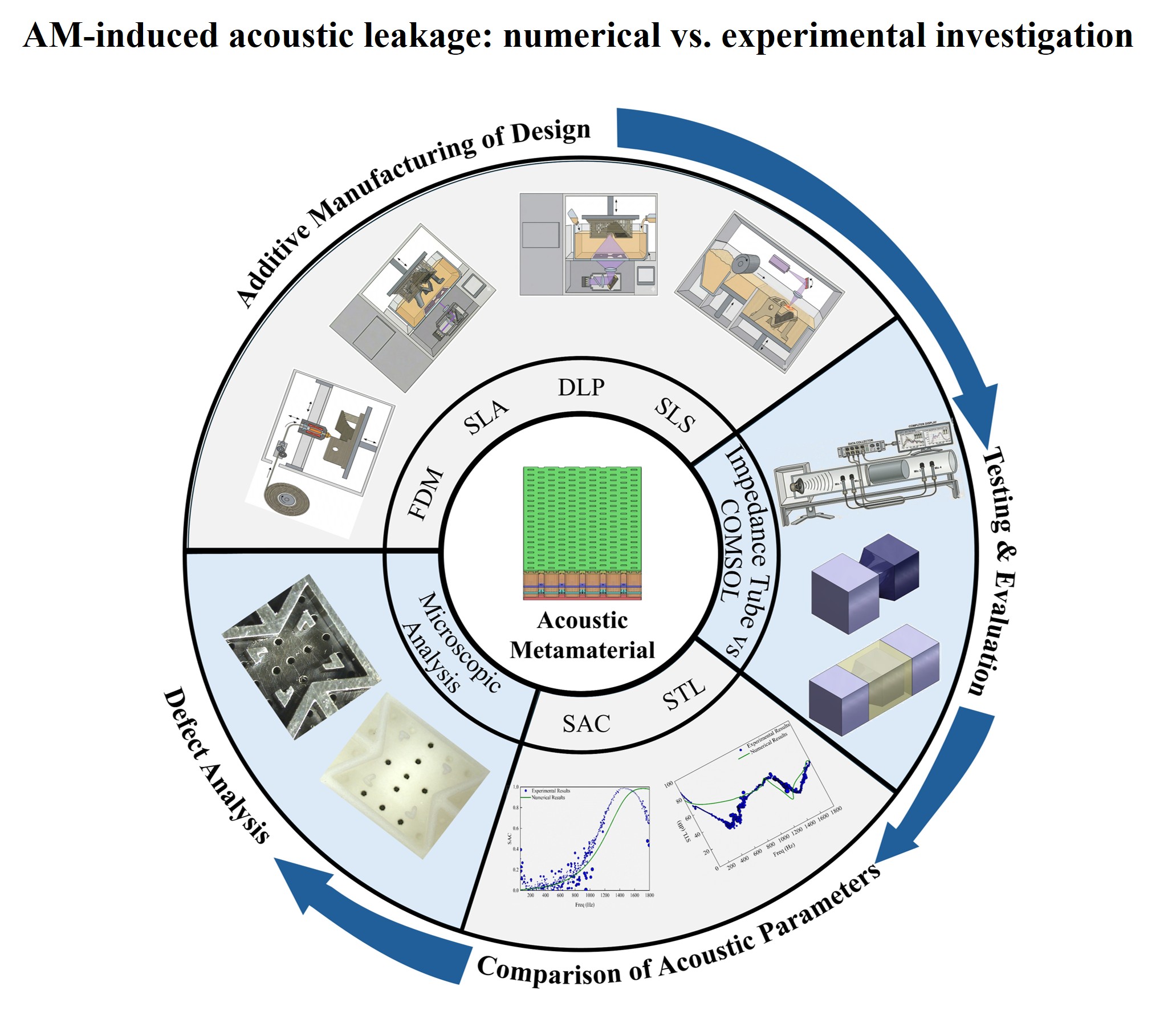
Additive manufacturing (AM) has enabled the realization of complex, high-performance acoustic metamaterials. However, bridging the gap between idealized numerical performance and physical reality remains an ongoing engineering challenge. This research investigates the effects of four AM technologies (fused deposition modeling [FDM], stereolithography, digital light processing [DLP], selective laser sintering [SLS]) on the acoustic performance of a specialized acoustic metamaterial (AMM). While numerical models in COMSOL Multiphysics provide idealized benchmarks for sound absorption coefficient (SAC) and sound transmission loss (STL), this study demonstrates that the physical manufacturing process introduces critical deviations. Experimental results reveal that for SAC, DLP provided the highest fidelity due to its superior surface finish and sharp geometric definition. In contrast, FDM samples showed significant SAC deviations, where inherent process limitations increased thermoviscous losses, leading to higher-than-predicted absorption. However, an inverse trend was observed for STL. The ability of FDM to produce a monolithic structure resulted in STL values that closely aligned with numerical predictions. Conversely, the high-precision DLP and SLS methods required subassembly joining, where microscopic interstitial leakages caused a sharp degradation in STL performance. The findings indicate that these leakages often appear as absorption in SAC measurements, hiding structural failures that only become evident during STL characterization. This study concludes that for industrial noise mitigation applications, the necessity of monolithic construction and the elimination of acoustic leaks outweigh the benefits of high-resolution surface finishes. These results provide a vital framework for selecting AM processes based on the specific acoustic requirements of the design.
- Ciochon A, Kennedy J, Leiba R, Flanagan L, Culleton M. The impact of surface roughness on an additively manufactured acoustic material: An experimental and numerical investigation. J Sound Vib. 2023;546:117434. doi: 10.1016/j.jsv.2022.117434
- Jamois A, Dragna D, Galland M-A. Impact of leakage on sound properties of 3D printed samples at normal and grazing incidence. J Acoust Soc Am. 2025;158(1):75-83. doi: 10.1121/10.0037074
- Naveed AB, Mubashar A, Khan MKA, Munir A, Khan KA. Additively manufactured hybrid auxetic structures for enhanced low frequency acoustic performance through experiments and modelling. Sci Rep. 2025;15(1):23460. doi: 10.1038/s41598-025-06970-2
- Amares S, Sujatmika E, Hong TW, Durairaj R, Hamid HSHB. A Review: Characteristics of Noise Absorption Material. J Phys Conf Ser. 2017;908:012005. doi: 10.1088/1742-6596/908/1/012005
- Wang S, Zhang X, Li F, Hosseini SM. Sound transmission loss of a novel acoustic metamaterial sandwich panel: Theory and experiment. Appl Acoust. 2022;199:109035. doi: 10.1016/j.apacoust.2022.109035
- Zhang P, Li Z, Liu B, et al. Sound absorption performance of micro-perforated plate sandwich structure based on triply periodic minimal surface. J Mater Res Technol. 2023;27:386-400. doi: 10.1016/j.jmrt.2023.09.237
- Akiwate DC, Date MD, Venkatesham B, Suryakumar S. Acoustic characterization of additive manufactured perforated panel backed by honeycomb structure with circular and non-circular perforations. Appl Acoust. 2019;155:271-279. doi: 10.1016/j.apacoust.2019.05.025
- Rezaieyan E, Taban E, Berardi U, Mortazavi SB, Faridan M, Mahmoudi E. Acoustic properties of natural fiber reinforced composite micro-perforated panel (NFRC-MPP) made from cork fiber and polylactic acid (PLA) using 3D printing. J Build Eng. 2024;84:108491. doi: 10.1016/j.jobe.2024.108491
- Fotsing ER, Dubourg A, Ross A, Mardjono J. Acoustic properties of periodic micro-structures obtained by additive manufacturing. Appl Acoust. 2019;148:322-331. doi: 10.1016/j.apacoust.2018.12.030
- Mei Z, Yang H, Ding Y, Lyu Y, Cheng X, Yang J. Ultra-broadband sound absorption via a parallel composite structure consisting of perforated panel resonators with tube bundles and porous material. Appl Acoust. 2024;222:110071. doi: 10.1016/j.apacoust.2024.110071
- Pierre J, Iervolino F, Farahani RD, Piccirelli N, Lévesque M, Therriault D. Material extrusion additive manufacturing of multifunctional sandwich panels with load-bearing and acoustic capabilities for aerospace applications. Addit Manuf. 2023;61:103344. doi: 10.1016/j.addma.2022.103344
- Tang Y, Ren S, Meng H, et al. Hybrid acoustic metamaterial as super absorber for broadband low-frequency sound. Sci Rep. 2017;7(1):43340. doi: 10.1038/srep43340
- Zhao T, Chen Y, Zhang K, Hu G. Tunable network sound absorber based on additive manufacturing. J Acoust Soc Am. 2021;150(1):94-101. doi: 10.1121/10.0005507
- Yang Z, Dai HM, Chan N, Ma G, Sheng P. Acoustic metamaterial panels for sound attenuation in the 50–1000 Hz regime. Appl Phys Lett. 2010;96(4):041906. doi: 10.1063/1.3299007
- Li F, Chen Y, Zhu D. Revealing the Sound Transmission Loss Capacities of Sandwich Metamaterials with Re-Entrant Negative Poisson’s Ratio Configuration. Materials. 2023;16(17):5928. doi: 10.3390/ma16175928
- Kim J, Choi E, Jeon W. Lightweight soundproofing meta-panel for separate wide frequency bands. Mech Syst Signal Pr. 2023;184:109647. doi: 10.1016/j.ymssp.2022.109647
- Abueidda DW, Jasiuk I, Sobh NA. Acoustic band gaps and elastic stiffness of PMMA cellular solids based on triply periodic minimal surfaces. Mater Desn. 2018;145:20-27. doi: 10.1016/j.matdes.2018.02.032
- Lu JY, AlZaabi F, Teneiji MA, Lee DW. Acoustic band structures of Architectured Materials based on Triply Periodic Minimal Surfaces. In: Proceedings of the 2021 Fifteenth International Congress on Artificial Materials for Novel Wave Phenomena (Metamaterials). IEEE; September 20-23, 2021; Online. 2021:1-3. doi: 10.1109/metamaterials52332.2021.9577144
- Sirivuri KK, Sekar V, Cantwell WJ, et al. Computational Study of Sound Absorption in TPMS Lattice Materials Using a Thermoviscous Model. J Build Eng. 2025;112:113658. doi: 10.1016/j.jobe.2025.113658
- Yang W, An J, Chua CK, Zhou K. Acoustic absorptions of multifunctional polymeric cellular structures based on triply periodic minimal surfaces fabricated by stereolithography. Virtual Phys Prototyp. 2020;15(2):242-249. doi: 10.1080/17452759.2020.1740747
- Zhang M, Liu C, Deng M, Li Y, Li J, Wang D. Graded minimal surface structures with high specific strength for broadband sound absorption produced by laser powder bed fusion. Coatings. 2023;13(11):1950. doi: 10.3390/coatings13111950
- Guan X, Deckers E, Dong H, Hornikx M, Yang J. Optimization of graded porous acoustic absorbers based on triply periodic minimal surfaces. Mater Desn. 2025;253:113852. doi: 10.1016/j.matdes.2025.113852
- Naveed AB, Butt SI, Mubashar A, Chaudhry FN, Qadir Nu, Faping Z. Design and verification of enhanced CFRTPCs fabrication technique using fused deposition modeling. J Thermoplast Compos Mater. 2022;35(11):1957-1980. doi: 10.1177/0892705720941918
- Chua JW, Li X, Zhai W. Design, multiscale modelling, and experimental characterisation of TPMS-based composite lattices with enhanced sound absorption. Compos Struct. 2025;370:119437. doi: 10.1016/j.compstruct.2025.119437
- Lai Z, Zhao M, Lim CH, Chua JW. Experimental and numerical studies on the acoustic performance of simple cubic structure lattices fabricated by digital light processing. Mater Sci Addit Manuf. 2022;1(4):22. doi: 10.18063/msam.v1i4.22
- Zou L, Zhang A, Liu Z, Du P, Guo Y. The Sound Absorption Performance of Laser-Sintered Composite Biomimetic Wood Porous Structures. Polymers. 2024;16(23):3290. doi: 10.3390/polym16233290
- Setaki F, Tian F, Turrin M, Tenpierik M, Nijs L, Van Timmeren A. 3D-printed sound absorbers: Compact and customisable at broadband frequencies. Arch Struct Construct. 2023;3(2):205-215. doi: 10.1007/s44150-023-00086-9
- Zhang M, Deng M, Wang G, et al. Multicavity structures with triply periodic minimal surface for broadband and perfect sound absorption manufactured by laser powder bed fusion. Mater Sci Addit Manuf. 2025;4(1):5737. doi: 10.36922/msam.5737
- Wu Y, Qi X, Sun L, Wang B, Wang P, Li W. Acoustic Performance of Micro-Perforated Plate Sandwich Structure Based on Triply Periodic Minimal Surfaces. Mater Today Commun. 2025;49:114249. doi: 10.1016/j.mtcomm.2025.114249
- International Organization for Standardization. Acoustics—Determination of sound absorption coefficient and impedance in impedance tubes—Part 2: Two-microphone technique for normal sound absorption coefficient and normal surface impedance. ISO 10534-2:2023. Geneva, Switzerland: International Organization for Standardization; 2023.
- Formlabs. Design specifications for 3D models (Form 3/Form 3B). Accessed January 28, 2026. https://support.formlabs.com/s/article/Design-specifications-for-3D-models-form-3?language=en_US
- Cox T, d’Antonio P. Acoustic absorbers and diffusers: theory, design and application. Boca Raton, FL: CRC Press; 2016.
- Sakamoto S, Azami T, Nitta I, Tsukiyama Y. Fundamental study of acoustic leakage through a gap between gasket and flange surface. J Adv Mech Des Syst. 2016;10(4):JAMDSM0067. doi: 10.1299/jamdsm.2016jamdsm0067