
Development of a compact multi-material vat photopolymerization printing solution

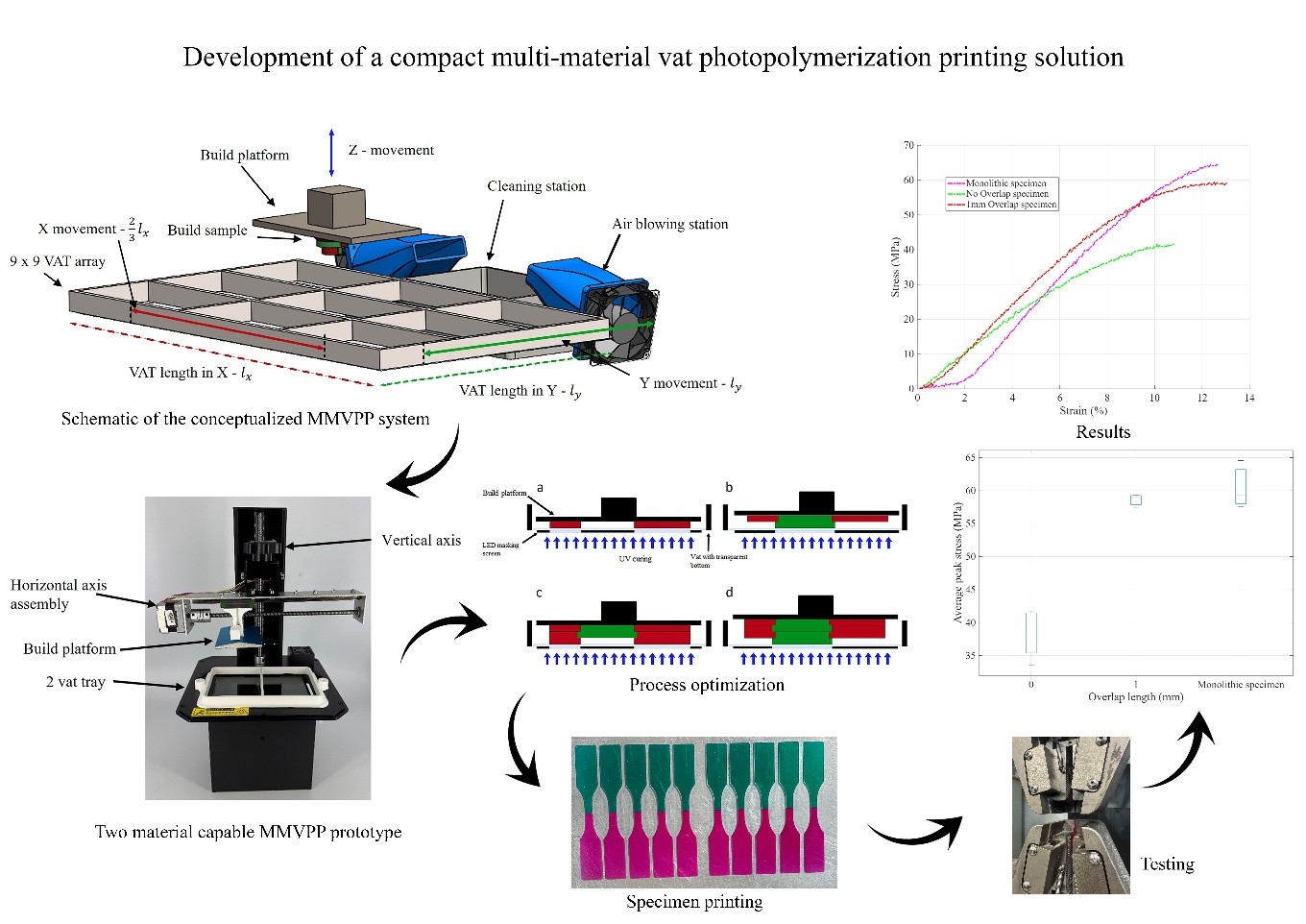
Multi-material vat photopolymerization (MMVPP) is an emerging additive manufacturing technology with great potential in biomedical engineering, soft robotics, electronics, and customized manufacturing, particularly where functional gradients and spatially varying material properties are essential. The capability to precisely control composition at the voxel level enables the fabrication of bioinspired structures and multifunctional components with tailored mechanical and functional performance. This study presents the conceptual design and development of a compact and commercially viable MMVPP system that addresses key challenges in current state-of-the-art technologies. A two-vat prototype printer was fabricated to demonstrate the feasibility of precise multi-material printing. Critical challenges, including resin compatibility, interfacial adhesion, and mechanical property optimization, were systematically investigated. Novel strategies such as variable layer height exposure control, overlapped layer printing, and optimized curing parameters were introduced to improve interfacial bonding and overall structural integrity. The proposed methods were validated through mechanical testing, confirming enhanced interface strength and material cohesion. The study also details system-level innovations, including efficient vat-switching mechanisms and process synchronization for rapid material transition. These advances establish foundational methodologies for reliable multi-material photopolymerization and expand the design space of photopolymer-based additive manufacturing. The results demonstrate MMVPP’s transformative potential to enable next-generation manufacturing of functionally graded and multi-material components with superior performance and design freedom.
- Gibson I. Additive Manufacturing Technologies. 3rd ed. Germany: Springer; 2021.
- Loh GH, Pei E, Harrison D, Monzón MD. An overview of functionally graded additive manufacturing. Addit Manuf. 2018;23:34-44. doi: 10.1016/j.addma.2018.06.023
- Subedi S, Liu S, Wang W, Naser Shovon SMA, Chen X, Ware HOT. Multi-material vat photopolymerization 3D printing: A review of mechanisms and applications. Npj Adv Manuf. 2024;1(1):9. doi: 10.1038/s44334-024-00005-w
- Sampson KL, Deore B, Go A, et al. Multimaterial vat polymerization additive manufacturing. ACS Appl Polym Mater. 2021;3(9):4304-4324. doi: 10.1021/acsapm.1c00262
- Nazir A, Gokcekaya O, Md Masum Billah K, et al. Multi-material additive manufacturing: A systematic review of design, properties, applications, challenges, and 3D printing of materials and cellular metamaterials. Mater Des. 2023;226:111661. doi: 10.1016/j.matdes.2023.111661
- Salmi M. Additive manufacturing processes in medical applications. Materials. 2021;14(1):191. doi: 10.3390/ma14010191
- Kumar SS, Akmal JS, Salmi M. 4D printing of shape memory polymer with continuous carbon fiber. Prog Addit Manuf. 2024;9(6):1985-1995. doi: 10.1007/s40964-023-00553-1
- Kumar SS, Niyagama WW, Akmal JS, Salmi M. 4D printing of electro-activated thermochromic composites for dynamic 3D displays. Mater Des. 2025;251:113674. doi: 10.1016/j.matdes.2025.113674
- Ghaderi I, Behravesh AH, Hedayati SK, et al. Multimaterial additive manufacturing of poly-L-lactic acid– hydroxylapatite/graphene oxide scaffold fabricated via vat photopolymerization: Experimental investigation, analysis and cell study. Rapid Prototyp J. 2024;30(9):1789-1802. doi: 10.1108/RPJ-02-2024-0085
- Al Rashid A, Ahmed W, Khalid MY, Koç M. Vat photopolymerization of polymers and polymer composites: Processes and applications. Addit Manuf. 2021;47:102279. doi: 10.1016/j.addma.2021.102279
- McKerricher G, Vaseem M, Shamim A. Fully inkjet-printed microwave passive electronics. Microsyst Nanoeng. 2017;3(1):16075. doi: 10.1038/micronano.2016.75
- Vyas A, Garg V, Ghosh SB, Bandyopadhyay-Ghosh S. Photopolymerizable resin-based 3D printed biomedical composites: Factors affecting resin viscosity. Mater Today Proc. 2022;62:1435-1439. doi: 10.1016/j.matpr.2022.01.172
- Choi JW, Kim HC, Wicker R. Multi-material stereolithography. J Mater Process Technol. 2011;211(3):318-328. doi: 10.1016/j.jmatprotec.2010.10.003
- Inamdar A, Magana M, Medina F, Grajeda Y, Wicker R. Development of an automated multiple material stereolithography machine. In: 17th Annual International Solid Freeform Fabrication (SFF) Symposium in Austin TX. 2006. p. 624-635.
- Wicker R, Medina F, Elkins C. Multiple material micro-fabrication: Extending stereolithography to tissue engineering and other novel applications. In: 15th Annual International Solid Freeform Fabrication (SFF) Symposium in Austin TX. 2004. p. 754-764.
- Zhou C, Chen Y, Yang Z, Khoshnevis B. Digital material fabrication using mask‐image‐projection‐based stereolithography. Rapid Prototyp J. 2013;19(3):153-165. doi: 10.1108/13552541311312148
- Huang P, Deng D, Chen Y. Modeling and fabrication of heterogeneous three-dimensional objects based on additive manufacturing. In: Volume 2A: Advanced Manufacturing. United States: American Society of Mechanical Engineers; 2013. p. V02AT02A056. doi: 10.1115/IMECE2013-65724
- Bhusal A, Dogan E, Nguyen HA, et al. Multi-material digital light processing bioprinting of hydrogel-based microfluidic chips. Biofabrication. 2022;14(1):014103. doi: 10.1088/1758-5090/ac2d78
- Jiang CP, Romario YS, Bhat C, Hentihu MFR, Zeng XC, Ramezani M. Design and fabrication of multi-material pneumatic soft gripper using newly developed high-speed multi-material vat photopolymerization 3D printer. Int J Adv Manuf Technol. 2024;130(3-4):1093-1106. doi: 10.1007/s00170-023-12774-3
- Matte CD, Pearson M, Trottier-Cournoyer F, Dafoe A, Kwok TH. Automated storage and active cleaning for multi-material digital-light-processing printer. Rapid Prototyp J. 2019;25(5):864-874. doi: 10.1108/RPJ-08-2018-0211
- Shaukat U, Thalhamer A, Rossegger E, Schlögl S. Dual-vat photopolymerization 3D printing of vitrimers. Addit Manuf. 2024;79:103930. doi: 10.1016/j.addma.2023.103930
- Khatri B, Frey M, Raouf-Fahmy A, Scharla MV, Hanemann T. Development of a multi-material stereolithography 3D printing device. Micromachines. 2020;11(5):532. doi: 10.3390/mi11050532
- Hu K, Zhao P, Li J, Lu Z. High-resolution multiceramic additive manufacturing based on digital light processing. Addit Manuf. 2022;54:102732. doi: 10.1016/j.addma.2022.102732
- Cheng J, Wang R, Sun Z, et al. Centrifugal multimaterial 3D printing of multifunctional heterogeneous objects. Nat Commun. 2022;13(1):7931. doi: 10.1038/s41467-022-35622-6
- Wu X, Lian Q, Li D, Jin Z. Biphasic osteochondral scaffold fabrication using multi-material mask projection stereolithography. Rapid Prototyp J. 2019;25(2):277-288. doi: 10.1108/RPJ-07-2017-0144
- Nam OH, Chung SY, Hyun HK, et al. Influence of postprinting cleaning methods on the cleaning efficiency and surface and mechanical properties of three-dimensionally printed resins. J Prosthet Dent. 2024;132(4):838.e1-838.e9. doi: 10.1016/j.prosdent.2024.02.026
- Parks GS, Barton B. Vapor pressure data for isopropyl alcohol and tertiary butyl alcohol. J Am Chem Soc. 1928;50(1):24-26. doi: 10.1021/ja01388a004
- Santos EO, Oliveira PLE, De Mello TP, et al. Surface characteristics and microbiological analysis of a vat-photopolymerization additive-manufacturing dental resin. Materials. 2022;15(2):425. doi: 10.3390/ma15020425
- ASTM Subcommittee D20. Standard Test Method for Tensile Properties of Plastics. United States: ASTM International; 2022. doi: 10.1520/D0638-22
- Riccio C, Civera M, Grimaldo Ruiz O, et al. Effects of curing on photosensitive resins in SLA additive manufacturing. Appl Mech. 2021;2(4):942-955. doi: 10.3390/applmech2040055
- Anastasio R, Peerbooms W, Cardinaels R, van Breemen LCA. Characterization of ultraviolet-cured methacrylate networks: From photopolymerization to ultimate mechanical properties. Macromolecules. 2019;52(23):9220-9231. doi: 10.1021/acs.macromol.9b01439
- Ligon SC, Liska R, Stampfl J, Gurr M, Mülhaupt R. Polymers for 3D printing and customized additive manufacturing. Chem Rev. 2017;117(15):10212-10290. doi: 10.1021/acs.chemrev.7b00074
- Wang X, Jiang M, Zhou Z, Gou J, Hui D. 3D printing of polymer matrix composites: A review and prospective. Compos Part B Eng. 2017;110:442-458. doi: 10.1016/j.compositesb.2016.11.034
- Pagac M, Hajnys J, Ma QP, et al. A Review of vat photopolymerization technology: Materials, applications, challenges, and future trends of 3D printing. Polymers. 2021;13(4):598. doi: 10.3390/polym13040598
- Lur’e ZY. Analysis of pitch error in lead screws. Meas Tech. 1973;16(9):1340-1341. doi: 10.1007/BF00813042
- Jin G, Gu H, Jang M, et al. Influence of postwashing process on the elution of residual monomers, degree of conversion, and mechanical properties of a 3D printed crown and bridge materials. Dent Mater. 2022;38(11):1812-1825. doi: 10.1016/j.dental.2022.09.017
- Hassanpour M, Narongdej P, Alterman N, Moghtadernejad S, Barjasteh E. Effects of post-processing parameters on 3D-printed dental appliances: A review. Polymers. 2024;16(19):2795. doi: 10.3390/polym16192795
- Wang X, Li Z, Deng J, et al. Unprecedented strength enhancement observed in interpenetrating phase composites of aperiodic lattice metamaterials. Adv Funct Mater. 2025;35(1):2406890. doi: 10.1002/adfm.202406890
- Xavier MS, Tawk CD, Yong YK, Fleming AJ. 3D-printed omnidirectional soft pneumatic actuators: Design, modeling and characterization. Sens Actuators Phys. 2021;332:113199. doi: 10.1016/j.sna.2021.113199