
Heat transfer model for powder bed temperature management in binder jetting of 316L

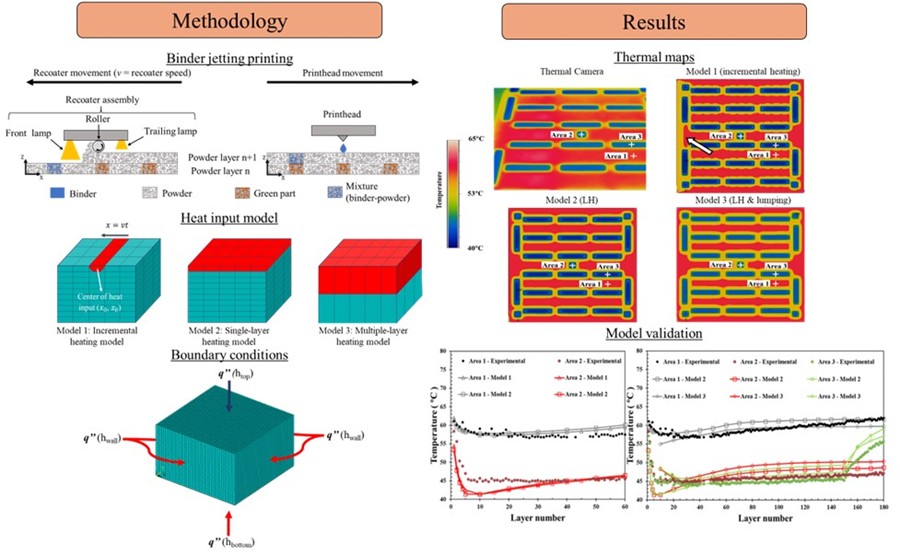
Accurate management of powder bed temperature is essential in binder jetting (BJ) to achieve dimensional accuracy and adequate mechanical properties. Three different models using the finite element method operating at different scales were developed in this study to compare their accuracy in predicting the thermal history of the powder bed during the BJ process. The simulated temperatures were compared with in situ experimental thermal measurements of the powder bed during printing. The first model relied on 2D Gaussian heat sources to model the movement of infrared lamps, achieving an absolute average error of just 1.5°C with the experimental data, but taking 28 h to simulate only 20 layers using eight CPUs. The second model employed a layer heating (LH) approach to reduce computation time while maintaining accuracy similar to that of the previous model. The second model was able to simulate 200 layers in 33 h with an average error of 1.7°C in comparison with the thermal measurements. The third model combines the LH and lumping approach to further reduce the model computational time, enabling simulation of the full process (2000 layers) in 33 h with an average error of 2.3°C compared to the experimental case. This parametric study suggests that thermal management of the powder bed during BJ can be improved using a combination of infrared lamps above the powder bed and a heated build box. This avoids bleeding, interlayer stitching issues, and other detrimental phenomena regardless of the nesting configuration.
- Manjhi SK, Sekar P, Bontha S, Balan ASS. Additive manufacturing of magnesium alloys: Characterization and post-processing. Int J Lightweight Mater Manuf. 2024;7(1):184-213. doi: 10.1016/j.ijlmm.2023.06.004
- Mostafaei A, Ghiaasiaan R, Ho IT, et al. Additive manufacturing of nickel-based superalloys: A state-of-the-art review on process-structure-defect-property relationship. Prog Mater Sci. 2023;136:101108. doi: 10.1016/j.pmatsci.2023.101108
- Zhu Z, Hu Z, Seet HL, et al. Recent progress on the additive manufacturing of aluminum alloys and aluminum matrix composites: Microstructure, properties, and applications. Int J Mach Tools Manuf. 2023;190:104047. doi: 10.1016/j.ijmachtools.2023.104047
- Karimialavijeh H, Ghasri-Khouzani M, Das A, Pröebstle M, Martin É. Effect of laser contour scan parameters on fatigue performance of A20X fabricated by laser powder bed fusion. Int J Fatigue. 2023;175:107775. doi: 10.1016/j.ijfatigue.2023.107775
- Im S, Ghasri-Khouzani M, Muhammad W, et al. Evaluation of different sintering agents for binder jetting of aluminum alloy. J Mater Eng Perform. 2023;32(21):9550-9560. doi: 10.1007/s11665-023-07829-1
- Mirzababaei S, Pasebani S. A review on binder jet additive manufacturing of 316L stainless steel. J Manuf Mater Process. 2019;3(3):82. doi: 10.3390/jmmp3030082
- Li M, Du W, Elwany A, Pei Z, Ma C. Metal binder jetting additive manufacturing: A literature review. J Manuf Sci Eng. 2020;142:090801. doi: 10.1115/1.4047430
- Zhao K, Su Z, Ye Z, et al. Review of the types, formation mechanisms, effects, and elimination methods of binder jetting 3D-printing defects. J Mater Res Technol. 2023;27:5449-5469. doi: 10.1016/j.jmrt.2023.11.045
- Onler R, Koca AS, Kirim B, Soylemez E. Multi-objective optimization of binder jet additive manufacturing of Co-Cr-Mo using machine learning. Int J Adv Manuf Technol. 2022;119(1):1091-1108. doi: 10.1007/s00170-021-08183-z
- Boillat E, Kolossov S, Glardon R, Loher M, Saladin D, Levy G. Finite element and neural network models for process optimization in selective laser sintering. Proc Inst Mech Eng Part B J Eng Manuf. 2004;218(6):607-614. doi: 10.1243/0954405041167121
- Krol TA, Seidel C, Schilp J, Hofmann M, Gan W, Zaeh MF. Verification of structural simulation results of metal-based additive manufacturing by means of neutron diffraction. Phys Procedia. 2013;41:849-857. doi: 10.1016/j.phpro.2013.03.158
- Zhang K, Zhang W, Brune R, et al. Numerical simulation and experimental measurement of pressureless sintering of stainless steel part printed by binder jetting additive manufacturing. Addit Manuf. 2021;47:102330. doi: 10.1016/j.addma.2021.102330
- Lee Y, Nandwana P, Simunovic S. Powder spreading, densification, and part deformation in binder jetting additive manufacturing. Prog Addit Manuf. 2022;7(1):111-125. doi: 10.1007/s40964-021-00214-1
- Chen Z, Li F, Chen W, Zhu D, Fu Z. Numerical simulation of particle size influence on the sintering behavior of 316L stainless steel powders fabricated by binder jet 3D printing. J Mater Eng Perform. 2021;30(5):3705-3717. doi: 10.1007/s11665-021-05709-0
- Luo Z, Zhao Y. A survey of finite element analysis of temperature and thermal stress fields in powder bed fusion additive manufacturing. Addit Manuf. 2018;21:318-332. doi: 10.1016/j.addma.2018.03.022
- Schoinochoritis B, Chantzis D, Salonitis K. Simulation of metallic powder bed additive manufacturing processes with the finite element method: A critical review. Proc Inst Mech Eng Part B J Eng Manuf. 2017;231(1):96-117. doi: 10.1177/0954405414567522
- Zhang Z, Huang Y, Rani Kasinathan A, et al. 3-Dimensional heat transfer modeling for laser powder-bed fusion additive manufacturing with volumetric heat sources based on varied thermal conductivity and absorptivity. Opt Laser Technol. 2019;109:297-312. doi: 10.1016/j.optlastec.2018.08.012
- Goldak J, Chakravarti A, Bibby M. A new finite element model for welding heat sources. Metall Trans B. 1984;15(2):299-305. doi: 10.1007/BF02667333
- Roberts IA, Wang CJ, Esterlein R, Stanford M, Mynors DJ. A three-dimensional finite element analysis of the temperature field during laser melting of metal powders in additive layer manufacturing. Int J Mach Tools Manuf. 2009;49(12):916-923. doi: 10.1016/j.ijmachtools.2009.07.004
- Tangestani R, Chakraborty A, Sabiston T, Yuan L, Ghasri- Khouzani M, Martin É. Multi-scale model to simulate stress directionality in laser powder bed fusion: Application to thin-wall part failure. Mater Des. 2023;232:112147. doi: 10.1016/j.matdes.2023.112147
- Thorborg J, Esser P, Bayat M. Thermomechanical modeling of additively manufactured structural parts - different approaches on the macroscale. IOP Conf Ser Mater Sci Eng. 2020;861(1):012008. doi: 10.1088/1757-899X/861/1/012008
- Bayat M, Klingaa CG, Mohanty S, et al. Part-scale thermo-mechanical modelling of distortions in laser powder bed fusion - analysis of the sequential flash heating method with experimental validation. Addit Manuf. 2020;36:101508. doi: 10.1016/j.addma.2020.101508
- An K, Yuan L, Dial L, Spinelli I, Stoica AD, Gao Y. Neutron residual stress measurement and numerical modeling in a curved thin-walled structure by laser powder bed fusion additive manufacturing. Mater Des. 2017;135:122-132. doi: 10.1016/j.matdes.2017.09.018
- Lee H, Lim CHJ, Low MJ, Tham N, Murukeshan VM, Kim YJ. Lasers in additive manufacturing: A review. Int J Precis Eng Manuf-Green Technol. 2017;4(3):307-322. doi: 10.1007/s40684-017-0037-7
- Mills KC. Recommended Values of Thermophysical Properties for Selected Commercial Alloys. United Kingdom: Woodhead Publishing; 2002.
- Imani Shahabad S, Karimi G, Toyserkani E. An extended rosenthal’s model for laser powder-bed fusion additive manufacturing: Energy auditing of thermal boundary conditions. Lasers Manuf Mater Process. 2021;8(3):288-311. doi: 10.1007/s40516-021-00148-0
- ANSYS. Advanced Analysis Guide. United States: ANSYS; 2022.
- Van Nguyen C. Numerical Simulation of Hot Isostatic Pressing with Particular Consideration of Powder Density Distribution and Temperature Gradient. Vol 11. Germany: Shaker Verlag; 2016.
- Peng W, Jizu L, Minli B, Yuyan W, Chengzhi H. A Numerical Investigation of Impinging Jet Cooling with Nanofluids. Nanoscale Microscale Thermophys Eng. 2014;18:329-353. doi: 10.1080/15567265.2014.921749
- Landau E, Tiferet E, Ganor YI, et al. Thermal characterization of the build chamber in electron beam melting. Addit Manuf. 2020;36:101535. doi: 10.1016/j.addma.2020.101535
- Crane NB. Impact of part thickness and drying conditions on saturation limits in binder jet additive manufacturing. Addit Manuf. 2020;33:101127. doi: 10.1016/j.addma.2020.101127