
Investigating ethnic variation in the immune response to Fusobacterium nucleatum

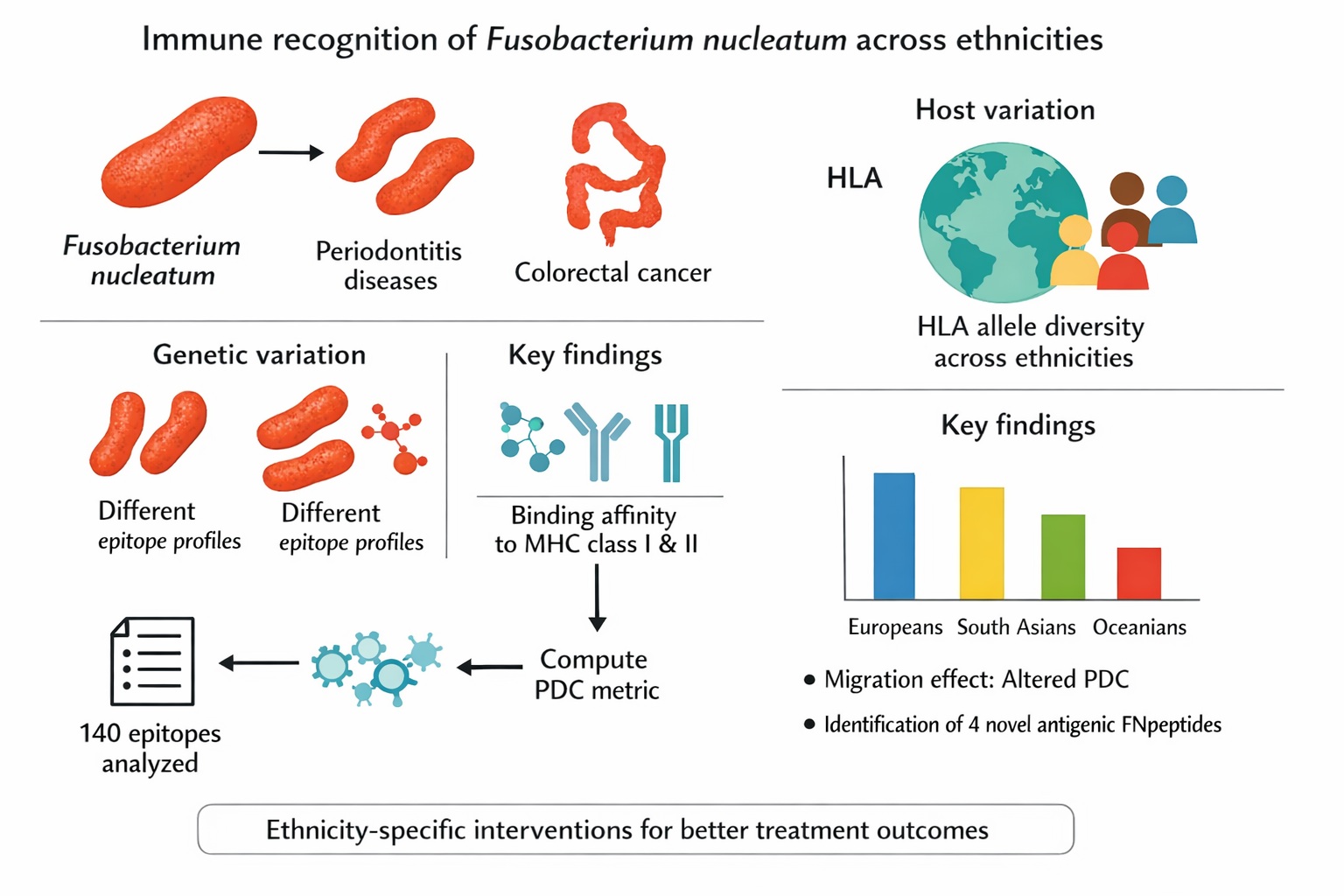
Fusobacterium nucleatum (FN) is an opportunistic pathogen associated with several diseases, including periodontitis, cardiovascular disease, and colorectal cancer. Owing to genetic variation, FN strains may display distinct epitope profiles to the host immune system. Likewise, the human leukocyte antigen allele repertoire is highly polymorphic and varies across ethnic groups. This study examines how these variations influence immune recognition of FN among different ethnicities and evaluates the potential for autoimmune responses arising from cross‑reactivity with the FN proteome. A set of 140 experimentally verified epitopes and their variants was analyzed for binding affinities to major histocompatibility complex Class‑I and Class‑II molecules. Using the prevalence of these molecules across ethnicities and their affinity for FN epitopes, a new metric—pathogen detection capacity (PDC)—was formulated. PDC enabled comparison of FN recognition across populations. Additionally, the FN proteome was assessed for similarity to human epitopes implicated in autoimmune disorders. Results showed that European, South Asian, and Amerindian populations had a greater potential to detect FN, whereas Oceanian groups exhibited comparatively lower PDC values. Within super‑populations, ethnicities that migrated from their ancestral homelands displayed altered PDC profiles relative to non‑migrating groups. The analysis also identified four previously unreported FN peptide fragments with potential antigenic properties. Overall, this study provides a foundational framework for understanding FN immunogenicity and its variation across ethnicities. The findings highlight that disease pathophysiology can differ meaningfully among populations and that ethnicity‑specific medical strategies may contribute to improved therapeutic outcomes.
- Crux NB, Elahi S. Human Leukocyte Antigen (HLA) and Immune Regulation: How Do Classical and Non-Classical HLA Alleles Modulate Immune Response to Human Immunodeficiency Virus and Hepatitis C Virus Infections? Front Immunol. 2017;8:832. doi: 10.3389/fimmu.2017.00832
- Medhasi S, Chantratita N. Human Leukocyte Antigen (HLA) System: Genetics and Association with Bacterial and Viral Infections. J Immunol Res. 2022;2022:9710376. doi: 10.1155/2022/9710376
- Bose T, Pant N, Pinna NK, Bhar S, Dutta A, Mande SS. Does immune recognition of SARS-CoV2 epitopes vary between different ethnic groups? Virus Res. 2021;305:198579. doi: 10.1016/j.virusres.2021.198579
- Yu MR, Kim HJ, Park HR. Fusobacterium nucleatum Accelerates the Progression of Colitis-Associated Colorectal Cancer by Promoting EMT. Cancers. 2020;12(10):2728. doi: 10.3390/cancers12102728
- Brennan CA, Garrett WS. Fusobacterium nucleatum — symbiont, opportunist and oncobacterium. Nat Rev Microbiol. 2019;17(3):156-166. doi: 10.1038/s41579-018-0129-6
- Mark Welch JL, Ramírez-Puebla ST, Borisy GG. Oral Microbiome Geography: Micron-Scale Habitat and Niche. Cell Host Microbe. 2020;28(2):160-168. doi: 10.1016/j.chom.2020.07.009
- Fan Z, Tang P, Li C, et al. Fusobacterium nucleatum and its associated systemic diseases: epidemiologic studies and possible mechanisms. J Oral Microbiol. 2023;15(1):2145729. doi: 10.1080/20002297.2022.2145729
- Ghosh A, Jaaback K, Boulton A, et al. Fusobacterium nucleatum: An Overview of Evidence, Demi-Decadal Trends, and Its Role in Adverse Pregnancy Outcomes and Various Gynecological Diseases, including Cancers. Cells. 2024;13(8):717. doi: 10.3390/cells13080717
- Han YW. Fusobacterium nucleatum: a commensal-turned pathogen. Curr Opin Microbiol. 2015;23:141-147. doi: 10.1016/j.mib.2014.11.013
- Yang C, Chowdhury D, Zhang Z, et al. A review of computational tools for generating metagenome-assembled genomes from metagenomic sequencing data. Comput Struct Biotechnol J. 2021;19:6301-6314. doi: 10.1016/j.csbj.2021.11.028
- Tang W, Li F, Zheng H, et al. Unveiling hidden players: the role of intratumoral microbiota in gastrointestinal cancer dynamics. J Cancer Res Clin Oncol. 2025;152(1):15. doi: 10.1007/s00432-025-06401-9
- Mehmood MS, Iqbal I, Hajj F. Intratumoral microbiota as prognostic biomarkers in gastrointestinal cancers. Ann Med Surg. 2025;87(12):9137-9138. doi: 10.1097/MS9.0000000000004144
- Ganesan K, Guo S, Fayyaz S, Zhang G, Xu B. Targeting Programmed Fusobacterium nucleatum Fap2 for Colorectal Cancer Therapy. Cancers. 2019;11(10):1592. doi: 10.3390/cancers11101592
- Mesa F, Mesa-López MJ, Egea-Valenzuela J, et al. A New Comorbidity in Periodontitis: Fusobacterium nucleatum and Colorectal Cancer. Medicina (Mex). 2022;58(4):546. doi: 10.3390/medicina58040546
- Ma X, Sun T, Zhou J, et al. Pangenomic Study of Fusobacterium nucleatum Reveals the Distribution of Pathogenic Genes and Functional Clusters at the Subspecies and Strain Levels. Microbiol Spectr. 2023;11(3):e0518422. doi: 10.1128/spectrum.05184-22
- Immune Epitope Database (IEDB): 2018 update. Nucleic Acids Res. 2018;47(D1):D339-D343. Available from: https://academic.oup.com/nar/article/47/D1/D339/5144151?login=false [Last accessed on 2025 Aug 21].
- Altschul SF, Gish W, Miller W, Myers EW, Lipman DJ. Basic local alignment search tool. J Mol Biol. 1990;215(3):403-410. doi: 10.1016/S0022-2836(05)80360-2
- Kuntal BK, Mande SS. Web-igloo: a web based platform for multivariate data visualization. Bioinformatics. 2017;33(4):615-617. doi: 10.1093/bioinformatics/btw669
- Zeddou M. Class I HLA Allele Predicted Restricted Antigenic Coverages for Fap2 Protein of Fusobacterium Nucleatum Are Associated with Colorectal Cancer Incidence. Asian Pac J Cancer Prev. 2023;24(10):3629-3636. doi: 10.31557/APJCP.2023.24.10.3629
- Zepeda-Rivera M, Minot SS, Bouzek H, et al. A distinct Fusobacterium nucleatum clade dominates the colorectal cancer niche. Nature. 2024;628(8007):424-432. doi: 10.1038/s41586-024-07182-w
- Sconocchia G, Eppenberger-Castori S, Zlobec I, et al. HLA class II antigen expression in colorectal carcinoma tumors as a favorable prognostic marker. Neoplasia. 2014;16(1):31-42. doi: 10.1593/neo.131568
- Loroña NC, Santiago-Torres M, Lopez-Pentecost M, et al. Traditional Mexican dietary pattern and cancer risk among women of Mexican descent. Cancer Causes Control. 2024;35(6):887-896. doi: 10.1007/s10552-024-01849-5
- Santiago-Torres M, Tinker LF, Allison MA, et al. Development and Use of a Traditional Mexican Diet Score in Relation to Systemic Inflammation and Insulin Resistance among Women of Mexican Descent. J Nutr. 2015;145(12):2732-2740. doi: 10.3945/jn.115.213538
- Cuellar-Gómez H, Ocharán-Hernández ME, Calzada-Mendoza CC, Comoto-Santacruz DA. Association of Fusobacterium nucleatum infection and colorectal cancer: A Mexican study. Rev Gastroenterol Méx Engl Ed. 2022;87(3):277-284. doi: 10.1016/j.rgmxen.2021.07.001
- Paredes J, Zabaleta J, Garai J, et al. Immune-Related Gene Expression and Cytokine Secretion Is Reduced Among African American Colon Cancer Patients. Front Oncol. 2020;10:1498. doi: 10.3389/fonc.2020.01498
- Lo CH, Blot WJ, Teras LR, et al. Prediagnostic Antibody Responses to Fusobacterium nucleatum Proteins Are Not Associated with Risk of Colorectal Cancer in a Large U.S. Consortium. Cancer Epidemiol Biomarkers Prev. 2021;30(6):1279-1282. doi: 10.1158/1055-9965.EPI-20-1471
- Hong M, Li Z, Liu H, et al. Fusobacterium nucleatum aggravates rheumatoid arthritis through FadA-containing outer membrane vesicles. Cell Host Microbe. 2023;31(5):798-810.e7. doi: 10.1016/j.chom.2023.03.018
- Dong L, Zheng Q, Cheng Y, et al. Gut Microbial Characteristics of Adult Patients With Epilepsy. Front Neurosci. 2022;16:803538. doi: 10.3389/fnins.2022.803538
- Lorente E, Redondo-Antón J, Martín-Esteban A, et al. Substantial Influence of ERAP2 on the HLA-B*40:02 Peptidome: Implications for HLA-B*27-Negative Ankylosing Spondylitis. Mol Cell Proteomics. 2019;18(11):2298-2309. doi: 10.1074/mcp.RA119.001710
- Weingarten-Gabbay S, Klaeger S, Sarkizova S, et al. Profiling SARS-CoV-2 HLA-I peptidome reveals T cell epitopes from out-of-frame ORFs. Cell. 2021;184(15):3962-3980.e17. doi: 10.1016/j.cell.2021.05.046
- Fujiwara K, Shao Y, Niu N, et al. Direct identification of HLA class I and class II-restricted T cell epitopes in pancreatic cancer tissues by mass spectrometry. J Hematol Oncol. 2022;15(1):154. doi: 10.1186/s13045-022-01373-6
- Marcu A, Bichmann L, Kuchenbecker L, et al. HLA Ligand Atlas: a benign reference of HLA-presented peptides to improve T-cell-based cancer immunotherapy. J Immunother Cancer. 2021;9(4):e002071. doi: 10.1136/jitc-2020-002071
- Henne K, Schilling H, Stoneking M, Conrads G, Horz HP. Sex-specific differences in the occurrence of Fusobacterium nucleatum subspecies and Fusobacterium periodonticum in the oral cavity. Oncotarget. 2018;9(29):20631-20639. doi: 10.18632/oncotarget.25042