
Inflammaging as a systems-level integrator of disease: Biological foundations of chronic low-grade inflammation

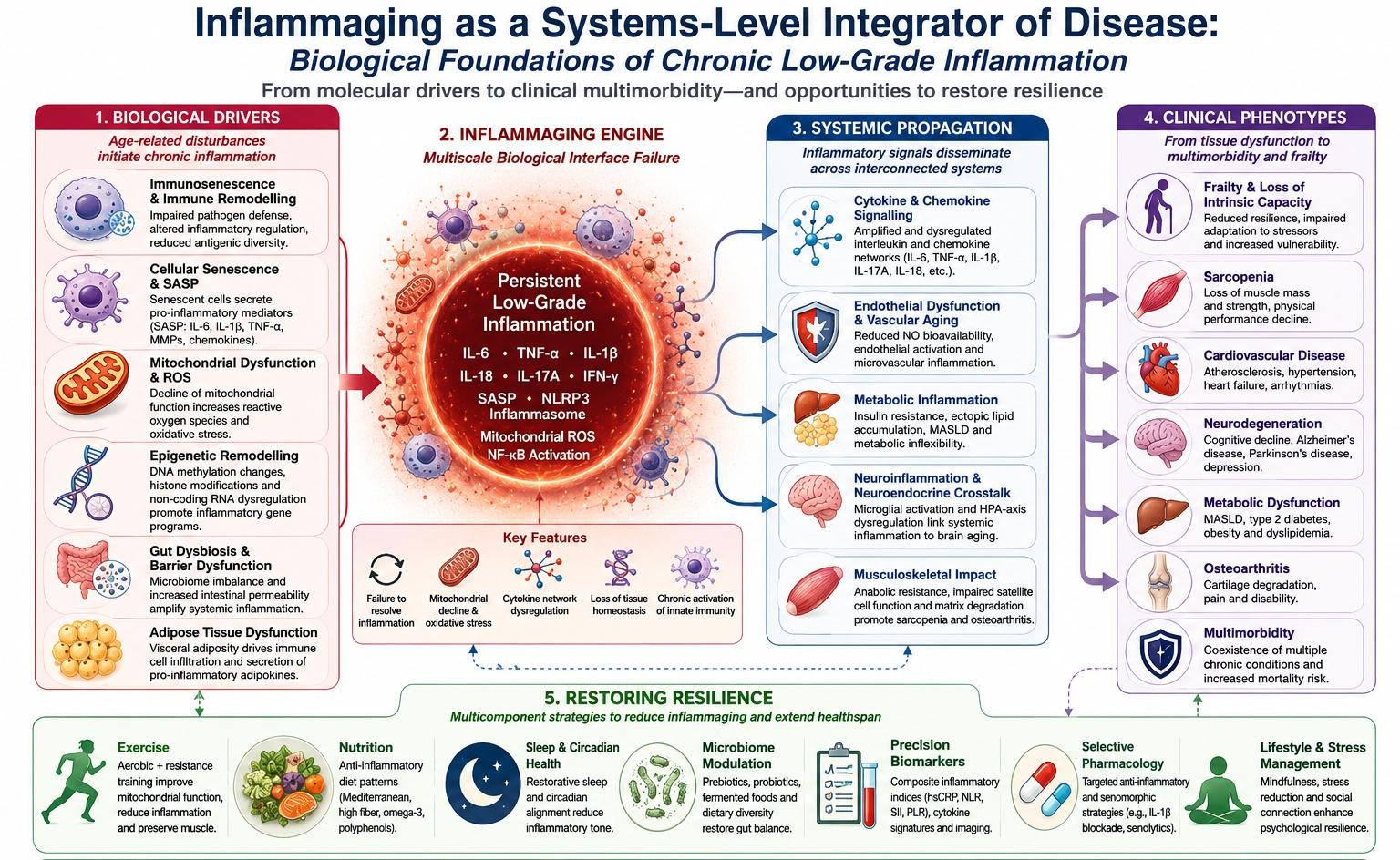
The concept of inflammaging—defined as the persistent, low-grade inflammatory state accompanying biological aging—has emerged as a unifying framework for understanding chronic disease in later life. Unlike acute inflammation, which is adaptive, transient, and protective, inflammaging reflects persistent dysregulation of immune signaling, impaired resolution of inflammatory responses, mitochondrial decline, and progressive loss of tissue homeostasis. Evidence increasingly indicates that inflammaging is not merely a consequence of aging but an active systems-level process that reshapes metabolic, vascular, neurological, and musculoskeletal physiology. Sustained inflammatory activation contributes to frailty, cardiovascular disease, neurodegeneration, sarcopenia, metabolic dysfunction, and osteoarthritis through interconnected molecular and cellular mechanisms involving immunosenescence, cellular senescence, oxidative stress, inflammasome activation, and epigenetic remodeling. Recent advances in geroscience have reframed inflammation as a multidirectional biological network integrating immune, endocrine, metabolic, microbiological, and biomechanical signals. This perspective moves beyond reductionist cytokine models by conceptualizing inflammation as a distributed regulatory architecture operating across tissues and organ systems. Accordingly, chronic disease may arise not only from local organ pathology but also from progressive failure of intersystem communication and adaptive resilience. This review examines the biological foundations of inflammaging, emphasizing immunosenescence, senescence-associated secretory pathways, mitochondrial dysfunction, inflammasome biology, cytokine network dynamics, and epigenetic regulation. We propose that inflammaging is best understood as multiscale biological interface failure, in which persistent inflammatory signaling progressively destabilizes tissue integration across physiological systems. This framework may support the development of more precise biomarkers, systems-oriented therapeutic strategies, and translational interventions designed to extend health span rather than merely prolong survival.
- Tylutka A, Walas Ł, Zembron-Lacny A. Level of IL-6, TNF, and IL-1β and age-related diseases: a systematic review and meta-analysis. Front Immunol. 2024;15:1330386. doi: 10.3389/fimmu.2024.1330386
- Herrero-Cervera A, Soehnlein O, Kenne E. Neutrophils in chronic inflammatory diseases. Cell Mol Immunol. 2022;19(2):177-191. doi: 10.1038/s41423-021-00832-3
- Kopp W. A shared stress-inflammation signalling architecture underlying chronic disease and multimorbidity. Front Immunol. 2026;17:1813984. doi: 10.3389/fimmu.2026.1813984
- Dong H, Shi Y, Ma Y, et al. Novel metabolic and inflammatory stratification of overweight/obesity to characterize risks of adverse outcomes: a large population-based cohort study. Diabetes Obes Metab. 2025;27(5):2613-2625. doi: 10.1111/dom.16262
- Xu Y, Liu X, Liu X, et al. The roles of the gut microbiota and chronic low-grade inflammation in older adults with frailty. Front Cell Infect Microbiol. 2021;11:675414. doi: 10.3389/fcimb.2021.675414
- Franceschi C, Garagnani P, Parini P, Giuliani C, Santoro A. Inflammaging: a new immune-metabolic viewpoint for age-related diseases. Nat Rev Endocrinol. 2018;14(10):576-590. doi: 10.1038/s41574-018-0059-4
- Zhang M, Wei J, Sun Y, et al. The efferocytosis process in aging: supporting evidence, mechanisms, and therapeutic prospects for age-related diseases. J Adv Res. 2025;69:31-49. doi: 10.1016/j.jare.2024.03.008
- Müller L, Di Benedetto S. Immunosenescence and inflammaging: mechanisms and modulation through diet and lifestyle. Front Immunol. 2025;16:1708280. doi: 10.3389/fimmu.2025.1708280
- Lu B, Huang L, Cao J, et al. Adipose tissue macrophages in aging-associated adipose tissue function. J Physiol Sci. 2021;71(1):38. doi: 10.1186/s12576-021-00820-2
- Sayed N, Huang Y, Nguyen K, et al. An inflammatory aging clock (iAge) based on deep learning tracks multimorbidity, immunosenescence, frailty and cardiovascular aging. Nat Aging. 2021;1(7):598-615. doi: 10.1038/s43587-021-00082-y
- Di Micco R, Krizhanovsky V, Baker D, d’Adda di Fagagna F. Cellular senescence in ageing: from mechanisms to therapeutic opportunities. Nat Rev Mol Cell Biol. 2021;22(2):75-95. doi: 10.1038/s41580-020-00314-w
- Saito Y, Yamamoto S, Chikenji TS. Role of cellular senescence in inflammation and regeneration. Inflamm Regen. 2024;44(1):28. doi: 10.1186/s41232-024-00342-5
- Furman D, Campisi J, Verdin E, et al. Chronic inflammation in the etiology of disease across the life span. Nat Med. 2019;25(12):1822-1832. doi: 10.1038/s41591-019-0675-0
- Laphanuwat P, Gomes DCO, Akbar AN. Senescent T cells: beneficial and detrimental roles. Immunol Rev. 2023;316(1):160-175. doi: 10.1111/imr.13206
- Zubova A, Pietrocola F, Morsli S. Immunological consequences of senescence in physiology and pathology. J Transl Med. 2026;24(1):747. doi: 10.1186/s12967-026-08335-3
- Zhang L, Pitcher LE, Yousefzadeh MJ, Niedernhofer LJ, Robbins PD, Zhu Y. Cellular senescence: a key therapeutic target in aging and diseases. J Clin Invest. 2022;132(15):e158450. doi: 10.1172/JCI158450
- Teissier T, Boulanger E, Cox LS. Interconnections between inflammaging and immunosenescence during aging. Cells. 2022;11(3):359. doi: 10.3390/cells11030359
- Lelarge V, Capelle R, Oger F, Mathieu T, Le Calvé B. Senolytics: from pharmacological inhibitors to immunotherapies, a promising future for patients’ treatment. npj Aging. 2024;10(1):12. doi: 10.1038/s41514-024-00138-4
- Ferrucci L, Fabbri E. Inflammageing: chronic inflammation in ageing, cardiovascular disease, and frailty. Nat Rev Cardiol. 2018;15(9):505-522. doi: 10.1038/s41569-018-0064-2
- Liu BH, Xu CZ, Liu Y, et al. Mitochondrial quality control in human health and disease. Mil Med Res. 2024;11(1):32. doi: 10.1186/s40779-024-00536-5
- Xu X, Pang Y, Fan X. Mitochondria in oxidative stress, inflammation and aging: from mechanisms to therapeutic advances. Signal Transduct Target Ther. 2025;10(1):190. doi: 10.1038/s41392-025-02253-4
- Zhu X, Chen Z, Shen W, et al. Inflammation, epigenetics, and metabolism converge to cell senescence and ageing: the regulation and intervention. Signal Transduct Target Ther. 2021;6(1):245. doi: 10.1038/s41392-021-00646-9
- Ramos-Lopez O, Milagro FI, Riezu-Boj JI, Martinez JA. Epigenetic signatures underlying inflammation: an interplay of nutrition, physical activity, metabolic diseases, and environmental factors for personalized nutrition. Inflamm Res. 2021;70(1):29-49. doi: 10.1007/s00011-020-01425-y
- Upadhyay P, Suhail A, Khanal P, Kumar S. Mechanistic insights and biomarker discovery in immune cell aging and age-associated diseases. Front Immunol. 2025;16:1637191. doi: 10.3389/fimmu.2025.1637191
- Rea IM, Gibson DS, McGilligan V, McNerlan SE, Alexander HD, Ross OA. Age and age-related diseases: role of inflammation triggers and cytokines. Front Immunol. 2018;9:586. doi: 10.3389/fimmu.2018.00586
- Li X, Li C, Zhang W, Wang Y, Qian P, Huang H. Inflammation and aging: signaling pathways and intervention therapies. Signal Transduct Target Ther. 2023;8(1):239. doi: 10.1038/s41392-023-01502-8
- Xia S, Zhang X, Zheng S, et al. An update on inflamm-aging: mechanisms, prevention, and treatment. J Immunol Res. 2016;2016:8426874. doi: 10.1155/2016/8426874
- Andonian BJ, Hippensteel JA, Abuabara K, et al. Inflammation and aging-related disease: a transdisciplinary inflammaging framework. Geroscience. 2024;47(1):515-542. doi: 10.1007/s11357-024-01364-0
- Sinke L, van Dongen J, Delerue T, et al. Epigenome-wide association study of circulating interleukin-6 connects DNA methylation to immunometabolic and inflammatory health. Commun Biol. 2026;9(1):242. doi: 10.1038/s42003-026-09520-2
- Jin Z, Chen Q, Zhou L, et al. Integrated metabolic and inflammatory clustering reveals distinct risk profiles for digestive diseases. Adv Sci. 2025;12(44):e11000. doi: 10.1002/advs.202511000
- Ou MY, Zhang H, Tan PC, Zhou SB, Li QF. Adipose tissue aging: mechanisms and therapeutic implications. Cell Death Dis. 2022;13(4):300. doi: 10.1038/s41419-022-04752-6
- Zhang YX, Ou MY, Yang ZH, Sun Y, Li QF, Zhou SB. Adipose tissue aging is regulated by an altered immune system. Front Immunol. 2023;14:1125395. doi: 10.3389/fimmu.2023.1125395
- Vamvakou G, Theodorakis N, Anagnostou D, et al. Obesity-related inflammatory biomarkers in the elderly population. Cells. 2025;14(21):1733. doi: 10.3390/cells14211733
- Saadati S, Godini R, Reddy A, Teede H, Mousa A. Metabolic crossroads in insulin resistance: exploring lipid dysregulation and inflammation. Front Immunol. 2025;16:1692742. doi: 10.3389/fimmu.2025.1692742
- Elsanhoury A, Nelki V, Kelle S, Van Linthout S, Tschöpe C. Epicardial fat expansion in diabetic and obese patients with heart failure and preserved ejection fraction-a specific HFpEF phenotype. Front Cardiovasc Med. 2021;8:720690. doi: 10.3389/fcvm.2021.720690
- Wang J, Yang R, Miao Y, et al. Metabolic dysfunction-associated steatotic liver disease is associated with accelerated brain ageing: a population-based study. Liver Int. 2025;45(6):e70109. doi: 10.1111/liv.70109
- Nie L, Zhao Y, Liu W, Zhou X, Xia Q. The liver-brain axis: a three-stage model linking MASLD to cognitive impairment and dementia. J Mol Neurosci. 2026;76(2):81. doi: 10.1007/s12031-026-02525-w
- Caldarelli M, Rio P, Marrone A, et al. Inflammaging: the next challenge-exploring the role of gut microbiota, environmental factors, and sex differences. Biomedicines. 2024;12(8):1716. doi: 10.3390/biomedicines12081716
- Gyriki D, Nikolaidis CG, Bezirtzoglou E, Voidarou C, Stavropoulou E, Tsigalou C. The gut microbiota and aging: interactions, implications, and interventions. Front Aging. 2025;6:1452917. doi: 10.3389/fragi.2025.1452917
- Nepal S, Shi N, Hoyd R, et al. Role of insulinemic and inflammatory dietary patterns on gut microbial composition and circulating biomarkers of metabolic health among older American men. Gut Microbes. 2025;17(1):2497400. doi: 10.1080/19490976.2025.2497400
- Cheng Y, Huang Y, Zhu Z, et al. Gut microbiota dysbiosis and systemic inflammation in elderly Chinese hypertensive patients: a case-control study. Front Immunol. 2025;16:1662578. doi: 10.3389/fimmu.2025.1662578
- Zhang N, Zhai L, Wong RMY, et al. Harnessing immunomodulation to combat sarcopenia: current insights and possible approaches. Immun Aging. 2024;21(1):55. doi: 10.1186/s12979-024-00458-9
- Morawin B, Białorudzki M, Nicikowski J, Tylutka A, Wawrzyniak-Gramacka E, Zembron-Lacny A. Association between dietary inflammatory index and sarcopenia development in Polish population. Sci Rep. 2025;15(1):44455. doi: 10.1038/s41598-025-28185-1
- Kim BJ, Lee SH, Kwak MK, Isales CM, Koh JM, Hamrick MW. Inverse relationship between serum hsCRP concentration and hand grip strength in older adults: a nationwide population-based study. Aging. 2018;10(8):2051-2061. doi: 10.18632/aging.101529
- Davenport A. The effect of low-grade inflammation on body composition in peritoneal dialysis patients. J Ren Nutr. 2025;35(6):787-794. doi: 10.1053/j.jrn.2025.06.005
- Cacciatore S, Calvani R, Prokopidis K, et al. Intrinsic capacity-frailty phenotypes and subclinical inflammation in community-dwelling octogenarians: a cross-sectional analysis from the ilSIRENTE study. Exp Gerontol. 2026;214:113026. doi: 10.1016/j.exger.2026.113026
- Pan Y, Ma L. Inflammatory markers associated with physical frailty and cognitive impairment. Aging Dis. 2024;16(2):859-875. doi: 10.14336/AD.2024.0258
- Miao Y, Wang J, Li X, et al. Poor sleep health is associated with older brain age: the role of systemic inflammation. eBioMedicine. 2025;120:105941. doi: 10.1016/j.ebiom.2025.105941
- Kim JW, Yoo SA, Choi Y, Jeong GH, Lee J, Joo J. Perioperative inflammatory cytokines in Parkinson’s disease. Biomolecules. 2026;16(2):261. doi: 10.3390/biom16020261
- Aid M, Boero-Teyssier V, McMahan K, et al. Long COVID involves activation of proinflammatory and immune exhaustion pathways. Nat Immunol. 2026;27(1):61-71. doi: 10.1038/s41590-025-02353-x
- Mohammadnia N, van Broekhoven A, Bax WA, et al. Interleukin-6 modifies lipoprotein(a) and oxidized phospholipids associated cardiovascular disease risk in a secondary prevention cohort. Atherosclerosis. 2025;405:119211. doi: 10.1016/j.atherosclerosis.2025.119211
- Kurniawan RB, Siahaan PP, Saputra PB, et al. Neutrophil-to-lymphocyte ratio as a prognostic biomarker in patients with peripheral artery disease: a systematic review and meta-analysis. Vasc Med. 2024;29(6):687-699. doi: 10.1177/1358863X241281699
- Peng X, Huo H, Zhao Z, et al. Impact of glucose metabolism on myocardial fibrosis and inflammation in hypertrophic cardiomyopathy: a cardiac MR study. Front Endocrinol. 2025;16:1653927. doi: 10.3389/fendo.2025.1653927
- Geraets AFJ, Köhler S, Schram MT. Vascular and metabolic risk factors of late-life depression. Vessel Plus. 2022;6:19. doi: 10.20517/2574-1209.2021.102
- Steens ILM, Schram MT, Houben AJHM, et al. Type 2 diabetes and depression via microvascular dysfunction, neurodegeneration, inflammation, advanced glycation end products (AGEs), and arterial stiffness. Diabetes Obes Metab. 2025;27(9):4847-4858. doi: 10.1111/dom.16527
- Mancinetti F, Labarile F, Bastiani P, et al. A novel sex-specific association between insulin resistance and depressive symptoms in older adults: the potential mediating role of vascular endothelial growth factor. J Affect Disord. 2025;382:194-200. doi: 10.1016/j.jad.2025.04.115
- Gernert M, Schmalzing M, Fröhlich M, et al. [18F]-FDG-PET/CT detects subclinical optic nerve inflammation in giant cell arteritis. Front Immunol. 2026;17:1802935. doi: 10.3389/fimmu.2026.1802935
- Liang Z, Zhang T, Liu H, et al. Inflammaging: the ground for sarcopenia? Exp Gerontol. 2022;168:111931. doi: 10.1016/j.exger.2022.111931
- Cheon SY, Song J. Novel insights into non-alcoholic fatty liver disease and dementia: insulin resistance, hyperammonemia, gut dysbiosis, vascular impairment, and inflammation. Cell Biosci. 2022;12(1):99. doi: 10.1186/s13578-022-00836-0
- Cąkała-Jakimowicz M, Domaszewska-Szostek A, Puzianowska-Kuźnicka M. A healthy lifestyle can slow immune system aging and reduce age-related chronic inflammation: a narrative review. Int J Mol Sci. 2026;27(12):5605. doi: 10.3390/ijms27125605
- Pérez-Castillo IM, Rueda R, Bouzamondo H, et al. Does lifelong exercise counteract low-grade inflammation associated with aging? A systematic review and meta-analysis. Sports Med. 2025;55(3):675-696. doi: 10.1007/s40279-024-02152-8
- Kim SD, Yeun YR. Effects of resistance training on C-reactive protein and inflammatory cytokines in elderly adults: a systematic review and meta-analysis of randomized controlled trials. Int J Environ Res Public Health. 2022;19(6):3434. doi: 10.3390/ijerph19063434
- Kunz HE, Lanza IR. Age-associated inflammation and implications for skeletal muscle responses to exercise. Exp Gerontol. 2023;177:112177. doi: 10.1016/j.exger.2023.112177
- Flensted-Jensen M, Weinreich CM, Kleis-Olsen AS, et al. Effects of resistance-based training and polyphenol supplementation on physical function, metabolism, and inflammation in aging individuals. Geroscience. 2025;48(2):2945-2968. doi: 10.1007/s11357-025-01839-8
- Hernández-Lepe MA, Ortiz-Ortiz M, Hernández-Ontiveros DA, Mejía-Rangel MJ. Inflammatory profile of older adults in response to physical activity and diet supplementation: a systematic review. Int J Environ Res Public Health. 2023;20(5):4111. doi: 10.3390/ijerph20054111
- Prokopidis K, Mazidi M, Sankaranarayanan R, Tajik B, McArdle A, Isanejad M. Effects of whey and soy protein supplementation on inflammatory cytokines in older adults: a systematic review and meta-analysis. Br J Nutr. 2023;129(5):759-770. doi: 10.1017/S0007114522001787
- Cunningham A, Gomes A, Meng L, Shapses S, Byham-Gray L, Samavat H. Effects of green tea extract supplementation on inflammatory cytokines among postmenopausal women with overweight or obesity-a secondary analysis of a randomized controlled trial. Nutrients. 2026;18(1):143. doi: 10.3390/nu18010143
- Xu P, Zhu H, Zhou R, et al. Beneficial effects of Huanglian Jiedu decoction on metabolic syndrome: a prospective randomized controlled clinical trial. J Tradit Chin Med. 2026;46(2):411-417. doi: 10.19852/j.cnki.jtcm.2026.02.013
- Lazou-Ahrén I, Björklund M, Molin G, et al. Probiotic-reduced inflammaging in older adults: a randomized, double-blind, placebo-controlled trial. Probiotics Antimicrob Proteins. 2025;17(5):3429-3439. doi: 10.1007/s12602-024-10310-7
- Müller A, Kob R, Sieber CC, Freiberger E, Rohleder N, Britting S. Relationship between stress systems and inflammation in older adults concerned about falling -findings from the FEARFALL study. Exp Gerontol. 2025;211:112899. doi: 10.1016/j.exger.2025.112899
- Gong H, Su WJ, Deng SL, et al. Anti-inflammatory interventions for the treatment and prevention of depression among older adults: a systematic review and meta-analysis. Transl Psychiatry. 2025;15(1):114. doi: 10.1038/s41398-025-03317-3
- Martinez-Lemus JD, Molony DA, Suescun J, et al. Allogeneic bone marrow-derived mesenchymal stem cells in the aging kidney: secondary results of a Parkinson’s disease clinical trial. Stem Cell Res Ther. 2025;16(1):493. doi: 10.1186/s13287-025-04577-y
- Adibi S. A conceptual digital health framework for longevity optimization: inflammation-centered approach integrating microbiome and lifestyle data—a review and proposed platform. Nutrients. 2026;18(2):231. doi: 10.3390/nu18020231
- López-Otín C, Kroemer G. Hallmarks of health. Cell. 2021;184(1):33-63. doi: 10.1016/j.cell.2020.11.034
- Cummings SR, Kritchevsky SB. Endpoints for geroscience clinical trials: health outcomes, biomarkers, and biologic age. Geroscience. 2022;44(6):2925-2931. doi: 10.1007/s11357-022-00671-8
- Saarela L, Lehtisalo J, Ngandu T, et al. Effects of multidomain lifestyle intervention on frailty among older men and women -a secondary analysis of a randomized clinical trial. Ann Med. 2025;57(1):2446699. doi: 10.1080/07853890.2024.2446699
- Pan Y, Ma L. Inflammatory markers and physical frailty: towards clinical application. Immun Aging. 2024;21(1):4. doi: 10.1186/s12979-023-00410-3
- Karpuzoglu E, Holladay SD, Gogal RM Jr. Inflammaging: triggers, molecular mechanisms, immunological consequences, sex differences, and cutaneous manifestations. Front Immunol. 2025;16:1704203. doi: 10.3389/fimmu.2025.1704203