
Antibacterial emulsion based on methyl cellulose and lavender essential oil: Rheology and drug release kinetics

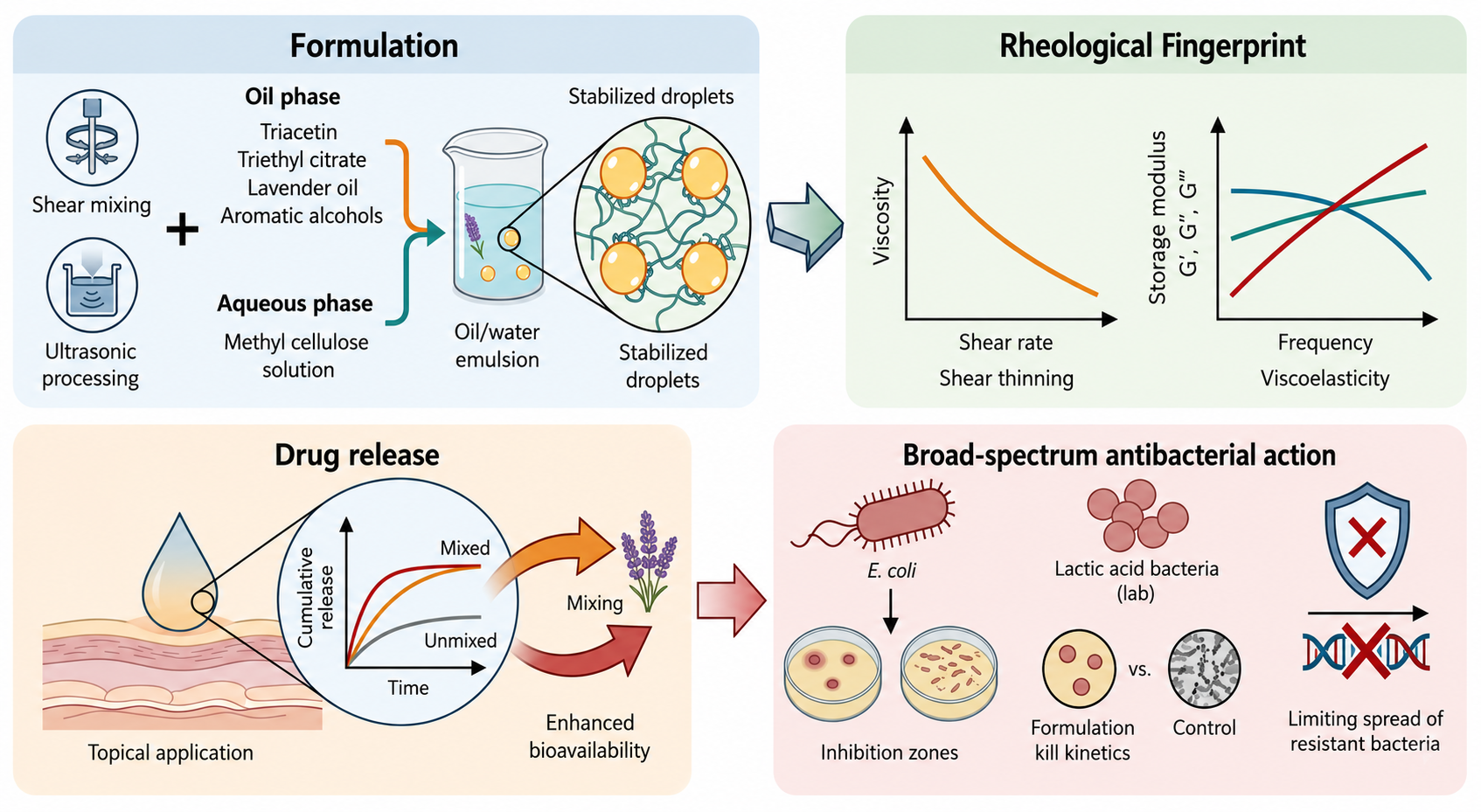
Topical antibacterial emulsions require optimized formulation strategies to maximize drug release, bioavailability, and antimicrobial efficacy while maintaining desirable rheological properties. This study presents the formulation and characterization of an antibacterial emulsion comprising methyl cellulose, triacetin, triethyl citrate, and a synergistic blend of benzyl alcohol, phenylethanol, and lavender essential oil, designed for topical drug delivery. Emulsions were prepared by shear mixing and ultrasonic processing and evaluated for rheological behavior, essential oil release kinetics, and antimicrobial efficacy. Mechanical mixing physically disrupts macromolecular matrix entanglements, accelerating the dispersion of essential oils and significantly enhancing active terpene bioavailability, thereby driving rapid bactericidal kinetics. Viscoelastic and shear-thinning properties were modeled using Maxwell, Cross, and Herschel–Bulkley frameworks incorporating thixotropic considerations, revealing a yield stress of 8 Pa and strong structural recovery behavior. Ultraviolet–Visible spectrophotometry-based drug release studies demonstrated that shear mixing significantly enhanced essential oil release rates, with the Weibull model providing the best fit to the release profiles. Antibacterial testing against Escherichia coli and ten genetically diverse strains of lactic acid bacteria showed that aromatic alcohol-containing formulations significantly reduced minimum inhibitory concentration and minimum bactericidal concentration values, confirming synergistic antibacterial action. Optical density monitoring and bacterial viability modeling revealed substantially improved bactericidal activity under mixing conditions, attributed to enhanced dispersion and bioavailability of the essential oil. These results demonstrate that the formulation method plays a decisive role in both physical and antimicrobial performance, supporting the potential of these emulsions for treating skin infections and limiting the spread of antibiotic-resistant bacteria.
- Qu F, Geng R, Liu Y, Zhu J. Advanced nanocarrier- and microneedle-based transdermal drug delivery strategies for skin diseases treatment. Theranostics. 2022;12(7):3372-3406. doi: 10.7150/thno.69999
- Yukuyama MN, Kato ET, Lobenberg R, Bou-Chacra N. Challenges and future prospects of nanoemulsion as a drug delivery system. Curr Pharm Des. 2017;23(3):495-508. doi: 10.2174/1381612822666161027111957
- Charman SA, Charman WN, Rogge MC, Wilson DT, Dutko FJ, Pouton CW. Self-emulsifying drug delivery systems: formulation and biopharmaceutic evaluation of an investigational lipophilic compound. Pharm Res. 1992;9(1):87-93. doi: 10.1023/A:1018987928936
- Rodriguez J, Martín MJ, Ruiz MJG, Clares B. Current encapsulation strategies for bioactive oils: from alimentary to pharmaceutical perspectives. Food Res Int. 2016;83:41-59. doi: 10.1016/j.foodres.2016.01.032
- Stefanov SR, Andonova VY. Lipid nanoparticulate drug delivery systems: recent advances in the treatment of skin disorders. Pharmaceuticals. 2021;14(11):1083. doi: 10.3390/ph14111083
- Jeong WY, Kwon M, Choi HE, Kim KS. Recent advances in transdermal drug delivery systems: a review. Biomater Res. 2021;25(1):24. doi: 10.1186/s40824-021-00226-6
- Raina N, Rani R, Thakur VK, Gupta M. New insights in topical drug delivery for skin disorders: from a nanotechnological perspective. ACS Omega. 2023;8(22):19145-19167. doi: 10.1021/acsomega.2c08016
- Opatha SAT, Titapiwatanakun V, Chutoprapat R. Transfersomes: a promising nanoencapsulation technique for transdermal drug delivery. Pharmaceutics. 2020;12(9):855. doi: 10.3390/pharmaceutics12090855
- Tran M, Wang C. Semi-solid materials for controlled release drug formulation: current status and future prospects. Front Chem Sci Eng. 2014;8(2):225-232. doi: 10.1007/s11705-014-1429-7
- Zhang H, Pan Y, Hou Y, Li M, Deng J, Wang B, Hao S. Smart physical-based transdermal drug delivery system: towards intelligence and controlled release. Small. 2024;20(9):e2306944. doi: 10.1002/smll.202306944
- Bushi E, Malaj L, Di Martino P, Mataj G, Myftari B. Formulation of semi solid dosage forms for topical application utilizing quality by design (QbD) approach. Drug Dev Ind Pharm. 2025;51(7):670-678. doi: 10.1080/03639045.2025.2498521
- Papadopoulou V, Kosmidis K, Vlachou M, Macheras P. On the use of the Weibull function for the discernment of drug release mechanisms. Int J Pharm. 2006;309(1-2):44-50. doi: 10.1016/j.ijpharm.2005.10.044
- Kosmidis K, Argyrakis P, Macheras P. A reappraisal of drug release laws using Monte Carlo simulations: the prevalence of the Weibull function. Pharm Res. 2003;20(7):988-995. doi: 10.1023/A:1024497920145
- Corsaro C, Neri G, Mezzasalma MAM, Fazio E. Weibull modeling of controlled drug release from Ag-PMA nanosystems. Polymers. 2021;13(17):2897. doi: 10.3390/polym13172897
- Chaves CRS, Salamandane A, Vieira EJF, Salamandane C. Antibiotic resistance in fermented foods chain: evaluating the risks of emergence of enterococci as an emerging pathogen in raw milk cheese. Int J Microbiol. 2024;2024(1):2409270. doi: 10.1155/ijm/2409270
- Nawaz M, Wang J, Zhou A, Ma C, Ma C, Wu X, Moore J, Millar BC, Xu J. Characterization and transfer of antibiotic resistance in lactic acid bacteria from fermented food products. Curr Microbiol. 2011;62(3):1081-1089. doi: 10.1007/s00284-010-9856-2
- Floris I, Battistini R, Tramuta C, Garcia-Vozmediano A, Musolino N, Scardino G, Masotti C, Brusa B, Orusa R, Serracca L, et al. Antibiotic resistance in lactic acid bacteria from dairy products in Northern Italy. Antibiotics. 2025;14(4):375. doi: 10.3390/antibiotics14040375
- Jian Z, Zeng L, Xu T, Sun S, Yan S, Yang L, Huang Y, Jia J, Dou T. Antibiotic resistance genes in bacteria: occurrence, spread, and control. J Basic Microbiol. 2021;61(12):1049-1070. doi: 10.1002/jobm.202100201
- Anisimova E, Yarullina D. Antibiotic resistance of Lactobacillus strains. Curr Microbiol. 2019;76(12):1407-1416. doi: 10.1007/s00284-019-01769-7
- Yusupova U, Tojiboeva D, Mukhamatkhanova R, Dusmatova D. Essential oils as an alternative to synthetic antiseptics in cosmetics and personal care products. Chem Biodivers. 2026;23(1):e03449. doi: 10.1002/cbdv.202503449
- Wells R, Truong F, Adal AM, Sarker LS, Mahmoud SS. Lavandula essential oils: a current review of applications in medicinal, food, and cosmetic industries of lavender. Nat Prod Commun. 2018;13(10). doi: 10.1177/1934578X1801301038
- Samuelson R, Lobl M, Higgins S, Clarey D, Wysong A. The effects of lavender essential oil on wound healing: a review of the current evidence. J Altern Complement Med. 2020;26(8):680-690. doi: 10.1089/acm.2019.0286
- Zuzarte M, Gonçalves M, Cavaleiro C, Canhoto J, Vale-Silva L, Silva M, Pinto E, Salgueiro L. Chemical composition and antifungal activity of the essential oils of Lavandula viridis from Portugal. J Med Microbiol. 2011;60(5):612-618. doi: 10.1099/jmm.0.027748-0
- Garcia CR, Malik MH, Biswas S, Tam VH, Rumbaugh KP, Li W, Liu X. Nanoemulsion delivery systems for enhanced efficacy of antimicrobials and essential oils. Biomater Sci. 2022;10(3):633-653. doi: 10.1039/D1BM01537K
- Bakkali F, Averbeck S, Averbeck D, Idaomar M. Biological effects of essential oils: a review. Food Chem Toxicol. 2008;46(2):446-475. doi: 10.1016/j.fct.2007.09.106
- Nunziata L, Brasca M, Morandi S, Silvetti T. Antibiotic resistance in wild and commercial non-enterococcal lactic acid bacteria and bifidobacteria strains of dairy origin: an update. Food Microbiol. 2022;104:103999. doi: 10.1016/j.fm.2022.103999
- Botina SG, Poluektova E, Glazova A, Zakharevich NV, Koroban N, Zinchenko V, Babykin M, Zhilenkova O, Amerkhanova A, et al. Antibiotic resistance of potential probiotic bacteria of the genus Lactobacillus from human gastrointestinal microbiome. Microbiology. 2011;80(2):164-171. doi: 10.1134/S0026261711020032
- Toomey N, Monaghan A, Fanning S, Bolton D. Transfer of antibiotic resistance marker genes between lactic acid bacteria in model rumen and plant environments. Appl Environ Microbiol. 2009;75(10):3146-3152. doi: 10.1128/AEM.02471-08
- Gad GF, Abdel-Hamid AM, Farag ZS. Antibiotic resistance in lactic acid bacteria isolated from some pharmaceutical and dairy products. Braz J Microbiol. 2014;45(1):25-33. doi: 10.1590/S1517-83822014000100005
- Samtiya M, Matthews KR, Dhewa T, Puniya AK. Antimicrobial resistance in the food chain: trends, mechanisms, pathways, and possible regulation strategies. Foods. 2022;11(19):2966. doi: 10.3390/foods11192966
- Tadros TF. Emulsion formation, stability, and rheology. In: Emulsion Formation and Stability. Wiley; 2013:1-75. doi: 10.1002/9783527647941.ch1
- Wu X, Xue H, Bordia G, Fink Z, Kim PY, Streubel R, Han J, Helms BA, Ashby PD, Omar AK, Russell TP. Self-propulsion by directed explosive emulsification. Adv Mater. 2024;36(19):2310435. doi: 10.1002/adma.202310435
- Forgiarini A, Esquena J, González C, Solans C. Formation of nano-emulsions by low-energy emulsification methods at constant temperature. Langmuir. 2001;17(7):2076-2083. doi: 10.1021/LA001362N
- Dabbaghi M, Namjoshi S, Panchal B, Grice J, Prakash S, Roberts M, Mohammed YH. Viscoelastic and deformation characteristics of structurally different commercial topical systems. Pharmaceutics. 2021;13(9):1351. doi: 10.3390/pharmaceutics13091351
- Herbig ME, Evers DH, Gorissen S, Köllmer M. Rational design of topical semi-solid dosage forms—how far are we? Pharmaceutics. 2023;15(7):1822. doi: 10.3390/pharmaceutics15071822
- Salim N, Ahmad N, Musa SH, Hashim R, Tadros TF, Basri M. Nanoemulsion as a topical delivery system of antipsoriatic drugs. RSC Adv. 2016;6(8):6234-6250. doi: 10.1039/C5RA14946K
- McClements DJ. Food Emulsions: Principles, Practices, and Techniques. 2nd ed. CRC Press; 2004. doi: 10.1201/9781420039436
- Walstra P. Physical Chemistry of Foods. CRC Press; 2001. doi: 10.1201/9780203910436
- Karasulu HY. Microemulsions as novel drug carriers: the formation, stability, applications and toxicity. Expert Opin Drug Deliv. 2008;5(1):119-135. doi: 10.1517/17425247.5.1.119
- Villay A, De Filippis F, Picton L, Cerf D, Vial C, Michaud P. Comparison of polysaccharide degradations by dynamic high-pressure homogenization. Food Hydrocoll. 2012;27(2):278-286. doi: 10.1016/J.FOODHYD.2011.10.003
- Qayum A, Rashid A, Liang Q, Wu Y, Cheng Y, Kang L, Liu Y, Zhou C, Hussain M, Ren X, et al. Ultrasonic and homogenization: an overview of the preparation of an edible protein–polysaccharide complex emulsion. Compr Rev Food Sci Food Saf. 2023;22(6):4242-4281. doi: 10.1111/1541-4337.13221
- Kumbhar P, Desai H, Desai V, Priya S, Rana V, Singhvi G. Versatility of emulgel in topical drug delivery: transforming its expedition from bench to bedside. Expert Opin Drug Deliv. 2025;22(1):55-68. doi: 10.1080/17425247.2024.2439457
- Ojha B, Jain VK, Gupta S, Talegaonkar S, Jain K. Nanoemulgel: a promising novel formulation for treatment of skin ailments. Polym Bull. 2021;79(7):4441-4465. doi: 10.1007/s00289-021-03729-3
- Ciocarlan A, Lupascu L, Aricu A, Dragalin I, Popescu V, Geană E, Ionete R, Vornicu N, Duliu O, Hristozova G, et al. Chemical composition and assessment of antimicrobial activity of lavender essential oil and some by-products. Plants. 2021;10(9):1829. doi: 10.3390/plants10091829
- Manjanna KM, Gouda BV, Tanusha AS, Ankita S, Anusha H, Arpita J. Formulation and evaluation of capsaicin transemulgel for the treatment of arthritis. J Drug Deliv Ther. 2025;15(1):73-83. doi: 10.22270/jddt.v15i1.6946
- Bayer IS. Fungal quorum sensing molecules as potential drugs in the treatment of chronic wounds and their delivery. Expert Opin Drug Deliv. 2025;22(2):277-296. doi: 10.1080/17425247.2025.2452303
- Sulaiman M , Hassan Y, Tok T, Noundou X. Synthesis, antibacterial activity and docking studies of benzyl alcohol derivatives. J Turk Chem Soc Sect A Chem. 2020;7(2):481-488. doi: 10.18596/jotcsa.692113
- Singh Y, Meher J, Raval K, Khan FA, Chaurasia M, Jain N, Chourasia MK. Nanoemulsion: concepts, development and applications in drug delivery. J Control Release. 2017;252:28-49. doi: 10.1016/j.jconrel.2017.03.008
- Askarizadeh M, Esfandiari N, Honarvar B, Sajadian SA, Azdarpour A. Kinetic modeling to explain the release of medicine from drug delivery systems. ChemBioEng Rev. 2023;10(6):1006-1049. doi: 10.1002/cben.202300027
- Moser K, Kriwet K, Naik A, Kalia YN, Guy RH. Passive skin penetration enhancement and its quantification in vitro. Eur J Pharm Biopharm. 2001;52(2):103-112. doi: 10.1016/S0939-6411(01)00166-7
- Setti C, Suarato G, Perotto G, Athanassiou A, Bayer IS. Investigation of in vitro hydrophilic and hydrophobic dual drug release from polymeric films produced by sodium alginate–MaterBi drying emulsions. Eur J Pharm Biopharm. 2018;130:71-82. doi: 10.1016/j.ejpb.2018.06.019
- Ignacio M, Chubynsky MV, Slater GW. Interpreting the Weibull fitting parameters for diffusion-controlled release data. Physica A. 2017;486:486-496. doi: 10.1016/j.physa.2017.05.033
- Cavanagh H, Wilkinson J. Biological activities of lavender essential oil. Phytother Res. 2002;16(4):301-308. doi: 10.1002/ptr.1103
- Peleg M. Advanced Quantitative Microbiology for Foods and Biosystems: Models for Predicting Growth and Inactivation. CRC Press; 2006. doi: 10.1201/9781420005370
- Geeraerd AH, Valdramidis VP, Van Impe JF. GInaFiT, a freeware tool to assess non-log-linear microbial survivor curves. Int J Food Microbiol. 2005;102(1):95-105. doi: 10.1016/j.ijfoodmicro.2004.11.038
- Whiting RC. Microbial modeling in foods. Crit Rev Food Sci Nutr. 1995;35(6):467-494. doi: 10.1080/10408399509527711
- Virtanen P, Gommers R, Oliphant TE, Haberland M, Reddy T, Cournapeau D, Burovski E, Peterson P, Weckesser W, Bright J, et al. SciPy 1.0: fundamental algorithms for scientific computing in Python. Nat Methods. 2020;17(3):261-272. doi: 10.1038/s41592-019-0686-2
- Wax RG, Lewis K, Salyers AA, Taber H. Bacterial Resistance to Antimicrobials. 2nd ed. CRC Press; 2007. doi: 10.1201/9781420008753
- Mouton JW, Vinks AA. Pharmacokinetic/pharmacodynamic modelling of antibacterials in vitro and in vivo using bacterial growth and kill kinetics. Clin Pharmacokinet. 2005;44(2):201-210. doi: 10.2165/00003088-200544020-00005
- Choi SJ, Decker EA, Henson L, Popplewell LM, McClements DJ. Stability of citral in oil-in-water emulsions prepared with medium-chain triacylglycerols and triacetin. J Agric Food Chem. 2009;57(23):11349-11353. doi: 10.1021/jf902761h
- Givaudan SA. Flavour composition. Patent WO2015185553A1. Published December 10, 2015. https://patents.google.com/patent/WO2015185553A1/en
- T Hasegawa Co Ltd. Triacetin-mixed oil-in-water type emulsion composition. Patent JP2011045316A. Published March 10, 2011. https://patents.google.com/patent/JP2011045316A/en