

Department of Mathematics, Balikesir University, Balikesir, TurkeyNonlinear Programming; Mathematical Programming; Numerical Optimization; Mathematical Modelling; Differential Equations; Fractional; Differential Equations; Stability Analysis; Optimal Control; Mathematical Biology

Department of the Industrial Engineering, Balikesir University, Balikesir, TurkeyJava Programming; MATLAB; Production; Operations Management; Artificial Intelligence; Algorithms; Optimization; Logistics; Simulation; Production Planning

WMG, University of Warwick, Coventry, United KingdomDigital and Sustainable Manufacturing; Industry 4.0/5.0; Manufacturing Systems Modelling and Optimisation; Simulation; Resilient and Sustainable Production Systems; Digital Transformation; Technology Adoption in Manufacturing Organizations

Aim & Scope
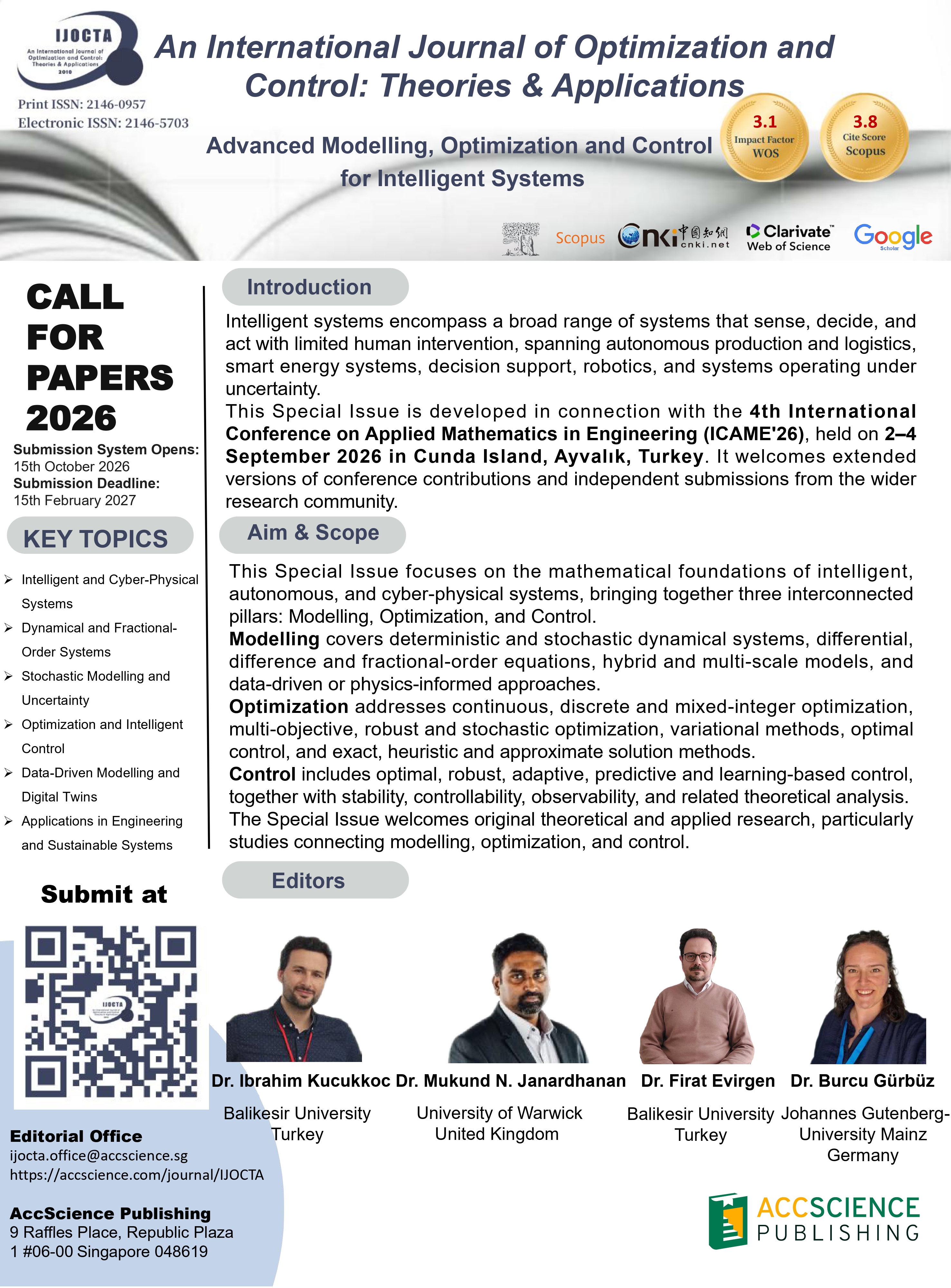
The term intelligent systems covers a broad class of systems that sense their environment, decide and act with limited human intervention. Such systems arise wherever decisions are delegated to a model: adaptive production and logistics networks, self-managing energy and water systems, algorithmic decision support in health and finance, and engineered systems operating under uncertainty, as well as robotic and unmanned platforms.
This special issue is built around three interacting pillars. Modelling concerns the construction and analysis of the underlying descriptions: deterministic and stochastic dynamical systems, differential, difference and fractional-order equations, hybrid and multi-scale formulations, and data-driven or physics-informed alternatives. Optimization concerns decision making over these models: continuous, discrete and mixed-integer formulations, multi-objective, robust and stochastic programming, variational and optimal control problems, and exact, heuristic or approximate solution methods. Control concerns the feedback mechanisms that realize the decisions: optimal, robust, adaptive, predictive and learning-based control, together with the associated questions of stability, controllability, observability and well-posedness.
We invite original research that advances any of these pillars, and particularly work that connects them — for instance, analysis of a model that reveals the structure of the associated optimization problem, control schemes derived from optimization principles, or learning components embedded in a model-based framework with provable guarantees. Both rigorous theoretical contributions and methodologically sound applications in engineering and applied sciences are welcome. Application-oriented papers are expected to make their mathematical formulation and solution approach explicit.
The issue follows the scientific scope of the 4th International Conference on Applied Mathematics in Engineering (ICAME'26, 2-4 September 2026, Cunda Island, Ayvalık, Türkiye) and is open to extended versions of works presented at the conference as well as to independent submissions from the wider research community.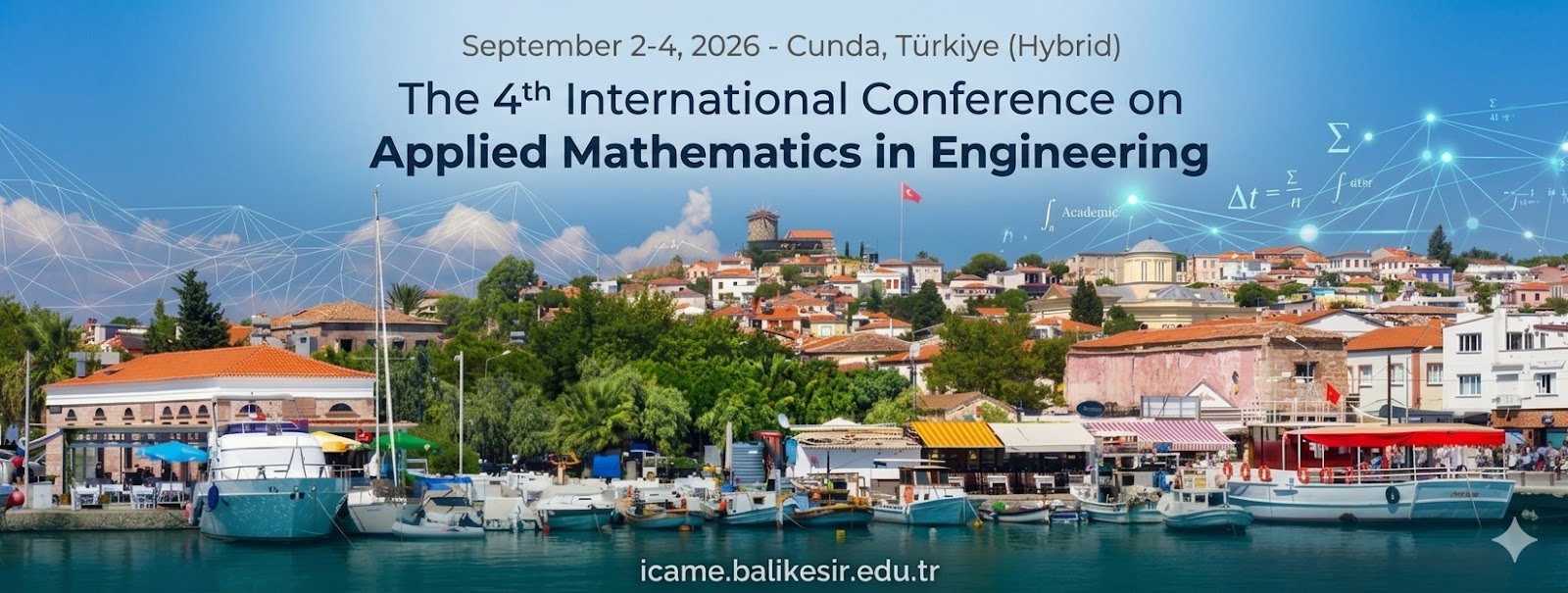
Topics of interest (include, but are not limited to):
- Mathematical modelling of intelligent, autonomous and cyber-physical systems
- Dynamical systems, stability analysis, bifurcation and chaos in autonomous behaviour
- Fractional calculus and fractional-order modelling and control
- Stochastic modelling, uncertainty quantification and risk-aware decision making
- Optimal control theory, variational methods and the calculus of variations
- Optimal control strategies in epidemiological and biomedical models (e.g., treatment, vaccination, and quarantine policies in compartmental disease models)
- Model predictive, robust, adaptive and learning-based control
- Continuous, discrete and mixed-integer optimization for autonomous decision making
- Multi-objective, robust and stochastic optimization; metaheuristic and matheuristic methods
- Operational research models for scheduling, routing, assignment and resource allocation
- Game-theoretic, multi-agent and distributed decision models
- Data-driven, hybrid and physics-informed modelling; digital twins and simulation-based analysis
- Numerical methods, computational aspects and algorithmic performance analysis
- Modelling and optimization of energy, environmental and sustainable systems
- Applications in manufacturing, logistics, transportation, health, biological and financial systems
- Safety, fault detection, resilience and verification of model-based autonomous decisions
- Case studies and benchmark problems with explicit mathematical formulations
All submissions will go through a standard peer-reviewing process. The authors must prepare their manuscript strictly following the Instructions for Authors given on the journal’s website (https://accscience.com/journal/IJOCTA/instructions).
Important Dates:
Submission System Opens: 15th October 2026
Submission Deadline: 15th February 2027
First Round of Revisions: 30th May 2027
Final Decision: 30th July 2027