
Numerical simulation and neural-network approximation for solving impulsive stochastic delay equations

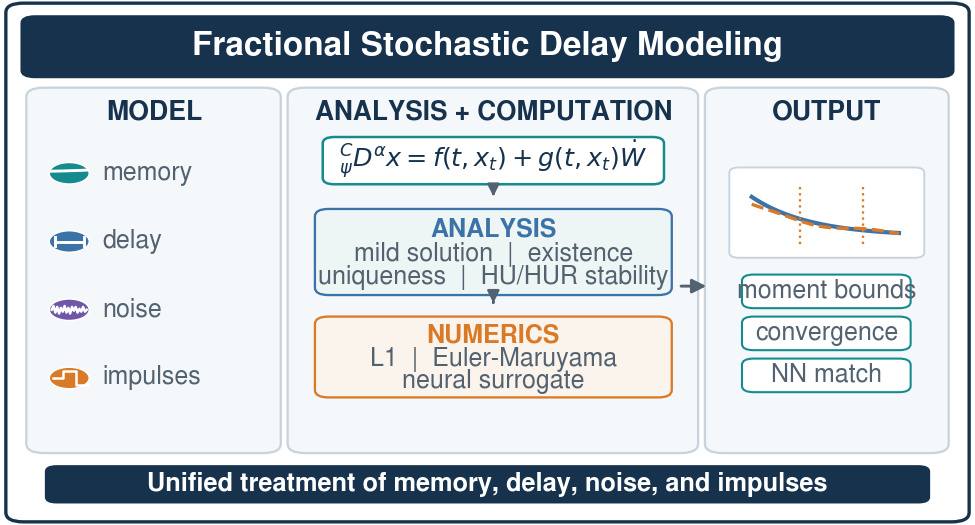
This study investigates random impulsive stochastic functional differential equations with finite delay using the ψ-Caputo operator. The stochastic basis is specified through an enlarged filtration that contains the impulse variables and preserves the Wiener property, and solutions are formulated in a piecewise-continuous Lp path space. Under Lipschitz, growth, compact-range, and random-impulse conditions, Krasnoselskii's theorem establishes existence; uniqueness follows from a constructive local-partition rule. The analysis also gives a finite-time moment estimate, continuous dependence on the initial history, mean pth-moment Hyers–Ulam stability, and Hyers–Ulam–Rassias stability with explicit admissible weight functions. The computational section develops a ψ-Caputo L1 discretization, a fractional Euler–Maruyama update, one-sided delay interpolation, graded meshes for the initial singularity, and a stochastic residual-based neural surrogate. Numerical tests report uniform-versus-graded convergence, strong and weak Monte Carlo diagnostics, delay-interpolation sensitivity, impulse effects, and neural approximations of the empirical mean and second moment.
- Ulam SM. A Collection of Mathematical Problems. Interscience; 1968. Accessed November 19, 2026. https://books.google.com/books?id=YUr8dD7YKhUC
- Hyers D. On the stability of the linear functional equation. Proc Natl Acad Sci U S A. 1941;27:222–224. https://doi.org/10.1073/pnas.27.4.222
- Aoki T. On the stability of the linear transformation in Banach spaces. J Math Soc Japan. 1950;2:64–66. https://doi.org/10.2969/jmsj/00210064
- Bourgin D. Classes of transformations and bordering transformations. Bull Am Math Soc. 1951;57:223–238. https://doi.org/10.1090/S0002-9904-1951-09511-7
- Rassias TM. On the stability of the linear mapping in Banach spaces. Proc Am Math Soc. 1978;72:297–300. https://doi.org/10.1090/S0002-9939-1978-0507327-1
- Wang J, Fečkan M, Zhou Y. Ulam's type stability of impulsive ordinary differential equations. J Math Anal Appl. 2012;395:258–264. https://doi.org/10.1016/j.jmaa.2012.05.040
- Zhao X. Mean square Hyers-Ulam stability of stochastic differential equations driven by Brownian motion. Adv Differ Equ. 2016;2016:271. https://doi.org/10.1186/s13662-016-1002-4
- Mao X. Stochastic Differential Equations and Applications. Chichester: Horwood; 1997. Accessed November 19, 2026. https://books.google.com/books?id=l5ejAgAAQBAJ
- Zhou Y, Wu S. Existence and uniqueness of solutions to stochastic differential equations with random impulses under Lipschitz conditions. Chin J Appl Probab Stat. 2010;26(4):347–356. https://doi.org/10.3969/j.issn.1001-4268.2010.04.002
- Vinodkumar A, Malar K, Gowrisankar M, Mohankumar P. Existence, uniqueness and stability of random impulsive fractional differential equations. Acta Math Sci. 2016;36B(2):428–442. https://doi.org/10.1016/S0252-9602(16)30010-8
- Anguraj A, Vinodkumar A, Malar K. Existence and stability results for random impulsive fractional pantograph equations. 2016;30(14):3839–3854. https://doi.org/10.2298/FIL1614839A
- Miller KS, Ross B. An Introduction to the Fractional Calculus and Fractional Differential Equations. New York: Wiley; 1993.
- Samko SG, Kilbas AA, Marichev OI. Fractional Integrals and Derivatives: Theory and Applications. Gordon and Breach; 1993.
- Podlubny I. Fractional Differential Equations. San Diego: Academic Press; 1999. https://doi.org/10.1016/S0076-5392(99)X8001-5
- Kilbas AA, Srivastava HM, Trujillo JJ. Theory and Applications of Fractional Differential Equations. Amsterdam: Elsevier; 2006. Accessed November 19, 2026. https://www.sciencedirect.com/bookseries/north-holland-mathematics-studies/vol/204/suppl/C
- Almeida R. A Caputo fractional derivative of a function with respect to another function. Commun Nonlinear Sci Numer Simul. 2017;44:460–481. https://doi.org/10.1016/j.cnsns.2016.09.006
- Shu X, Shi Y. A study on the mild solution of impulsive fractional evolution equations. Appl Math Comput. 2016;273:465–476. https://doi.org/10.1016/j.amc.2015.10.020
- Diethelm K, Ford NJ, Freed AD. A predictor-corrector approach for the numerical solution of fractional differential equations. Nonlinear Dyn. 2002;29:3–22. https://doi.org/10.1023/A:1016592219341
- Li C, Zeng F. Numerical Methods for Fractional Calculus. Boca Raton: Chapman and Hall/CRC; 2015. https://doi.org/10.1201/b18503
- Lagaris IE, Likas A, Fotiadis DI. Artificial neural networks for solving ordinary and partial differential equations. IEEE Trans Neural Netw. 1998;9(5):987–1000. https://doi.org/10.1109/72.712178
- Raissi M, Perdikaris P, Karniadakis GE. Physics-informed neural networks: A deep learning framework for solving forward and inverse problems involving nonlinear partial differential equations. J Comput Phys. 2019;378:686–707. https://doi.org/10.1016/j.jcp.2018.10.045
- Benzarouala C, Tunç C. Hyers-Ulam-Rassias stability of fractional delay differential equations with Caputo derivative. Math Methods Appl Sci. 2024;47:13499–13509. https://doi.org/10.1002/mma.10202
- Tang P, Luo X, Chen L, Gao D. Ulam-Hyers stability of fractional stochastic differential equations with time-delays and non-instantaneous impulses. 2024;38(17):5983–6001. https://doi.org/10.2298/FIL2417983T
- Saeed U. A generalized CAS wavelet method for solving ψ-Caputo fractional differential equations. Eng Comput. 2023;40(6):1351–1370. https://doi.org/10.1108/EC-12-2022-0711
- Pang G, Lu L, Karniadakis GE. fPINNs: Fractional physics-informed neural networks. SIAM J Sci Comput. 2019;41(4):A2603–A2626. https://doi.org/10.1137/18M1229845
- Coelho C, Costa MFP, Ferrás LL. Neural fractional differential equations: Optimising the order of the fractional derivative. Fractal Fract. 2024;8(9):529. https://doi.org/10.3390/fractalfract8090529
- Radmanesh M, Ebadi MJ. A local meshless radial basis functions based method for solving fractional integral equations. Comput Algorithms Numer Dimens. 2024;2(1):35–46. https://doi.org/10.22105/cand.2023.400616.1064
- Abdollahi Z, Mohseni Moghadam M, Saeedi H, Ebadi MJ. A computational approach for solving fractional Volterra integral equations based on two-dimensional Haar wavelet method. Int J Comput Math. 2022;99(7):1488–1504. https://doi.org/10.1080/00207160.2021.1983549
- Ebadi MJ. A novel approach to nonlinear 2D fractional optimal control problems via generalized Lerch polynomials. Math Methods Appl Sci. 2025;48(13):12738–12748. https://doi.org/10.1002/mma.11058
- Haq MU, Haq S, Ali I, Ebadi MJ. Approximate solution of PHI-Four and Allen-Cahn equations using non-polynomial spline technique. 2024;12(6):798. https://doi.org/10.3390/math12060798
- Hassani H, Avazzadeh Z, Ezzatzadegan Jahromi S, Ebadi MJ. Optimal solution of kidney function model via fractional clique polynomials neural network. Comput Methods Differ Equ. Published online 2026. https://doi.org/10.22034/cmde.2026.68172.3290
- Krasnoselskii MA. Two remarks on the method of successive approximations. Uspekhi Mat Nauk. 1955;10(1):123–127. Accessed November 19, 2026. https://www.mathnet.ru/eng/rm7954