

An analytical-computational method for parameter optimization of hyperbolic electrostatic energy analyzers

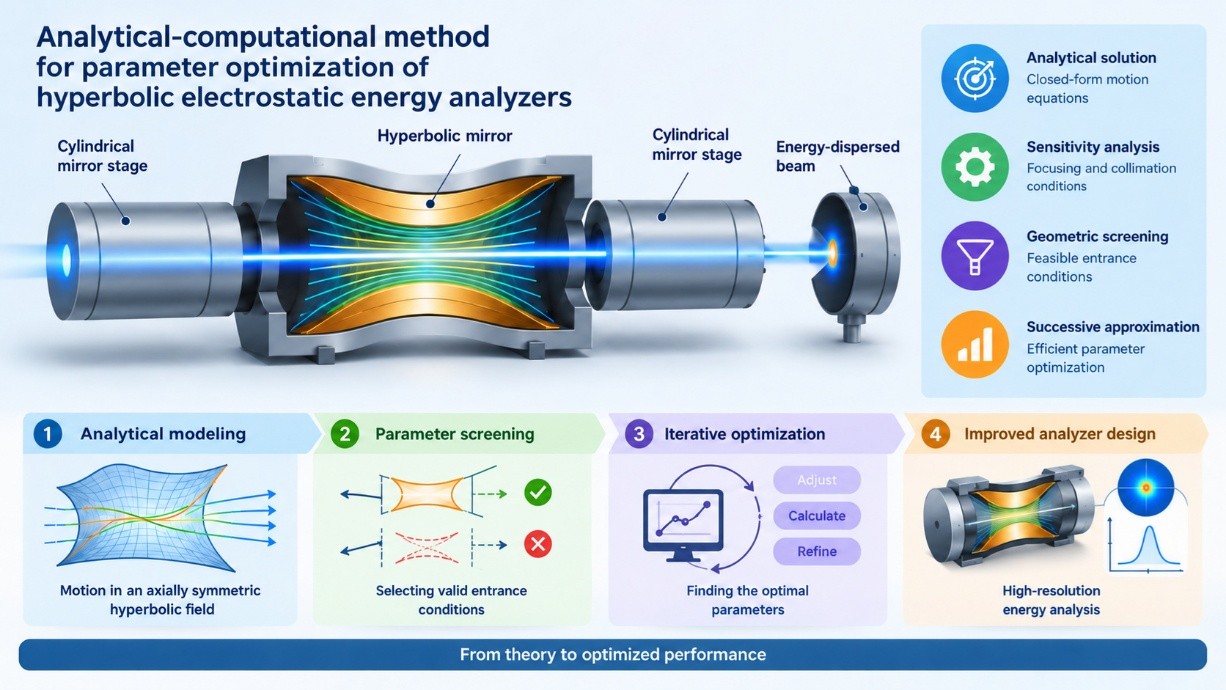
Hyperbolic electrostatic mirrors are promising elements of compact high-luminosity charged-particle energy analyzers, but their operating parameters are usually determined through extensive numerical trajectory calculations. For a hyperbolic mirror placed between two cylindrical mirror stages, with the beam entering and exiting through the hyperbolic electrode, analytical first-order focusing and collimation conditions have not been reported. This paper presents an analytical-computational method for determining the parameters of such a mirror. Closed-form solutions of the equations of motion are obtained for the axially symmetric hyperbolic field, and their differentiation with respect to the entrance angle yields explicit first-order sensitivity relations for the exit coordinate and exit angle, from which the focusing and collimation conditions are formulated. A geometric pre-screening of the straight-line trajectory segments in the field-free region excludes parameter combinations for which the beam cannot enter the field or leave it symmetrically; for the electrode parameter μ = 0.8, admissible entrance conditions exist only for normalized beam offsets b < μ. The remaining transcendental equations are solved using successive approximations within this reduced domain. For a fixed entrance point, the exit coordinate decreases with increasing entrance angle and electrode parameter. The method replaces broad numerical scanning with analytical screening followed by low-dimensional iteration and provides initial approximations for designing cylindrical–hyperbolic–cylindrical analyzers for space and plasma diagnostics.
- Ashimbaeva BU, Chokin KSh, Saulebekov AO, Kambarova ZhT. The combined energy analyzer composed of electrostatic mirror fields. J Electron Spectros Relat Phenomena. 2012;185(11):518-522. https://doi.org/10.1016/j.elspec.2012.10.008
- Kambarova ZhT, Saulebekov AO, Kopbalina KB. Calculation of the electron-optical scheme of a new type mirror energy analyzer of charged particles. Bull Karaganda Univ Phys. 2022;106(2):49-57. https://doi.org/10.31489/2022PH2/49-57
- Kambarova ZhT, Saulebekov AO, Kassymov SS. A novel design of an energy analyzer for charged particles based on a non-uniform electrostatic field. Eurasian Phys Tech J. 2025;22(3):148-155. https://doi.org/10.31489/2025N3/148-155
- Spivak-Lavrov IF, Shugayeva TZh, Seiten AB, Amantaeva ASh. Analytical description of the electrostatic field of multiple system based on a conducting circular cylinder. J Electrostat. 2026;140:104249. https://doi.org/10.1016/j.elstat.2026.104249
- Yang S, Xu L, Yin J, Wang H, Li B. Fast finite element electrostatic analysis with domain decomposition method. IEICE Electron Express. 2023;20(5):20220540. https://doi.org/10.1587/elex.20.20220540
- Read FH, Bowring NJ. The CPO programs and the BEM for charged particle optics. Nucl Instrum Methods Phys Res A. 2011;645:273-277. https://doi.org/10.1016/j.nima.2010.12.163
- Vallette A, Indelicato P. Analytical study of electrostatic ion beam traps. Phys Rev Spec Top Accel Beams. 2010;13(11):114001. https://doi.org/10.1103/PhysRevSTAB.13.114001
- Gonzalez-Lizardo A, Ulloa-Dávila E, Leal-Quiros E. Simulation of a hyperbolic field energy analyzer. In: Proceedings of the 16th Latin American Workshop on Plasma Physics (LAWPP). Piscataway, NJ: IEEE; 2017:52-55. https://doi.org/10.1109/LAWPP.2017.8692187
- Leal-Quiros E, Prelas MA. A hyperbolic energy analyzer. Rev Sci Instrum. 1990;61(6):1708-1712. https://doi.org/10.1063/1.1141136
- Hesam Mahmoudi Nezhad N, Ghaffarian Niasar M, Hagen CW, Kruit P. A new approach for fast field calculation in electrostatic electron lens design and optimization. Sci Rep. 2024;14:4859. https://doi.org/10.1038/s41598-024-55518-3
- Yao K, Ma W, Huang H, Li G, Ding Z, Liu J. A fast and accurate method for multi-electrode electrostatic lens design. IEEE J Electron Devices Soc. 2026;14:311-317. https://doi.org/10.1109/JEDS.2026.3693909
- Gorelik V. Optimization of cylindrical mirror analyzer. J Electron Spectros Relat Phenomena. 2023;264:147315. https://doi.org/10.1016/j.elspec.2023.147315
- Hoffstaetter GH. Successive approximations for charged particle motion. Ultramicroscopy. 2000;81(3-4):111-121. https://doi.org/10.1016/S0304-3991(99)00186-2
- Sabouri A, Perez-Martinez CS. Design of electrostatic lenses through genetic algorithm and particle swarm optimisation methods integrated with differential algebra. Ultramicroscopy. 2024;266:114024. https://doi.org/10.1016/j.ultramic.2024.114024
- Sise O, Ulu M, Dogan M, Martinez G, Zouros TJM. Fringing field optimization of hemispherical deflector analyzers using BEM and FDM. J Electron Spectros Relat Phenomena. 2010;177(1):42-51. https://doi.org/10.1016/j.elspec.2010.01.003
- Isik N, Ince M. Determination of electron trajectories within an energy analyzer using by a genetic algorithm method. Optik. 2022;260:169076. https://doi.org/10.1016/j.ijleo.2022.169076
- Kambarova Zh, Saulebekov A, Trubitsyn A. Numerical search for time-of-flight focusing conditions and its application to the analysis of TOF mass analyzer schemes. Eng Res Express. 2024;6(1):015037. https://doi.org/10.1088/2631-8695/ad1c0a
- Brais CJ, Ray SJ. A convolution approach to calculating the m/z-dependent mass analyzer response in orthogonal acceleration time-of-flight mass spectrometers. Int J Mass Spectrom. 2022;471:116734. https://doi.org/10.1016/j.ijms.2021.116734
- Sachenko VD, Antonov AS, Gall LN, Berdnikov AS. Optimization of vertical acceptance of the static mass analyzer. J Anal Chem. 2020;75(13):1660-1664. https://doi.org/10.1134/S1061934820130122
- Odintsov DD, Poteshin SS. Comparison of the results of the aberration approach for the calculation of electrostatic TOF mass analyzers with simulation in SIMION. Int J Mass Spectrom. 2026;519:117526. https://doi.org/10.1016/j.ijms.2025.117526
- Turtia SB, Satchenko VD, Berdnikov AS, Compagner A. Multi-criteria approach in optimization of the optical schemes for magnet mass analyzers. Nucl Instrum Methods Phys Res A. 1999;427(1-2):382-386. https://doi.org/10.1016/S0168-9002(98)01515-0
- Kotana AN, Mohanty AK. Computation of Mathieu stability plot for an arbitrary toroidal ion trap mass analyser. Int J Mass Spectrom. 2017;414:13-22. https://doi.org/10.1016/j.ijms.2016.11.021
- Xie XD, Xu FX, Yang HY, Xiao Y, Jiang J, Ding CF. Structure and property of ladder electrode linear ion trap mass analyzer. Chin J Anal Chem. 2016;44(6):994-1000. https://doi.org/10.1016/S1872-2040(16)60940-4
- Rawat SS, Komal, Naudiyal A, Khajuria R. Archimedean t-norm based q-rung orthopair fuzzy Hamy mean operator with ordinal priority weights. Intell Syst Res Appl J. 2026;2:54-75. https://doi.org/10.59543/f7febg22
- Musbah J, Badi I. LLM-assisted virtual expert weight elicitation in pharmaceutical supply chains: a Z-number multi-agent framework. Intell Syst Res Appl J. 2026;2:27-39. https://doi.org/10.59543/mmhqdg22
- Liebl H. Applied Charged Particle Optics. Berlin, Germany: Springer; 2008. https://doi.org/10.1007/978-3-540-71925-0
- Wollnik H. Optics of Charged Particles. 2nd ed. London, England: Academic Press; 2021. https://doi.org/10.1016/C2018-0-03671-3
- Yavor MI, Plaß WR, Dickel T, Geissel H, Scheidenberger C. Ion-optical design of a high-performance multiple-reflection time-of-flight mass spectrometer and isobar separator. Int J Mass Spectrom. 2015;381-382:1-9. https://doi.org/10.1016/j.ijms.2015.01.002