
A new bio-inspired metaheuristic optimization algorithm for solving an optimal control problem based on type 2 diabetes mellitus

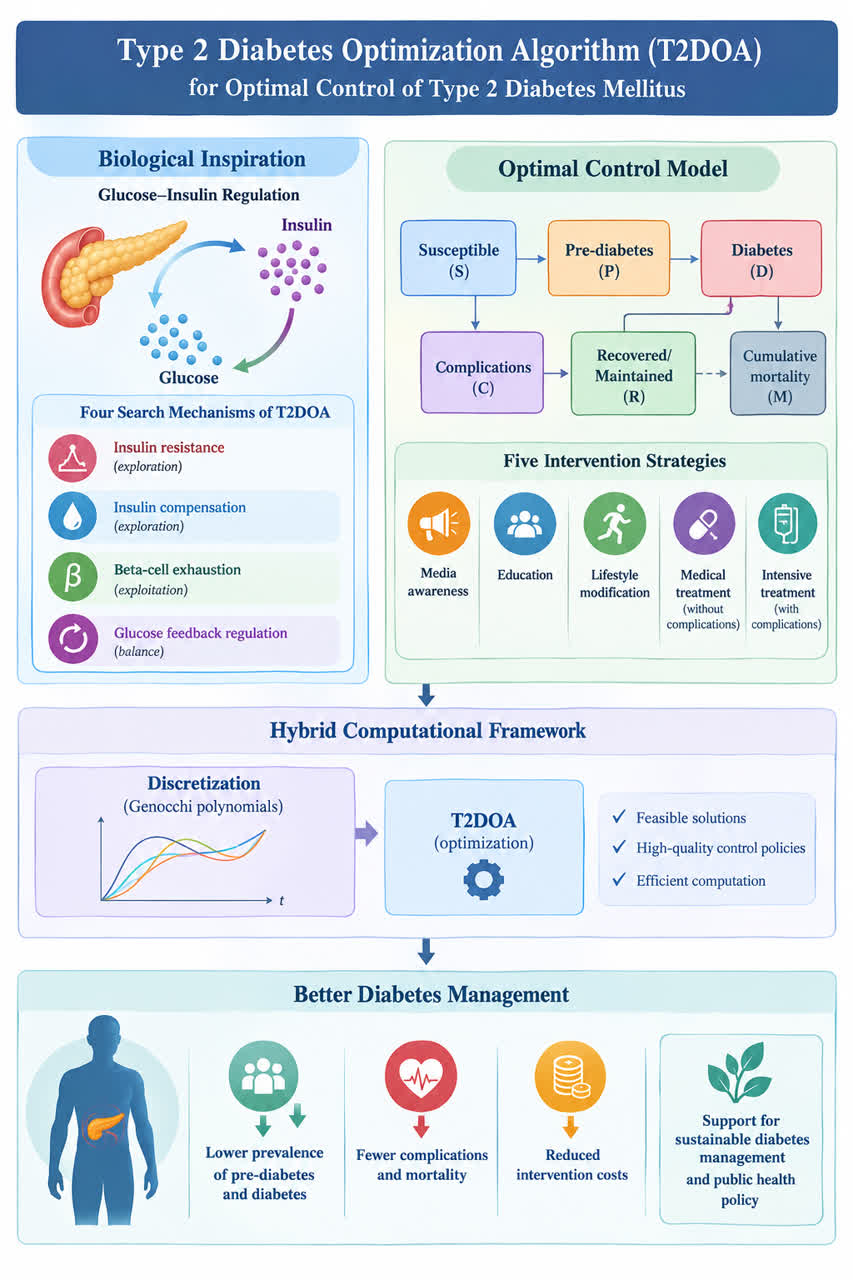
Type 2 diabetes mellitus (T2DM) remains one of the most challenging chronic diseases because of its complex progression, multiple complications, and substantial healthcare costs. Designing cost-effective intervention policies therefore requires robust mathematical models and efficient optimization techniques capable of solv optimal control problems (OCPs). In this paper, we propose a novel bio-inspired metaheuristic, called the type 2 diabetes optimization algorithm (T2DOA), inspired by the physiological mechanisms governing glucose-insulin regulation. The algorithm incorporates four biologically motivated search operators, namely insulin resistance, insulin compensation, beta-cell exhaustion, and glucose feedback regulation, to achieve an adaptive balance between global exploration and local exploitation. We develop a comprehensive optimal control model to describe the progression of T2DM through six interacting epidemiological compartments and an auxiliary cumulative mortality variable. The model integrates five time-dependent intervention strategies: media awareness campaigns, community-based education, lifestyle modification, medical treatment for patients without complications, and intensive treatment for patients with complications. We first discretize the resulting OCP using a collocation method based on Genocchi polynomials and then solve it using the proposed T2DOA, yielding a hybrid computational framework. In addition to the computational methodology, we rigorously establish the mathematical properties of the epidemiological model, including positivity, boundedness, existence and uniqueness of solutions, invariant regions, equilibrium analysis, the diabetes progression threshold, and local stability of both disease-free and endemic equilibria. Numerical experiments demonstrate that the proposed hybrid approach efficiently computes high-quality control policies while effectively reducing the prevalence of pre-diabetes, diabetes-related complications, cumulative mortality, and intervention costs. Comparative analyses indicate that the T2DOA-based framework provides competitive optimization performance and constitutes a promising decision-support tool for sustainable diabetes management and public health policy planning.
- Derouich M, Boutayeb A, Boutayeb W, Lamlili M. Optimal control approach to the dynamics of a population of diabetics. Appl Math Sci. 2014;8(56):2773-2782. https://doi.org/10.12988/ams.2014.43155
- Permatasari AH, Tjahjana RH, Udjiani T. Existence and characterization of optimal control in mathematics model of diabetics population. J Phys Conf Ser. 2018;983(1):012069. https://doi.org/10.1088/1742-6596/983/1/012069
- Kouidere A, Balatif O, Ferjouchia H, Boutayeb A, Rachik M. Optimal control strategy for a discrete time to the dynamics of a population of diabetics with highlighting the impact of living environment. Discrete Dyn Nat Soc. 2019;2019:6342169. https://doi.org/10.1155/2019/6342169
- Kouidere A, Labzai A, Ferjouchia H, Balatif O, Rachik M. A new mathematical modeling with optimal control strategy for the dynamics of population of diabetics and its complications with effect of behavioral factors. J Appl Math. 2020;2020:1943410. https://doi.org/10.1155/2020/1943410
- Kouidere A, Khajji B, Balatif O, Rachik M. A multi-age mathematical modeling of the dynamics of population diabetics with effect of lifestyle using optimal control. J Appl Math Comput. 2021;67(1-2):375-403. https://doi.org/10.1007/s12190-020-01474-w
- Logaprakash P, Monica C. Optimal control of diabetes model with the impact of endocrine-disrupting chemical: An emerging increased diabetes risk factor. Math Model Numer Simul Appl. 2023;3(4):318-334. https://doi.org/10.53391/mmnsa.1397575
- Aye PO, Jayeola D, Akintunlaji ID, Adegbite BE. Application of optimal control strategies on incidence of medical complications in diabetic patients' population. Earthline J Math Sci. 2025;15(2):257-271. https://doi.org/10.34198/ejms.15225.257271
- Sánchez Chávez IY, Morales-Menéndez R, Martínez-Chapa SO. Glucose optimal control system in diabetes treatment. Appl Math Comput. 2009;209(1):19-30. https://doi.org/10.1016/j.amc.2008.06.030
- Boiroux D, Finan DA, Jørgensen JB, Poulsen NK, Madsen H. Optimal insulin administration for people with type 1 diabetes. IFAC Proc Vol. 2010;43(5):248-253. https://skoge.folk.ntnu.no/prost/proceedings/dycops-2010/Papers_DYCOPS2010/MoAT1-02.pdf
- Ferjouchia H, Iftahy FZ, Chadli A, et al. Application of optimal control strategies for physiological model of type 1 diabetes-T1D. Commun Math Biol Neurosci. 2020;2020:35. https://doi.org/10.28919/cmbn/4598
- Al Helal Z, Rehbock V, Loxton R. Insulin injections and exercise scheduling for individuals with diabetes: An optimal control model. Optim Control Appl Methods. 2018;39(2):663-681. https://doi.org/10.1002/oca.2371
- Bassey BE. Optimal control model for dual treatment of delayed type-II diabetes infection in human population. Open Sci J Math Appl. 2019;7(1):34-49. https://www.researchgate.net/publication/333021455_Optimal_Control_Model_for_Dual_Treatment_of_Delayed_Type-II_Diabetes_Infection_in_Human_Population
- El Mansouri A, Smouni I, Khajji B, Labzai A, Belam M, Tidli Y. Optimal control in a mathematical model of a spread of the obesity epidemic and its impact on diabetes. Commun Math Biol Neurosci. 2023;2023:74. https://doi.org/10.28919/cmbn/8041
- Imken I, Fatmi NI. A new mathematical model of drinking alcohol among diabetes population taking anti-diabetic drugs: An optimal control approach. Commun Math Biol Neurosci. 2024;2024:5. https://doi.org/10.28919/cmbn/8359
- Kennedy J, Eberhart R. Particle swarm optimization. In: Proceedings of ICNN'95-International Conference on Neural Networks. Vol 4. IEEE; 1995:1942-1948. https://doi.org/10.1109/ICNN.1995.488968
- Mirjalili S, Mirjalili SM, Lewis A. Grey wolf optimizer. Adv Eng Softw. 2014;69:46-61. https://doi.org/10.1016/j.advengsoft.2013.12.007
- Heidari AA, Mirjalili S, Faris H, Aljarah I, Mafarja M, Chen H. Harris hawks optimization: Algorithm and applications. Future Gener Comput Syst. 2019;97:849-872. https://doi.org/10.1016/j.future.2019.02.028
- Mirjalili S, Lewis A. The whale optimization algorithm. Adv Eng Softw. 2016;95:51-67. https://doi.org/10.1016/j.advengsoft.2016.01.008
- Li S, Chen H, Wang M, Heidari AA, Mirjalili S. Slime mould algorithm: A new method for stochastic optimization. Future Gener Comput Syst. 2020;111:300-323. https://doi.org/10.1016/j.future.2020.03.055
- Houssein EH, Saeed MK, Hu G, Al-Sayed MM. Metaheuristics for solving global and engineering optimization problems: Review, applications, open issues and challenges. Arch Comput Methods Eng. 2024;31:4485-4519. https://doi.org/10.1007/s11831-024-10168-6
- Mohammed U, Karataev T, Oshiga O, Oghenewvogaga O. Comprehensive review of metaheuristic algorithms (MAs) for optimal control (OCl) improvement. Arch Comput Methods Eng. 2024;31(5):2785-2903. https://doi.org/10.1007/s11831-023-10060-9
- Pirouzeh Z, Noori Skandari MH, Pirbazari KN. A convergent Legendre spectral collocation method for the variable-order fractional-functional optimal control problems. J Math. 2024;2024:3934093. https://doi.org/10.1155/2024/3934093
- Çevik M, Baykuş Savaşaneril N, Sezer M. A review of polynomial matrix collocation methods in engineering and scientific applications. Arch Comput Methods Eng. 2025;32(6):3355-3373. https://doi.org/10.1007/s11831-025-10235-6
- Hager WW. Computational Methods in Optimal Control: Theory and Practice. Society for Industrial and Applied Mathematics; 2025. https://doi.org/10.1137/1.9781611978261
- Abadia-Doyle G, Hager WW, Rao AV. Integral form of Legendre-Gauss-Lobatto collocation for optimal control. J Franklin Inst. 2026;363(1):108120. https://doi.org/10.1016/j.jfranklin.2025.108120
- Manohara G, Kumbinarasaiah S. An innovative operational matrix approach for the numerical solution of fractional order diabetes mellitus model using the Genocchi wavelets. Nonlinear Sci. 2025;3:100019. https://doi.org/10.1016/j.nls.2025.100019
- Evirgen F, Uçar S, Özdemir N. Mathematical analysis and optimal control of a Caputo fractional diabetes system with parameter identification. J Comput Appl Math. 2026;477:117151. https://doi.org/10.1016/j.cam.2025.117151
- Madani N. Modeling and controlling diabetic complications with deep neural networks and optimal control via artificial bee colony. J Comput Sci. 2026;99:102932. https://doi.org/10.1016/j.jocs.2026.102932
- Aslan E, Özüpak Y. A hybrid deep learning framework based on VGG19 and U-Net for accurate brain tumor segmentation in MRI images. Magn Reson Lett. 2026;6(4):200275. https://doi.org/10.1016/j.mrl.2026.200275
- Alpsalaz SD, Aslan E, Özüpak Y, Alpsalaz F, Uzel H, Zaitsev I. Explainability-aligned reliability-weighted fuzzy ensemble for automated cervical cancer classification. Int J Intell Syst. 2026;2026:2931556. https://doi.org/10.1155/int/2931556
- Rajwar K, Deep K, Das S. An exhaustive review of the metaheuristic algorithms for search and optimization: Taxonomy, applications, and open challenges. Artif Intell Rev. 2023;56:13187-13257. https://doi.org/10.1007/s10462-023-10470-y
- Velasco L, Guerrero H, Hospitaler A. A literature review and critical analysis of metaheuristics recently developed. Arch Comput Methods Eng. 2024;31:125-146. https://doi.org/10.1007/s11831-023-09975-0
- Lagaros ND, Kournoutos M, Kallioras NA, Nordas AN. Constraint handling techniques for metaheuristics: A state-of-the-art review and new variants. Optim Eng. 2023;24:2251-2298. https://doi.org/10.1007/s11081-022-09782-9
- Salgotra R, Sharma P, Raju S, Gandomi AH. A contemporary systematic review on meta-heuristic optimization algorithms with their MATLAB and Python code reference. Arch Comput Methods Eng. 2024;31:1749-1822. https://doi.org/10.1007/s11831-023-10030-1
- Shaikh MS, Raj S, Zheng G, et al. Applications, classifications, and challenges: A comprehensive evaluation of recently developed metaheuristics for search and analysis. Artif Intell Rev. 2025;58:390. https://doi.org/10.1007/s10462-025-11377-6
- Suman A, Gunjan, Udmale SS. Metaheuristic algorithms: A benchmark-driven functional taxonomy and performance analysis. Comput Sci Rev. 2026;60:100884. https://doi.org/10.1016/j.cosrev.2025.100884
- Dhiman R, Sood M, Thakur J. A decade survey on exploration-exploitation trade-off in metaheuristics: A proposal for conceptual framework-based validation model. Comput Sci Rev. 2026;61:100944. https://doi.org/10.1016/j.cosrev.2026.100944
- Araci S. Novel identities for q-Genocchi numbers and polynomials. J Funct Spaces Appl. 2012;2012:214961. https://doi.org/10.1155/2012/214961
- Araci S. Novel identities involving Genocchi numbers and polynomials arising from applications of umbral calculus. Appl Math Comput. 2014;233:599-607. https://doi.org/10.1016/j.amc.2014.01.013
- Bayad A, Kim T. Identities for the Bernoulli, the Euler and the Genocchi numbers and polynomials. Adv Stud Contemp Math. 2010;20(2):247-253. https://www.researchgate.net/publication/283146615_Identities_for_the_Bernoulli_the_Euler_and_the_Genocchi_numbers_and_polynomials