

A probabilistic hesitant fuzzy BWM-TODIM framework with coordinated consistency adjustment and a probability-sensitive dissimilarity measure for logistics provider selection

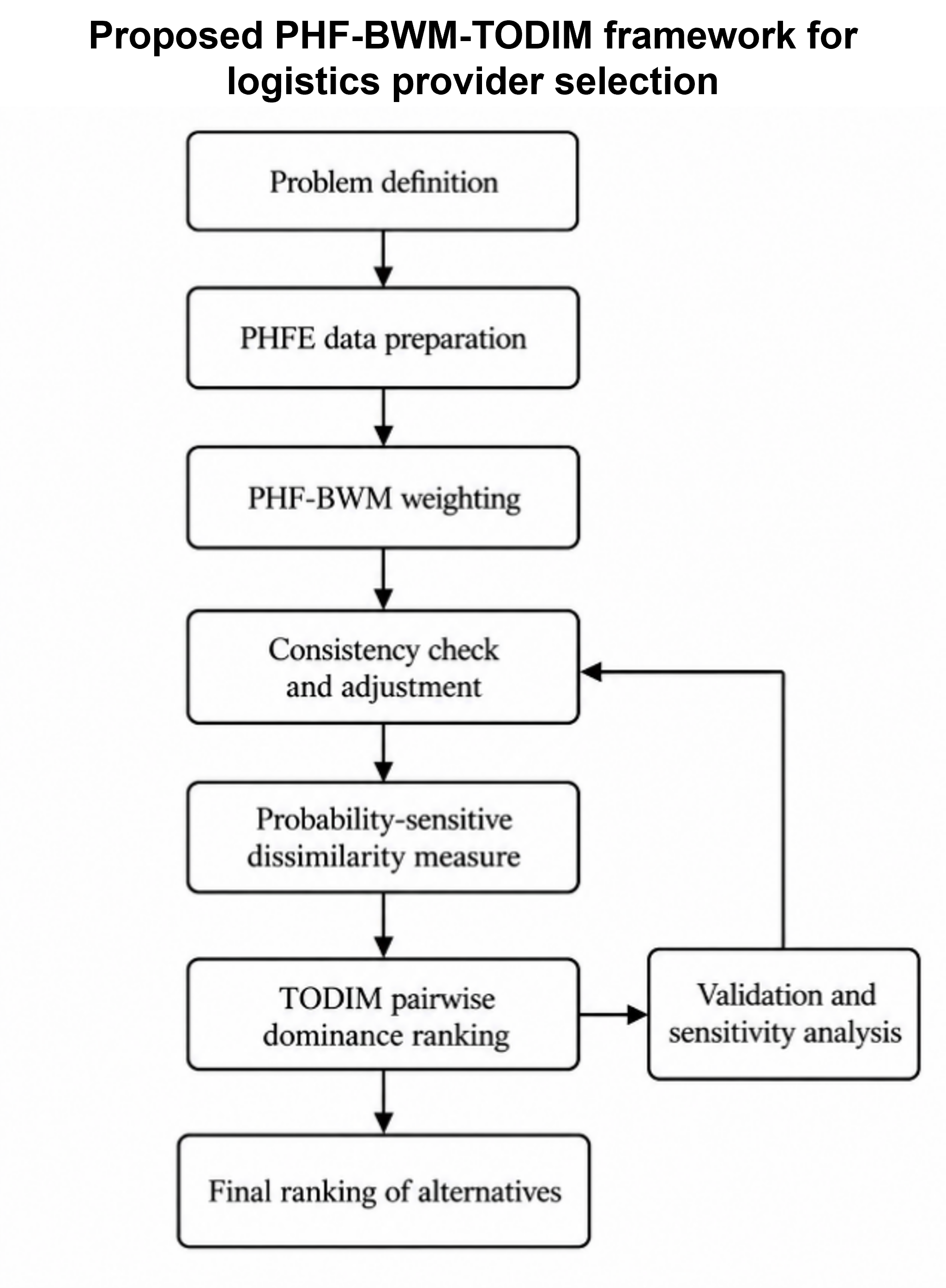
Selecting a third-party logistics provider is a multicriteria decision problem involving delivery reliability, service quality, environmental performance, cost control, and transport risk. In such problems, expert assessments are often uncertain and hesitant, and different possible membership values may carry different confidence levels. To better represent this type of evaluation information, this study develops a probabilistic hesitant fuzzy BWM-TODIM framework for logistics provider selection. In the weighting stage, probabilistic hesitant fuzzy information is incorporated into the best–worst method (BWM) to derive criterion weights, and a coordinated inconsistency adjustment mechanism is introduced to reduce the loss of probability-weighted preference information and the resulting weight disturbance during consistency improvement. In the ranking stage, a probability-sensitive dissimilarity measure is constructed by adding a probability–membership interaction term, so that probabilistic hesitant fuzzy elements with similar membership structures but different probability distributions can be more clearly distinguished. The obtained dissimilarity information is then embedded into the TODIM procedure to support pairwise gain–loss dominance analysis under the decision maker’s risk preferences. A published logistics-provider selection case is used to illustrate the proposed framework. Since the source case does not provide direct BWM pairwise comparisons, the required comparison vectors are transparently reconstructed from the reported criterion-importance probabilistic hesitant fuzzy elements, and the decision matrix is normalized before calculation. The empirical analysis and supplementary tests show that the proposed methodological modifications can improve the interpretability of weighting and ranking under probabilistic hesitant fuzzy information. Sensitivity analyses, including dissimilarity-measure ablation, inconsistency stress testing, criterion-weight perturbation, probability perturbation, and comparison with alternative methods, further indicate that the framework is useful for identifying close competing alternatives and for examining the stability of the final ranking.
- Garg H, Krishankumar R, Ravichandran KS. Decision framework with integrated methods for group decision-making under probabilistic hesitant fuzzy context and unknown weights. Expert Syst Appl. 2022;200:117082. https://doi.org/10.1016/j.eswa.2022.117082
- Fang B. Some uncertainty measures for probabilistic hesitant fuzzy information. Inf Sci. 2023;625:255-276. https://doi.org/10.1016/j.ins.2022.12.101
- Aydoğan H, Özkır V. A Fermatean fuzzy MCDM method for selection and ranking problems: Case studies. Expert Syst Appl. 2024;237:121628. https://doi.org/10.1016/j.eswa.2023.121628
- Zadeh LA. Fuzzy sets. Inf Control. 1965;8(3):338-353. https://doi.org/10.1016/S0019-9958(65)90241-X
- Torra V. Hesitant fuzzy sets. Int J Intell Syst. 2010;25(6):529-539. https://doi.org/10.1002/int.20418
- Xu Z, Zhou W. Consensus building with a group of decision makers under the hesitant probabilistic fuzzy environment. Fuzzy Optim Decis Mak. 2017;16(4):481-503. https://doi.org/10.1007/s10700-016-9257-5
- Greco S, Słowiński R, Wallenius J. Fifty years of multiple criteria decision analysis: From classical methods to robust ordinal regression. Eur J Oper Res. 2025;323(2):351-377. https://doi.org/10.1016/j.ejor.2024.07.038
- Das S, Dutta R, De S, De S. Review of multi-criteria decision-making for sustainable decentralized hybrid energy systems. Renew Sustain Energy Rev. 2024;202:114676. https://doi.org/10.1016/j.rser.2024.114676
- Ortiz-Barrios M, Cabarcas-Reyes J, Ishizaka A, Barbati M, Jaramillo-Rueda N, Carrascal-Zambrano GDJ. A hybrid fuzzy multi-criteria decision making model for selecting a sustainable supplier of forklift filters: A case study from the mining industry. Ann Oper Res. 2021;307(1-2):443-481. https://doi.org/10.1007/s10479-020-03737-y
- Ding Q, Zhou Y, Cheng TCE, Ji M. A decision framework for selecting emergency logistics suppliers based on an extended PHFS-TODIM method. Int J Fuzzy Syst. 2025;27(5):1498-1513. https://doi.org/10.1007/s40815-024-01848-3
- Liu Y, Guan X, Wu B. Research on decision-making method based on probabilistic hesitant fuzzy comprehensive distance measurement. J Northwest Polytech Univ. 2023;41(6):1209-1220. https://doi.org/10.1051/jnwpu/20234161209
- Liao N, Wei G, Chen X. TODIM method based on cumulative prospect theory for multiple attributes group decision making under probabilistic hesitant fuzzy setting. Int J Fuzzy Syst. 2022;24(1):322-339. https://doi.org/10.1007/s40815-021-01138-2
- Zhou Y, Zhou L, Lin Z, Xu X. Probabilistic q-rung hesitant fuzzy TODIM method and its application. J Shandong Univ Nat Sci. 2023;58(6):9-17. https://doi.org/10.6040/j.issn.1671-9352.0.2022.260
- Leoneti AB, Gomes LFAM. A novel version of the TODIM method based on the exponential model of prospect theory: The ExpTODIM method. Eur J Oper Res. 2021;295(3):1042-1055. https://doi.org/10.1016/j.ejor.2021.03.055
- Divsalar M, Ahmadi M, Ghaedi M, Ishizaka A. An extended TODIM method for hyperbolic fuzzy environments. Comput Ind Eng. 2023;185:109655. https://doi.org/10.1016/j.cie.2023.109655
- Liu Y, Qin Y, Liu H, Abdullah S, Rong Y. Prospect theory-based q-rung orthopair fuzzy TODIM method for risk assessment of renewable energy projects. Int J Fuzzy Syst. 2024;26(3):1046-1068. https://doi.org/10.1007/s40815-023-01652-5
- Więckowski J, Kizielewicz B, Shekhovtsov A, Sałabun W. RANCOM: A novel approach to identifying criteria relevance based on inaccuracy expert judgments. Eng Appl Artif Intell. 2023;122:106114. https://doi.org/10.1016/j.engappai.2023.106114
- Więckowski J, Kizielewicz B, Sałabun W. Fuzzy RANCOM: A novel approach for modeling uncertainty in decision-making processes. Inf Sci. 2025;694:121716. https://doi.org/10.1016/j.ins.2024.121716
- Zakeri S, Konstantas D, Chatterjee P, Zavadskas EK. Soft cluster-rectangle method for eliciting criteria weights in multi-criteria decision-making. Sci Rep. 2025;15:284. https://doi.org/10.1038/s41598-024-81027-4
- Yang W, Liang C. A large-scale consensus decision-making model for non-cooperative behavior based on incomplete probabilistic hesitant fuzzy information in social trust networks. Inf Sci. 2025;714:122196. https://doi.org/10.1016/j.ins.2025.122196
- Yang G, Ren M, Hao X. Multi-criteria decision-making problem based on the novel probabilistic hesitant fuzzy entropy and TODIM method. Alex Eng J. 2023;68:437-451. https://doi.org/10.1016/j.aej.2023.01.014
- Saha A, Debnath BK, Chatterjee P, Panaiyappan AK, Das S, Anusha G. Generalized Dombi-based probabilistic hesitant fuzzy consensus reaching model for supplier selection under healthcare supply chain framework. Eng Appl Artif Intell. 2024;133:107966. https://doi.org/10.1016/j.engappai.2024.107966
- Wang C, Zhou J, Yang Y, Zhou L. Probabilistic q-rung hesitant fuzzy TOPSIS method and its application. Fuzzy Syst Math. 2025;39(4):129-139.
- Rezaei J. Best-worst multi-criteria decision-making method. Omega. 2015;53:49-57. https://doi.org/10.1016/j.omega.2014.11.009
- Guo S, Zhao H. Fuzzy best-worst multi-criteria decision-making method and its applications. Knowl Based Syst. 2017;121:23-31. https://doi.org/10.1016/j.knosys.2017.01.010
- Ali A, Rashid T. Hesitant fuzzy best-worst multi-criteria decision-making method and its applications. Int J Intell Syst. 2019;34(8):1953-1967. https://doi.org/10.1002/int.22131
- Xu D, Li W, Ren X, Shen W, Dong L. Technology selection for sustainable hydrogen production: A multi-criteria assessment framework under uncertainties based on the combined weights and interval best-worst projection method. Int J Hydrogen Energy. 2020;45(59):34396-34411. https://doi.org/10.1016/j.ijhydene.2019.09.030
- Wan S, Dong J, Chen SM. Fuzzy best-worst method based on generalized interval-valued trapezoidal fuzzy numbers for multi-criteria decision-making. Inf Sci. 2021;573:493-518. https://doi.org/10.1016/j.ins.2021.03.038
- Ali A, Rashid T. Generalized interval-valued trapezoidal fuzzy best-worst multiple criteria decision-making method with applications. J Intell Fuzzy Syst. 2020;38(2):1705-1719. https://doi.org/10.3233/JIFS-182932
- Mou Q, Xu Z, Liao H. An intuitionistic fuzzy multiplicative best-worst method for multi-criteria group decision making. Inf Sci. 2016;374:224-239. https://doi.org/10.1016/j.ins.2016.08.074
- Deveci M, Özcan E, John R, Pamucar D, Karaman H. Offshore wind farm site selection using interval rough numbers based Best-Worst Method and MARCOS. Appl Soft Comput. 2021;109:107532. https://doi.org/10.1016/j.asoc.2021.107532
- Li J, Wang J, Hu J. Multi-criteria decision-making method based on dominance degree and BWM with probabilistic hesitant fuzzy information. Int J Mach Learn Cybern. 2019;10(7):1671-1685. https://doi.org/10.1007/s13042-018-0845-2
- Liu M, Zhang X, Mo Z. Probabilistic hesitant fuzzy MEREC-TODIM decision-making based on improved distance measures. Int J Fuzzy Syst. 2024;26(7):2370-2393. https://doi.org/10.1007/s40815-024-01741-z
- Amjad H, Stoklasa J, Bhat SA. Rank reversal free VIKOR and fuzzy VIKOR—Heading toward absolute-type fuzzy multiple-criteria evaluation methods. IEEE Trans Fuzzy Syst. 2026;34(9):2978-2992. https://doi.org/10.1109/TFUZZ.2026.3706988
- Krishankumar R, Mishra AR, Rani P, et al. Two-stage EDAS decision approach with probabilistic hesitant fuzzy information. Informatica. 2025;36(1):65-97. https://doi.org/10.15388/24-INFOR577
- Ding Q, Wang YM, Goh M. TODIM dynamic emergency decision-making method based on hybrid weighted distance under probabilistic hesitant fuzzy information. Int J Fuzzy Syst. 2021;23(2):474-491. https://doi.org/10.1007/s40815-020-00978-8
- Bhowmik C, Zindani D, Chatterjee P, Marinković D, Šliogerienė J. Evaluation of green energy sources: An extended fuzzy-TODIM approach based on Schweizer-Sklar and power averaging operators. Facta Univ Ser Mech Eng. 2025;23(3):627-648. https://doi.org/10.22190/FUME240711042B
- Liu Y, Guan X. Probabilistic hesitant fuzzy recognition method based on comprehensive characteristic distance measure. Math Probl Eng. 2021;2021:1738026. https://doi.org/10.1155/2021/1738026
- Su Z, Xu ZS, Zhao H, Hao Z, Chen B. Entropy measures for probabilistic hesitant fuzzy information. IEEE Access. 2019;7:65714-65727. https://doi.org/10.1109/ACCESS.2019.2916564
- Fang B, Han B, Wen C. [Probabilistic hesitant fuzzy multi-attribute group decision-making based on new distance measure]. Control Decis. 2022;37(3):729-736. [In Chinese] https://doi.org/10.13195/j.kzyjc.2020.1118