

Thermal and mass transport analysis of solar-driven Williamson nanofluid flow over a stretching/shrinking wedge under an inclined magnetic field and heat generation

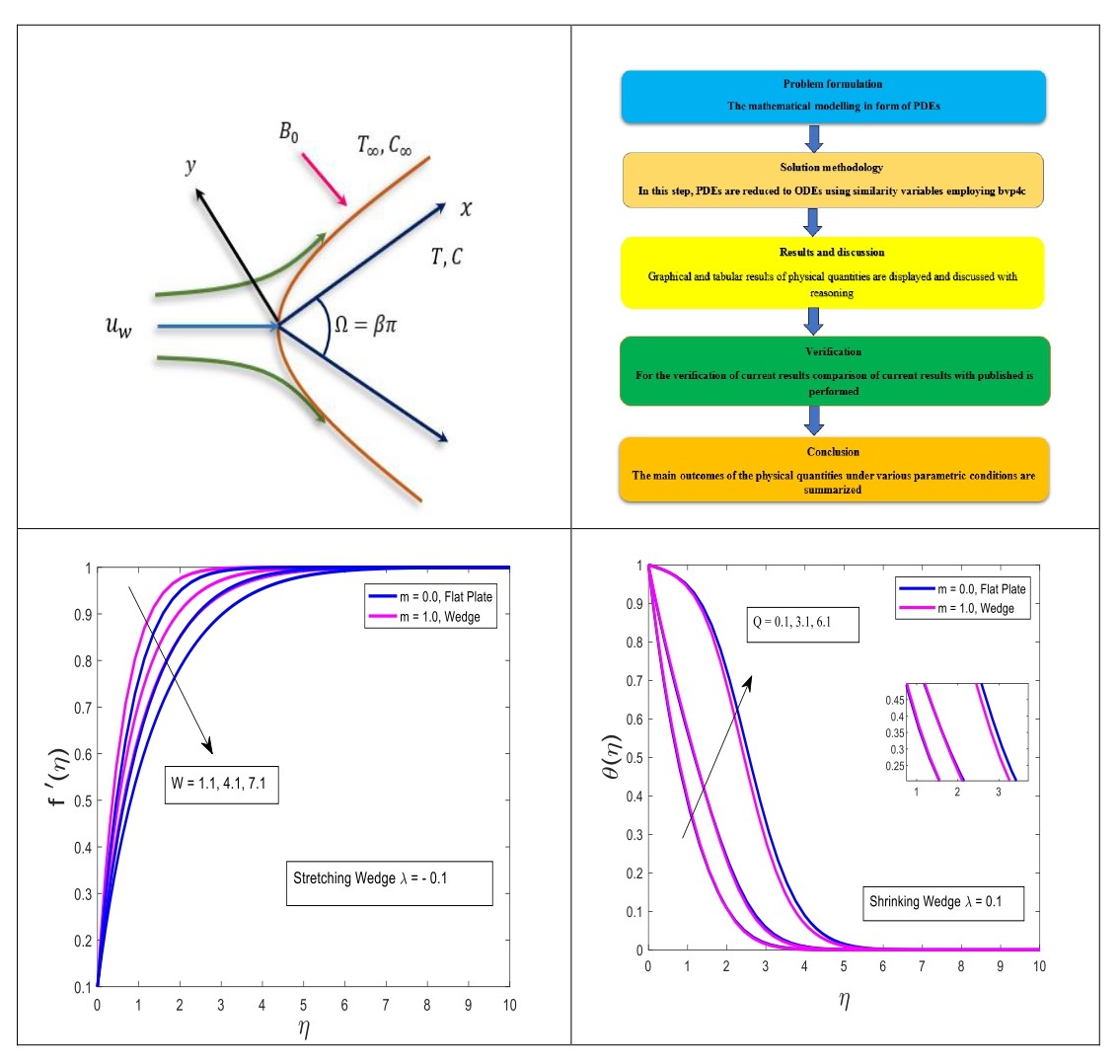
The growing energy consumption, increasing demand for efficient cooling systems, energy preservation in clean energy technology, cooling technology, and chemical engineering, and the applications of nanofluids and non-Newtonian fluids have attracted the attention of researchers and scientists in fluid mechanics. Because this demand cannot be accommodated in current systems using fluids of low thermal conductivity, fluids such as nanofluids with high thermal conductivity are used to improve cooling systems. Therefore, the combined study of the interactions among solar radiation, heat generation, and an inclined magnetic field in a two-phase Buongiorno nanofluid model coupled with a non-Newtonian Williamson fluid model, considering shrinking and stretching wedges along a flat plate and a full wedge, was conducted in the present study. The transformed differential equations were solved using MATLAB’s bvp4c solver. The results show that increasing values of the Williamson fluid parameter, heat generation parameter, and inclined magnetic field parameter lead to a decrease in the velocity field for both the shrinking and stretching wedges along a flat plate and the full wedge under an inclined magnetic force . There is an increase in the temperature profile with increasing thermophoresis parameter and solar radiation parameter. The nanoparticle volume fraction increases with increasing values of the thermophoresis parameter for both cases of a wedge along a flat plate and a full wedge. A grid-independent test was performed to ensure that the solutions are grid-independent and that convergence of the solutions was maintained. The current results are compared with existing published results, which validates the accuracy of the present solutions.
- Ramesh GK, Gireesha BJ, Gorla RSR. Study on Sakiadis and Blasius flows of Williamson fluid with convective boundary condition. Nonlinear Eng. 2015;4(4):215-221. https://doi.org/10.1515/nleng-2015-0020
- Priyadharshini P, Karpagam V, Gayathri P. Numerical and ANN optimization analysis for Williamson fluid flow across a porous surface. Neural Comput Appl. 2026;38(9). https://doi.org/10.1007/s00521-026-12073-4
- Asjad MI, Zahid M, Inc M, Baleanu D, Almohsen B. Impact of activation energy and MHD on Williamson fluid flow in the presence of bioconvection. Alex Eng J. 2022;61(11):8715-8727. https://doi.org/10.1016/j.aej.2022.02.013
- Rashid M, Ansar K, Nadeem S. Effects of induced magnetic field for peristaltic flow of Williamson fluid in a curved channel. Phys A Stat Mech Appl. 2020;553:123979. https://doi.org/10.1016/j.physa.2019.123979
- Abbas A, Jeelani MB, Alnahdi AS, Ilyas A. MHD Williamson nanofluid flow and heat transfer past a non-linear stretching sheet implanted in a porous medium: Effects of heat generation and viscous dissipation. Processes. 2022;10(6):1221. https://doi.org/10.3390/pr10061221
- Hussain SM. Dynamics of radiative Williamson hybrid nanofluid with entropy generation: Significance in solar aircraft. Sci Rep. 2022;12(1). https://doi.org/10.1038/s41598-022-13086-4
- Raza J, Mebarek-Oudina F, Mahanthesh B. Magnetohydrodynamic flow of nano Williamson fluid generated by stretching plate with multiple slips. Multidiscip Model Mater Struct. 2019;15(5):871-894. https://doi.org/10.1108/MMMS-11-2018-0183
- Hashim, Hamid A, Khan M, Khan U. Thermal radiation effects on Williamson fluid flow due to an expanding/contracting cylinder with nanomaterials: Dual solutions. Phys Lett A. 2018;382(30):1982-1991. https://doi.org/10.1016/j.physleta.2018.04.057
- Zehra I, Yousaf MM, Nadeem S. Numerical solutions of Williamson fluid with pressure dependent viscosity. Results Phys. 2015;5:20-25. https://doi.org/10.1016/j.rinp.2014.12.002
- Hayat T, Bibi S, Rafiq M, Alsaedi A, Abbasi FM. Effect of an inclined magnetic field on peristaltic flow of Williamson fluid in an inclined channel with convective conditions. J Magn Magn Mater. 2016;401:733-745. https://doi.org/10.1016/j.jmmm.2015.10.107
- Ishak A, Nazar R, Pop I. Falkner-Skan equation for flow past a moving wedge with suction or injection. J Appl Math Comput. 2007;25(1-2):67-83. https://doi.org/10.1007/BF02832339
- Maaitah H, Olimat AN, Quran O, Duwairi HM. Viscous dissipation analysis of Williamson fluid over a horizontal saturated porous plate at constant wall temperature. Int J Thermofluids. 2023;19:100361. https://doi.org/10.1016/j.ijft.2023.100361
- Rashad AM, Nafe MA, Eisa DA. Heat variation on MHD Williamson hybrid nanofluid flow with convective boundary condition and Ohmic heating in a porous material. Sci Rep. 2023;13(1). https://doi.org/10.1038/s41598-023-33043-z
- Salahuddin T, Khan M, Saeed T, Ibrahim M, Chu YM. Induced MHD impact on exponentially varying viscosity of Williamson fluid flow with variable conductivity and diffusivity. Case Stud Therm Eng. 2021;25:100895. https://doi.org/10.1016/j.csite.2021.100895
- Mishra P, Kumar D, Dharmendar Reddy Y, Shankar Goud B. Numerical investigation of MHD flow of Williamson nanofluid with variable viscosity past a wedge within porous media: A non-Darcy model approach. Heat Transfer. 2022;51(7):6071-6086. https://doi.org/10.1002/htj.22580
- Florence AD. Temperature-dependent variable viscosity and thermal conductivity effects on non-Newtonian fluids flow in a porous medium. World J Eng. 2022;20(3):445-457. https://doi.org/10.1108/WJE-03-2021-0130
- Salahuddin T, Fatima G, Awais M, Khan M. Numerical study of the heat and mass transport along with variable viscosity of magnetohydrodynamic Williamson fluid by considering the Soret and Dufour effects: Using Milne’s method. Int J Model Simul. 2025. https://doi.org/10.1080/02286203.2025.2518588
- Khan WA, Pop I. Boundary layer flow past a wedge moving in a nanofluid. Math Probl Eng. 2013;2013:1-7. https://doi.org/10.1155/2013/637285
- Mahendran MS, Wong LS, Antony Dhanapal ACT, Djearamane S. The effect of titanium dioxide nanoparticles on Haematococcus pluvialis biomass concentration. J Exp Biol Agric Sci. 2023;11(2):416-422. https://doi.org/10.18006/2023.11(2).416.422
- Berrehal H, Dinarvand S, Khan I. Mass-based hybrid nanofluid model for entropy generation analysis of flow upon a convectively-warmed moving wedge. Chin J Phys. 2022;77:2603-2616. https://doi.org/10.1016/j.cjph.2022.04.017
- Sajid T, Al Mesfer MK, Jamshed W, et al. Endo/exothermic chemical processes influences of tri-hybridity nanofluids flowing over wedge with convective boundary constraints and activation energy. Results Phys. 2023;51:106676. https://doi.org/10.1016/j.rinp.2023.106676
- Mahanthesh B, Shehzad SA, Ambreen T, Khan SU. Significance of Joule heating and viscous heating on heat transport of MoS₂–Ag hybrid nanofluid past an isothermal wedge. J Therm Anal Calorim. 2020;143(2):1221-1229. https://doi.org/10.1007/s10973-020-09578-y
- Dawar A, Shah Z, Tassaddiq A, Kumam P, Islam S, Khan W. A convective flow of Williamson nanofluid through cone and wedge with non-isothermal and non-isosolutal conditions: A revised Buongiorno model. Case Stud Therm Eng. 2021;24:100869. https://doi.org/10.1016/j.csite.2021.100869
- Nasir M, Ali AB, Anwar T, et al. Impact of liquid hydrogen in stagnation-point flow of hydromagnetic Williamson nanomaterial configured by a stretched vertical wedge featuring nonlinear chemical reaction. Case Stud Therm Eng. 2025;75:107122. https://doi.org/10.1016/j.csite.2025.107122
- Patil VS, Humane PP, Patil AB. MHD Williamson nanofluid flow past a permeable stretching sheet with thermal radiation and chemical reaction. Int J Model Simul. 2022;43(3):185-199. https://doi.org/10.1080/02286203.2022.2062166
- Hussain M, Lubna A, Ashraf M, Anwar MS, Ranjha QA, Ali A. Ohmically dissipated MHD mixed convective flow of Williamson fluid over a penetrable stretching convective wedge with thermal radiations. Numer Heat Transfer B Fundam. 2023;85(8):1026-1040. https://doi.org/10.1080/10407790.2023.2261623
- Abbas A, Khandelwal R, Ahmad H, et al. Magnetohydrodynamic bioconvective flow of Williamson nanofluid over a moving inclined plate embedded in a porous medium. Mathematics. 2023;11(4):1043. https://doi.org/10.3390/math11041043
- Usman, Lin P, Ghaffari A. Heat and mass transfer in a steady flow of Sutterby nanofluid over the surface of a stretching wedge. Phys Scr. 2021;96(6):065003. https://doi.org/10.1088/1402-4896/abecf7
- Oderinu RA, Oyeyinka TA, Alao S, Ayanbukola FJ, Sanusi BA. Mixed convection and permeability effects on magnetohydrodynamic Williamson fluid flow over an inclined stretchy surface with radiation influence: Analytical investigation. Eng Rep. 2025;7(4). https://doi.org/10.1002/eng2.70078
- Alao S, Abdulkareem FA, Ogunmola OJ, Oderinu RA. Theoretical investigation of heat and mass transfer in unsteady magnetohydrodynamic Williamson nanofluid flow past a permeable stretching surface with viscous dissipation effect. Therm Adv. 2026;6:100101. https://doi.org/10.1016/j.thradv.2026.100101
- Sankari MS, Rao ME, Shams ZE, et al. Williamson MHD nanofluid flow via a porous exponentially stretching sheet with bioconvective fluxes. Case Stud Therm Eng. 2024;59:104453. https://doi.org/10.1016/j.csite.2024.104453
- Obalalu AM, Salawu SO, Olayemi OA, Ajala OA, Issa K. Analysis of hydromagnetic Williamson fluid flow over an inclined stretching sheet with Hall current using Galerkin Weighted Residual Method. Comput Math Appl. 2023;146:22-32. https://doi.org/10.1016/j.camwa.2023.06.021
- Sankari S, Rao ME, Elsiddieg AM, et al. Analytical solution of MHD bioconvection Williamson nanofluid flow over an exponentially stretching sheet with the impact of viscous dissipation and gyrotactic microorganism. PLoS ONE. 2025;20(3):e0306358. https://doi.org/10.1371/journal.pone.0306358
- Priyadharshini P, Karpagam V, Shah NA, Alshehri MH. Bio-convection effects of MHD Williamson fluid flow over a symmetrically stretching sheet: Machine learning. Symmetry. 2023;15(9):1684. https://doi.org/10.3390/sym15091684
- Naz S, Hayat T, Momani S. Dufour and Soret features in entropy optimized Williamson fluid with nonlinear thermal radiation: Modified Darcy law analysis. Results Eng. 2025;25:104293. https://doi.org/10.1016/j.rineng.2025.104293
- Swalmeh MZ, Alwawi FA, Kausar MS, et al. Numerical simulation on energy transfer enhancement of a Williamson ferrofluid subjected to thermal radiation and a magnetic field using hybrid ultrafine particles. Sci Rep. 2023;13(1). https://doi.org/10.1038/s41598-023-29707-5
- Zafar SS, Zaib A, Lone SA, Mahnashi AM, Hamali W, Saeed A. Numerical analysis of Williamson nanofluid over lubricated surface due to microorganism with thermal radiation. J Therm Anal Calorim. 2025;150(4):2319-2334. https://doi.org/10.1007/s10973-023-12874-y
- Akbar S, Sohail M, Abbas ST, Badi N. Optimal homotopic strategy for thermal and mass transport in Williamson model flow PDEs under heat generation/absorption and Joule heating. Adv Mech Eng. 2024;16(11):16878132241294262. https://doi.org/10.1177/16878132241294262
- Znaidia S, Rehman S, Drissi N, Asiri F, Nasr S. Mixed convection flow and heat transfer of Williamson drilling nanofluid over a stretching cylinder using Brinkman-Maxwell-Garnett model and temperature-dependent features. J Nonlinear Math Phys. 2025;32(1). https://doi.org/10.1007/s44198-025-00292-7
- Zafar SS, Zaib A, Lone SA, Mahnashi AM, Hamali W, Saeed A. Radiative heat in a Williamson fluid flow through a lubricated surface containing swimming microorganism. J Therm Anal Calorim. 2025;150(4):2633-2650. https://doi.org/10.1007/s10973-023-12861-3