
Risk prioritization of catalytic converters in sulfur recovery units using an extended failure modes and effects analysis

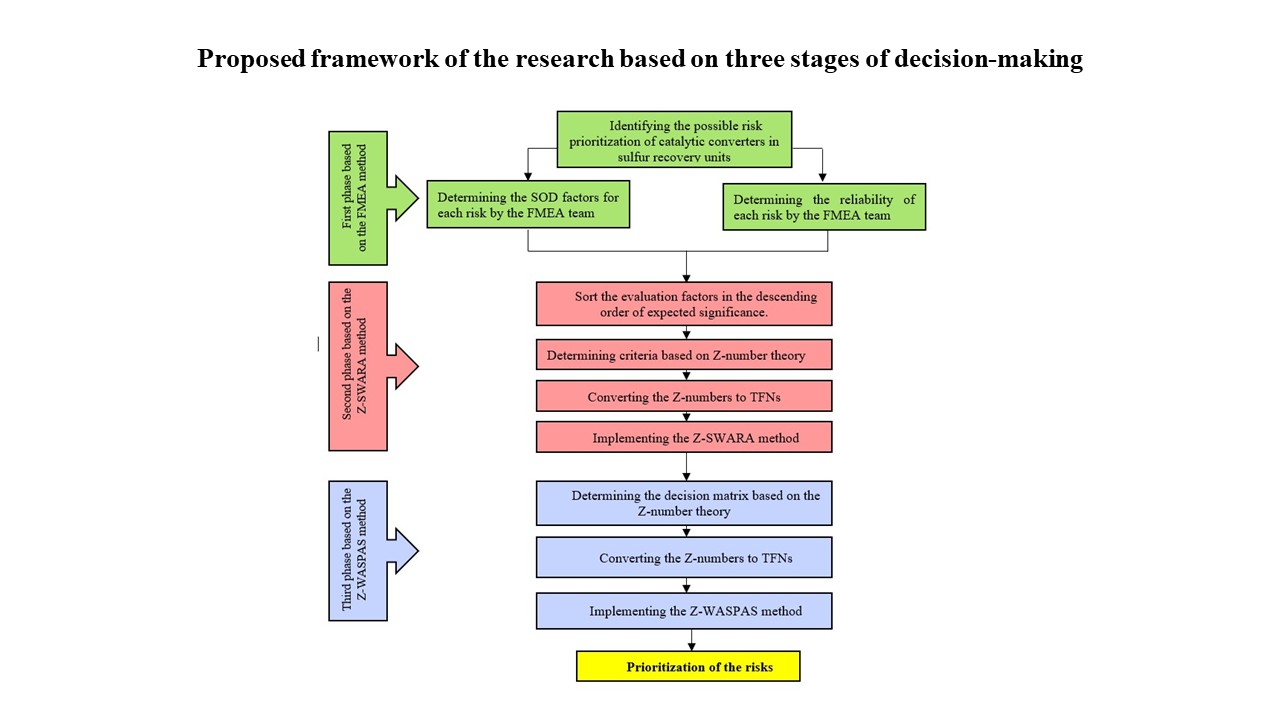
Catalytic converters in sulfur recovery units (SRUs) play a vital role in ensuring efficient sulfur conversion and minimizing hazardous emissions, yet their specific failure modes remain largely understudied. Traditional failure mode and effects analysis-based risk assessment is constrained by equal criterion weighting and by its inability to concurrently address vagueness and the reliability of expert judgments. To address this methodological gap, this study introduces a novel framework that integrates Z-number Stepwise Weight Assessment Ratio Analysis (Z-SWARA) to determine fuzzy reliability-based weights for severity, occurrence, and detection criteria and Z-number Weighted Aggregated Sum Product Assessment (Z-WASPAS) to rank failure modes. This represents the application of this specific hybrid Z-number approach to SRU catalytic converters, explicitly capturing both uncertainty and expert confidence. Expert linguistic evaluations were converted into Z-numbers to construct a realistic weighted decision matrix evaluating 23 identified SRU risk modes. Based on the Z-SWARA results, severity emerged as the most critical criterion (weight = 0.420), followed by occurrence (0.325) and detection (0.256). Furthermore, the Z-WASPAS ranking revealed that the most critical risks are hot spot formation in the catalyst bed (K = 0.83), coke formation on the catalyst (K = 0.78), and malfunction of the inlet control valve (K = 0.77). The results demonstrate that the proposed hybrid approach significantly improves the discriminative power and accuracy of risk prioritization, supporting proactive maintenance and effective risk management in complex process facilities.
- Zahid MA, Ahsan M, Ahmad I, Khan MNA. Process modeling, optimization and cost analysis of a sulfur recovery unit by applying pinch analysis on the Claus process in a gas processing plant. 2021;10(1):88. https://doi.org/10.3390/math10010088
- Jagannath A, Ibrahim S, Raj A. Heat integration in straight-through sulfur recovery units to in- crease net high-pressure steam production. Chem Eng Technol. 2021;44(1):164-173. https://doi.org/10.1002/ceat.202000399
- Gao J, Tian G, Sorniotti A, Karci AE, Di Palo R. Review of thermal management of catalytic converters to decrease engine emissions during cold start and warm up. Appl Therm Eng. 2019;147:177-187. https://doi.org/10.1016/j.applthermaleng.2018. 10.037
- Ebadzadeh F, Monavari SM, Jozi SA, Robati M, Rahimi R. An integrated fuzzy-WASPAS and E- FMEA method for environmental risk assessment: a case study of the petrochemical industry in Iran. Environ Sci Pollut Res. 2023;30(14):40315-40326. https://doi.org/10.1007/s11356-022-25088-w
- Sagharidooz M, Soltanali H, Farinha JT, Raposo HD, de-Almeida-e-Pais JE. Reliability, availability, and maintainability assessment-based sustainability-informed maintenance optimization in power transmission networks. 2024;16(15):6489. https://doi.org/10.3390/su16156489
- Jiang Y, Li Q. Review of hydrogen sulfide purification and purification waste chemical upgrading and reuse technology. Chemical Engineering Communications,2025;212(12):1914-1934. https://doi.org/10.1080/00986445.2025.2503009
- Sadighi S, Masoudian SK, Mohaddecy SRS, Karimi A. Sub-dew point Claus process for reducing hydrogen sulfide emission from sulfur recovery units. Pet Sci Technol. 2025;43(11):1166-1181. https://doi.org/10.1080/10916466.2024.2325592
- Meshram RB, Yadav GD, Marathe KV, Sahoo K. Evaluating the carbon footprint of sulphur recovery unit: a comprehensive analysis. J Environ Chem Eng. 2024;12(2):111916. https://doi.org/10.1016/j.jece.2024.111916
- Benson C, Obasi IC, Akinwande DV, Ile C. The impact of interventions on health, safety and environment in the process industry. Heliyon. 2024;10(1):e23420. https://doi.org/10.1016/j.heliyon.2023.e23604
- Pu S, Pan Y, Zhang L, Lv Y. Recent advances in chemiluminescence and cataluminescence for the detection of volatile sulfur compounds. Appl Spectrosc Rev. 2023;58(6):401-427. https://doi.org/10.1080/05704928.2021.2016792
- Poormirzaee R, Hosseini S, Taghizadeh R. Smart mining policy: integrating fuzzy-VIKOR technique and the Z-number concept to implement Industry 4.0 strategies in mining engineering. Resour Policy. 2022;77:102768. https://doi.org/10.1016/j.resourpol.2022.102768
- Chakhrit A, Benharkat NEH, Guetarni IHM, Guedri A, Chennoufi M. A literature review of risk assessment approaches in failure mode and effects analysis. Int J Qual Reliab Manag. 2025;42(9):2415-2454. https://doi.org/10.1108/IJQRM-01-2025-0042
- Djenadic S, Tanasijevic M, Jovancic P, Ignjatovic D, Petrovic D, Bugaric U. Risk evaluation: brief review and innovation model based on fuzzy logic and MCDM. 2022;10(5):811. https://doi.org/10.3390/math10050811
- Jafarzadeh Ghoushchi S, Shaffiee Haghshenas S, Vahabzadeh S, Shaffiee Haghshenas S, Astarita V, Guido G. Risk assessment of young driver behavior using an extended decision-making approach based on FMEA in uncertain environments. Neural Comput Appl. https://doi.org/10.1007/s00521-025-11087-8
- Enayati Fatollah S, Dabbagh R, Shahsavar Jalavat A. An extended approach using failure modes and effects analysis and weighting methods for assessment of risk factors in the petrochemical industry. Environ Dev Sustain. 2025;27(9):22263- 22288. https://doi.org/10.1007/s10668-022-02609-8
- Ali JA, Khodakarami L, Abdulqadir S, Abdulrahman H, Mazar G. Modified FMEA quality risk management technique for cross-country petroleum pipeline using GIS. Int J Qual Reliab Manag. 2025;42(6):1672-1705. https://doi.org/10.1108/IJQRM-08-2023-0271
- Azadi Chegini M, Farahbod F. Presenting a mathematical model for modeling the catalytic reactors of the Claus process of the sulfur recovery unit. Process Integr Optim Sustain. 2025;9(3):1083-1097. https://doi.org/10.1007/s41660-025-00500-3
- Eftekharzadeh S, Ghoushchi SJ, Momayezi F. Enhancing safety and risk management through an integrated spherical fuzzy approach for managing laboratory errors. Decis Sci Lett. 2024;13(3):545-564. https://doi.org/10.5267/j.dsl.2024.5.006
- Bouraima MB, Qian S, Qiu Y, Badi I, Sangar-Oumar MM. Addressing Human Capital Development Challenges in Developing Countries Using an Interval-spherical Fuzzy Environment. Management Science Advances. 2025;2(1):59-68. https://doi.org/10.31181/msa2120258
- Qian S, Qiu Y, Bouraima MB, Badi I, Chusi TN. (2024). Assessing the Challenges to Leverage Carbon Markets for Renewable Energy in Developing Countries: A Multi-Criteria Decision-Making Approach. Spectr Eng Manag Sci. 2024;2(1):151- 160. https://doi.org/10.31181/sems21202412s
- Ali J, Syam MI, Al-Kenani AN. Decision-making algorithm with complex hesitant fuzzy partitioned Maclaurin symmetric mean aggregation operators and SWARA method. Sci Rep. 2025;15(1):18841. https://doi.org/10.1038/s41598-025-02923-x
- Avramova T, Peneva T, Ivanov A. Overview of existing multi-criteria decision-making methods used in industrial environments. 2025;13(10):444. https://doi.org/10.3390/technologies13100444
- Mohammadi M., et al. Assessing and prioritizing construction contracting risks with an extended FMEA decision-making model in uncertain environments. Spectr Decis Mak Appl. 2026;1(1):12-28. https://doi.org/10.31181/sdmap31202642
- Ishtiaq A, Kubra KT, Uzair A, Ali A. Quantifying multi-cause psychological disorder risk through an advanced mathematical model using intuitionistic pentagonal fuzzy logic. Spectr Oper Res. 2025;2(1):1-21. https://doi.org/10.31181/sor41202762
- Turgay A, Ozyurt S. Dynamic ergonomic risk assessment with REBA and fuzzy multi-criteria decision making: addressing repetitive movements. Spectr Decis Mak Appl. 2025;1(1):45-60. https://doi.org/10.31181/sdmap4157
- Pamuˇcar D, Stevi´c Zˇ, Sremac S. A new model for determining weight coefficients of criteria in MCDM models: full consistency method (FUCOM). 2018;10(9):393. https://doi.org/10.3390/sym10090393
- Zˇiˇzovi´c M, Pamuˇcar D. New model for determining criteria weights: level based weight assessment (LBWA) model. Decis Mak Appl Manag Eng. 2019;2(2):126-143. https://doi.org/10.31181/dmame1902102z
- Zavadskas EK, Kalibatas D, Kalibatiene D. A multi-attribute assessment using WASPAS for choosing an optimal indoor environment. Civ. Mech. Eng. 2016;16(1):76-85. https://doi.org/10.1016/j.acme.2015.10.002
- Aydeniz EG, Gu¨ven I˙, O¨ z¸celik N, C¸ etin HT, U¨ nlu¨ E. Selection of sustainable facade materials for buildings using Fermatean fuzzy AHP and WASPAS methodology. J Intell Fuzzy Syst. 2025;49(5):1175-1197. https://doi.org/10.1177/10641246251328442
- Zadeh LA. A note on Z-numbers. Inf Sci. 2011;181(14):2923-2932. https://doi.org/10.1016/j.ins.2011.02.022
- Sun H, Zhang X. A probability-exponential method of converting Z-numbers and its systematic applications in multi-attribute decision making. J Intell Fuzzy Syst. 2024;46(3):6219-6233. https://doi.org/10.3233/JIFS-235304
- Rahmati S, Mahdavi MH, Ghoushchi SJ, Tomaskova H, Haseli G. Assessment and prioritization of risk factors of financial measurement of management control systems for production companies using hybrid Z-SWARA and Z-WASPAS with FMEA method: a meta-analysis. 2022;10(2):253. https://doi.org/10.3390/math10020253
- Qin M, Liao K, He G, He T, Leng J, Zhang S. Quantitative risk assessment of static equipment in petroleum and natural gas processing stations based on corrosion-thinning failure degree. Process Saf Environ Prot. 2023;172:144-156. https://doi.org/10.1016/j.psep.2023.01.045
- Yang B, Dai J, Zhao Y, Wu J, Ji C, Zhang Y. Advances in preparation, application in contaminant removal, and environmental risks of biochar-based catalysts: a review. 2022;4(1):51. https://doi.org/10.1007/s42773-022-00169-8