
Agentic artificial intelligence-driven digital twin for real-time irrigation control with fuzzy sustainability objectives

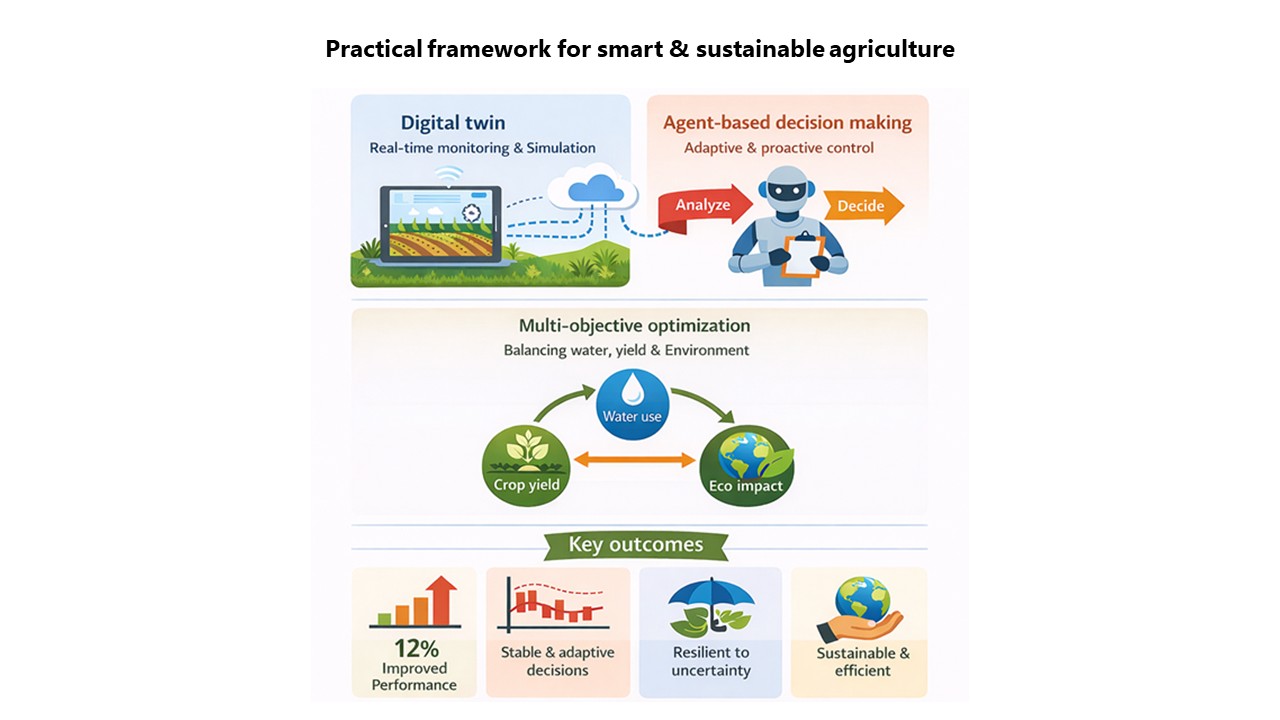
Irrigation management in modern agriculture faces simultaneous challenges, including water scarcity, climate uncertainty, and the need for long-term sustainability. In this study, an integrated framework for real-time irrigation control is presented, in which a digital twin is not merely used as a monitoring or simulation tool but is directly embedded in the decision-making and control loop through an agent-based fuzzy multi-objective optimization mechanism. Unlike conventional smart irrigation approaches that rely on static thresholds or offline optimization, the proposed framework enables adaptive, context-based decision updates by continuously integrating physical system feedback into a dynamic optimization engine. The decision-making agent, by simultaneously assessing soil, climate, and plant growth conditions, generates irrigation policies that balance water consumption, crop growth, and environmental sustainability requirements under fuzzy uncertainty. Experimental results show that using dynamic feedback in the digital twin framework improves the multi-objective performance index by more than 12% compared to the static state and significantly reduces control fluctuations. Convergence, stability under uncertainty, and parameter sensitivity analyses also indicate that the proposed framework can establish a sustainable balance across water resource utilization, crop yield, and environmental considerations. The findings indicate that this approach can provide a practical and reliable platform for transitioning to smart, adaptive, and sustainable irrigation systems.
- Zhao T, Song C, Yu J, Xing L, Xu F, Li W, Wang Z. Leveraging immersive digital twins and AI-driven decision support systems for sustain- able water reserves management: a conceptual framework. Sustainability. 2025;17(8):3754. https://www.doi.org/10.3390/su17083754
- Ahsen R, Di Bitonto P, Novielli P, Magarelli M, Romano D, Diacono D, Tangaro S. Harnessing digital twins for sustainable agricultural water management: a systematic review. Appl Sci. 2025;15(8):4228. https://www.doi.org/10.3390/app15084228
- Yang X, Hou M, Qi F, Dong A, Wang Z. Pol- icy evolution and frameworks in China’s irrigation management informatization: insights from China’s experience from the basics to AI-driven digital twin innovations. Irrig Drain. 2025;74(5):2197-2216. https://www.doi.org/10.1002/ird.70003
- Prasad BK, Raj V, Kumari K, et al. Digital twins in sustainable agriculture in precision irrigation and water management: challenges and future perspectives. In: Srivastav AL, Kumar N, Zini- covscaia I, eds. Digital Twin Technology for Sustainable Agriculture. Springer ;2026. https://www.doi.org/10.1007/978-981-95-5915-2_15
- Awais M, Wang X, Hussain S, Aziz F, Mahmood MQ. Advancing precision agriculture through digital twins and smart farming technologies: a review. AgriEngineering. 2025;7(5):137. https://www.doi.org/10.3390/agriengineering7050137
- Amanatidis P, Lyratzis E, Angelopoulos V, Kouloumpris E, Skaperdas E, Bassiliades N, Vlahavas I, Maris F, Emmanouloudis D, Karampatzakis D. Intelligent water management through edge- enabled IoT, AI, and big data technologies. IoT. 2026;7(1):5. https://www.doi.org/10.3390/iot7010005
- Suthar OP, Parihar V, Kumar M, Verma NK, Kashyap AK. Digital twins and AI: synergizing intelligence for sustainable farm management. In: Srivastav AL, Kumar N, Zinicovscaia I, eds. Digital Twin Technology for Sustainable Agriculture. Springer ; 2026. https://www.doi.org/10.1007/978-981-95-5915-2_19
- Dutta P, Sarma S. Smart water management: role of IoT, AI, and machine learning in water quality monitoring. Water Environ Res. 2026;98(2):e70249. https://www.doi.org/10.1002/wer.70249
- Biswal SR, Choudhury TR, Panda B, Mishra S. AI-enabled energy management for sustainable smart greenhouses: an integrated review. IEEE Access. 2026;14:5482-5509. https://www.doi.org/10.1109/ACCESS.2026.3651685
- Nozari H, Szmelter-Jarosz A. A predictive maintenance approach for composting plants based on ERP and digital twin integration. Machines. 2025;13(12):1123. https://www.doi.org/10.3390/machines13121123
- Ghorbani Bam P, Rezaei N, Roubanis A, Austin D, Austin E, Tarroja B, Takacs I, Villez K, Rosso D. Digital twin applications in the water sector: a review. Water. 2025;17(20):2957. https://www.doi.org/10.3390/w17202957
- Guo Y, Chen C, Luo X, Martek I. Critical drivers and barriers of digital twin adoption in water infrastructure: an environmental, social, governance, and financial perspective. Sustain Dev. 2025;33(2):1623-1648. https://www.doi.org/10.1002/sd.3196
- Nozari H. Integrating neuromorphic intelligence with fuzzy multi-objective models in resilient green supply chain design. Process Integr Optim Sustain. 2025. https://www.doi.org/10.1007/s41660-025-00598-5
- Surianarayanan C, Lawrence JJ, Chelliah PR, Prakash E, Hewage C. A survey on optimization techniques for edge artificial intelligence (AI). Sensors. 2023;23(3):1279. https://www.doi.org/10.3390/s23031279
- Ayoub A. Integration of artificial intelligence in food processing technologies. Processes. 2026;14(3):513. https://www.doi.org/10.3390/pr14030513
- Wang X, Choi D, Adams D, Ahn J, Balmant K, Dias R, Messina CD, Mun˜oz-Carpena R, Whitaker VM, Yu H, Yu Z, Zhao C, Li C. Artificial intelligence-powered plant phenomics: progress, challenges, and opportunities. Plant Phenome J. 2026;9:e70060. https://www.doi.org/10.1002/ppj2.70060
- Gacu JG, Monjardin CEF, Mangulabnan RGT, t GCE, Solmerin JG. Artificial intelligence in surface water management: a comprehensive review of methods, applications, and challenges. Water. 2025;17(11):1707. https://www.doi.org/10.3390/w17111707
- Razavi HS, Nejadhashemi AP, Deb K, Toscano G, Harrigan T, Linker L. Artificial intelligence, optimization, and modeling techniques in water resource management: interconnections and emerging synergies. Water Environ Res. 2026;98(1):e70246. https://www.doi.org/10.1002/wer.70246
- Nozari H, Yordanova Z. A fuzzy-digital twin optimization framework for simultaneous manage- ment of waste and energy consumption in sustain- able manufacturing. Int J Optim Control Theor Appl. 2025. https://www.doi.org/10.36922/IJOCTA025360152
- Rao S, Neethirajan S. Computational architectures for precision dairy nutrition digital twins: a technical review and implementation framework. Sensors. 2025;25(16):4899. https://www.doi.org/10.3390/s25164899
- Mohamed AMO, Mohamed D, Fayad A, Al Nahyan MT. Enhancing decision making and decarbonation in environmental management: a review on the role of digital technologies. Sustain- ability. 2024;16(16):7156. https://www.doi.org/10.3390/su16167156
- Aparnna VP, Roy K, Singh S, Rose H, Khamrui K, Gautam AK. Recent advancements in the ap- plication of blockchain, IoT, and fuzzy systems in food science and bioprocess development. In: Artificial Intelligence in Food Science. Academic Press; 2026:281-302. https://www.doi.org/10.1016/B978-0-443-26468-9.00012-6
- Nozari H, Szmelter-Jarosz A, Samadi S. Machine learning models for energy optimization and re- source consumption in smart factories. In: Nozari H, ed. Artificial Intelligence of Everything and Sustainable Development. Springer https://www.doi.org/10.1007/978-981-96-7202- 8_10
- Kang M, Wang X, Wang H, Hua J, de Reffye P, Wang FY. The development of AgriVerse: past, present, and future. IEEE Trans Syst Man Cybern Sys 2023;53(6):3718-3727. https://www.doi.org/10.1109/TSMC.2022.3230830
- Rana R, Bhambri P. AI-driven MCDM tools for optimizing industrial wastewater treatment. In: Smarandache F, Majumder P, eds. Modern SuperHyperSoft Computing Trends in Science and Technology. IGI Global; 2025:61-106. https://www.doi.org/10.4018/979-8-3693-6875-6.ch003
- Violos J, Mamanis G, Kompatsiaris I, et al. Cognition and context-aware decision-making systems for a sustainable planet: a survey on recent advancements, applications and open challenges. Discov Sustain. 2025;6:235. https://www.doi.org/10.1007/s43621-025-00954-y
- Bai X, Zhang X. Artificial intelligence-powered materials science. Nano Micro Let 2025;17:135. https://www.doi.org/10.1007/s40820-024-01634-8
- Bassanelli S, Bucchiarone A, Wanick V, Oz Buruk O. Immersive gamification in the metaverse for sustainable development: state of the art and guidelines. In: Hui P, Zhou PY, Lee LH, Braud T, eds. Handbook of the Metaverse. Springer ; 2026. https://www.doi.org/10.1007/978-3-032-03296-6 8
- Ali ZA, Zain M, Hasan R, et al. Digital twins: cornerstone to circular economy and sustainability goals. Environ Dev Sustain. 2025. https://www.doi.org/10.1007/s10668-025-06221-4
- Zaghdoud R, Zidi I, Rhaiem OB, El Khediri S, Mesghouni K. A hybrid NSGA-II and delayed local search approach for home healthcare scheduling and routing optimization. Appl Soft Comput. 2026;114617. https://www.doi.org/10.1016/j.asoc.2026.114617
- Letsoalo MR, Mkhohlakali A, Bungani T, Mukwevho N, Toona P, Mokgosi D, Tshilongo J. Digital approaches in water quality management: transitioning conventional techniques to digitalisation. In: Handbook of Digitalization and Big Data in the Water Sector. CRC Press. https://www.doi.org/10.1201/9781003536079-2
- Mahmood GG, Sacco P, Carabin G, Mazzetto F. Farm-level operational monitoring in smart agriculture: review and classification framework. Sustainability. 2026;18(1):419. https://www.doi.org/10.3390/su18010419
- Nozari H, Yordanova Z. An adaptive fuzzy multi- objective digital twin framework for multi-depot cold-chain vehicle routing in agri-biotech supply networks. Logistics. 2026;10(2):27. https://www.doi.org/10.3390/logistics10020027
- Smaldone F, Supino S, Sica D, Esposito B. Profiling employability skills for the digital and circular transition in the agri-food sector: a big data analysis. Br Food J. 2026. https://www.doi.org/10.1108/BFJ-04-2025- 0525
- Morchid A, Qjidaa H, Alami RE, et al. Smart irrigation-based internet of things and cloud computing technologies for sustainable farming. Sci Rep. 2026;16:5293. https://www.doi.org/10.1038/s41598-026-35810-0
- Morchid A, Jebabra R, Alami RE, Charqi M, Boukili B. Smart agriculture for sustainability: the implementation of smart irrigation using real-time embedded system technology. In: 2024 4th Int Conf Innov Res Appl Sci Eng Technol (IRASET). IEEE ; 2024:1-6. https://www.doi.org/10.1109/IRASET60544.2024.10548972
- Toufighi SP, Tafazoli R, Habibi S, Vang J. A Delphi-informed fuzzy multi-criteria decision framework for prioritizing sustainable development goals in industrial strategy: an application to the paint and coatings sector. J Ind Inf Integr. 2026;101091. https://www.doi.org/10.1016/j.jii.2026.101091
- Benzidia S, Makaoui N, Bentahar O. The impact of big data analytics and artificial intelligence on green supply chain process integration and hospital environmental performance. Technol Forecast Soc Change. 2021;165:120557. https://www.doi.org/10.1016/j.techfore.2020.120557
- Kontos G, Soumplis P, Makris P, Varvarigos E. Multi-objective hierarchical edge infrastructure design for service chain workloads: a MOEA/D- driven joint planning and operation approach. Comput Netw. 2026;111988. https://www.doi.org/10.1016/j.comnet.2025.111988
- Pan F, Gao Q, Feng XX, Li WX. Improvements to MOPSO. In: Particle Swarm Optimizer and Multi-Objective Optimization. Springer ; 2025. https://www.doi.org/10.1007/978-981-95-3381-7_9
- Hu Z, Guan C, Li T, Tao Y, Xiong T, Wu W, Romagnoli A. Enhanced MOEA/D and response surface methodology for multi-objective optimization of multi-zone borehole thermal energy storage. Energy Convers Manag. 2026;349:120829. https://www.doi.org/10.1016/j.enconman.2025.120829
- Boujelbene M, Basem A, Sawwan H, Samad S, Hamida MBB, Amari A, Mahariq I. Multi- objective optimization of a biogas-fueled multi- generation system with a supercritical CO2-based power and multi-level cooling cycle: a hybrid ANN-MOPSO approach. Fuel. 2026;405:136687. https://www.doi.org/10.1016/j.fuel.2025.136687