

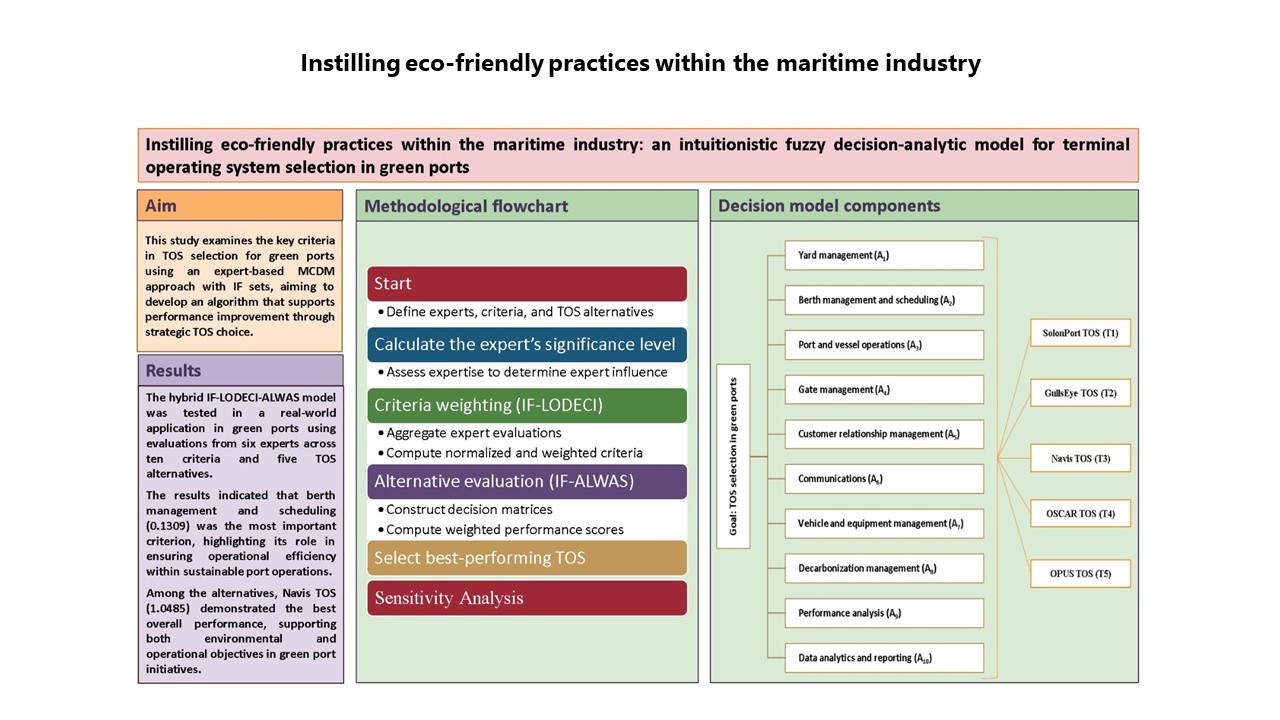
Instilling eco-friendly practices within the maritime industry: An intuitionistic fuzzy decision-analytic model for terminal operating system selection in green ports

Green port operations require efficient and sustainable terminal management, supported by robust decision-making tools for selecting a terminal operating system (TOS). This research examines the complex process of selecting TOS in the context of green ports, aiming to identify the key criteria that influence the preference for TOS in facilitating port services. The study develops an intuitionistic fuzzy (IF) set-based hybrid decision-analytic model for TOS selection to enhance the overall performance of green ports. The IF–logarithmic decomposition of criteria importance (LODECI)–Aczel–Alsina Weighted Assessment (ALWAS) model was introduced. The IF–LODECI method was formulated for criterion weighting. It incorporated the maximum decomposition approach for robust weight stabilization. The IF–ALWAS method, based on the ALWAS method, was proposed to evaluate alternatives. The new hybrid decision-analytic model integrated Aczel–Alsina t-norm and t-conorm operations, with the IF–Aczel–Alsina weighted averaging operator as the final step. The application of the model was exemplified through a case study conducted at green ports in Türkiye, focusing on environmentally conscious criteria for TOS selection, involving six experts, 10 criteria, and five alternatives. The results revealed that “berth management and scheduling” was identified as the most significant criterion, while “Navis TOS” demonstrated the highest overall performance among the alternatives. Rigorous sensitivity analyses were conducted to validate the robustness of the proposed hybrid model and algorithm. This study presents a comprehensive decision-making framework for selecting TOS in green ports, bridging the gap between theoretical advancements and practical applications.
- European Environment Agency. Greenhouse gas emissions from transport in Europe. EEA. https://www.eea.europa.eu/data-and-maps/daviz/greenhouse-gas-emissions-from-transport-8#tab-chart 1
- Review of maritime transport 2023 towards green and just transition. UNC- TAD. https://unctad.org/system/files/official-document/rmt2023 en.pdf
- Filonchyk M, Peterson MP, Yan H, et al. Greenhouse gas emissions and reduction strategies for the world’s largest greenhouse gas emitters. Sci Total Environ. 2024;944:173895. https://doi.org/10.1016/j.scitotenv.2024.173895
- International Maritime Organization. Marine environment protection committee (MEPC). IMO. https://www.imo.org/en/MediaCentre/MeetingSummaries/Pages/MEPC-79th-session.aspx
- Dinis DC, Figueira JR, Teixeira AˆP. A multiple criteria approach for ship risk classification: an alternative to the Paris MoU Ship Risk Profile. Socioecon Plann Sci. 2023;90:101718. https://doi.org/10.1016/j.seps.2023.101718
- Yal¸cın GC, Kara K, Toygar A, Simic V, Pa- mucar D, K¨oleo˘glu N. An intuitionistic fuzzy- based model for performance evaluation of Eco- Ports. Eng Appl Artif Intell. 2023;126(D):107192. https://doi.org/10.1016/j.engappai.2023.107192
- Wang B, Liu Q, Wang L, Chen Y, Wang J. A review of the port carbon emission sources and related emission reduction technical measures. Environ Pollut. 2023:121000. https://doi.org/10.1016/j.envpol.2023.121000
- Jin Selection of virtual team members for smart port development projects through the application of the direct and indirect uncertain TOPSIS method. Expert Syst Appl. 2023; 217:119555. https://doi.org/10.1016/j.eswa.2023.119555
- Li X, Peng Y, Guo Y, Wang W, Song X. An integrated simulation and AHP- entropy-based NR-TOPSIS method for automated container terminal layout planning. Expert Syst 2023;225:120197. https://doi.org/10.1016/j.eswa.2023.120197
- Ayfantopoulou G, Tsoukos G, Stathacopoulos A, Bizakis A, Gagatsi E. Greener port performance through ICT. In: Sustainable Development of Sea-Corridors and Coastal Waters: The TEN ECOPORT Project in South- east Europe. New York: Springer; https://doi.org/10.1007/978-3-319-11385-2 23
- Iris C¸ Lam JSL. A review of energy efficiency in ports: Operational strategies, technologies and energy management systems. Re- new Sustain Energy Rev. 2019;112:170-182. https://doi.org/10.1016/j.rser.2019.04.069
- Gekara VO, Nguyen XVT. Challenges of implementing container terminal operating system: the case of the port of Mombasa from the Belt and Road Initiative (BRI) perspective. J Int Logist Trade. 2020;18(1):49-60. https://doi.org/10.24006/jilt.2020.18.1.049
- Tsertou A, Amditis A, Latsa E, Kanellopoulos I, Kotras M. Dynamic and synchromodal container consolidation: the cloud computing enabler. Transp Res Procedia. 2016;14:2805-2813. https://doi.org/10.1016/j.trpro.2016.05.345
- Sdoukopoulos E, Boile M, Tromaras A, Anastasiadis N. Energy efficiency in European ports: state-of-practice and insights on the way forward. Sustainability. 2019;11(18):4952. https://doi.org/10.3390/su11184952
- Xu B, Wang H, Li J. Evaluation of operation cost and energy consumption of ports: comparative study on different container terminal layouts. Simul Model Pract Theory. 2023;127:102792. https://doi.org/10.1016/j.simpat.2023.102792
- Asif M, Ishtiaq U, Zeb A, Ahmad W, Hou M. Aczelalsina aggregation operators for pythagorean fuzzy linear diophantine set and application to multiple-attribute decision-making problem related to medical diagnosis. Int J Fuzzy Syst. 2024;27:1-15. https://doi.org/10.1007/s40815-024-01842-9
- Asif M, Zeb A, Ishtiaq U, Ahmad W, Hou M. Aczel-Alsina aggregation operators for linear diophantine fuzzy set and their application to multiple-attribute decision making problems. Expert Syst Appl. 2025;271:126552. https://doi.org/10.1016/j.eswa.2025.126552
- Herv´as-Peralta M, Poveda-Reyes S, Molero GD, Santarremigia FE, Pastor-Ferrando JP. Improving the performance of dry and maritime ports by increasing knowledge about the most relevant functionalities of the Terminal Operating System (TOS). Sustainability. 2019;11(6):1648. https://doi.org/10.3390/su11061648
- Golias M, Boile M, Theofanis S, Efstathiou C. The berth-scheduling problem: maximizing berth productivity and minimizing fuel consumption and emissions production. Transp Res Rec. 2010;2166(1):20-27. https://doi.org/10.3141/2166-03
- Sahraoui A, Tran NK, Tliche Y, Kacem A, Taghipour A. Examining ICT innovation for sustainable terminal operations in developing countries: a case study of the Port of Rad`es in Tunisia. Sustainability. 2023;15(11):9123. https://doi.org/10.3390/su15119123
- Kara K, Yal¸cın GC, Acar AZ, Simic V, Konya S, Pamucar The MEREC- AROMAN method for determining sustain- able competitiveness levels: a case study for Türkiye. Socio-Econ Plan Sci. 2024;91:101762. https://doi.org/10.1016/j.seps.2023.101762
- Moslem S, Gu¨ndo˘gdu FK, Saylam S, Pilla F. A hybrid decomposed fuzzy multi-criteria decision-making model for optimizing parcel lockers location in the last-mile delivery land- scape. Appl Soft Comput. 2024;154:111321. https://doi.org/10.1016/j.asoc.2024.111321
- Karagoz S, Deveci M, Simic V, Aydin N, Bolukbas U. A novel intuitionistic fuzzy MCDM based CODAS approach for locating an authorized dismantling centre: a case study of Istanbul. Waste Manag Res. 2020;38(6):660-672. https://doi.org/10.1177/0734242X19899729
- Majumder P, Bhowmik P, Das A, Senap- ati T, Simic V, Pamucar D. An intuitionistic fuzzy based hybrid decision-making approach to determine the priority value of indicators and its application to solar energy feasibility analysis. 2023;295:171492. https://doi.org/10.1016/j.ijleo.2023.171492
- Jin LS,Yager RR, Ma C, et al. Intuition- istic fuzzy type basic uncertain information. Iran J Fuzzy Syst. 2023;20(5):189-197. https://doi.org/10.22111/ijfs.2023.7840
- Jin L, Mesiar R, Senapati T, et al. Ordered weighted geometric averaging operators for basic uncertain information. Inform Sci. 2024;663:120275. https://doi.org/10.1016/j.ins.2024.120275
- Saeed M, Saeed MH, Shafaqat R, Sessa S, Ishtiaq U, Di Martino F. A theoretical development of cubic pythagorean fuzzy soft set with its application in multi-attribute decision making. Symmetry. 2022;14(12):2639. https://doi.org/10.3390/sym14122639
- Majid SZ, Saeed M, Ishtiaq U, Argyros IK. The development of a hybrid model for dam site selection using a fuzzy hypersoft set and a plithogenic multipolar fuzzy hypersoft Foundations. 2024;4(1):32-46. https://doi.org/10.3390/foundations4010004
- Ishtiaq U, Hussain A, Al Sulami H. Certain new aspects in fuzzy fixed point theory. AIMS Math. 2022;7(5):8558-8573. https://doi.org/10.3934/math.2022477
- Senapati T, Chen G, Mesiar R, Yager RR. Intuitionistic fuzzy geometric aggregation operators in the framework of Aczel-Alsina triangular norms and their application to multiple attribute decision making. Expert Syst Appl. 2023;212:118832. https://doi.org/10.1016/j.eswa.2022.118832
- Senapati T, Simic V, Saha A, Dobrodolac M, Rong Y, Tirkolaee EB. Intuitionistic fuzzy power Aczel-Alsina model for prioritization of sustainable transportation sharing practices. Eng Appl Artif Intell. 2023;119:105716. https://doi.org/10.1016/j.engappai.2022.105716
- Majumder P, Bhowmik P, Das A, Senap- ati T, Simic V, Pamucar D. An intuitionistic fuzzy based hybrid decision-making approach to determine the priority value of indicators and its application to solar en- ergy feasibility analysis. Optik. 2023;295:171492. https://doi.org/10.1016/j.ijleo.2023.171492
- Deveci M, Gokasar I, Pamucar D, Zaidan AA, Wei W, Pedrycz W. Advantage prioritization of digital carbon footprint awareness in optimized urban mobility using fuzzy Aczel Alsina based decision making. Appl Soft Comput. 2024;151:111136. https://doi.org/10.1016/j.asoc.2023.111136
- Rani P, Alrasheedi AF, Mishra AR, Cavallaro F. Interval-valued Pythagorean fuzzy operational competitiveness rating model for assessing the metaverse integration options of sharing economy in transportation sector. Appl Soft Comput. 2023;148:110806. https://doi.org/10.1016/j.asoc.2023.110806
- Senapati T, Chen G, Yager RR. Aczel–Alsina aggregation operators and their application to intuitionistic fuzzy multiple attribute decision making. Int J Intell Syst. 2022;37(2):1529-1551. https://doi.org/10.1002/int.22684
- Pala Assessment of the social progress on European Union by logarithmic decomposition of criteria importance. Expert Syst Appl. 2024;238:121846. https://doi.org/10.1016/j.eswa.2023.121846
- Pamucar D, Ecer F, Gligori´c Z, Gligori´c M, Deveci M. A novel WENSLO and AL- WAS multicriteria methodology and its application to green growth performance evaluation. IEEE Trans Eng Manag. 2023;71:9510-9525 https://doi.org/10.1109/TEM.2023.3321697
- Atanassov KT, Stoeva S. Intuitionistic fuzzy sets. Fuzzy Sets Syst. 1986;20(1):87-96. https://doi.org/10.1016/S0165-0114(86)80034-3
- Aczel J, Alsina C. Characterizations of some classes of quasilinear functions with applications to triangular norms and to synthesizing judgements. Aequ Math. 1982;25(1):313-315. https://doi.org/10.1007/BF02189626
- Tripathi DK, Nigam SK, Rani P, Shah AR. New intuitionistic fuzzy parametric divergence measures and score function-based CoCoSo method for decision-making problems. Decis Making: Appl Manag Eng. 2023;6(1):535-563. https://doi.org/10.31181/dmame0318102022t
- Ecer F, B¨oyu¨kaslan A, Hashemkhani Zolfani S. Evaluation of cryptocurrencies for investment decisions in the era of Industry 4.0: a borda count-based intuitionistic fuzzy set extensions EDAS-MAIRCA-MARCOS multi-criteria methodology. Axioms. 2022;11(8):404. https://doi.org/10.3390/axioms11080404
- Alieksieiev V, Kovalenko V, Stryzhak V, et al. Towards the improvement of yard management systems (YMS) using radio frequency identification (RFID). In: International Conference on Reliable Systems Engineering. Cham: Springer International Publishing. 2022:222-232. https://doi.org/10.1007/978-3-031-15944-2 21
- Yu H, Deng Y, Zhang L, Xiao X, Tan C. Yard operations and management in automated container terminals: a review. Sustainability. 2022;14(6):3419. https://doi.org/10.3390/su14063419
- Fatemi-Anaraki S, Tavakkoli-Moghaddam R, Abdolhamidi D, Vahedi-Nouri B. Simultaneous waterway scheduling, berth allocation, and quay crane assignment: a novel matheuristic approach. Int J Prod Res. 2021;59(24):7576-7593. https://doi.org/10.1080/00207543.2020.1845412
- Golias MM, Saharidis GK, Boile M, Theofanis S, Ierapetritou MG. The berth al- location problem: optimizing vessel arrival time. Marit Econ Logis. 2009;11:358-377. https://doi.org/10.1057/mel.2009.12
- Zanne M, Twrdy E, Beˇskovnik B. The effect of port gate location and gate procedures on the port-city relation. Sustainability. 2021;13(9):4884. https://doi.org/10.3390/su13094884
- Guan C, Liu Container terminal gate appointment system optimization. Marit Econ Logis. 2009;11:378-398. https://doi.org/10.1057/mel.2009.13
- Caliskan A, Esmer An assessment of port and shipping line relationships: the value of relationship marketing. Marit Policy Manag. 2020;47(2);240-257. https://doi.org/10.1080/03088839.2019.1690172
- Yau KLA, Peng S, Qadir J, Low YC, Ling Towards smart port infrastructures: enhancing port activities using information and communications technology. IEEE Access. 2020;8:83387-83404. https://doi.org/10.1109/ACCESS.2020.2990961
- Min H. Developing a smart port architecture and essential elements in the era of Indus- try 4.0. Marit Econ Logis. 2022;24(2):189-207. https://doi.org/10.1057/s41278-022-00211-3
- Lam JSL, Notteboom T. The greening of ports: a comparison of port management tools used by leading ports in Asia and Europe. Transp Rev. 2014;34(2):169-189. https://doi.org/10.1080/01441647.2014.891162
- Buonomano A, Del Papa G, Giuzio GF, Palombo A, Russo G. Future pathways for decarbonization and energy efficiency of ports: modelling and optimization as sustainable energy hubs. J Cleaner Prod. 2023;420:138389. https://doi.org/10.1016/j.jclepro.2023.138389
- Alamoush AS, O¨ l¸cer AI, Ballini F. Ports’ role in shipping decarbonisation: a common port incentive scheme for shipping greenhouse gas emissions Cleaner Logis Supply Chain. 2022;3:100021. https://doi.org/10.1016/j.clscn.2021.100021
- Yap WY, Ho J. Port strategy and performance: empirical evidence from major container ports and implications for role of data analytics. Marit Policy Manag. 2023;50(5):608-628. https://doi.org/10.1080/03088839.2021.2017040
- SolonPort Terminal Operating System. https://solonport.com/
- GullsEye Terminal Operating System. https://www.gullseye.com/en. Accessed: 2023
- Navis Terminal Operating System. https://www.jadelogistics.com/. Accessed: 2023
- Terminal Operating System. https://tgims.com/container-and-roro-management-software/. Accessed: 2023
- Terminal Operating System. https://www.cyberlogitec.com/en/sub/solution/port/opus terminal.php. Accessed: 2023