

Response control of buoyant leg storage and regasification platform using magnetorheological dampers

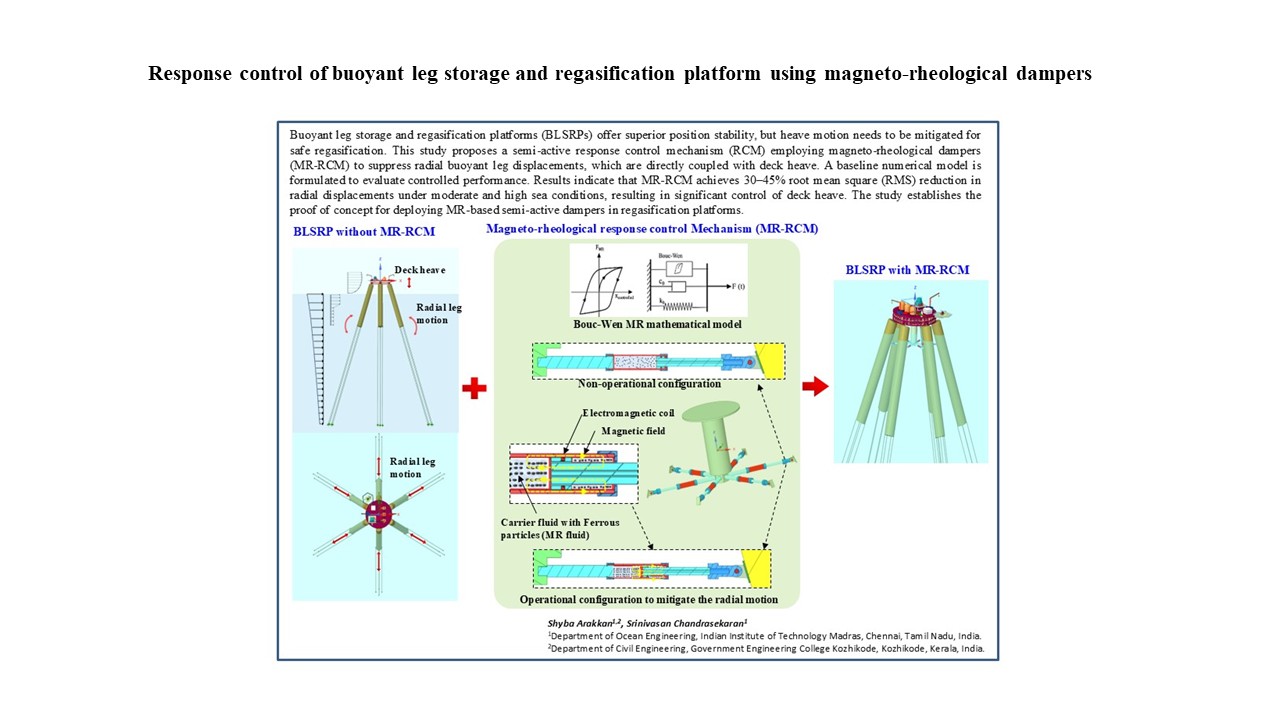
The rising demand for liquefied natural gas (LNG) has spurred research into offshore regasification platforms as a reliable solution to meet global energy needs. Buoyant leg storage and regasification platforms (BLSRPs) offer superior positional stability compared to ship-shaped alternatives; however, heave motion needs to be mitigated for safe regasification. This study proposes a semi-active response control mechanism (RCM) employing magnetorheological (MR) dampers to suppress radial buoyant leg displacements, which are directly coupled with deck heave. A baseline numerical model of the BLSRP was developed in AQWA software without an RCM, and a mathematical model incorporating the MR-RCM was formulated to evaluate the controlled system performance. Unlike previous BLSRP studies, we explicitly incorporated combined wave–wind–current environmental loading conditions. Transformation matrices were established to convert radial responses into deck heave, with influence factors calibrated for varying sea states and approach angles. Results indicate that the MR-RCM achieves 30–45% root-mean-square reductions in radial displacements under moderate and high sea conditions, resulting in significant control of deck heave. Even under very high sea states, 8–11% reductions are maintained, preventing uncontrolled escalation. Hysteresis plots validate the nonlinear energy dissipation of MR dampers and their adaptability to broadband excitations. The findings demonstrate that MRRCM improves platform stability, reduces boil-off gas generation, and enhances safety in LNG operations. Overall, the study establishes MR-based semi-active damping as a practical and scalable solution for offshore platforms, bridging the limitations of passive devices and the complexities of fully active systems.
- Banaszkiewicz T, Chorowski M, Gizicki W, et al. Liquefied natural gas in mobile applications—opportunities and challenges. Energies. 2020;13(21):5673. https://www.doi.org/10.3390/en13215673
- Semaskaite V, Bogdevicius M, Paulauskiene T, Uebe J, Filina-Dawidowicz L. Improvement of regasification process efficiency for floating storage regasification unit. J Mar Sci Eng. 2022;10(7):897. https://www.doi.org/10.3390/jmse10070897
- Giranza MJ, Bergmann A. An economic evaluation of onshore and floating liquefied natural gas receiving terminals: the case study of Indonesia. IOP Conf Ser Earth Environ Sci. 2018;150:012026. https://www.doi.org/10.1088/1755-1315/150/1/012026
- Naveiro M, Romero G´omez M, Arias Fern´andez I, Baalin˜a Insua A´. Energy efficiency and environmental measures for floating storage regasification units. J Nat Gas Sci Eng. 2021;96:104271. https://www.doi.org/10.1016/j.jngse.2021.104271
- Naveiro M, G´omez MR, Fern´andez IA, G´omez J. Exploitation of liquefied natural gas cold energy in floating storage regasification units. Brodogradnja. 2021;72(4):47-78. https://www.doi.org/10.21278/brod 72404
- American Bureau of Shipping (ABS). Guide for Building and Classing – Floating Offshore Liquefied Gas Terminals. ABS; 2018.
- Det Norske Veritas Germanischer DNVGL-RP-C205: Environmental Conditions and Environmental Loads. DNV; 2019. https://www.dnv.com
- Milioulis K, Bolbot V, Theotokatos G, et al. Safety analysis of a high-pressure fuel gas supply system for LNG-fuelled vessels. Proc Inst Mech Eng Part M J Eng Marit Environ. 2022;236(4):1025-1046. https://www.doi.org/10.1177/14750902221078426
- Chandrasekaran S, Lognath RS. Dynamic analyses of buoyant leg storage and regasification platform: numerical studies. Mar Syst Ocean Technol. 2017;12(2):39-48. https://www.doi.org/10.1007/s40868-017-0022-6
- Chandrasekaran S, Lognath RS. Dynamic analyses of buoyant leg storage regasification platform under regular waves: experimental investigations. Ships Offshore Struct. 2017;12(2):227-232. https://www.doi.org/10.1080/17445302.2015.1131006
- Chandrasekaran S, Kiran PA. Mathieu stability of offshore buoyant leg storage and regasification platform. Ocean Syst Eng. 2018;8(3):345-360. https://www.doi.org/10.12989/ose.2018.8.3.345
- Liang X, Zhang Y, Ge SS, How B, Li D. Dynamic control for LNG carrier with output constraints. IET Control Theory Appl. 2022;16(7):729-740. https://www.doi.org/10.1049/cth2.12264
- Katsimpini P, Papagiannopoulos G, Hatzigeorgiou G. Innovative supplementary dampers for enhancing seismic behavior of structural systems. Appl Sci. 2025;15(3):1226. https://www.doi.org/10.3390/app15031226
- Kandasamy R, Cui F, Townsend N, et al. A review of vibration control methods for marine off- shore structures. Ocean Eng. 2016;127:279-297. https://www.doi.org/10.1016/j.oceaneng.2016. 10.001
- Suja TP, Chandrasekaran S. Response control of TLP with single tuned mass damper under wind, wave, and current loads. Mar Technol Res. 2025;7(1):1-24. https://doi.org/10.33175/mtr.2025.272515
- You YS, Song KY, Sun MY. Variable natural frequency damper for minimizing response of offshore wind turbine. J Mar Sci Eng. 2022;10(7):983. https://www.doi.org/10.3390/jmse10070983
- Zhang Y, Ma H, Xu J, Su H, Zhang J. Model reference adaptive vibration control of an offshore platform considering marine environment approximation. J Mar Sci Eng. 2023;11(1):138. https://www.doi.org/10.3390/jmse11010138
- Chandrasekaran S, Srivastava G. Design Aids of Offshore Structures Under Special Environmental Loads Including Fire Resistance. Springer; 2017. https://www.doi.org/10.1007/978-981-10-7608-4
- Zakerzadeh M, Mohsenian A, Zakerzadeh MR, Shariat Panahi M, Fakhrzadeh A. Modeling SMA-actuated systems based on the Bouc–Wen hysteresis model and feed-forward neural net- work. J Comput Appl Mech. 2017;48(2):185-200. https://www.doi.org/10.22059/jcamech.2017. 151
- Wang SQ, Li N. Semi-active vibration control for offshore platforms based on LQG method. J Mar Sci Technol. 2013;21(5):562-568. https://www.doi.org/10.6119/JMST-012-0917-2
- Hua D, Liu X, Li Z, Fracz P, Hnydiuk-Stefan A, Li Z. Structural configurations of magnetorheological fluid-based devices: a review. Front Mater. 2021;8:640102. https://www.doi.org/10.3389/fmats.2021.640102
- Ravare D, Mhatre P, Alam H, Sayed A. Magnetorheological damper. Int J Res Publ Rev. 2024;5. https://ijrpr.com/uploads/v5issue3/ijrpr23632.pdf
- Spencer BF Jr, Dyke SJ, Sain MK, Carlson JD. Phenomenological model for magnetorheological dampers. J Eng Mech. 1997;123(3):230-238. https://www.doi.org/10.1061/(asce)0733- 9399(1997)123:3(230)
- Jiang Z, Spencer BF Jr, Sain MK, Carlson JD. Modeling and control of magnetorheological dampers for seismic response reduction. Smart Mater Struct. 1996;5(5):566-576. https://www.doi.org/10.1088/0964-1726/5/5/006
- Ambhore N, Hivarale S, Pangavhane DR. Bouc–Wen model of magnetorheological fluid damper for vibration control. Int J Eng Res Technol. 2013;2(2). https://www.ijert.org/research/a-study-of-bouc-wen-model-of-magnetorheological-fluid- damper-for-vibration-control-ijertv2is2296.pdf
- Heredia PM, Alvarez DA, Bedoya RD. Bouc–Wen class model of hysteresis: evolution, and current state. Arch Comput Methods Eng. 2025. https://www.doi.org/10.1007/s11831-025-10301-z
- Negash BA, You W, Lee J, Lee K. Parameter identification of Bouc–Wen model damper using genetic algorithm. Adv Mech Eng. 2020;12(8). https://www.doi.org/10.1177/1687814020950546
- Oh S, Kim T, Song J. Bouc–Wen class models considering hysteresis mechanism of RC columns. Int J Non Linear Mech. 2023;148:104263. https://www.doi.org/10.1016/j.ijnonlinmec.2022.104263
- Fabrizio M, Lazzari B, Morro A. Mathematical models and methods for smart materials. In: Proceedings of the International School on Mathematical Theory in Smart Materials; 2001. Cortona, Italy. World Scientific; 2002. https://www.doi.org/10.1142/5162
- Hokmabady, H., Mohammadyzadeh, S., Mojtahedi, A. Suppressing structural vibration of a jacket-type platform employing a novel MR-tuned liquid column gas damper. Ocean Eng. 2019;180:60-70.2007.12.007
- Syed KAA, Kumar D. Response and control of jacket structure with magnetorheological damper at multiple locations. Ocean Syst Eng. 2018;8(2):201-221. https://www.doi.org/10.12989/ ose.2018.8.2.201
- Dutta S, Chakraborty G. Performance analysis of nonlinear vibration isolator with MR damper. J Sound Vib. 2014;333(20):5097-5114. https://www.doi.org/10.1016/j.jsv.2014.05.028
- Høgsberg J, Krenk S. Energy dissipation control of magnetorheological damper. Probab Eng Mech. 2008;23(2-3):188-197. https://www.doi.org/10.1016/j.probengmech.2007.12.007
- Spencer, B.F. Jr, Nagarajaiah, S. State of the art of structural control. J Struct Eng. 2003;129(7):845-856. https://www.doi.org/10.1061/(asce)0733–9445
- Arakkan S, Chandrasekaran S. Mitigating heave response for safer LNG operations: numerical study on offshore BLSRP. In: Proceedings of the ISOPE Conference; 2025; ISOPE-I-25-143.
- Srilekha M, Dutta A. Design and optimization of boil-off gas recondensation by recovering waste cold energy in LNG regasification terminals. Chem Eng Res Des. 2024;205:292- 300. https://www.doi.org/10.1016/j.cherd.2024.03.041
- Arakkan S, Chandrasekaran S. International Conference on Oceanography and Marine Biology. 2024;63. https://scisynopsisconferences-.com/uploads/conferences/oceanography 73/170497182.pdf
- Chauhan V, Kumar A, Sham R. Magnetorheological fluids: a comprehensive review. Manuf Rev. 2024;11:5. https://www.doi.org/10.1051/mfreview/2024005
- Bahar A, Pozo F, Meybodi MR, Karami S. Magnetorheological fluid dampers: efficient parametric models. Struct Control Health Monit. 2024;2024:6860185. https://www.doi.org/10.1155/2024/6860185
- Charalampakis AE. Parameters of Bouc–Wen hysteretic Hysteretic model Model revisited. https://www. charalam- pakis.com/files/c09.pdf
- Guo Q, Yang X, Li K, Li D. Parameter identification of magnetorheological damper based on particle swarm optimization. Eng Appl Artif Intell. 2025;143:110016. https://www.doi.org/10.1016/j.engappai.2025.110016
- Ismail M, Ikhouane F, Rodellar J. The hysteresis Bouc–Wen model: a survey. Arch Comput Methods Eng. 2009;16(2):161-188. https://www.doi.org/10.1007/s11831-009-9031-8
- Tu J, Li Z, Zhang J, Gao K, Liao J, Gao J. Development, test, and mechanical model of a leak- proof magnetorheological damper. Front Mater. 2019;6.https://www.doi.org/10.3389/fmats.2019.00118