

Shanghai Ninth People's Hospital, Shanghai Jiao Tong University School of Medicine, Shanghai, ChinaBioprinting

Shanghai Ninth People’s Hospital,Shanghai Jiao Tong University School of MedicineBioprinting, Bone regeneration
Dear Colleagues,
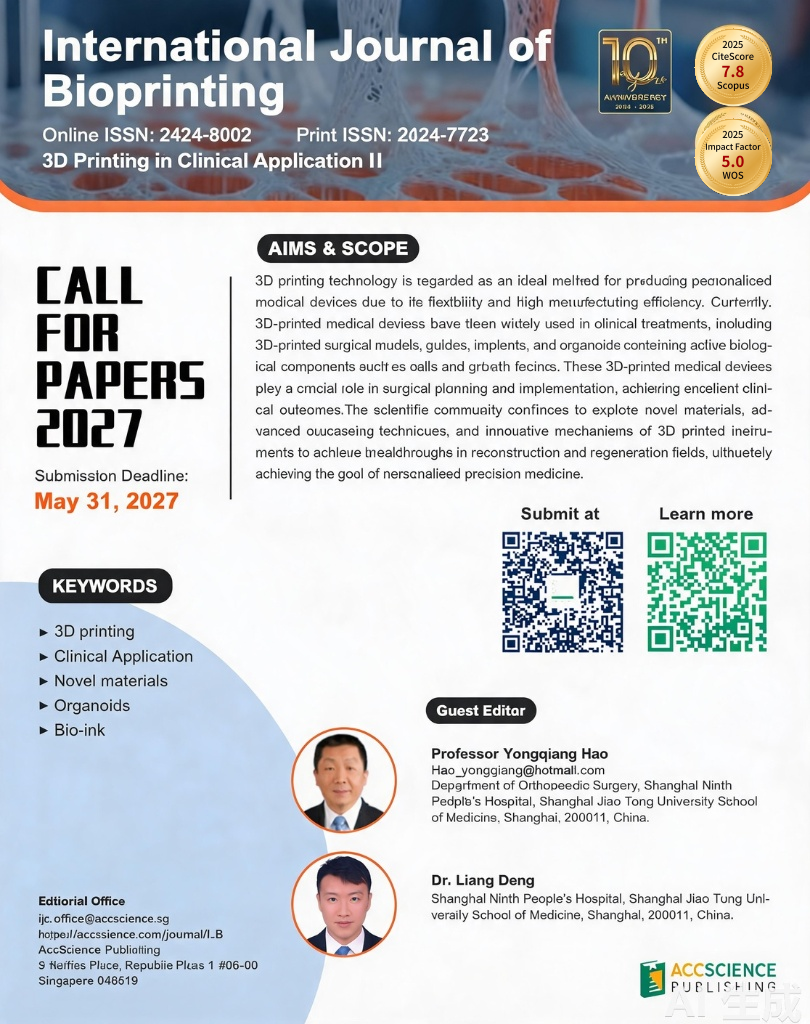
Following the success of the first edition of the Special Issue “3D Printing in Clinical Applications,” we are pleased to launch its second edition, “3D Printing in Clinical Applications II.” The first edition brought together research addressing the growing role of 3D printing in clinical and biomedical applications, highlighting its potential to advance personalized treatment, surgical planning, tissue reconstruction, and regeneration.
3D printing technology has emerged as a powerful approach for producing personalized medical products and patient-specific solutions due to its design flexibility, structural versatility, and manufacturing efficiency. In recent years, 3D printing has been increasingly applied in clinical and biomedical settings, including 3D-printed surgical models, surgical guides, implants, prostheses, scaffolds, and biologically functional constructs.
Building upon the scientific advances and research interests highlighted in the first edition, this second edition aims to further explore emerging technologies, novel materials, innovative structures, and translational strategies that can accelerate the clinical application of 3D printing.
The scientific community continues to investigate new approaches to overcome challenges in manufacturing, biological performance, mechanical properties, clinical translation, and personalized treatment. These efforts are expected to contribute to the development of more precise, functional, and patient-specific solutions for reconstruction, regeneration, and personalized medicine.
We warmly invite researchers, clinicians, and engineers to contribute to this second edition and continue the scientific discussion initiated by the successful first edition.
Examples of relevant topics include, but are not limited to:
- Novel materials, structures, and processing techniques for 3D-printed implants
- Clinical research and applications of 3D-printed medical products
- Structural and mechanical analysis of 3D-printed implants
- Patient-specific 3D printing and personalized medicine
- 3D-printed surgical models and surgical guides
- Organoids and 3D-printed biological constructs for clinical applications
- Novel bioinks for biomedical and clinical applications
- Innovative materials and structures for 3D printing in tissue regeneration
- 3D bioprinting for tissue engineering and regenerative medicine
- Emerging 3D printing technologies for clinical translation