
Vascular function in bioprinted skin and implications for wound repair

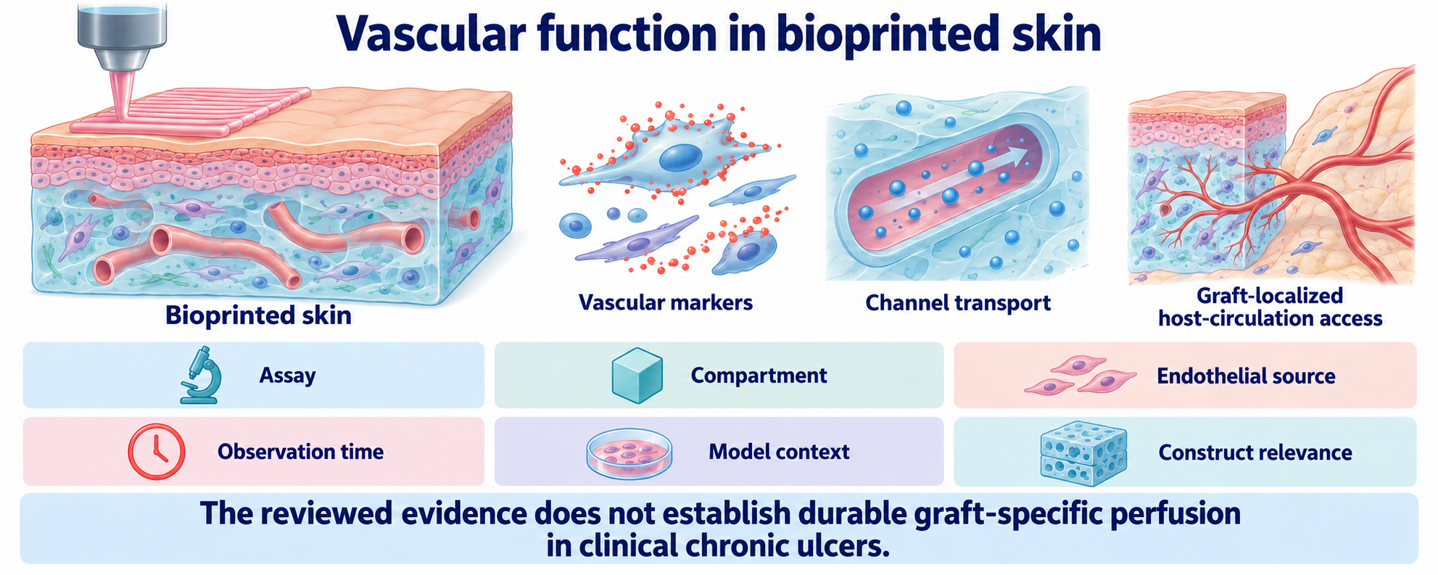
Vascular markers, lumen-like structures, and fluid-conducting channels provide evidence of vascular cell identity, structural organization, and channel patency, respectively, in bioprinted skin. This critical narrative review examines how bioink design, cellular organization, and network architecture relate to measured transport and host-circulation access. A purposively assembled core of 19 primary or translational studies and 10 reviews informs the synthesis. We describe each vascular observation using independent fields for assay, compartment, endothelial source, observation time, model context, and construct relevance. Transient injection-assisted patency, sustained channel perfusion, and endothelial permeability are evaluated separately. Host angiogenesis, regional wound blood flow, and structural contact are distinguished from blood or circulating-tracer access localized to graft-associated vessels. Selected printed-skin studies demonstrate source-resolved host access in immunodeficient implantation models, whereas several transport principles come from skin chips or non-skin platforms. Four core studies treat newly excised wounds in diabetic animals; the clinical diabetic-foot-ulcer series has no vascular endpoint. These observations do not establish durable graft-specific vascular integration in clinical chronic ulcers. The review connects assay interpretation with bioink design and proposes product-specific reporting and validation priorities. Preserved search records and the core study registers are provided, while incomplete screening records, retrieval limits, and full-text availability constrain coverage. The synthesis is not a systematic review, meta-analysis, or estimate of evidence prevalence across the field. Clinical studies of chronic ulcers are needed to establish whether host blood reaches graft vessels and how long that access persists.
- Chortova M, Zanzov E, Anastasova V. Application of 3D-Bioprinting in Treatment of Chronic Wounds: A Review. Life (Basel). 2026;16(4):581. doi: 10.3390/life16040581
- Masri S, Zawani M, Zulkiflee I, et al. Cellular Interaction of Human Skin Cells towards Natural Bioink via 3D-Bioprinting Technologies for Chronic Wound: A Comprehensive Review. Int J Mol Sci. 2022;23(1):476. doi: 10.3390/ijms23010476
- Liu L, Spessot E, Lim KS, et al. Bioprinting vascularized skin analogs: a stepwise approach. Burns Trauma. 2025;13:tkaf018. doi: 10.1093/burnst/tkaf018
- Abuhamad AY, Masri S, Fadilah NIM, Alamassi MN, Maarof M, Fauzi MB. Application of 3D-Printed Bioinks in Chronic Wound Healing: A Scoping Review. Polymers (Basel). 2024;16(17):2456. doi: 10.3390/polym16172456
- Derman ID, Rivera T, Garriga Cerda L, et al. Advancements in 3D skin bioprinting: processes, bioinks, applications and sensor integration. Int J Extrem Manuf. 2025;7(1):012009. doi: 10.1088/2631-7990/ad878c
- Weng T, Zhang W, Xia Y, et al. 3D bioprinting for skin tissue engineering: Current status and perspectives. J Tissue Eng. 2021;12:20417314211028574. doi: 10.1177/20417314211028574
- Kang MS, Jang J, Jo HJ, et al. Advances and Innovations of 3D Bioprinting Skin. Biomolecules. 2023;13(1):55. doi: 10.3390/biom13010055
- Manita PG, Garcia-Orue I, Santos-Vizcaino E, Hernandez RM, Igartua M. 3D Bioprinting of Functional Skin Substitutes: From Current Achievements to Future Goals. Pharmaceuticals (Basel). 2021;14(4):362. doi: 10.3390/ph14040362
- Zhang M, Zhang C, Li Z, Fu X, Huang S. Advances in 3D skin bioprinting for wound healing and disease modeling. Regen Biomater. 2023;10:rbac105. doi: 10.1093/rb/rbac105
- Gopakumar N, Ali AM, Oudda S, Singam A, Park S. 3D-Bioprinted Skin Tissues for Improving Wound Healing: Current Status and Perspective. Adv Exp Med Biol. 2025;1474:35-51. doi: 10.1007/5584_2024_817
- Iqbal MZ, Riaz M, Biedermann T, Klar AS. Breathing new life into tissue engineering: exploring cutting-edge vascularization strategies for skin substitutes. Angiogenesis. 2024;27(4):587-621. doi: 10.1007/s10456-024-09928-6
- Phua QH, Han HA, Soh BS. Translational stem cell therapy: vascularized skin grafts in skin repair and regeneration. J Transl Med. 2021;19(1):83. doi: 10.1186/s12967-021-02752-2
- Smandri A, Nordin A, Hwei NM, Chin KY, Abd Aziz I, Fauzi MB. Natural 3D-Printed Bioinks for Skin Regeneration and Wound Healing: A Systematic Review. Polymers (Basel). 2020;12(8):1782. doi: 10.3390/polym12081782
- Fang H, Xu J, Ma H, et al. Functional materials of 3D bioprinting for wound dressings and skin tissue engineering applications: A review. Int J Bioprint. 2023;9(5):757. doi: 10.18063/ijb.757
- Kızılkurtlu AA, Yılmaz Ö. A Roadmap to Perfused Skin: Defining the Next Generation of Research Questions in Cutaneous Tissue Engineering. Int J Mol Sci. 2026;27(12):5350. doi: 10.3390/ijms27125350
- Perez-Barreto A, Moscalu R, Tremolada C, Domingos M, Reid A, Wong J. 3D bioprinting of skin equivalents: Towards functional wound healing models. J Tissue Eng. 2026;17:20417314251407023. doi: 10.1177/20417314251407023
- Jorgensen AM, Varkey M, Gorkun A, et al. Bioprinted Skin Recapitulates Normal Collagen Remodeling in Full-Thickness Wounds. Tissue Eng Part A. 2020;26(9-10):512-526. doi: 10.1089/ten.tea.2019.0319
- Luo Y, Li D, Lin C, Zhang B, Ding H, Zhou X. Construction of gelatin methacryloyl-based artificial skin substitutes with “small-micro” vascular networks via hybrid double-crosslinked coaxial and extrusion bioprinting. Int J Bioprint. 2026;12(1):672-688. doi: 10.36922/ijb025490504
- Xia S, Weng T, Jin R, et al. Curcumin-incorporated 3D bioprinting gelatin methacryloyl hydrogel reduces reactive oxygen species-induced adipose-derived stem cell apoptosis and improves implanting survival in diabetic wounds. Burns Trauma. 2022;10:tkac001. doi: 10.1093/burnst/tkac001
- Shah KR, Garriga-Cerda L, Pappalardo A, et al. A biopsy-sized 3D skin model with a perifollicular vascular plexus enables studying immune cell trafficking in the skin. Biofabrication. 2024;16(4):045006. doi: 10.1088/1758-5090/ad5d1a
- Maggiotto F, Dalla Valle E, Fietta A, Visentin LM, Giomo M, Cimetta E. 3D bioprinting of a perfusable skin-on-chip model suitable for drug testing and wound healing studies. Mater Today Bio. 2025;33:101974. doi: 10.1016/j.mtbio.2025.101974
- Baltazar T, Merola J, Catarino C, et al. Three Dimensional Bioprinting of a Vascularized and Perfusable Skin Graft Using Human Keratinocytes, Fibroblasts, Pericytes, and Endothelial Cells. Tissue Eng Part A. 2020;26(5-6):227-238. doi: 10.1089/ten.tea.2019.0201
- Baltazar T, Jiang B, Moncayo A, et al. 3D bioprinting of an implantable xeno-free vascularized human skin graft. Bioeng Transl Med. 2023;8(1):e10324. doi: 10.1002/btm2.10324
- Zhao M, Wang J, Zhang J, et al. Functionalizing multi-component bioink with platelet-rich plasma for customized in-situ bilayer bioprinting for wound healing. Mater Today Bio. 2022;16:100334. doi: 10.1016/j.mtbio.2022.100334
- Xu L, Zhang Z, Jorgensen AM, et al. Bioprinting a skin patch with dual-crosslinked gelatin (GelMA) and silk fibroin (SilMA): An approach to accelerating cutaneous wound healing. Mater Today Bio. 2023;18:100550. doi: 10.1016/j.mtbio.2023.100550
- Albanna M, Binder KW, Murphy SV, et al. In Situ Bioprinting of Autologous Skin Cells Accelerates Wound Healing of Extensive Excisional Full-Thickness Wounds. Sci Rep. 2019;9(1):1856. doi: 10.1038/s41598-018-38366-w
- Levin AA, Karalkin PA, Koudan EV, et al. Commercial articulated collaborative in situ 3D bioprinter for skin wound healing. Int J Bioprint. 2023;9(2):675. doi: 10.18063/ijb.v9i2.675
- Wang X, Yang C, Yu Y, Zhao Y. In Situ 3D Bioprinting Living Photosynthetic Scaffolds for Autotrophic Wound Healing. Research (Wash D C). 2022;2022:9794745. doi: 10.34133/2022/9794745
- Dutta SD, An JM, Hexiu J, et al. 3D bioprinting of engineered exosomes secreted from M2-polarized macrophages through immunomodulatory biomaterial promotes in vivo wound healing and angiogenesis. Bioact Mater. 2025;45:345-362. doi: 10.1016/j.bioactmat.2024.11.026
- Kang Y, Xu L, Dong J, et al. Programmed microalgae-gel promotes chronic wound healing in diabetes. Nat Commun. 2024;15(1):1042. doi: 10.1038/s41467-024-45101-9
- Ferroni L, D'Amora U, Gardin C, et al. Stem cell-derived small extracellular vesicles embedded into methacrylated hyaluronic acid wound dressings accelerate wound repair in a pressure model of diabetic ulcer. J Nanobiotechnology. 2023;21(1):469. doi: 10.1186/s12951-023-02202-9
- Yeo M, Sarkar A, Singh YP, Derman ID, Datta P, Ozbolat IT. Synergistic coupling between 3D bioprinting and vascularization strategies. Biofabrication. 2024;16(1):012003. doi: 10.1088/1758-5090/ad0b3f
- Douglas A, Chen Y, Elloso M, Levschuk A, Jeschke MG. Bioprinting-By-Design of Hydrogel-Based Biomaterials for In Situ Skin Tissue Engineering. Gels. 2025;11(2):110. doi: 10.3390/gels11020110
- Tan CT, Liang K, Ngo ZH, Dube CT, Lim CY. Application of 3D Bioprinting Technologies to the Management and Treatment of Diabetic Foot Ulcers. Biomedicines. 2020;8(10):441. doi: 10.3390/biomedicines8100441
- Seria E, Galea G, Borg J, et al. Novel leukocyte-depleted platelet-rich plasma-based skin equivalent as an in vitro model of chronic wounds: a preliminary study. BMC Mol Cell Biol. 2021;22(1):28. doi: 10.1186/s12860-021-00366-6
- Botusan IR, Sunkari VG, Savu O, et al. Stabilization of HIF-1α is critical to improve wound healing in diabetic mice. Proc Natl Acad Sci USA. 2008;105(49):19426-19431. doi: 10.1073/pnas.0805230105
- Mirza RE, Fang MM, Ennis WJ, Koh TJ. Blocking Interleukin-1β Induces a Healing-Associated Wound Macrophage Phenotype and Improves Healing in Type 2 Diabetes. Diabetes. 2013;62(7):2579-2587. doi: 10.2337/db12-1450
- Mirza RE, Fang MM, Weinheimer-Haus EM, Ennis WJ, Koh TJ. Sustained Inflammasome Activity in Macrophages Impairs Wound Healing in Type 2 Diabetic Humans and Mice. Diabetes. 2014;63(3):1103-1114. doi: 10.2337/db13-0927
- Fu C, Liu G, Fan Y, et al. Highly printable and multifunctional cell-laden collagen-based bioinks for precise DLP bioprinting and rapid diabetic wound regeneration. Mater Today Bio. 2025;32:101908. doi: 10.1016/j.mtbio.2025.101908
- Huang J, Yang R, Jiao J, et al. A click chemistry-mediated all-peptide cell printing hydrogel platform for diabetic wound healing. Nat Commun. 2023;14(1):7856. doi: 10.1038/s41467-023-43364-2
- Zur Y, Hayam R, Almog N, et al. 3D Printing of Oxygen-Sensing ECM-Based Skin Graft for Personalized Treatment of Chronic Wounds-A Technological Proof of Concept. J Funct Biomater. 2026;17(1):28. doi: 10.3390/jfb17010028
- Li Z, Zheng A, Mao Z, et al. Silk fibroin-gelatin photo-crosslinked 3D-bioprinted hydrogel with MOF-methylene blue nanoparticles for infected wound healing. Int J Bioprint. 2023;9(5):773. doi: 10.18063/ijb.773
- Wang X, Jia J, Niu M, Li W, Zhao Y. Living Chinese Herbal Scaffolds from Microfluidic Bioprinting for Wound Healing. Research (Wash D C). 2023;6:0138. doi: 10.34133/research.0138
- Demaria M, Ohtani N, Youssef SA, et al. An Essential Role for Senescent Cells in Optimal Wound Healing through Secretion of PDGF-AA. Dev Cell. 2014;31(6):722-733. doi: 10.1016/j.devcel.2014.11.012
- Pazhouhnia Z, Noori A, Farzin A, et al. 3D-bioprinted GelMA/gelatin/amniotic membrane extract (AME) scaffold loaded with keratinocytes, fibroblasts, and endothelial cells for skin tissue engineering. Sci Rep. 2024;14(1):12670. doi: 10.1038/s41598-024-62926-y
- Lee D, Lee S, Lee J, et al. Vascularized skin tissue models featuring adipose cell spheroid-laden GelMA hydrogels. Mater Today Bio. 2025;32:101835. doi: 10.1016/j.mtbio.2025.101835
- Liu Y, Liu X, Guo H, et al. 3D bioprinting bioglass to construct vascularized full-thickness skin substitutes for wound healing. Mater Today Bio. 2024;24:100899. doi: 10.1016/j.mtbio.2023.100899
- Tanadchangsaeng N, Pasanaphong K, Tawonsawatruk T, et al. 3D bioprinting of fish skin-based gelatin methacryloyl (GelMA) bio-ink for use as a potential skin substitute. Sci Rep. 2024;14(1):23240. doi: 10.1038/s41598-024-73774-1
- Wang H, Wan J, Zhang Z, Hou R. Recent advances on 3D-bioprinted gelatin methacrylate hydrogels for tissue engineering in wound healing: A review of current applications and future prospects. Int Wound J. 2024;21(4):e14533. doi: 10.1111/iwj.14533
- Wang Y, Yuan X, Yao B, Zhu S, Zhu P, Huang S. Tailoring bioinks of extrusion-based bioprinting for cutaneous wound healing. Bioact Mater. 2022;17:178-194. doi: 10.1016/j.bioactmat.2022.01.024
- Shamasha R, Ramanathan SK, Oskarsdotter K, et al. Biphasic Granular Bioinks for Biofabrication of High Cell Density Constructs for Dermal Regeneration. Adv Healthc Mater. 2025;14(21):e2501430. doi: 10.1002/adhm.202501430
- Kanokova D, Matejka R, Zaloudkova M, Zigmond J, Supova M, Matejkova J. Active Media Perfusion in Bioprinted Highly Concentrated Collagen Bioink Enhances the Viability of Cell Culture and Substrate Remodeling. Gels. 2024;10(5):316. doi: 10.3390/gels10050316
- Shiwarski DJ, Hudson AR, Tashman JW, et al. 3D bioprinting of collagen-based high-resolution internally perfusable scaffolds for engineering fully biologic tissue systems. Sci Adv. 2025;11(17):eadu5905. doi: 10.1126/sciadv.adu5905
- Jorgensen AM, Chou Z, Gillispie G, et al. Decellularized Skin Extracellular Matrix (dsECM) Improves the Physical and Biological Properties of Fibrinogen Hydrogel for Skin Bioprinting Applications. Nanomaterials (Basel). 2020;10(8):1484. doi: 10.3390/nano10081484
- Huang J, Lei X, Huang Z, et al. Bioprinted Gelatin-Recombinant Type III Collagen Hydrogel Promotes Wound Healing. Int J Bioprint. 2022;8(2):517. doi: 10.18063/ijb.v8i2.517
- Yang Y, Xu R, Wang C, Guo Y, Sun W, Ouyang L. Recombinant Human Collagen-Based Bioinks for the 3D Bioprinting of Full-thickness Human Skin Equivalent. Int J Bioprint. 2022;8(4):611. doi: 10.18063/ijb.v8i4.611
- Guan G, Lv Q, Liu S, Jiang Z, Zhou C, Liao W. 3D-bioprinted peptide coupling patches for wound healing. Mater Today Bio. 2022;13:100188. doi: 10.1016/j.mtbio.2021.100188
- Wu Y, Liang T, Hu Y, et al. 3D bioprinting of integral ADSCs-NO hydrogel scaffolds to promote severe burn wound healing. Regen Biomater. 2021;8(3):rbab014. doi: 10.1093/rb/rbab014
- Bashiri Z, Rajabi Fomeshi M, Ghasemi Hamidabadi H, et al. 3D-printed placental-derived bioinks for skin tissue regeneration with improved angiogenesis and wound healing properties. Mater Today Bio. 2023;20:100666. doi: 10.1016/j.mtbio.2023.100666
- Abaci HE, Guo Z, Coffman A, et al. Human Skin Constructs with Spatially Controlled Vasculature Using Primary and iPSC-Derived Endothelial Cells. Adv Healthc Mater. 2016;5(14):1800-1807. doi: 10.1002/adhm.201500936
- Zheng Y, Chen J, Craven M, et al. In vitro microvessels for the study of angiogenesis and thrombosis. Proc Natl Acad Sci USA. 2012;109(24):9342-9347. doi: 10.1073/pnas.1201240109
- Wang K, Lan X, Chen J, et al. One-Step Coaxial 3D Printing of Pre-Vascularized Skin Organoid Models with ADSC Microspheres for Enhanced Wound Healing. Adv Sci (Weinh). 2026;13(9):e17409. doi: 10.1002/advs.202517409
- Nessbach P, Schwarz S, Becke TD, Clausen-Schaumann H, Machens HG, Sudhop S. Angiogenic Potential of Co-Cultured Human Umbilical Vein Endothelial Cells and Adipose Stromal Cells in Customizable 3D Engineered Collagen Sheets. J Funct Biomater. 2022;13(3):107. doi: 10.3390/jfb13030107
- Kang R, Shin S, Choi Y, et al. Bioengineered Skin Grafts from Patient‐Derived Decellularized Extracellular Matrix and Autologous Cells for Personalized Regenerative. Adv Sci (Weinh). 2025;12(44):e11889. doi: 10.1002/advs.202511889
- Ma X, Zhu X, Lv S, et al. 3D bioprinting of prefabricated artificial skin with multicomponent hydrogel for skin and hair follicle regeneration. Theranostics. 2025;15(7):2933-2950. doi: 10.7150/thno.104854
- Zhang D, Fu Q, Fu H, Zeng J, Jia L, Chen M. 3D-bioprinted human lipoaspirate-derived cell-laden skin constructs for healing of full-thickness skin defects. Int J Bioprint. 2023;9(4):718. doi: 10.18063/ijb.718
- Yao R, Alkhawtani AYF, Chen R, Luan J, Xu M. Rapid and efficient in vivo angiogenesis directed by electro-assisted bioprinting of alginate/collagen microspheres with human umbilical vein endothelial cell coating layer. Int J Bioprint. 2019;5(2.1):194. doi: 10.18063/ijb.v5i2.1.194
- Schmitt T, Katz N, Kishore V. A Feasibility Study on 3D Bioprinting of Microfat Constructs Towards Wound Healing Applications. Front Bioeng Biotechnol. 2021;9:707098. doi: 10.3389/fbioe.2021.707098
- Louis F, Piantino M, Liu H, et al. Bioprinted Vascularized Mature Adipose Tissue with Collagen Microfibers for Soft Tissue Regeneration. Cyborg Bionic Syst. 2021;2021:1412542. doi: 10.34133/2021/1412542
- Kim J, Lee J, Cho JK, Bong KW, Song SC. Thermo-responsive Bioink for Personalized 3D Printed Scaffolds with Antioxidant and Fibroblast Delivery to Accelerate Diabetic Wound Healing. Biomater Res. 2025;29:0216. doi: 10.34133/bmr.0216
- Kim N, Lee H, Han G, et al. 3D-Printed Functional Hydrogel by DNA-Induced Biomineralization for Accelerated Diabetic Wound Healing. Adv Sci (Weinh). 2023;10(17):e2300816. doi: 10.1002/advs.202300816
- Wang L, Li X, Zhang X, et al. Comparative regenerative mechanisms of adipose-derived mesenchymal stem cell- and conditioned medium-loaded three-dimensional bioprinted hydrogels in chronic diabetic wounds. Regen Biomater. 2026;13:rbag095. doi: 10.1093/rb/rbag095
- Zhang Y, Liao H, Wei X, et al. A 3-Dimensional Bioprinted Decellularized Umbilical Cord Matrix Patch for Enhanced Storage and Delivery of Extracellular Vesicles in Diabetic Wound Healing. Research (Wash D C). 2026;9:1246. doi: 10.34133/research.1246
- Yan Z, Li R, Gao W, et al. pH-responsive printable conductive hydrogels loaded with ApoVs promote diabetic wound repair through oxidative stress scavenging and macrophage reprogramming. Mater Today Bio. 2026;37:102882. doi: 10.1016/j.mtbio.2026.102882
- Zhang F, Zhang Z, Duan X, et al. Integrating zinc/silicon dual ions with 3D-printed GelMA hydrogel promotes in situ hair follicle regeneration. Int J Bioprint. 2023;9(3):703. doi: 10.18063/ijb.703
- Fuchs B, Mert S, Hofmann D, et al. Bioactivated scaffolds promote angiogenesis and lymphangiogenesis for dermal regeneration in vivo. J Tissue Eng. 2025;16:20417314251317542. doi: 10.1177/20417314251317542
- Cao X, Wang Y, Xu Y, et al. Three-dimensional-printed ROS-scavenging and immunomodulatory hydrogel accelerates diabetic wound healing through synergistic microenvironment regulation. Regen Biomater. 2026;13:rbag066. doi: 10.1093/rb/rbag066
- Zhang C, Fang Y, Pan L, et al. 3D-bioprinted asymmetric bilayer scaffolds with anti-infection and pro-regeneration characteristics for chronic diabetic wound healing. Int J Bioprint. 2026;12(2):026120099. doi: 10.36922/IJB026120099
- Cao W, Li D, Yang Q, et al. 3D-bioprinted skin-mimicking bilayer hydrogel dressing with compartmentalized antibacterial and pro-healing functions for diabetic wounds. Int J Bioprint. 2026;12(3):026150134. doi: 10.36922/IJB026150134
- Pontiggia L, Van Hengel IA, Klar A, et al. Bioprinting and plastic compression of large pigmented and vascularized human dermo-epidermal skin substitutes by means of a new robotic platform. J Tissue Eng. 2022;13:20417314221088513. doi: 10.1177/20417314221088513
- Anthon SG, Valente KP. Vascularization Strategies in 3D Cell Culture Models: From Scaffold-Free Models to 3D Bioprinting. Int J Mol Sci. 2022;23(23):14582. doi: 10.3390/ijms232314582
- Chen J, Wu Y, Huang J, et al. Microscopically Adaptable Bioink Guide Cell Compartmentalization toward Morphogenesis of a Functional Vasculature‐Like System. Adv Healthc Mater. 2025;14(29):e02347. doi: 10.1002/adhm.202502347
- Miller JS, Stevens KR, Yang MT, et al. Rapid casting of patterned vascular networks for perfusable engineered three-dimensional tissues. Nat Mater. 2012;11(9):768-774. doi: 10.1038/nmat3357
- Kolesky DB, Homan KA, Skylar-Scott MA, Lewis JA. Three-dimensional bioprinting of thick vascularized tissues. Proc Natl Acad Sci USA. 2016;113(12):3179-3184. doi: 10.1073/pnas.1521342113
- Kim JH, Park M, Shim JH, Yun WS, Jin S. Multi-scale vascularization strategy for 3D-bioprinted tissue using coaxial core–shell pre-set extrusion bioprinting and biochemical factors. Int J Bioprint. 2023;9(4):726. doi: 10.18063/ijb.726
- You S, Xiang Y, Hwang HH, et al. High cell density and high-resolution 3D bioprinting for fabricating vascularized tissues. Sci Adv. 2023;9(8):eade7923. doi: 10.1126/sciadv.ade7923
- Wang D, Maharjan S, Kuang X, et al. Microfluidic bioprinting of tough hydrogel-based vascular conduits for functional blood vessels. Sci Adv. 2022;8(43):eabq6900. doi: 10.1126/sciadv.abq6900
- Wang X, Liu X, Liu W, et al. 3D bioprinting microgels to construct implantable vascular tissue. Cell Prolif. 2023;56(5):e13456. doi: 10.1111/cpr.13456
- Szklanny AA, Machour M, Redenski I, et al. 3D Bioprinting of Engineered Tissue Flaps with Hierarchical Vessel Networks (VesselNet) for Direct Host-To-Implant Perfusion. Adv Mater. 2021;33(42):e2102661. doi: 10.1002/adma.202102661
- Mou S, Zhou Y, Suo L, et al. 3D bioprinting of flap-tissue with heterogenous cells and flexible perfusable vessels. Bioact Mater. 2026;65:167-180. doi: 10.1016/j.bioactmat.2026.05.029
- Wufuer M, Lee G, Hur W, et al. Skin-on-a-chip model simulating inflammation, edema and drug-based treatment. Sci Rep. 2016;6(1):37471. doi: 10.1038/srep37471
- Jones CFE, Di Cio S, Connelly JT, Gautrot JE. Design of an Integrated Microvascularized Human Skin-on-a-Chip Tissue Equivalent Model. Front Bioeng Biotechnol. 2022;10:915702. doi: 10.3389/fbioe.2022.915702
- Mazari-Arrighi E, Lépine M, Ayollo D, et al. Self-Organization of Long-Lasting Human Endothelial Capillary-Like Networks Guided by DLP Bioprinting. Adv Healthc Mater. 2024;13(14):e2302830. doi: 10.1002/adhm.202302830
- Figueiredo L, Le Visage C, Weiss P, Yang J. Quantifying Oxygen Levels in 3D Bioprinted Cell-Laden Thick Constructs with Perfusable Microchannel Networks. Polymers (Basel). 2020;12(6):1260. doi: 10.3390/polym12061260
- Hudson AR, Shiwarski DJ, Kramer AJ, Feinberg AW. Enhancing Viability in Static and Perfused 3D Tissue Constructs Using Sacrificial Gelatin Microparticles. ACS Biomater Sci Eng. 2025;11(5):2888-2897. doi: 10.1021/acsbiomaterials.4c02169
- Dudaryeva OY, Buchholz MB, Größbacher G, et al. Multi-scale Engineered Vasculature and Hierarchical Porosity via Volumetric Bioprinting-Guided Photopolymerization-Induced Phase Separation. Adv Mater. 2026;38(9):e21171. doi: 10.1002/adma.202521171
- Vuerich R, Groppa E, Vodret S, et al. Ischemic wound revascularization by the stromal vascular fraction relies on host-donor hybrid vessels. npj Regen Med. 2023;8(1):8. doi: 10.1038/s41536-023-00283-6
- Fischer EO, Tsukerman A, Machour M, et al. Bioprinting Perfusable and Vascularized Skeletal Muscle Flaps for the Treatment of Volumetric Muscle Loss. Adv Healthc Mater. 2025;14(13):e2404542. doi: 10.1002/adhm.202404542
- Gensler M, Malkmus C, Ockermann P, et al. Perfusable Tissue Bioprinted into a 3D-Printed Tailored Bioreactor System. Bioengineering (Basel). 2024;11(1):68. doi: 10.3390/bioengineering11010068
- Wu X, Zhao F, Wang H, Schirhagl R, Włodarczyk-Biegun MK. Integrating melt electrowriting (MEW) PCL scaffolds with fibroblast-laden hydrogel toward vascularized skin tissue engineering. Mater Today Bio. 2025;31:101593. doi: 10.1016/j.mtbio.2025.101593
- Zuniga K, Ghousifam N, Shaffer L, et al. Development of a Static Avascular and Dynamic Vascular Human Skin Equivalent Employing Collagen/Keratin Hydrogels. Int J Mol Sci. 2024;25(9):4992. doi: 10.3390/ijms25094992
- Miyazaki H, Tsunoi Y, Akagi T, Sato S, Akashi M, Saitoh D. A novel strategy to engineer pre-vascularized 3-dimensional skin substitutes to achieve efficient, functional engraftment. Sci Rep. 2019;9(1):7797. doi: 10.1038/s41598-019-44113-6
- Zielinska D, Fisch P, Moehrlen U, et al. Combining bioengineered human skin with bioprinted cartilage for ear reconstruction. Sci Adv. 2023;9(40):eadh1890. doi: 10.1126/sciadv.adh1890
- Dai NT, Huang WS, Chang FW, et al. Development of a Novel Pre-Vascularized Three-Dimensional Skin Substitute Using Blood Plasma Gel. Cell Transplant. 2018;27(10):1535-1547. doi: 10.1177/0963689718797570
- Tobiasova Z, Sefik E, Qin L, et al. Endothelial MHC expression is required to initiate T cell-mediated rejection of 3D-printed skin grafts. JCI Insight. 2026;11(8):e201946. doi: 10.1172/jci.insight.201946
- Hindle SA, Bachas Brook H, Chrysanthou A, Chambers ES, Caley MP, Connelly JT. Replicating Dynamic Immune Responses at Single‐Cell Resolution within a Microfluidic Human Skin Equivalent. Adv Sci (Weinh). 2025;12(10):2415717. doi: 10.1002/advs.202415717
- Sun S, Jin L, Zheng Y, Zhu J. Modeling human HSV infection via a vascularized immune-competent skin-on-chip platform. Nat Commun. 2022;13(1):5481. doi: 10.1038/s41467-022-33114-1
- Ahmed M, Hill D, Ahmed S, Przyborski S, Dalgarno K, Dickinson A. Bioprinted autologous human skin equivalents for in vitro testing of therapeutic antibodies. Int J Bioprint. 2024;10(2):1851. doi: 10.36922/ijb.1851
- Bajuri MY, Kim J, Yu Y, Shahul Hameed MS. New Paradigm in Diabetic Foot Ulcer Grafting Techniques Using 3D-Bioprinted Autologous Minimally Manipulated Homologous Adipose Tissue (3D-AMHAT) with Fibrin Gel Acting as a Biodegradable Scaffold. Gels. 2023;9(1):66. doi: 10.3390/gels9010066
- Tojo S, Miyazaki H, Saiki T, Tsunoi Y, Nakamura S, Azuma R. Pre-Vascularized 3-Dimensional Skin Substitutes Promote Angiogenesis and Tissue Repair in a Murine Model of Refractory Skin Ulcers. J Funct Biomater. 2025;16(11):409. doi: 10.3390/jfb16110409
- Glover K, Mathew E, Pitzanti G, Magee E, Lamprou DA. 3D bioprinted scaffolds for diabetic wound-healing applications. Drug Deliv Transl Res. 2023;13(8):2096-2109. doi: 10.1007/s13346-022-01115-8
- Nuutila K, Samandari M, Endo Y, et al. In vivo printing of growth factor-eluting adhesive scaffolds improves wound healing. Bioact Mater. 2022;8:296-308. doi: 10.1016/j.bioactmat.2021.06.030
- Pita‐Vilar M, Caicedo‐Valdés D, Bravo SB, et al. Growth Hormone‐Loaded 3D Printed Silk Fibroin‐Cellulose Dressings for Ischemic Wounds. Adv Healthc Mater. 2026;15(5):e02969. doi: 10.1002/adhm.202502969
- Dong T, Hu J, Dong Y, et al. Advanced biomedical and electronic dual-function skin patch created through microfluidic-regulated 3D bioprinting. Bioact Mater. 2024;40:261-274. doi: 10.1016/j.bioactmat.2024.06.015
- Chen S, Xiong Y, Yang F, et al. Approaches to scarless burn wound healing: application of 3D printed skin substitutes with dual properties of anti-infection and balancing wound hydration levels. eBioMedicine. 2024;106:105258. doi: 10.1016/j.ebiom.2024.105258
- Yang R, Sun J, Peng G, et al. Synergistic promotion of diabetic wound healing by glucose-responsive functional chitosan-based composite nanohydrogels. Carbohydr Polym. 2026;377:124835. doi: 10.1016/j.carbpol.2025.124835
- Yang Z, Li R, Wang R, Qian S. Enhancing Healing of Infected Wounds with Glycerin-Modified Sodium Alginate/Silk Sericin Composite Film Functionalized with Polygonatum sibiricum Polysaccharide-Capped Silver Nanoparticles. ChemistrySelect. 2024;9(14):e202400566. doi: 10.1002/slct.202400566
- Sun Z, Liu Q, Wang Z, et al. Hierarchical chitosan/polyvinyl alcohol/polyethylene glycol/nonwoven fabric micro/nanofiber composite membrane: a potential biomaterial for wound dressing. Macromol Res. 2023;31(12):1209-1215. doi: 10.1007/s13233-023-00204-y
- Rocha F, Vala IS, de Oliveira P, et al. Low-dose ionizing radiation in vivo unlocks the therapeutic potential of prevascularized dermal spheroids in chronic wounds. Mater Today Bio. 2025;35:102561. doi: 10.1016/j.mtbio.2025.102561
- Revokatova DP, Khristidis YI, Fayzullin AL, et al. Portable Bioprinter in Ischemic Wound Therapy: a Pilot Study. Sovrem Tekhnologii Med. 2026;18(1):23-31. doi: 10.17691/stm2026.18.1.02
- Abellan Lopez M, Hutter L, Pagin E, et al. In vivo efficacy proof of concept of a large-size bioprinted dermo-epidermal substitute for permanent wound coverage. Front Bioeng Biotechnol. 2023;11:1217655. doi: 10.3389/fbioe.2023.1217655
- Kang Y, Yeo M, Derman ID, et al. Intraoperative bioprinting of human adipose-derived stem cells and extra-cellular matrix induces hair follicle-like downgrowths and adipose tissue formation during full-thickness craniomaxillofacial skin reconstruction. Bioact Mater. 2024;33:114-128. doi: 10.1016/j.bioactmat.2023.10.034
- Matsumura R, Matsumura H, Kawai Y, et al. Three-Dimensional Bioprinted Autologous Minimally Manipulated Homologous Adipose Tissue for Skin Defects After Wide Excision of Skin Cancer Provides Early Wound Closure and Good Esthetic Patient Satisfaction. J Clin Med. 2025;14(6):1795. doi: 10.3390/jcm14061795
- Yoon HM, Song WJ. Using 3D Bioprinted Autologous Minimally Manipulated Homologous Adipose Tissue for Limb Salvage in Treating Diabetic Foot Ulcer. Arch Plast Surg. 2024;51(3):332-336. doi: 10.1055/a-2263-7957
- Zhao W, Chen H, Zhang Y, et al. Adaptive multi-degree-of-freedom in situ bioprinting robot for hair-follicle-inclusive skin repair: A preliminary study conducted in mice. Bioeng Transl Med. 2022;7(3):e10303. doi: 10.1002/btm2.10303
- Wang C, Hu C, Cheng H, et al. A Programmable Handheld Extrusion-Based Bioprinting Platform for In Situ Skin Wounds Dressing: Balance Mobility and Customizability. Adv Sci (Weinh). 2024;11(46):e2405823. doi: 10.1002/advs.202405823
- Chai RJ, Wong WL, Beh CW. Developing a bioink for single-step deposition and maturation of human epidermis. Int J Bioprint. 2023;9(4):738. doi: 10.18063/ijb.738
- Riabinin A, Pankratova M, Rogovaya O, Vorotelyak E, Terskikh V, Vasiliev A. Ideal Living Skin Equivalents, From Old Technologies and Models to Advanced Ones: The Prospects for an Integrated Approach. Biomed Res Int. 2024;2024(1):9947692. doi: 10.1155/2024/9947692
- Oualla-Bachiri W, Fernández-González A, Quiñones-Vico MI, Arias-Santiago S. From Grafts to Human Bioengineered Vascularized Skin Substitutes. Int J Mol Sci. 2020;21(21):8197. doi: 10.3390/ijms21218197
- Kondej K, Zawrzykraj M, Czerwiec K, Deptuła M, Tymińska A, Pikuła M. Bioengineering Skin Substitutes for Wound Management—Perspectives and Challenges. Int J Mol Sci. 2024;25(7):3702. doi: 10.3390/ijms25073702
- Sörgel CA, Cai A, Schmid R, Horch RE. Perspectives on the Current State of Bioprinted Skin Substitutes for Wound Healing. Biomedicines. 2023;11(10):2678. doi: 10.3390/biomedicines11102678
- Zhang T, Sheng S, Cai W, et al. 3-D bioprinted human-derived skin organoids accelerate full-thickness skin defects repair. Bioact Mater. 2024;42:257-269. doi: 10.1016/j.bioactmat.2024.08.036
- Fu H, Zhang D, Zeng J, et al. Application of 3D-printed tissue-engineered skin substitute using innovative biomaterial loaded with human adipose-derived stem cells in wound healing. Int J Bioprint. 2023;9(2):674. doi: 10.18063/ijb.v9i2.674
- Niu C, Wang L, Ji D, et al. Fabrication of SA/Gel/C scaffold with 3D bioprinting to generate micro-nano porosity structure for skin wound healing: a detailed animal in vivo study. Cell Regen. 2022;11(1):10. doi: 10.1186/s13619-022-00113-y
- Albouy M, Desanlis A, Brosset S, et al. A Preliminary Study for an Intraoperative 3D Bioprinting Treatment of Severe Burn Injuries. Plast Reconstr Surg Glob Open. 2022;10(1):e4056. doi: 10.1097/gox.0000000000004056