

Advances in bioactive glass-based 3D bioprinting for bone regeneration: From functional bioink design to microenvironmental regulation

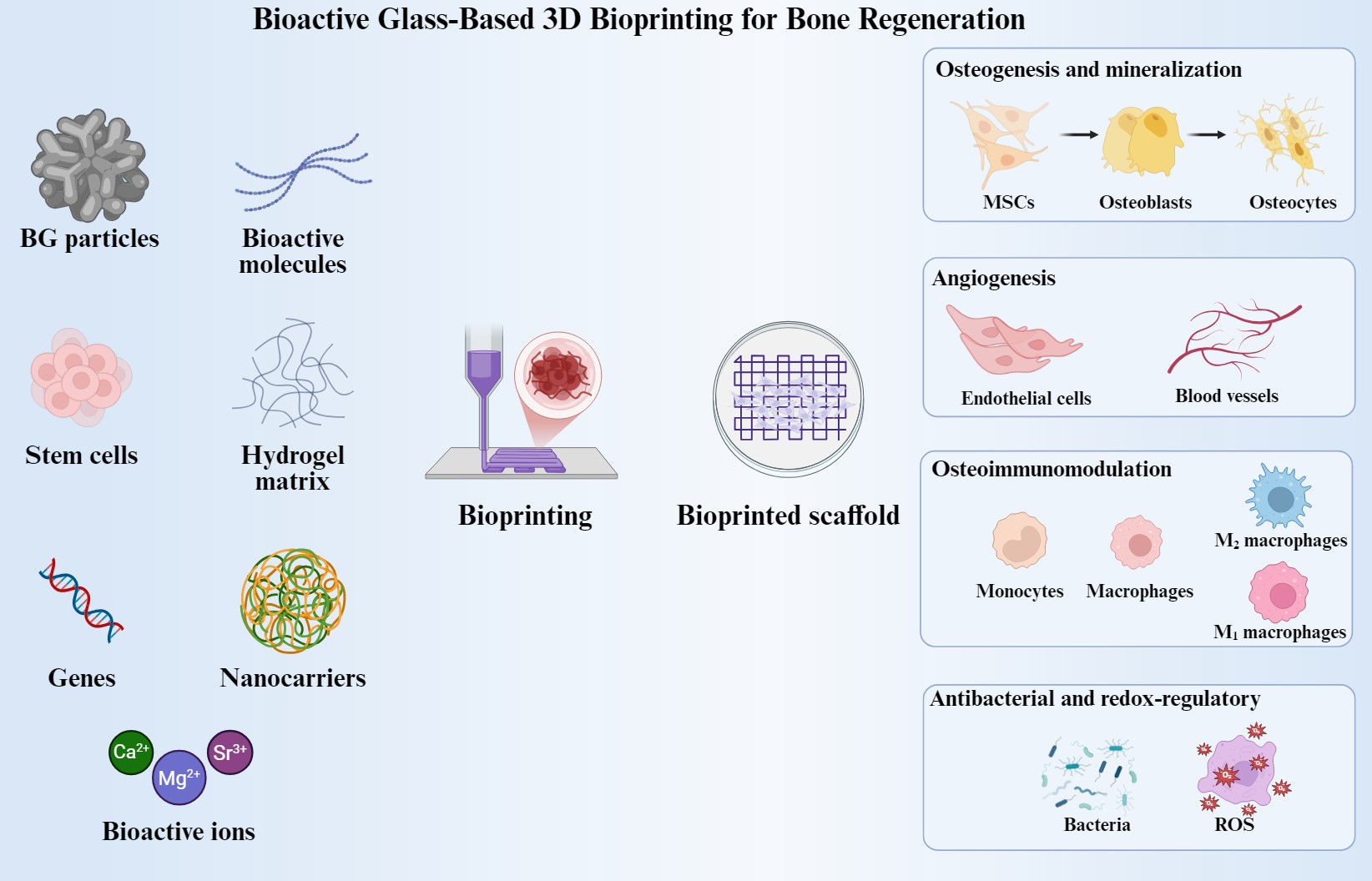
Bone regeneration requires coordinated structural reconstruction and regulation of osteogenesis, vascularization, redox balance, and bone remodeling. Although three-dimensional (3D) bioprinting enables the spatial organization of cells and biomaterials, conventional bioinks often lack mechanical stability, osteoinductive activity, and the capacity to regulate the evolving bone-defect microenvironment. Bioactive glass (BG), with its tunable composition, degradability, apatite-forming ability, and release of bioactive ions, offers a promising functional component for bone-regenerative constructs. This review critically examines BG-based 3D printing and bioprinting for bone regeneration, emphasizing BG-functionalized bioink design and interactions among glass composition, particle properties, mesoporous structure, polymer networks, ion-release kinetics, and printed architecture. It also distinguishes acellular printed scaffolds, scaffolds seeded after printing, and directly cell-laden bioprinted constructs, recognizing that these strategies provide different levels of evidence for the contribution of bioprinting. We discuss how BG-derived ionic cues and incorporated therapeutic agents regulate osteogenic differentiation and mineralization, angiogenesis and angiogenesis–osteogenesis coupling, the osteoimmune microenvironment, antibacterial activity in infected defects, and oxidative stress and bone remodeling. Current evidence suggests that regenerative outcomes depend on the combined effects of material chemistry, surface and pore characteristics, spatial organization, and cellular responses, rather than BG incorporation or ion release alone. Nevertheless, direct cell-laden BG bioprinting remains limited, while translation is challenged by the need to balance printability, mechanical properties, cell viability, controlled release, manufacturing reproducibility, sterilization, long-term biosafety, and regulatory requirements. Future studies should prioritize stage-specific, programmable bioinks and validation in clinically relevant large-animal models to advance BG-based bioprinting toward microenvironment-guided bone repair.
- Duda GN, Geissler S, Checa S, Tsitsilonis S, Petersen A, Schmidt-Bleek K. The decisive early phase of bone regeneration. Nat Rev Rheumatol. 2023;19(2):78-95. doi: 10.1038/s41584-022-00887-0
- Mallorie A, Shine B. Normal bone physiology, remodelling and its hormonal regulation. Surgery (Oxford). 2022;40(3):163-168. doi: 10.1016/j.mpsur.2021.12.001
- Jia Z, Xu X, Zhu D, Zheng Y. Design, printing, and engineering of regenerative biomaterials for personalized bone healthcare. Prog Mater Sci. 2023;134:101072. doi: 10.1016/j.pmatsci.2023.101072
- Migliorini F, La Padula G, Torsiello E, Spiezia F, Oliva F, Maffulli N. Strategies for large bone defect reconstruction after trauma, infections or tumour excision: a comprehensive review of the literature. Eur J Med Res. 2021;26(1):118. doi: 10.1186/s40001-021-00593-9
- Mirkhalaf M, Men Y, Wang R, No Y, Zreiqat H. Personalized 3D printed bone scaffolds: A review. Acta Biomater. 2023;156:110-124. doi: 10.1016/j.actbio.2022.04.014
- Schmidt AH. Autologous bone graft: Is it still the gold standard? Injury. 2021;52:S18-S22. doi: 10.1016/j.injury.2021.01.043
- Bai Y, Wang Z, He X, et al. Application of Bioact Mater for Osteogenic Function in Bone Tissue Engineering. Small Methods. 2024;8(8):2301283. doi: 10.1002/smtd.202301283
- Shahrezaie M, Zamanian A, Sahranavard M, Shahrezaee MH. A critical review on the 3D bioprinting in large bone defects regeneration. Bioprinting. 2024;37:e00327. doi: 10.1016/j.bprint.2023.e00327
- Wu Z, Li W, Jiang K, et al. Regulation of bone homeostasis: signaling pathways and therapeutic targets. MedComm. 2024;5(8):e657. doi: 10.1002/mco2.657
- Zhu Y, Zhang X, Chang G, Deng S, Chan HF. Bioactive Glass in Tissue Regeneration: Unveiling Recent Advances in Regenerative Strategies and Applications. Adv Mater. 2054;37(2):2312964. doi: 10.1002/adma.202312964
- Chae S, Cho D-W. Biomaterial-based 3D bioprinting strategy for orthopedic tissue engineering. Acta Biomater. 2023;156:4-20. doi: 10.1016/j.actbio.2022.08.004
- Gupta T, Ghosh SB, Bandyopadhyay-Ghosh S, Sain M. Is it possible to 3D bioprint load-bearing bone implants? A critical review. Biofabrication. 2023;15(4). doi: 10.1088/1758-5090/acf6e1
- Parmentier L, Vermeersch E, Van Vlierberghe S. Recapitulating the bone extracellular matrix through 3D bioprinting using various crosslinking chemistries. Front Bioeng Biotechnol. 2025;13:1506122. doi: 10.3389/fbioe.2025.1506122
- Subramanian A, Mohanbabu J, Srinivasan T, et al. Reviewing the literature of 3D printing of bones and cartilage: Evidence and practice. Ann 3D Print Med. 2024;16:100180. doi: 10.1016/j.stlm.2024.100180
- Badhe RV, Chatterjee A, Bijukumar D, Mathew MT. Current advancements in bio-ink technology for cartilage and bone tissue engineering. Bone. 2023;171:116746. doi: 10.1016/j.bone.2023.116746
- Chiticaru EA, Ioniță M. Commercially available bioinks and state-of-the-art lab-made formulations for bone tissue engineering: A comprehensive review. Mater Today Bio. 2024;29:101341. doi: 10.1016/j.mtbio.2024.101341
- Zhu Y, Yu X, Liu H, et al. Strategies of functionalized GelMA-based bioinks for bone regeneration: Recent advances and future perspectives. Bioact Mater. 2024;38:346-373. doi: 10.1016/j.bioactmat.2024.04.032
- Prem Ananth K, Jayram ND. A comprehensive review of 3D printing techniques for biomaterial-based scaffold fabrication in bone tissue engineering. Ann 3D Print Med. 2024;13:100141. doi: 10.1016/j.stlm.2023.100141
- Li F, Ye J, Liu P, Jiang J, Chen X. An Overview on Bioactive Glasses for Bone Regeneration and Repair: Preparation, Reinforcement, and Applications. Tissue Eng Part B Rev. 2025;31(6):517-540. doi: 10.1089/ten.teb.2024.0272
- Hench LL. The story of Bioglass®. J Mater Sci: Mater Med. 2006;17(11):967-978. doi: 10.1007/s10856-006-0432-z
- Piatti E, Miola M, Verné E. Tailoring of bioactive glass and glass-ceramics properties for in vitro and in vivo response optimization: a review. Biomater Sci. 2024;12(18):4546-4589. doi: 10.1039/d3bm01574b
- Xu Z, Qi X, Bao M, et al. Biomineralization inspired 3D printed bioactive glass nanocomposite scaffolds orchestrate diabetic bone regeneration by remodeling micromilieu. Bioact Mater. 2023;25:239-255. doi: 10.1016/j.bioactmat.2023.01.024
- Zhang M, Zhai X, Ma T, et al. Sequential Therapy for Bone Regeneration by Cerium Oxide-Reinforced 3D-Printed Bioactive Glass Scaffolds. ACS Nano. 2023;17(5):4433-4444. doi: 10.1021/acsnano.2c09855
- Liao M, Zhu S, Guo A, et al. 3D printed bioactive glasses porous scaffolds with high strength for the repair of long-bone segmental defects. Compos B: Eng. 2023;254:110582. doi: 10.1016/j.compositesb.2023.110582
- Barkow P, Polley C, Schöbel L, et al. 3D printing of microstructured piezoelectric and bioactive PCL-composite scaffolds for bone regeneration. Int J Bioprinting. 2024;11(2):216-233. doi: 10.36922/ijb.5964
- Huang Q, Li X, Fan Q, et al. Immunomodulation and bone repair of 3D-printed SrBG/PCL scaffolds with PDA coating. Int J Bioprint. 2025;11(4):025210211. doi: 10.36922/ijb025210211
- Groll J, Burdick JA, Cho DW, et al. A definition of bioinks and their distinction from biomaterial inks. Biofabrication. 2018;11(1):013001. doi: 10.1088/1758-5090/aaec52
- Loukelis K, Kontogianni GI, Arango‐Ospina M, et al. 3D Bioprinted Constructs Enriched with Zinc‐Doped Bioactive Glass Promote Antibacterial Activity and Osteochondral Tissue Regeneration. Adv Healthc Mater. 2026;15(10):e03186. doi: 10.1002/adhm.202503186
- Pianou ME, Mîrț AL, Rigano V, Verné E, Baino F, Boccaccini AR. Bioprinting with bioactive glasses: a review on material design, biological performance and tissue engineering applications. Acta Biomater. 2026;217:1-20. doi: 10.1016/j.actbio.2026.05.010
- Kajave NS, Schmitt T, Nguyen TU, Gaharwar AK, Kishore V. Bioglass incorporated methacrylated collagen bioactive ink for 3D printing of bone tissue. Biomed Mater. 2021;16(3). doi: 10.1088/1748-605X/abc744
- Peter M, Binulal NS, Nair SV, Selvamurugan N, Tamura H, Jayakumar R. Novel biodegradable chitosan–gelatin/nano-bioactive glass ceramic composite scaffolds for alveolar bone tissue engineering. Chem Eng J. 2010;158(2):353-361. doi: 10.1016/j.cej.2010.02.003
- Cui Y, Hong S, Jiang W, et al. Engineering mesoporous bioactive glasses for emerging stimuli-responsive drug delivery and theranostic applications. Bioact Mater. 2024;34:436-462. doi: 10.1016/j.bioactmat.2024.01.001
- Jalilinejad N, Baheiraei N, Azami M, Ramezani M, Haramshahi SMA, Shahrezaee M. Fabrication and characterizations of 3D printed GelMA-Gel/bioactive glass scaffolds containing cerium for bone damage repair. Sci Rep. 2025;15(1):28156. doi: 10.1038/s41598-025-13449-7
- Jin Z, Neuville DR, Brauer DS. Glasses for bone regeneration: structural features controlling physical properties and ion release of bioactive glasses 45S5, S53P4 and 13-93. RSC Adv. 2025;15(7):4997-5006. doi: 10.1039/d4ra06081d
- Nogueira DMB, Rosso MPdO, Buchaim DV, Zangrando MSR, Buchaim RL. Update on the use of 45S5 bioactive glass in the treatment of bone defects in regenerative medicine. World J Orthop. 2024;15(3):204-214. doi: 10.5312/wjo.v15.i3.204
- Shearer A, Molinaro M, Montazerian M, et al. The unexplored role of alkali and alkaline earth elements (ALAEs) on the structure, processing, and biological effects of bioactive glasses. Biomater Sci. 2024;12(10):2521-2560. doi: 10.1039/d3bm01338c
- Anand A, Kaňková H, Hájovská Z, Galusek D, Boccaccini AR, Galusková D. Bio-response of copper–magnesium co-substituted mesoporous bioactive glass for bone tissue regeneration. J Mater Chem B. 2024;12(7):1875-1891. doi: 10.1039/d3tb01568h
- Gavinho SR, Pádua AS, Holz LIV, et al. Bioactive Glasses Containing Strontium or Magnesium Ions to Enhance the Biological Response in Bone Regeneration. Nanomaterials. 2023;13(19):2717. doi: 10.3390/nano13192717
- Sharifianjazi F, Sharifianjazi M, Irandoost M, Tavamaishvili K, Mohabatkhah M, Montazerian M. Advances in Zinc-Containing Bioactive Glasses: A Comprehensive Review. J Funct Biomater. 2024;15(9):258. doi: 10.3390/jfb15090258
- Mobeen B, Muhammad N, Choudhury M, Feroz A, Feroz S. Mesoporous Bioactive Glass: Preparation, Characterisation, and Emerging Applications in Regenerative Medicine and Dentistry. Int Dent J. 2026;76(2):109454. doi: 10.1016/j.identj.2026.109454
- Wu L, Zhao J, Huang J, Huang P, Zhao H. Advances and challenges in three-dimensional bioprinting of bone organoids: Materials, techniques, and functionalization strategies. Int J Bioprint. 2025;11(5):025190183. doi: 10.36922/ijb025190183
- Chen K, Wang J, Liu Q, et al. Sodium hyaluronate based multifunctional hydrogels delivering SiRNA for sustained silencing of SMAD3: A novel strategy to treat intrauterine adhesions. Carbohydr Polym. 2026;380:125123. doi: 10.1016/j.carbpol.2026.125123
- Sun Z, Liu Q, Wang Z, et al. Hierarchical chitosan/polyvinyl alcohol/polyethylene glycol/nonwoven fabric micro/nanofiber composite membrane: a potential biomaterial for wound dressing. Macromol Res. 2023;31(12):1209-1215. doi: 10.1007/s13233-023-00204-y
- Wang X, Hou X, Wu Y, et al. D-α-tocopherol polyethylene glycol succinate and Poloxamer 188 modified liposomal chrysin hydrogel for enhanced topical treatment of ultraviolet-induced skin photoaging damage. Arab J Chem. 2023;16(7):104822. doi: 10.1016/j.arabjc.2023.104822
- Xu D, Li E, Karmakar B, et al. Green preparation of copper nanoparticle-loaded chitosan/alginate bio-composite: Investigation of its cytotoxicity, antioxidant and anti-human breast cancer properties. Arab J Chem. 2022;15(3):103638. doi: 10.1016/j.arabjc.2021.103638
- Akhtar M, Peng P, Bernhardt A, et al. Gelatin Methacryloyl (GelMA) - 45S5 Bioactive Glass (BG) Composites for Bone Tissue Engineering: 3D Extrusion Printability and Cytocompatibility Assessment Using Human Osteoblasts. ACS Biomater Sci Eng. 2024;10(8):5122-5135. doi: 10.1021/acsbiomaterials.4c00583
- Guo Z, Han J, Li Z, et al. Borate bioactive glass enhances 3D bioprinting precision and biocompatibility on a sodium alginate platform via Ca2+ controlled self-solidification. Int J Biol Macromol. 2024;277. doi: 10.1016/j.ijbiomac.2024.134338
- Bider F, Gunnella C, Reh JT, et al. Enhancing alginate dialdehyde-gelatin (ADA-GEL) based hydrogels for biofabrication by addition of phytotherapeutics and mesoporous bioactive glass nanoparticles (MBGNs). J Biomater Appl. 2025;39(6):524-556. doi: 10.1177/08853282241280768
- Zhu H, Monavari M, Zheng K, et al. 3D Bioprinting of Multifunctional Dynamic Nanocomposite Bioinks Incorporating Cu‐Doped Mesoporous Bioactive Glass Nanoparticles for Bone Tissue Engineering. Small. 2022;18(12):e2104996. doi: 10.1002/smll.202104996
- Anvari Kohestani A, Pishbin F. 3D Printing of Bone Scaffolds Based on Alginate/Gelatin Hydrogel Ink Containing Bioactive Glass 45S5 and ZIF‐8 Nanoparticles with Sustained Drug‐Release Capability. Adv Eng Mater. 2023;25(21):2300563. doi: 10.1002/adem.202300563
- Tu X, Guo L, Li Y, et al. 3D-printed gelatin/sodium alginate/58S bioactive glass scaffolds promote osteogenesis in vitro and in vivo. J Biomater Appl. 2023;37(10):1758-1766. doi: 10.1177/08853282231152128
- Li XZ, Hu PJ, Zhu ZD, et al. Release Mechanisms and Properties of pH-responsive Drug Nanocarriers. Chin J Inorg Chem. 2018;34(8):1399-1412. doi: 10.11862/cjic.2018.195
- Li Y, Zhang X, Liu S, et al. Engineered iron-based metal-organic frameworks nanoplatforms for cancer theranostics: A mini review. Chin Chem Lett. 2025;36(2). doi: 10.1016/j.cclet.2024.110501
- Mohammadzadeh M, Goli M, Shahrebabaki KE, Golshirazi A, Labbaf S. 3D-printing of alginate-based nanocomposite hydrogels incorporated with bioactive glass and calcium oxide nanoparticles for tissue engineering application. Bioprinting. 2025;50:e00421. doi: 10.1016/j.bprint.2025.e00421
- Sapkota A, Crutchfield N, Renken E, et al. Reactive Multifunctional Ink for Hydrogel Fabrication and Cell-Laden 3D Printing via Incorporation of Strontium-Doped Bioactive Glass. ACS Appl Bio Mater. 2026;9(13):5991-6004. doi: 10.1021/acsabm.6c00608
- Guduric V, Wieckhusen J, Bernhardt A, et al. Composite Bioinks With Mesoporous Bioactive Glasses—A Critical Evaluation of Results Obtained by In Vitro Experiments. Front Bioeng Biotechnol. 2022;9:767256. doi: 10.3389/fbioe.2021.767256
- Jang H-J, Yoon J-K. The Role of Vasculature and Angiogenic Strategies in Bone Regeneration. Biomimetics. 2024;9(2):75. doi: 10.3390/biomimetics9020075
- Molitoris KH, Huang M, Baht GS. Osteoimmunology of Fracture Healing. Curr Osteoporos Rep. 2024;22(3):330-339. doi: 10.1007/s11914-024-00869-z
- Mirshafiei M, Rashedi H, Yazdian F, Rahdar A, Baino F. Advancements in tissue and organ 3D bioprinting: Current techniques, applications, and future perspectives. Mater Des. 2024;240. doi: 10.1016/j.matdes.2024.112853
- Miao G, Liang L, Li W, et al. 3D Bioprinting of a Bioactive Composite Scaffold for Cell Delivery in Periodontal Tissue Regeneration. Biomolecules. 2023;13(7):1062. doi: 10.3390/biom13071062
- Dai K, Zhao F, Zhang W, et al. 3D-printed magnesium-doped micro-nano bioactive glass composite scaffolds repair critical bone defects by promoting osteogenesis, angiogenesis, and immunomodulation. Biomed Mater. 2024;19(6). doi: 10.1088/1748-605X/ad7e8e
- Wang Z, Lao A, Huang X, Zhou Y, Shen SGF, Lin D. Apt-19s-Functionalized 3D-Printed Mesoporous Bioactive Glass Scaffold Promotes BMSC Recruitment in Bone Regeneration via SDF-1α/CXCR4 Axis and MAPK Signaling. Adv Funct Mater. 2024;34(27):2316675. doi: 10.1002/adfm.202316675
- Li S, Mohammed AA, Nommeots-Nomm A, et al. Human bone marrow derived stem cell differentiation on 3D printed bioactive glass scaffolds. J Mater Sci: Mater Med. 2025;36(1):69. doi: 10.1007/s10856-025-06918-y
- Marsh AC, Hoque Apu E, Kleisoura T, et al. A New Bioactive Glass-Based Hybrid Bioink With Enhanced Cell Viability and Antibacterial Properties. Adv Healthc Mater. 2026;15(39):e03722. doi: 10.1002/adhm.202503722
- de Carvalho ABG, Cardoso LM, Mendes Soares IP, et al. Three-Dimensional Printing of Calcium Phosphate-Mesoporous Bioactive Glass Scaffolds for Bone Tissue Engineering. J Funct Biomater. 2025;16(12):463. doi: 10.3390/jfb16120463
- Chiu K-Y, Huang J-Y, Su Y-H, Ou S-F, Chen K-K, Wang Y-H. A 3D-printed bioactive glass scaffold coated with sustained-release PLGA/simvastatin stimulates calvarial bone repair. Mater Des. 2024;241. doi: 10.1016/j.matdes.2024.112898
- Xi H, Jiang X, Xiong S, et al. 3D-printed gallium-infused scaffolds for osteolysis intervention and bone regeneration. Mater Today Bio. 2025;31:101524. doi: 10.1016/j.mtbio.2025.101524
- Jeong JO, Moon YW, Song DR, et al. 3D Printing of Bioactive Glass-Poly(ε-Caprolactone) Scaffolds for Patient-Specific Bone Implants. Tissue Eng Part A. Published online March 21, 2026. doi: 10.1177/19373341261426393
- Sun X, Ma Z, Zhao X, et al. Three-dimensional bioprinting of multicell-laden scaffolds containing bone morphogenic protein-4 for promoting M2 macrophage polarization and accelerating bone defect repair in diabetes mellitus. Bioact Mater. 2021;6(3):757-769. doi: 10.1016/j.bioactmat.2020.08.030
- Kérourédan O, Washio A, Handschin C, et al. Bioactive gelatin-sheets as novel biopapers to support prevascularization organized by laser-assisted bioprinting for bone tissue engineering. Biomed Mater. 2024;19(2). doi: 10.1088/1748-605X/ad270a
- Yin J, Mao X, Shang P, et al. Synergistic 3D-bioprinted scaffold with multi-level adaptability for vascularized bone regeneration via osteogenesis-angiogenesis coupling. Mater Today Bio. 2026;37:102837. doi: 10.1016/j.mtbio.2026.102837
- Kong W, Ren Y, Zhang C, et al. Exosomes endow photocurable 3D printing 45S5 ceramic scaffolds to enhance angiogenesis-osteogenesis coupling for accelerated bone regeneration. Compos B: Eng. 2024;280:111455. doi: 10.1016/j.compositesb.2024.111455
- Chen J, Liao S, Kong Y, Xu B, Xuan J, Zhang Y. 3D-printed mesoporous bioactive glass scaffolds for enhancing bone repair via synergetic angiogenesis and osteogenesis. Mater Des. 2023;232:112089. doi: 10.1016/j.matdes.2023.112089
- Xiong W, Wu Z, Yuan Y, et al. Multifunctional 3D-printed Mg-doped bioactive glass/PLLA scaffolds with quercetin delivery for remodeling the osteoporotic microenvironment via osteogenic–angiogenic coupling and osteoclast inhibition. Int J Biol Macromol. 2026;375:153527. doi: 10.1016/j.ijbiomac.2026.153527
- Nikody M, Dalfino S, Habibovic P, et al. Additive manufacturing and in vitro characterization of scaffolds consisting of PCL/P2O5-free bioactive glasses composites with angiogenic and osteogenic potential. Biomaterials. 2026;335:124325. doi: 10.1016/j.biomaterials.2026.124325
- Hu X, Cheng S, Liu S, et al. Fast shape memory function and personalized PLTMC/SIM/MBG composite scaffold for bone regeneration. Mater Today Bio. 2025;32:101791. doi: 10.1016/j.mtbio.2025.101791
- Zhang Y, Xia L, Zhai D, et al. Mesoporous bioactive glass nanolayer-functionalized 3D-printed scaffolds for accelerating osteogenesis and angiogenesis. Nanoscale. 2015;7(45):19207-19221. doi: 10.1039/c5nr05421d
- Alasvand N, Behnamghader A, Milan PB, Simorgh S, Mobasheri A, Mozafari M. Tissue-engineered small-diameter vascular grafts containing novel copper-doped bioactive glass biomaterials to promote angiogenic activity and endothelial regeneration. Mater Today Bio. 2023;20:100647. doi: 10.1016/j.mtbio.2023.100647
- Wang L, Shen M, Tang Z, Tan J, Li K, Ma H. 3D printed magnesium silicate/β-tricalcium phosphate scaffolds promote coupled osteogenesis and angiogenesis. Front Bioeng Biotechnol. 2025;12:1518145. doi: 10.3389/fbioe.2024.1518145
- Pant S, Subramanian S, Thomas S, Loganathan S, Valapa RB. Tailoring of mesoporous bioactive glass composite scaffold via thermal extrusion based 3D bioprinting and scrutiny on bone tissue engineering characteristics. Microporous Mesoporous Mater. 2022;341. doi: 10.1016/j.micromeso.2022.112104
- Wu T, Du Y, Yang B, Wang J. Three-dimensionally printed mesoporous bioactive glass for craniomaxillofacial bone regeneration: Material evolution, functional mechanisms, and clinical translation. Cell Transplant. 2026;35. doi: 10.1177/09636897261445514
- Liu L, Chen H, Zhao X, et al. Advances in the application and research of biomaterials in promoting bone repair and regeneration through immune modulation. Mater Today Bio. 2025;30. doi: 10.1016/j.mtbio.2024.101410
- Miron RJ, Bohner M, Zhang Y, Bosshardt DD. Osteoinduction and osteoimmunology: Emerging concepts. Periodontology 2000. 2024;94(1):9-26. doi: 10.1111/prd.12519
- Gou M, Wang H, Xie H, Song H. Macrophages in guided bone regeneration: potential roles and future directions. Front Immunol. 2024;15. doi: 10.3389/fimmu.2024.1396759
- Dutta SD, Patil TV, Ganguly K, Randhawa A, Lim K-T. Unraveling the potential of 3D bioprinted immunomodulatory materials for regulating macrophage polarization: State-of-the-art in bone and associated tissue regeneration. Bioact Mater. 2023;28:284-310. doi: 10.1016/j.bioactmat.2023.05.014
- Yu X, Jiang S, Li D, Shen SGF, Wang X, Lin K. Osteoimmunomodulatory bioinks for 3D bioprinting achieve complete regeneration of critical-sized bone defects. Compos B: Eng. 2024;273. doi: 10.1016/j.compositesb.2024.111256
- Chen D, Liang Z, Su Z, et al. Selenium-Doped Mesoporous Bioactive Glass Regulates Macrophage Metabolism and Polarization by Scavenging ROS and Promotes Bone Regeneration In Vivo. ACS Appl Mater Interfaces. 2023;15(29):34378-34396. doi: 10.1021/acsami.3c03446
- Qiu H, Xiong H, Zheng J, et al. Sr-Incorporated Bioactive Glass Remodels the Immunological Microenvironment by Enhancing the Mitochondrial Function of Macrophage via the PI3K/AKT/mTOR Signaling Pathway. ACS Biomater Sci Eng. 2024;10(6):3923-3934. doi: 10.1021/acsbiomaterials.4c00228
- Qi X, Liu Y, Yin X, et al. Surface-based modified 3D-printed BG/GO scaffolds promote bone defect repair through bone immunomodulation. Compos B: Eng. 2023;257. doi: 10.1016/j.compositesb.2023.110673
- Azadani RN, Karbasi S, Poursamar A. Chitosan/MWCNTs nanocomposite coating on 3D printed scaffold of poly 3-hydroxybutyrate/magnetic mesoporous bioactive glass: A new approach for bone regeneration. Int J Biol Macromol. 2024;260. doi: 10.1016/j.ijbiomac.2024.129407
- Zang C, Che M, Xian H, et al. 3D‐printed silicate porous bioceramics promoted the polarization of M2‐macrophages that enhanced the angiogenesis in bone regeneration. J Biomed Mater Res B. 2024;112(9):e35469. doi: 10.1002/jbm.b.35469
- Tian P, Zhao L, Kim J, et al. Dual stimulus responsive borosilicate glass (BSG) scaffolds promote diabetic alveolar bone defectsrepair by modulating macrophage phenotype. Bioact Mater. 2023;26:231-248. doi: 10.1016/j.bioactmat.2023.02.023
- Ye Q, Zhang M, Li Q, et al. Regulation of the diabetic immune microenvironment by metformin-loaded strontium-doped mesoporous bioactive glass facilitates bone regeneration. J Mater Chem B. 2025;13(9):3114-3127. doi: 10.1039/d4tb01778a
- Zhao G, Tang H, Xie Q, et al. 3D-Printed Polydopamine-Coated Sustained-Release Melatonin-Loaded Hollow Mesoporous Bioactive Glass/Polycaprolactone Scaffolds Promote Cranial Bone Regeneration via M2 Macrophage Polarization. Regen Biomater. Published online September 7, 2026. doi: 10.1093/rb/rbag200
- Liu Y, Zhang S, Zhang X, et al. Porous PLGA/MBG scaffold enhanced bone regeneration through osteoimmunomodulation. Compos B: Eng. 2024;272. doi: 10.1016/j.compositesb.2024.111202
- Yu S-y, Wu T, Xu K-h, et al. 3D bioprinted biomimetic MOF-functionalized hydrogel scaffolds for bone regeneration: Synergistic osteogenesis and osteoimmunomodulation. Mater Today Bio. 2025;32. doi: 10.1016/j.mtbio.2025.101740
- Qu G, Liu Z, Zhang J, et al. PINK1/Parkin-Mediated Mitophagy Partially Protects against Inorganic Arsenic-Induced Hepatic Macrophage Polarization in Acute Arsenic-Exposed Mice. Molecules. 2022;27(24). doi: 10.3390/molecules27248862
- Chen L, Fang L, Lin H, Ge Y, Cheng Y, Wang J. Multi-enzyme mimic Mn3O4@SiO2 nanoparticles for efficient anti-inflammation therapy. RSC Adv. 2026;16(22):19752-19762. doi: 10.1039/d5ra10050j
- Chen J, Zhou H, Fan Y, Gao G, Ying Y, Li J. 3D printing for bone repair: Coupling infection therapy and defect regeneration. Chem Eng J. 2023;471. doi: 10.1016/j.cej.2023.144537
- Elahpour N, Niesner I, Abdellaoui N, et al. Antibacterial Therapeutic Ions Incorporation into Bioactive Glasses as a Winning Strategy against Antibiotic Resistance. Adv Mater Interfaces. 2024;11(32):2400068. doi: 10.1002/admi.202400068
- Sánchez-Salcedo S, García A, González-Jiménez A, Vallet-Regí M. Antibacterial effect of 3D printed mesoporous bioactive glass scaffolds doped with metallic silver nanoparticles. Acta Biomater. 2023;155:654-666. doi: 10.1016/j.actbio.2022.10.045
- Zheng L, Li M, Liang C, Zu W, Zhao Y. Development of a 3D-printed polycaprolactone/magnesium phosphate composite scaffold functionalized with novel antimicrobial peptides for enhanced bone defect regeneration. Int J Bioprint. 2025;11(3):277–291. doi: 10.36922/ijb025080060
- Wang L, Shang X, Hao Y, et al. Bi-functional titanium-polydopamine-zinc coatings for infection inhibition and enhanced osseointegration. RSC Adv. 2019;9(6):2892-2905. doi: 10.1039/c8ra09112a
- Hu Q, Zhou Z, Gao L, Zhou N, Chen Y, Wang S. Green Synthesis of Ag NP‐Decorated Poly(dopamine) Microcapsules for Antibacterial Applications. ChemistrySelect. 2021;6(37):10054-10058. doi: 10.1002/slct.202102654
- Yang Z, Li R, Wang R, Qian S. Enhancing Healing of Infected Wounds with Glycerin-Modified Sodium Alginate/Silk Sericin Composite Film Functionalized with Polygonatum sibiricum Polysaccharide-Capped Silver Nanoparticles. ChemistrySelect. 2024;9(14). doi: 10.1002/slct.202400566
- Zhang Z, Zhang Z, Zhou X, Chen Y, Hu Q. Synthesis of Hollow Zinc Phytate–Silver Nanocomposites for Antibacterial Applications. ChemistrySelect. 2026;11(6). doi: 10.1002/slct.202506416
- Zheng P, Li R, Li F, Wang R, Qian S. Exploration of Biological Properties and Antibacterial Action against Escherichia coli and Staphylococcus aureus of (LLKK)3-Derived Peptides. ChemistrySelect. 2023;8(12). doi: 10.1002/slct.202300355
- Wang R, Li R, Li F, Zheng P, Wang Z, Qian S. Glycerol and Antimicrobial Peptide-Modified Natural Latex for Bacteriostasis of Skin Wounds. ACS Omega. 2023;8(1):1505-1513. doi: 10.1021/acsomega.2c07008
- Wang M, Li H, Yang Y, et al. A 3D-bioprinted scaffold with doxycycline-controlled BMP2-expressing cells for inducing bone regeneration and inhibiting bacterial infection. Bioact Mater. 2021;6(5):1318-1329. doi: 10.1016/j.bioactmat.2020.10.022
- Trifan A, Liciu E, Busuioc C, et al. Developing Bioengineered 3D-Printed Composite Scaffolds with Antimicrobial Potential for Bone Tissue Regeneration. J Funct Biomater. 2025;16(6). doi: 10.3390/jfb16060227
- Parvinnasab A, Rostami S, Namdar A, et al. Balanced enhancement of antibacterial activity and biocompatibility in chitosan-vancomycin 3D-printed scaffolds through mesoporous bioactive glass addition. J Drug Deliv Sci Technol. 2025;105. doi: 10.1016/j.jddst.2025.106637
- Ismaeel GL, Hamzah AI, Alkubaisy SA, Naser IH, Darwish ETI, Reddy NV. Ciprofloxacin-Loaded 3D-Printed Polycaprolactone-Gelatin-Bioglass Composite Scaffolds as a Potential Drug Delivery System for Osteomyelitis. Regen Eng Transl Med. 2026;12(3):1233-1251. doi: 10.1007/s40883-025-00457-2
- Shan E, Feng L, Figuero E, Sanz M, Tonetti M, Wang J. Enhanced osteogenesis and antibacterial activity of bioactive glass-coated, epsilon-poly-L-lysine-loaded, polycaprolactone 3D-printed scaffolds with potential use in bone tissue engineering. J Mater Sci: Mater Med. 2026;37(1). doi: 10.1007/s10856-026-07065-8
- dos Santos VI, Li M, Benhassan S, Hotza D, Boccaccini AR. Use of manuka honey and oregano essential oil as antibacterial coatings for 3D-printed alginate/PVA/45S5 bioactive glass scaffolds. J Mater Sci. 2026;61(39):29851-29878. doi: 10.1007/s10853-026-13192-y
- Jin Y, Liu H, Chu L, et al. Initial therapeutic evidence of a borosilicate bioactive glass (BSG) and Fe3O4 magnetic nanoparticle scaffold on implant-associated Staphylococcal aureus bone infection. Bioact Mater. 2024;40:148-167. doi: 10.1016/j.bioactmat.2024.05.040
- Vishwakarma A, Raichur A, Sinha N. Mechanical, Antibacterial, and Antibiofilm Properties of Iron Carbide–Doped 3D-Printed Bioactive Glass Scaffolds. ACS Biomater Sci Eng. 2026;12(8):4377-4397. doi: 10.1021/acsbiomaterials.6c00460
- Xu N, Liu S, Xu Q, et al. Facile synthesis of porous graphitic carbon nitride modulated by up-conversion carbon quantum dots for visible light-triggered photocatalysis towards bacteria inactivation. Appl Catal A: Gen. 2024;673. doi: 10.1016/j.apcata.2024.119586
- Wang Y, Shi X, Hou S, et al. Gallium Oxide Nanoparticles With Controllable Morphologies as Effective Photocatalytic Antimicrobial Agents. Appl Organomet Chem. 2025;39(8). doi: 10.1002/aoc.70305
- Hou SX, Shi XC, Xiao Y, et al. Multifunctional mesoporous superparamagnetic Iron oxide-based nanocomposites for synergistic Photothermal/Fenton therapy in the treatment of acne vulgaris. J Colloid Interface Sci. 2026;707:139674. doi: 10.1016/j.jcis.2025.139674
- İyigün S, Güven A, Aslan C, et al. 3D printed 13-93B3 borate bioactive glass/hydroxypropyl methyl cellulose/gelatin scaffolds with cerium oxide submicrometric particles for potential bone regeneration. Biomed Mater. 2026;21(3):035020. doi: 10.1088/1748-605x/ae67c9
- Dubey A, Vahabi H, Kumaravel V. Antimicrobial and Biodegradable 3D Printed Scaffolds for Orthopedic Infections. ACS Biomater Sci Eng. 2023;9(7):4020-4044. doi: 10.1021/acsbiomaterials.3c00115
- He W, Xu T, Wang M, Ni N, Su Y, Fan X. ROS-scavenging nanomaterials as emerging tools for bone tissue regeneration: A comprehensive review of recent progress. Acta Pharm Sin B. 2025;15(12):6274-6306. doi: 10.1016/j.apsb.2025.09.040
- Hu H, Liu X, Chen J, et al. Regulation of hypoxic stress and oxidative stress in bone grafting: Current trends and future perspectives. J Mater Sci Technol.. 2023;157:144-153. doi: 10.1016/j.jmst.2023.01.055
- Li H, Zhang Z, Liu J, Wang H. Antioxidant scaffolds for enhanced bone regeneration: recent advances and challenges. Biomed Eng Online. 2025;24(1):41. doi: 10.1186/s12938-025-01370-z
- Zhao Z, Chen X, Chen H, et al. Cerium-Containing Mesoporous Bioactive Glass Nanoparticles Reinforced 3D-Printed Bioceramic Scaffolds toward Enhanced Mechanical, Antioxidant, and Osteogenic Activities for Bone Regeneration. Adv Healthc Mater. 2025;14(9). doi: 10.1002/adhm.202404346
- Shi JX, Zhai D, Zhu M, Zhu YF. Preparation and Characterization of Bioactive Glass-Manganese Dioxide Composite Scaffolds. J Inorg Mater. 2022;37(4):427-435. doi: 10.15541/jim20210264
- Sun X, Xu X, Zhao X, et al. Three-Dimensional Bioprinted Scaffolds Loaded with Multifunctional Magnesium-Based Metal-Organic Frameworks Improve the Senescence Microenvironment Prompting Aged Bone Defect Repair. ACS Nano. 2025;19(24):22141-22162. doi: 10.1021/acsnano.5c03023
- Zhao W, Ding X, Chen S, et al. CGA–Eu nanozyme-functionalized 3D-printed scaffolds accelerate osteoporotic bone regeneration via ROS scavenging and angio-osteogenic modulation. Int J Bioprint. 2026;12(3):026130117. doi: 10.36922/ijb026130117
- Tian B, Li X, Zhang J, et al. A 3D-printed molybdenum-containing scaffold exerts dual pro-osteogenic and anti-osteoclastogenic effects to facilitate alveolar bone repair. Int J Oral Sci. 2022;14(1). doi: 10.1038/s41368-022-00195-z
- Kong CH, Steffi C, Cai Y, Wang W. E-jet printed polycaprolactone with strontium-substituted mesoporous bioactive glass nanoparticles for bone tissue engineering. Biomater Adv. 2025;169. doi: 10.1016/j.bioadv.2024.214173
- Ren Y, Kong W, Liu Y, et al. Photocurable 3D-Printed PMBG/TCP Scaffold Coordinated with PTH (1-34) Bidirectionally Regulates Bone Homeostasis to Accelerate Bone Regeneration. Adv Healthc Mater. 2023;12(25):e2300292. doi: 10.1002/adhm.202300292
- Kaur K, Xu Z, Boccaccini AR, Murphy CM. Antioxidant-Thermoresponsive Collagen/Chitosan Nanocomposite Hydrogels With Praseodymium-Doped Mesoporous Bioglass for Enhanced Bone Regeneration. J Biomed Mater Res. 2026;114(9):e70128. doi: 10.1002/jbm.a.70128
- Wang C, Liu A, Zhao Z, et al. Application and progress of 3D printed biomaterials in osteoporosis. Front Bioeng Biotechnol. 2025;13. doi: 10.3389/fbioe.2025.1541746
- Castro-Rodríguez M, Diaz-Gomez L, Sanz Y, Alvarez-Lorenzo C, Vallet-Regí M. 3D- and 4D-printed scaffolds for osteoporotic bone regeneration: translational insights from in vivo preclinical and human-oriented studies. Front Biomater Sci. 2026;5:1937864. doi: 10.3389/fbiom.2026.1937864
- Lindfors SCE, Arts CJJ, Lindfors NC. Clinical Use of S53P4 Bioactive Glass in the Treatment of Bone Defects and Infected Bone: A Systematic Review of the Quality of Clinical Outcomes and A Grade Assessment. Adv Healthc Mater. 2026;15(5):e03013. doi: 10.1002/adhm.202503013
- Saghiri MA, Saini RS, Okshah A, Binduhayyim RIH, Heboyan A, Muradyan AA. Efficacy of bioactive glass versus traditional bone grafts in maxillofacial reconstruction: A systematic review and meta-analysis of clinical outcomes. Cell Transplant. 2025;34. doi: 10.1177/09636897251379572
- Luo D, Ran Z, Wu J, et al. MYC-Mediated Osseous Regeneration via BMSCs/PRP/β-TCP/PCL Bioprinted Constructs: Rapid Defect Rehabilitation and Preliminary Clinical Efficacy Evaluation. IUBMB Life. 2025;77(7). doi: 10.1002/iub.70036
- Agarwal T, Onesto V, Banerjee D, et al. 3D bioprinting in tissue engineering: current state-of-the-art and challenges towards system standardization and clinical translation. Biofabrication. 2025;17(4). doi: 10.1088/1758-5090/ade47a
- He L, Yin J, Gao X. Additive Manufacturing of Bioactive Glass and Its Polymer Composites as Bone Tissue Engineering Scaffolds: A Review. Bioengineering. 2023;10(6). doi: 10.3390/bioengineering10060672
- Sagar N, Chakravarti B, Maurya SS, Nigam A, Malakar P, Kashyap R. Unleashing innovation: 3D-printed biomaterials in bone tissue engineering for repairing femur and tibial defects in animal models – a systematic review and meta-analysis. Front Bioeng Biotechnol. 2024;12:1385365. doi: 10.3389/fbioe.2024.1385365
- Laubach M, Cheers GM, Frankenbach-Désor T, et al. Clinical translation of 3D-printed patient-specific bone implants: a consensus statement. Int J Surg. 2025;111(11):7497-7506. doi: 10.1097/js9.0000000000002944
- Perin F, Ouyang L, Lim KS, et al. Bioprinted Constructs in the Regulatory Landscape: Current State and Future Perspectives. Adv Mater. 2026;38(4):e04037. doi: 10.1002/adma.202504037