
3D-printed/bioprinted systems for spatially and temporally controlled drug delivery within tumor microenvironment

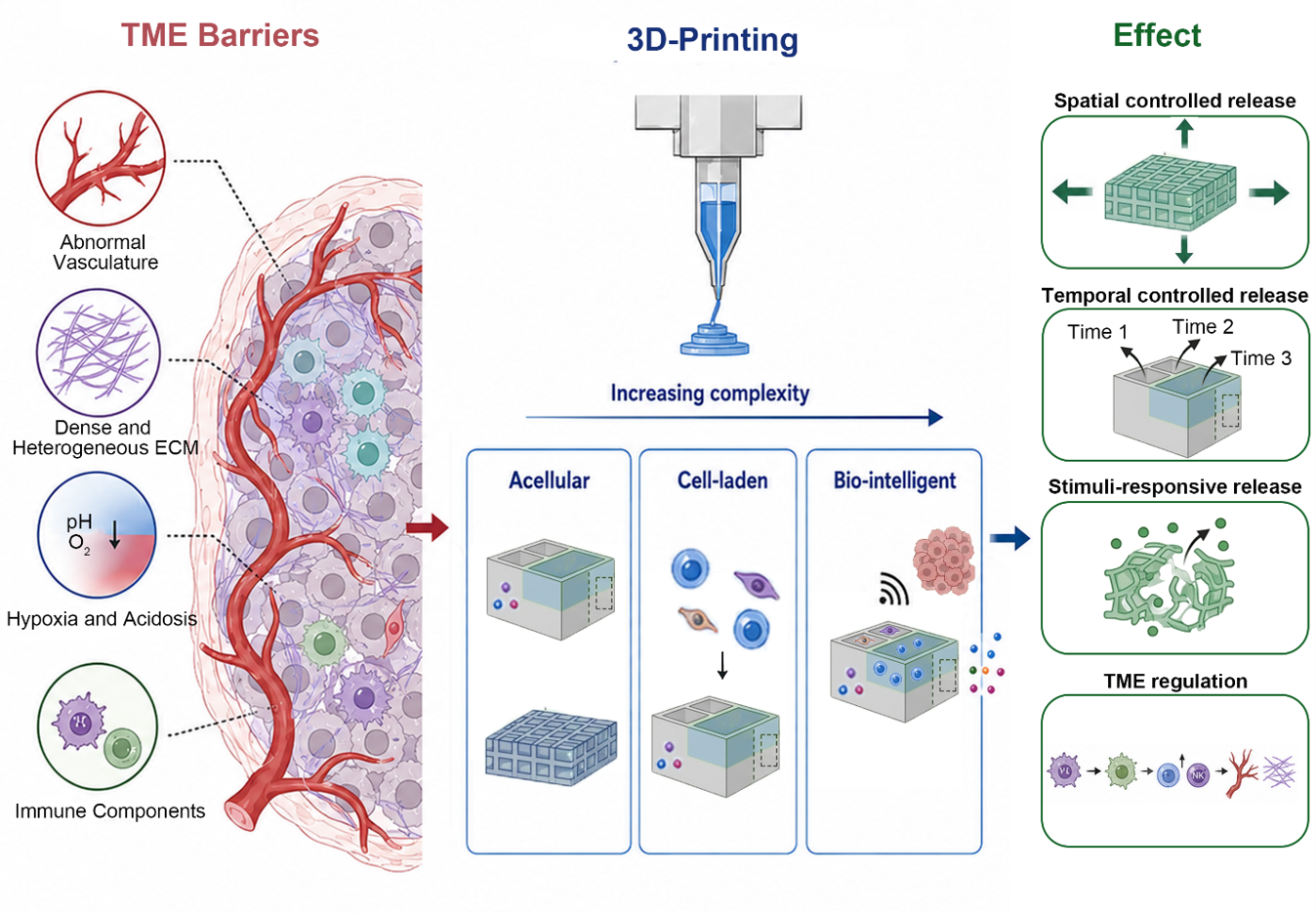
The pronounced spatial heterogeneity and dynamic evolution of the tumor microenvironment represent key factors limiting the sustained therapeutic efficacy of anti-tumor drugs in solid tumors. Traditional drug delivery strategies often rely on spatiotemporally uniform delivery profiles, making it difficult to match the complex structural organization and continuously evolving biological states within tumor tissues. This results in uneven drug distribution, limited therapeutic windows, and the development of drug resistance. In recent years, 3D-printing and bioprinting technologies, as layer-by-layer manufacturing methods based on digital design, have provided new solutions for constructing drug delivery systems with modifiable structures, partitioned spatial organization, and programmable time-release capabilities. By precisely controlling the arrangement of materials, bioactive molecules, and cells in three-dimensional space, these systems can not only achieve fine spatiotemporal regulation of the drug delivery process but also integrate cells, extracellular matrix, and mechanical cues during delivery, thereby partially reshaping the tumor microenvironment. This paper systematically reviews the design strategies and latest advancements of 3D-printing and bioprinting delivery systems in achieving spatiotemporally controllable drug delivery within the tumor microenvironment, focusing on their advantages in spatial regulation, temporal response, and tumor microenvironment reprogramming, while analyzing the current key challenges and clinical translation prospects, aiming to provide references for the rational design of next-generation tumor delivery systems.
- He Q, Chen J, Yan J, et al. Tumor microenvironment responsive drug delivery systems. Asian J Pharm Sci. 2020;15(4):416-448. doi: 10.1016/j.ajps.2019.08.003
- Loyher PL, Hamon P, Laviron M, et al. Macrophages of distinct origins contribute to tumor development in the lung. J Exp Med. 2018;215(10):2536-2553. doi: 10.1084/jem.20180534
- Mo CK, Liu J, Chen S, et al. Tumour evolution and microenvironment interactions in 2D and 3D space. Nature. 2024;634(8036):1178-1186. doi: 10.1038/s41586-024-08087-4
- Chen Z, Han F, Du Y, Shi H, Zhou W. Hypoxic microenvironment in cancer: molecular mechanisms and therapeutic interventions. Signal Transduct Target Ther. 2023;8(1):70. doi: 10.1038/s41392-023-01332-8
- Mitchell MJ, Billingsley MM, Haley RM, Wechsler ME, Peppas NA, Langer R. Engineering precision nanoparticles for drug delivery. Nat Rev Drug Discov. 2021;20(2):101-124. doi: 10.1038/s41573-020-0090-8
- Dewhirst MW, Secomb TW. Transport of drugs from blood vessels to tumour tissue. Nat Rev Cancer. 2017;17(12):738- 750. doi: 10.1038/nrc.2017.93
- Shabbir F, Mujeeb AA, Jawed SF, Khan AH, Shakeel CS. Simulation of transvascular transport of nanoparticles in tumor microenvironments for drug delivery applications. Sci Rep. 2024;14(1):1764. doi: 10.1038/s41598-024-52292-0
- Nguyen LNM, Ngo W, Lin ZP, et al. The mechanisms of nanoparticle delivery to solid tumours. Nat Rev Bioeng. 2024;2(3):201-213. doi: 10.1038/s44222-024-00154-9
- Li J, Mooney DJ. Designing hydrogels for controlled drug delivery. Nat Rev Mater. 2016;1(12). doi: 10.1038/natrevmats.2016.71
- Liang S, Wang T, Ding J, Yang J, He C, Rong Y. Injectable Matrix Metalloproteinase-Responsive Polypeptide Hydrogels as Drug Depots for Antitumor Chemo- Immunotherapy. Pharmaceutics. 2025;17(11):1453. doi: 10.3390/pharmaceutics17111453
- Kang T, Cha GD, Park OK, et al. Penetrative and Sustained Drug Delivery Using Injectable Hydrogel Nanocomposites for Postsurgical Brain Tumor Treatment. ACS Nano. 2023;17(6):5435-5447. doi: 10.1021/acsnano.2c10094
- Munoz NM, Williams M, Dixon K, et al. Influence of injection technique, drug formulation and tumor microenvironment on intratumoral immunotherapy delivery and efficacy. J Immunother Cancer. 2021;9(2):e001800. doi: 10.1136/jitc-2020-001800
- Huang A, Pressnall MM, Lu R, et al. Human intratumoral therapy: Linking drug properties and tumor transport of drugs in clinical trials. J Control Release. 2020;326:203-221. doi: 10.1016/j.jconrel.2020.06.029
- Datta P, Dey M, Ataie Z, Unutmaz D, Ozbolat IT. 3D bioprinting for reconstituting the cancer microenvironment. NPJ Precis Oncol. 2020;4(1):18. doi: 10.1038/s41698-020-0121-2
- Lau K, Tran HA, Tan R, et al. Advancements in 3D-printing strategies towards developing effective implantable drug delivery systems: Recent applications and opportunities. Adv Drug Deliv Rev. 2025;227:115711. doi: 10.1016/j.addr.2025.115711
- Michael B, Jayaprakash N, Munivel N, Jaisankar D. 3D printing in drug delivery: emerging technologies, clinical translation, and the future of personalized medicine. Med Drug Discov. 2025:100242. doi: 10.1016/j.medidd.2025.100242
- Yuan T, Fu X, Hu R, et al. Bioprinted, spatially defined breast tumor microenvironment models of intratumoral heterogeneity and drug resistance. Trends Biotechnol. 2024;42(11):1523-1550. doi: 10.1016/j.tibtech.2024.06.007
- Rodriguez-Gonzalez R, Delgado JA, Delgado LM, Perez RA. Silica 3D printed scaffolds as pH stimuli-responsive drug release platform. Mater Today Bio. 2024;28:101187. doi: 10.1016/j.mtbio.2024.101187
- Debnath S, Latiyan S, Jain N, et al. 3D Bioprinted Immunomodulation horizontal line The Advancing Landscape of Next-Generation Immuno-oncology. Biomacromolecules. 2025;26(6):3255-3280. doi: 10.1021/acs.biomac.4c01816
- Chlenski A, Guerrero LJ, Peddinti R, et al. Anti-angiogenic SPARC peptides inhibit progression of neuroblastoma tumors. Mol Cancer. 2010;9:138. doi: 10.1186/1476-4598-9-138
- Manzari MT, Shamay Y, Kiguchi H, Rosen N, Scaltriti M, Heller DA. Targeted drug delivery strategies for precision medicines. Nat Rev Mater. 2021;6(4):351-370. doi: 10.1038/s41578-020-00269-6
- Goos J, Cho A, Carter LM, et al. Delivery of polymeric nanostars for molecular imaging and endoradiotherapy through the enhanced permeability and retention (EPR) effect. Theranostics. 2020;10(2):567-584. doi: 10.7150/thno.36777
- Price LSL, Stern ST, Deal AM, Kabanov AV, Zamboni WC. A reanalysis of nanoparticle tumor delivery using classical pharmacokinetic metrics. Sci Adv. 2020;6(29):eaay9249. doi: 10.1126/sciadv.aay9249
- Kim YM, Kim H, Park SC, Lee M, Jang MK. Targeted drug delivery of cancer cell-derived extracellular vesicles decorated with a VEGFR-binding peptide. Colloids Surf B Biointerfaces. 2025;252:114661. doi: 10.1016/j.colsurfb.2025.114661
- Yuan Z, Li Y, Zhang S, et al. Extracellular matrix remodeling in tumor progression and immune escape: from mechanisms to treatments. Mol Cancer. 2023;22(1):48. doi: 10.1186/s12943-023-01744-8
- Stylianopoulos T, Jain RK. Combining two strategies to improve perfusion and drug delivery in solid tumors. Proc Natl Acad Sci U S A. 2013;110(46):18632-7. doi: 10.1073/pnas.1318415110
- Parodi A, Haddix SG, Taghipour N, et al. Bromelain surface modification increases the diffusion of silica nanoparticles in the tumor extracellular matrix. ACS Nano. 2014;8(10):9874- 9883. doi: 10.1021/nn502807n
- Hu Q, Zhu Y, Mei J, Liu Y, Zhou G. Extracellular matrix dynamics in tumor immunoregulation: from tumor microenvironment to immunotherapy. J Hematol Oncol. 2025;18(1):65. doi: 10.1186/s13045-025-01717-y
- Chu X, Tian Y, Lv C. Decoding the spatiotemporal heterogeneity of tumor-associated macrophages. Mol Cancer. 2024;23(1):150. doi: 10.1186/s12943-024-02064-1
- He S, Zheng L, Qi C. Myeloid-derived suppressor cells (MDSCs) in the tumor microenvironment and their targeting in cancer therapy. Mol Cancer. 2025;24(1):5. doi: 10.1186/s12943-024-02208-3
- Zhou Z, Xu J, Liu S, et al. Infiltrating treg reprogramming in the tumor immune microenvironment and its optimization for immunotherapy. Biomark Res. 2024;12(1):97. doi: 10.1186/s40364-024-00630-9
- Miller MA, Zheng YR, Gadde S, et al. Tumour-associated macrophages act as a slow-release reservoir of nano-therapeutic Pt(IV) pro-drug. Nat Commun. 2015;6(1):8692. doi: 10.1038/ncomms9692
- Lin ZP, Nguyen LNM, Ouyang B, et al. Macrophages Actively Transport Nanoparticles in Tumors After Extravasation. ACS Nano. 2022;16(4):6080-6092. doi: 10.1021/acsnano.1c11578
- Wang L, Zhang L, Zhang Z, Wu P, Zhang Y, Chen X. Advances in targeting tumor microenvironment for immunotherapy. Front Immunol. 2024;15:1472772. doi: 10.3389/fimmu.2024.1472772
- Liao C, Liu X, Zhang C, Zhang Q. Tumor hypoxia: From basic knowledge to therapeutic implications. Semin Cancer Biol. 2023;88:172-186. doi: 10.1016/j.semcancer.2022.12.011
- Cognet G, Muir A. Identifying metabolic limitations in the tumor microenvironment. Sci Adv. 2024;10(40):eadq7305. doi: 10.1126/sciadv.adq7305
- Bao MHR, Wong CCL. Hypoxia, Metabolic Reprogramming, and Drug Resistance in Liver Cancer. Cells. 2021;10(7):1715. doi: 10.3390/cells10071715
- Ahmed Z, LoGiudice K, Mays G, et al. Increasing Chemotherapeutic Efficacy Using pH-Modulating and Doxorubicin-Releasing Injectable Chitosan- Poly(ethylene glycol) Hydrogels. ACS Appl Mater Interfaces. 2023;15(39):45626-45639. doi: 10.1021/acsami.3c09733
- Liu Y, Si L, Jiang Y, et al. Design of pH-Responsive Nanomaterials Based on the Tumor Microenvironment. Int J Nanomedicine. 2025;20:705-721. doi: 10.2147/IJN.S504629
- Jin Z, Al Amili M, Guo S. Tumor Microenvironment- Responsive Drug Delivery Based on Polymeric Micelles for Precision Cancer Therapy: Strategies and Prospects. Biomedicines. 2024;12(2):417. doi: 10.3390/biomedicines12020417
- Xu X, Zhao J, Wang M, Wang L, Yang J. 3D Printed Polyvinyl Alcohol Tablets with Multiple Release Profiles. Sci Rep. 2019;9(1):12487. doi: 10.1038/s41598-019-48921-8
- Li J, Wu M, Chen W, et al. 3D printing of bioinspired compartmentalized capsular structure for controlled drug release. J Zhejiang Univ Sci B. 2021;22(12):1022-1033. doi: 10.1631/jzus.B2100644
- Kyobula M, Adedeji A, Alexander MR, et al. 3D inkjet printing of tablets exploiting bespoke complex geometries for controlled and tuneable drug release. J Control Release. 2017;261:207-215. doi: 10.1016/j.jconrel.2017.06.025
- Myung N, Jin S, Cho HJ, Kang HW. User-designed device with programmable release profile for localized treatment. J Control Release. 2022;352:685-699. doi: 10.1016/j.jconrel.2022.10.054
- Myung N, Kang HW. Local dose-dense chemotherapy for triple-negative breast cancer via minimally invasive implantation of 3D printed devices. Asian J Pharm Sci. 2024;19(1):100884. doi: 10.1016/j.ajps.2024.100884
- Hagan CT, Bloomquist C, Kim I, et al. Continuous liquid interface production of 3D printed drug-loaded spacers to improve prostate cancer brachytherapy treatment. Acta Biomater. 2022;148:163-170. doi: 10.1016/j.actbio.2022.06.023
- Li Y, Dong D, Qu Y, et al. A Multidrug Delivery Microrobot for the Synergistic Treatment of Cancer. Small. 2023;19(44):e2301889. doi: 10.1002/smll.202301889
- Fang Y, Luo X, Xu Y, et al. Sandwich-Structured Implants to Obstruct Multipath Energy Supply and Trigger Self- Enhanced Hypoxia-Initiated Chemotherapy Against Postsurgical Tumor Recurrence and Metastasis. Adv Sci (Weinh). 2023;10(22):e2300899. doi: 10.1002/advs.202300899
- Zhou L, Zhao S, Xu Y, et al. Spatial-Constraint Modulation of Intra/Extracellular Reactive Oxygen Species by Adaptive Hybrid Materials for Boosting Pyroptosis and Combined Immunotherapy of Breast Tumor. Adv Healthc Mater. 2025;14(17):e2500371. doi: 10.1002/adhm.202500371
- Yi HG, Choi YJ, Kang KS, et al. A 3D-printed local drug delivery patch for pancreatic cancer growth suppression. J Control Release. 2016;238:231-241. doi: 10.1016/j.jconrel.2016.06.015
- Hagan IV CT, Bloomquist C, Warner S, et al. 3D printed drug-loaded implantable devices for intraoperative treatment of cancer. J Control Release. 2022;344:147-156. doi: 10.1016/j.jconrel.2022.02.024
- Joo SH, Kim J, Hong J, Fakhraei Lahiji S, Kim YH. Dissolvable Self-Locking Microneedle Patches Integrated with Immunomodulators for Cancer Immunotherapy. Adv Mater. 2023;35(10):e2209966. doi: 10.1002/adma.202209966
- Tamjid E, Bohlouli M, Mohammadi S, Alipour H, Nikkhah M. Sustainable drug release from highly porous and architecturally engineered composite scaffolds prepared by 3D printing. J Biomed Mater Res A. 2020;108(6):1426-1438. doi: 10.1002/jbm.a.36914
- Sultan S, Mathew AP. 3D printed scaffolds with gradient porosity based on a cellulose nanocrystal hydrogel. Nanoscale. 2018;10(9):4421-4431. doi: 10.1039/c7nr08966j
- Wu X, Chen K, Chai Q, et al. A 3D printed multilayer biomimetic scaffold with a gradient-oriented structure for articular cartilage repair. J Mater Chem B. 2025;13(26):7728- 7743. doi: 10.1039/d5tb00383k
- Fan D, Zhang C, Wang H, et al. Fabrication of a composite 3D-printed titanium alloy combined with controlled in situ drug release to prevent osteosarcoma recurrence. Mater Today Bio. 2023;20:100683. doi: 10.1016/j.mtbio.2023.100683
- Zaer M, Moeinzadeh A, Abolhassani H, et al. Doxorubicin-loaded Niosomes functionalized with gelatine and alginate as pH-responsive drug delivery system: A 3D printing approach. Int J Biol Macromol. 2023;253(Pt 2):126808. doi: 10.1016/j.ijbiomac.2023.126808
- Kefayat A, Molaabasi F, Bahrami M, et al. 3D printed, biodegradable, and biocompatible intraperitoneal implants loaded with folic acid-targeted/pH-sensitive/doxorubicin-loaded hydroxyapatite nanoparticles for systemic treatment of metastatic breast cancer. J Nanobiotechnology. 2025;24(1):39. doi: 10.1186/s12951-025-03854-5
- Wang L, Ye C, Xue X, et al. 3D-Printed Breast Prosthesis that Smartly Senses and Targets Breast Cancer Relapse. Adv Sci (Weinh). 2024;11(46):e2402345. doi: 10.1002/advs.202402345
- Su Q, Wang Z, Li P, Wei X, Xiao J, Duan X. pH and ROS Dual-Responsive Autocatalytic Release System Potentiates Immunotherapy of Colorectal Cancer. Adv Healthc Mater. 2024;13(29):e2401126. doi: 10.1002/adhm.202401126
- Zhang X, Lian R, Fan B, et al. ROS/Enzyme Dual-Responsive Drug Delivery System for Targeted Colorectal Cancer Therapy: Synergistic Chemotherapy, Anti-Inflammatory, and Gut Microbiota Modulation. Pharmaceutics. 2025;17(7):940. doi: 10.3390/pharmaceutics17070940
- Hadipour Moghaddam SP, Yazdimamaghani M, Ghandehari H. Glutathione-sensitive hollow mesoporous silica nanoparticles for controlled drug delivery. J Control Release. 2018;282:62-75. doi: 10.1016/j.jconrel.2018.04.032
- Shen J, Wang Q, Fang J, et al. Therapeutic polymeric nanomedicine: GSH-responsive release promotes drug release for cancer synergistic chemotherapy. RSC Adv. 2019;9(64):37232-37240. doi: 10.1039/c9ra07051f
- Kang Y, She Y, Zang Y, et al. Biohybrid Microrobot Enteric- Coated Microcapsule for Oral Treatment of Colorectal Cancer. Adv Mater. 2025;37(40):e20586. doi: 10.1002/adma.202420586
- Yang C, Zhao W, Zhang L, et al. Intradermal Delivery of Cell Vaccine via Ice Microneedles for Cancer Treatment. Adv Healthc Mater. 2025;14(1):e2400678. doi: 10.1002/adhm.202400678
- Kim D, Jo S, Lee D, et al. NK cells encapsulated in micro/ macropore-forming hydrogels via 3D bioprinting for tumor immunotherapy. Biomater Res. 2023;27(1):60. doi: 10.1186/s40824-023-00403-9
- Xia P, Liu C, Wei X, Guo J, Luo Y. 3D-Printed hydrogel scaffolds with drug- and stem cell-laden core/shell filaments for cancer therapy and soft tissue repair. J Mater Chem B. 2024;12(44):11491-11501. doi: 10.1039/d4tb01571a
- Liu H, Shi X, Wang D, Zhang H, Xu Z, Tan Z. Three- Dimensional-Printed In Vitro Model of Colorectal Cancer with Immune Microenvironment and Reprogramming Capabilities. ACS Biomater Sci Eng. 2025;11(10):5991-6003. doi: 10.1021/acsbiomaterials.5c00263
- Xu HQ, Liu JC, Zhang ZY, Xu CX. A review on cell damage, viability, and functionality during 3D bioprinting. Mil Med Res. 2022;9(1):70. doi: 10.1186/s40779-022-00429-5
- Elango J, Zamora-Ledezma C. Rheological, Structural, and Biological Trade-Offs in Bioink Design for 3D Bioprinting. Gels. 2025;11(8):659 doi: 10.3390/gels11080659
- Martin KE, Hammer Q, Perica K, Sadelain M, Malmberg KJ. Engineering immune-evasive allogeneic cellular immunotherapies. Nat Rev Immunol. 2024;24(9):680-693. doi: 10.1038/s41577-024-01022-8
- Sun R, Jiao Y, Chen J, et al. Neutrophil-Mediated Delivery Platforms for Synergistic Chemo-Immunotherapy of Non-Small-Cell Lung Cancer Therapy. Nano Lett. 2025;25(38):14229-14236. doi: 10.1021/acs.nanolett.5c04210
- Zhang Y, Xu J, Fei Z, et al. 3D Printing Scaffold Vaccine for Antitumor Immunity. Adv Mater. 2021;33(48):e2106768. doi: 10.1002/adma.202106768
- Li C, Li C, Ma Z, et al. Regulated macrophage immune microenvironment in 3D printed scaffolds for bone tumor postoperative treatment. Bioact Mater. 2023;19:474-485. doi: 10.1016/j.bioactmat.2022.04.028
- Li C, Ma Z, Sun X, et al. Activation of bone tumor-eating macrophages via assembling and co-delivering 3D printed scaffold. Biomaterials. 2026;324:123495. doi: 10.1016/j.biomaterials.2025.123495
- Qu T, Li B, Wang Y. Targeting CD47/SIRPalpha as a therapeutic strategy, where we are and where we are headed. Biomark Res. 2022;10(1):20. doi: 10.1186/s40364-022-00373-5
- Huang M, Zhang L, Cui J, et al. 3D printing of GelMA/ nanohydroxyapatite/melanin nanoparticles composite hydrogel scaffolds for bone regeneration through immunomodulation. Int J Biol Macromol. 2025;306(Pt 2):141453. doi: 10.1016/j.ijbiomac.2025.141453
- Wang C, Wu Q, Zhuang L, et al. Immunometabolism of macrophages in the bone microenvironment: a new perspective for bone healing therapy. J Adv Res. 2026;82:485- 506. doi: 10.1016/j.jare.2025.07.046
- Dutta SD, Ganguly K, Hexiu J, Randhawa A, Moniruzzaman M, Lim KT. A 3D Bioprinted Nanoengineered Hydrogel with Photoactivated Drug Delivery for Tumor Apoptosis and Simultaneous Bone Regeneration via Macrophage Immunomodulation. Macromol Biosci. 2023;23(9):e2300096. doi: 10.1002/mabi.202300096
- Badiee P, Maritz MF, Thierry B. Glycogen kinase 3 inhibitor nanoformulation as an alternative strategy to inhibit PD-1 immune checkpoint. Int J Pharm. 2022;622:121845. doi: 10.1016/j.ijpharm.2022.121845
- Wang H, Liu Z, Fang Y, et al. Spatiotemporal release of non-nucleotide STING agonist and AKT inhibitor from implantable 3D-printed scaffold for amplified cancer immunotherapy. Biomaterials. 2024;311:122645. doi: 10.1016/j.biomaterials.2024.122645
- Yin M, Mao L, Zhang X, et al. Biodegradable 3D Injectable Amino Acid Hydrogels Delivering Immune Adjuvant for Enhancing Immunotherapy in Colon Cancer. Cancer Sci. 2025;116(10):2846-2857. doi: 10.1111/cas.70156
- Li K, Yu X, Xu Y, et al. Cascaded immunotherapy with implantable dual-drug depots sequentially releasing STING agonists and apoptosis inducers. Nat Commun. 2025;16(1):1629. doi: 10.1038/s41467-025-56407-7
- Kota N, Gonzalez DD, Liu HC, et al. Prophylactic and therapeutic cancer vaccine with continuous localized immunomodulation. Nanomedicine. 2024;62:102776. doi: 10.1016/j.nano.2024.102776
- Xie D, Han C, Chen C, et al. A scaffold vaccine to promote tumor antigen cross-presentation via sustained toll-like receptor-2 (TLR2) activation. Bioact Mater. 2024;37:315- 330. doi: 10.1016/j.bioactmat.2024.03.035
- Xu Y, Zhu W, Wu J, et al. 3D-Printed Dendritic Cell Vaccines for Post-Surgery Cancer Immunotherapy. Adv Funct Mater. 2024;34(33):2400507. doi: 10.1002/adfm.202400507
- Chen L, Xu Y, Hu X, et al. In situ generation of dendritic cell vaccines in 3D printing scaffolds for cancer post-surgical therapy. Natl Sci Rev. 2026;13(5):nwag037. doi: 10.1093/nsr/nwag037
- Fang Y, Liu Z, Wang H, et al. Implantable Sandwich-like Scaffold/Fiber Composite Spatiotemporally Releasing Combretastatin A4 and Doxorubicin for Efficient Inhibition of Postoperative Tumor Recurrence. ACS Appl Mater Interfaces. 2022;14(24):27525-27537. doi: 10.1021/acsami.2c02103
- Abbadessa A, Nunez Bernal P, Buttitta G, et al. Biofunctionalization of 3D printed collagen with bevacizumab-loaded microparticles targeting pathological angiogenesis. J Control Release. 2023;360:747-758. doi: 10.1016/j.jconrel.2023.07.017
- Xu H, Peng Z, Lin J, et al. 3D-Printed Magnesium Peroxide- Incorporated Scaffolds with Sustained Oxygen Release and Enhanced Photothermal Performance for Osteosarcoma Multimodal Treatments. ACS Appl Mater Interfaces. 2024;16(8):9626-9639. doi: 10.1021/acsami.3c10807
- Liu M, Qiao Y, Cheng S, et al. 3D bioprinted microneedle patches loaded with gambogic acid-iron-doxorubicin nanozymes for postoperative glioma in situ therapy via ferroptosis synergistic chemosensitization. J Nanobiotechnology. 2025;23(1):755. doi: 10.1186/s12951-025-03790-4
- Chao Y, Liu Z. Biomaterials tools to modulate the tumour microenvironment in immunotherapy. Nat Rev Bioeng. 2023;1(2):125-138. doi: 10.1038/s44222-022-00004-6
- Chen P, Xia Y, Wu Y, Wu X, Wang Y, Dai H. 3D-printed scaffolds with ROS-clearing capacity for critical-sized bone defect regeneration. Biomater Adv. 2026;180:214575. doi: 10.1016/j.bioadv.2025.214575
- First 3D-printed pill. Nat Biotechnol. 2015;33(10):1014. doi: 10.1038/nbt1015-1014a
- Denis L, Jorgensen AK, Do B, et al. Developing an innovative 3D printing platform for production of personalised medicines in a hospital for the OPERA clinical trial. Int J Pharm. 2024;661:124306. doi: 10.1016/j.ijpharm.2024.124306
- Gómez VJ, Martin-Gonzalez A, Zafra-Vallejo V, Zubillaga- Rodriguez I, Fernandez-Garcia A, Sanchez-Aniceto G. Controversies in point-of-care 3D printing for oncological and reconstructive surgery with free software in oral and maxillofacial surgery: European regulations, costs, and timeframe. Int J Oral Maxillofac Surg. 2024;53(8):650-660. doi: 10.1016/j.ijom.2024.01.005
- Yon CJ, Choi BC, Lee JM, Lee SW. Personalized 3D-Printed Prostheses for Bone Defect Reconstruction After Tumor Resection in the Foot and Ankle. J Funct Biomater. 2025;16(2):62. doi: 10.3390/jfb16020062
- Babaei M, Ebrahim-Najafabadi N, Mirzadeh M, et al. A comprehensive bench-to-bed look into the application of gamma-sterilized 3D-printed polycaprolactone/ hydroxyapatite implants for craniomaxillofacial defects, an in vitro, in vivo, and clinical study. Biomater Adv. 2024;161:213900. doi: 10.1016/j.bioadv.2024.213900
- Chen XB, Fazel Anvari-Yazdi A, Duan X, et al. Biomaterials / bioinks and extrusion bioprinting. Bioact Mater. 2023;28:511-536. doi: 10.1016/j.bioactmat.2023.06.006
- Gaglio CG, Baruffaldi D, Pirri CF, Napione L, Frascella F. GelMA synthesis and sources comparison for 3D multimaterial bioprinting. Front Bioeng Biotechnol. 2024;12:1383010. doi: 10.3389/fbioe.2024.1383010
- Jiao W, Chen W, Mei Y, et al. Effects of Molecular Weight and Guluronic Acid/Mannuronic Acid Ratio on the Rheological Behavior and Stabilizing Property of Sodium Alginate. Molecules. 2019;24(23):4374. doi: 10.3390/molecules24234374