
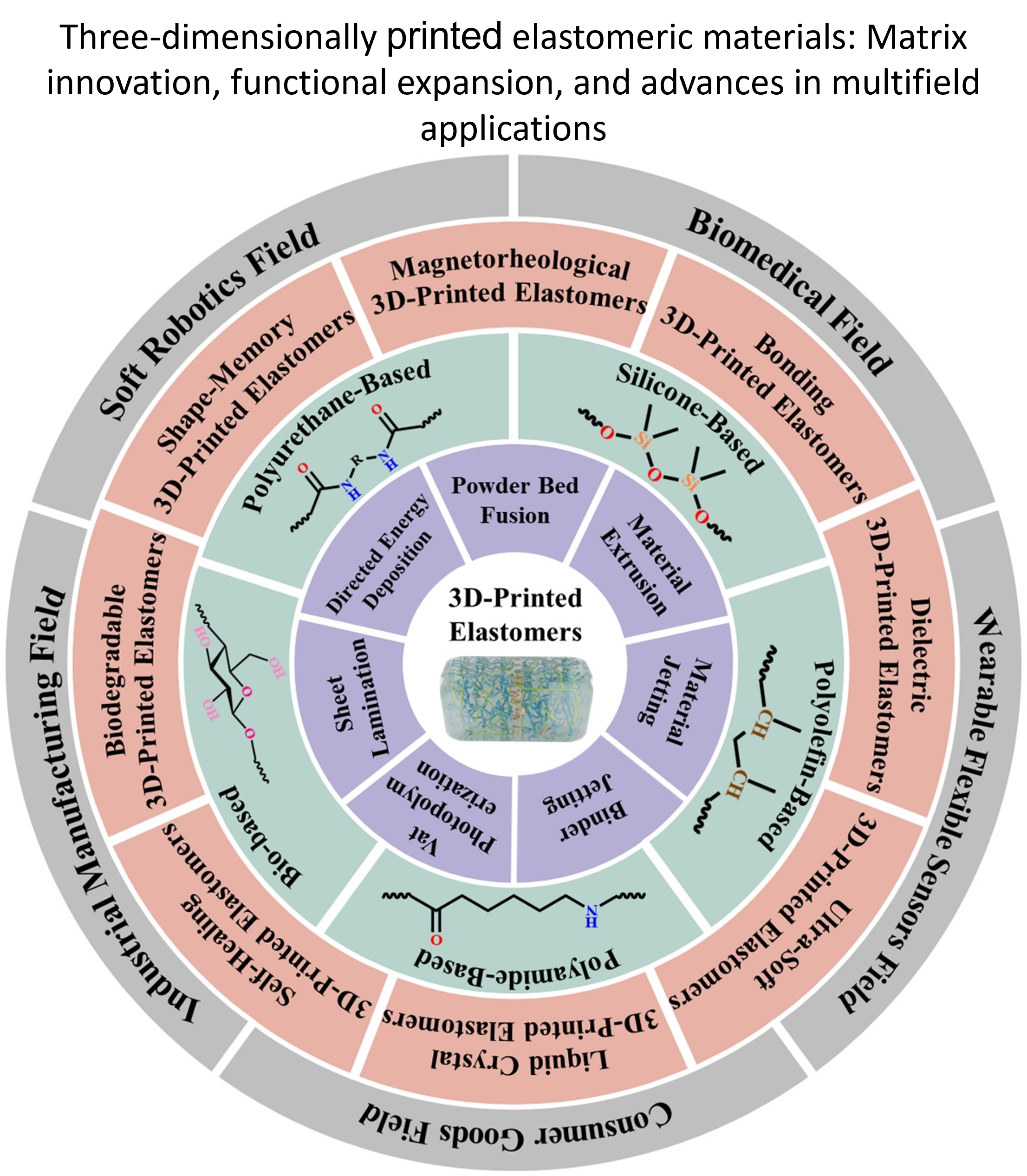
Three-dimensionally printed elastomeric materials: Matrix innovation, functional expansion, and advances in multifield applications

Additive manufacturing (AM; commonly known as three-dimensional [3D] printing) has gained widespread adoption across diverse fields owing to its high precision, capability to directly fabricate complex geometries, and support for personalized customization. Elastomeric polymers, which combine excellent elastic recovery with multifunctional properties, have converged with 3D printing to establish the emerging field of 3D-printed elastomers, thereby overcoming limitations of traditional manufacturing in design freedom and functional integration. This review systematically surveys advances in 3D-printed elastomers over the past five years. It focuses on the characteristics and suitability of mainstream processes, including material extrusion, material jetting, and photopolymerization, and provides detailed classifications of polyurethane-based, silicone-based, polyolefin-based, and bio-based matrix materials. The design and processing principles, core breakthroughs, and current technical bottlenecks of functional elastomers are comprehensively outlined, while summarizing demonstrated applications in biomedicine, flexible electronics, soft robotics, industrial manufacturing, and consumer products. Nevertheless, key challenges remain for 3D-printed elastomers, including balancing competing material properties, reconciling process throughput with dimensional precision, ensuring reliability in extreme environments, and enabling large-scale manufacturing. The review concludes by outlining future directions, such as the design of dynamic and adaptive polymer networks, the development of green and sustainable materials, and convergence-driven interdisciplinary innovation, thereby providing guidance for future research and industrial translation.
- Bliah O, Hegde C, Tan JMR, Magdassi S. Fabrication of Soft Robotics by Additive Manufacturing: From Materials to Applications. Chem Rev. 2025;125(16):7275-7320. doi: 10.1021/acs.chemrev.4c00749
- Das R, Joshi SS, Owuor PS, et al. Additive manufacturing of immiscible/incompatible systems. Mater Today. 2025;87:125-150. doi: 10.1016/j.mattod.2025.04.003
- Mora S, Pugno NM, Misseroni D. 3D printed architected lattice structures by material jetting. Mater Today. 2022;59:107-132. doi: 10.1016/j.mattod.2022.05.008
- Pessoa S, Guimarães AS, Lucas SS, Simões N. 3D printing in the construction industry - A systematic review of the thermal performance in buildings. Renew Sustain Energy Rev. 2021;141:110794. doi: 10.1016/j.rser.2021.110794
- Zhao Q, Gao C, Zhang Y, Zhang Y. Advances and application potential in the research of silicate mineral-based 3D printing materials. Prog Mater Sci. 2025;152:101450. doi: 10.1016/j.pmatsci.2025.101450
- Chen T, Luo L, Li J, et al. Advancements in 3D printing technologies for personalized treatment of osteonecrosis of the femoral head. Mater Today Bio. 2025;31:101531. doi: 10.1016/j.mtbio.2025.101531
- Chen Z, Rivkin B, Castellanos-Robles D, Soldatov I, Beyer L, Medina-Sánchez M. Rapid Fabrication of Self-Propelled and Steerable Magnetic Microcatheters for Precision Medicine. Adv Mater. Published online November 27, 2025. doi: 10.1002/adma.202506591
- Thakur MSH, Nath MD, Ajayan PM, Paulino GH, Rahman MM. Macroscale ceramic origami structures with hyper-elastic coating. Adv Compos Hybrid Mater. 2025;8(2):226. doi: 10.1007/s42114-025-01284-3
- Shi S, Jiang Y, Ren H, et al. 3D-Printed Carbon-Based Conformal Electromagnetic Interference Shielding Module for Integrated Electronics. Nano-Micro Lett. 2024;16(1):85. doi: 10.1007/s40820-023-01317-w
- Wang T, Wang W, Tian X, et al. A Universal Multiscale Ion–Electron Dual Regulation for on-Demand All-3D-Printed High-Voltage Full Batteries. Adv Funct Mater. 2025;35(45):2507097. doi: 10.1002/adfm.202507097
- Aliberti F, Longo R, Raimondo M, Pantani R, Vertuccio L, Guadagno L. Additive manufacturing of polymers and composites for applications in aerospace and aeronautics. Mater Horiz. 2026;13(2):532-588. doi: 10.1039/D5MH01403D
- Guo Z, Hou Z, Tian X, et al. Optimization design and 3D printing of curvilinear fiber reinforced variable stiffness composites based on polar coordinate sweeping. Addit Manuf. 2024;88:104272. doi: 10.1016/j.addma.2024.104272
- Li T, Shen K, Xiang C, et al. Hierarchical wrinkled structures via 3D printing and self-organization for energy-efficient transport. Matter. 2025;8(12):102345. doi: 10.1016/j.matt.2025.102345
- Brown NC, Ames DC, Mueller J. Multimaterial extrusion 3D printing printheads. Nat Rev Mater. 2025;10(11):807- 825. doi: 10.1038/s41578-025-00809-y
- Bai J, Guo B, Tian M, Chen F, Zhang L. Dynamic crosslinked elastomers and rubbers. Prog Mater Sci. 2026;155:101536. doi: 10.1016/j.pmatsci.2025.101536
- Xue H, Jin J, Huang X, et al. Wearable flexible ultrasound microneedle patch for cancer immunotherapy. Nat Commun. 2025;16(1):2650. doi: 10.1038/s41467-025-58055-z
- Tian H, Lu W, Wang C, et al. Development of highly robust polyurethane elastomers possessing self-healing capabilities for flexible sensors. Mater Horiz. 2025;12(11):3949-3964. doi: 10.1039/D5MH00022J
- Zhou W, Hu J, Kuang T, Zheng W, Shen B. Highly stretchable sandwich-architected liquid metal/elastomer film with robust leakage resistance for electromagnetic shielding and dual-mode thermal management. J Mater Sci Technol. 2026;264:62-69. doi: 10.1016/j.jmst.2025.11.010
- Li Z, Tang J, Wang X, et al. Bioinspired Liquid-Free Ion- Conductive Elastomers with Ultrahigh Mechanical Strength and Excellent Ionic Conductivity for Multifunctional Flexible Sensing Applications. Adv Sci. 2025;12(27):2503510. doi: 10.1002/advs.202503510
- Utrera-Barrios S, Verdejo R, López-Manchado MÁ, Hernández Santana M. Self-Healing Elastomers: A sustainable solution for automotive applications. Eur Polym J. 2023;190:112023. doi: 10.1016/j.eurpolymj.2023.112023
- Qin L, Cao J, Feng S, Zhang J. High-strength millable polydimethylsiloxane-based polyurethane elastomers with a broader application temperature range. J Mater Chem A. 2025;13(21):15883-15891. doi: 10.1039/D5TA01208B
- Yan R, Xu Z, Yi H, et al. Bioinspired Janus Universal Adhesive Patch: Bridging the Contrasting Interface of Soft Tissues and Medical Devices. Adv Funct Mater. 2025;35(22):2422130. doi: 10.1002/adfm.202422130
- Kim SH, Jung S, Yoon IS, Lee C, Oh Y, Hong J-M. Ultrastretchable Conductor Fabricated on Skin- Like Hydrogel–Elastomer Hybrid Substrates for Skin Electronics. Adv Mater. 2018;30(26):1800109. doi: 10.1002/adma.201800109
- Herzberger J, Sirrine JM, Williams CB, Long TE. Polymer Design for 3D Printing Elastomers: Recent Advances in Structure, Properties, and Printing. Prog Polym Sci. 2019;97:101144. doi: 10.1016/j.progpolymsci.2019.101144
- Lin C, Chen X, Wang Z, Guo X, Kiziroglou ME, Yeatman EM. High-performance electromagnetic micropumps fabricated via multi-material jetting additive manufacturing. Addit Manuf. 2025;114:105038. doi: 10.1016/j.addma.2025.105038
- Ebrahimi M, Shaikh H, Rezvani Sichani H, et al. Additive manufacturing for Dentistry: A comprehensive review of techniques and applications. Prog Mater Sci. 2026;157:101613. doi: 10.1016/j.pmatsci.2025.101613
- Shahzadi L, Maya F, Breadmore MC, Thickett SC. Functional Materials for DLP-SLA 3D Printing Using Thiol–Acrylate Chemistry: Resin Design and Postprint Applications. ACS Appl Polym Mater. 2022;4(5):3896-3907. doi: 10.1021/acsapm.2c00358
- Ahn S-J, Lee H, Cho K-J. 3D printing with a 3D printed digital material filament for programming functional gradients. Nat Commun. 2024;15(1):3605. doi: 10.1038/s41467-024-47480-5
- Wang Y, Willenbacher N. Phase-Change-Enabled, Rapid, High-Resolution Direct Ink Writing of Soft Silicone. Adv Mater. 2022;34(15):2109240. doi: 10.1002/adma.202109240
- Wang K, Pan W, Liu Z, et al. 3D Printing of Viscoelastic Suspensions via Digital Light Synthesis for Tough Nanoparticle–Elastomer Composites. Adv Mater. 2020;32(25):2001646. doi: 10.1002/adma.202001646
- Schulz VP, Schmitz S, Auvity B, Starke T. On the Potential of 3D Printed Micro Structured Porous Media to Enhance PEM Fuel Cell Performance. ECS Meet Abstr. 2019;MA2019- 01(33):1742. doi: 10.1149/MA2019-01/33/1742
- Hwangbo H, Jeon S-J. Digital light processing 3D printing of multi-materials with improved adhesion using resins containing low functional acrylates. Korean J Chem Eng. 2022;39(2):451-459. doi: 10.1007/s11814-021-0934-x
- Jin J, Zhang F, Yang Y, et al. Hybrid Multimaterial 3D Printing Using Photocuring-While-Dispensing. Small. 2023;19(50):2302405. doi: 10.1002/smll.202302405
- Odent J, Baleine N, Biard V, et al. 3D-Printed Stacked Ionic Assemblies for Iontronic Touch Sensors. Adv Funct Mater. 2023;33(3):2210485. doi: 10.1002/adfm.202210485
- Chekkaramkodi D, Jacob L, C MS, Umer R, Butt H. Review of vat photopolymerization 3D printing of photonic devices. Addit Manuf. 2024;86:104189. doi: 10.1016/j.addma.2024.104189
- Huang X, Peng S, Zheng L, Zhuo D, Wu L, Weng Z. 3D Printing of High Viscosity UV-Curable Resin for Highly Stretchable and Resilient Elastomer. Adv Mater. 2023;35(49):2304430. doi: 10.1002/adma.202304430
- Hossain M, Navaratne R, Perić D. 3D printed elastomeric polyurethane: Viscoelastic experimental characterizations and constitutive modelling with nonlinear viscosity functions. Int J Non Linear Mech. 2020;126:103546. doi: 10.1016/j.ijnonlinmec.2020.103546
- Mahmoodiyan Najafabadi F, Karbasi S, Benisi SZ, Shojaei S, Poursamar SA, Nasr Azadani R. Evaluation of the effects of alumina nanowire on 3D printed polycaprolactone / magnetic mesoporous bioactive glass scaffold for bone tissue engineering applications. Mater Chem Phys. 2023;303:127616. doi: 10.1016/j.matchemphys.2023.127616
- Meng J, Tan Z, Chen Y, et al. Host-Guest All-in-One Supercapacitors Enabled by 3D-Printed Zwitterionic Gel Microlattices for Advanced Energy Storage. Adv Funct Mater. 2026;36(18):e20575. doi: 10.1002/adfm.202520575
- Zhang Z, Gao N, Zhang F, Liu L, Chen Y. Photothermal-driven water-gliding microrobots based on fully integrated flexible sensors with heterogeneous wettability. Soft Sci. 2025;5(2):15. doi: 10.20517/ss.2024.71
- Luo X, Wan R, Zhang Z, et al. 3D-Printed Hydrogel-Based Flexible Electrochromic Device for Wearable Displays. Adv Sci. 2024;11(38):2404679. doi: 10.1002/advs.202404679
- Yu J, Wan R, Tian F, et al. 3D Printing of Robust High- Performance Conducting Polymer Hydrogel-Based Electrical Bioadhesive Interface for Soft Bioelectronics. Small. 2024;20(19):2308778. doi: 10.1002/smll.202308778
- Chen J, Virrueta C, Zhang S, Mao C, Wang J. 4D printing: The spotlight for 3D printed smart materials. Mater Today. 2024;77:66-91. doi: 10.1016/j.mattod.2024.06.004
- Jian BC, Demoly F, Zhang YC, Qi HJ, André JC, Gomes S. Origami-Based Design for 4D Printing of 3D Support-Free Hollow Structures. Engineering. 2022;12:70-82. doi: 10.1016/j.eng.2021.06.028
- Delavarde A, Savin G, Derkenne P, et al. Sustainable polyurethanes: toward new cutting-edge opportunities. Prog Polym Sci. 2024;151:101805. doi: 10.1016/j.progpolymsci.2024.101805
- Fang Z, Mu H, Sun Z, et al. 3D printable elastomers with exceptional strength and toughness. Nature. 2024;631(8022):783-788. doi: 10.1038/s41586-024-07588-6
- Zhang H, Lu D, Yang S, He Y, Zhang H, Bao J. A photocurable polyurethane elastomer for digital light processing with comprehensive reusability based on dynamic hindered urea bonds. Polymer. 2024;292:126657. doi: 10.1016/j.polymer.2023.126657
- Li H, Liang L, Zeng W, Deng Y, Ge N, Shan W. 3D printing polyurethane acrylate(PUA) based elastomer and its mechanical behavior. Mater Res Express. 2023;10(5):055306. doi: 10.1088/2053-1591/acd740
- Yang J, Liao Z, Hossain M, Huang G, Wang K, Yao X. Thermo-mechanical experimental investigations of 3D-printed elastomeric polyurethane from low to intermediate strain rates. Mech Res Commun. 2023;134:104212. doi: 10.1016/j.mechrescom.2023.104212
- Rapp JL, Borden MA, Bhat V, Sarabia A, Leibfarth FA. Continuous Polymer Synthesis and Manufacturing of Polyurethane Elastomers Enabled by Automation. ACS Polym Au. 2024;4(2):120-127. doi: 10.1021/acspolymersau.3c00033
- Luo Y, Lu Q, Lu J, et al. Mechanically Robust Polyurethane Elastomers Enabled by Soft-Segment-Regulated Hydrogen Bonds and Microphase Separation for Ultrasound Imaging Medical Catheters. Mater Horiz. 2026;13(5):2438-2450. doi: 10.1039/D5MH01806D
- Hu S, Shou T, Guo M, et al. Fabrication of New Thermoplastic Polyurethane Elastomers with High Heat Resistance for 3D Printing Derived from 3,3-Dimethyl-4,4′-diphenyl Diisocyanate. Ind Eng Chem Res. 2020;59(22):10476-10482. doi: 10.1021/acs.iecr.0c01101
- Hu S, Shou T, Zhao X, et al. Rational design of a novel NDI-based thermoplastic polyurethane elastomer with superior heat resistance. Polymer. 2020;205:122764. doi: 10.1016/j.polymer.2020.122764
- Natali P, Mazzocchetti L, Bertoldo D, et al. Study of the Behavior of 3D Printed Thermoplastic Elastomers Structures Aimed at Emulating Traditional Polyurethane Foams. Macromol Symp. 2024;413(4):2400027. doi: 10.1002/masy.202400027
- Lin X, Wu S, Wang D, et al. Super elastic-plastic behavior of the surface grooves resulting in tensile anisotropy of 3D-printed elastomers. Addit Manuf. 2024;82:104030. doi: 10.1016/j.addma.2024.104030
- León-Calero M, Reyburn Valés SC, Marcos-Fernández Á, Rodríguez-Hernandez J. 3D Printing of Thermoplastic Elastomers: Role of the Chemical Composition and Printing Parameters in the Production of Parts with Controlled Energy Absorption and Damping Capacity. Polymers. 2021;13(20):3551. doi: 10.3390/polym13203551
- Ngeow YW, Ismail NIN, Hassim DHAI, Sarkawi SS, Rahim MISA, Yong KC. A comparative evaluation of compression moulded and fused deposition modelling 3D printed thermoplastic polyurethane. J Rubber Res. 2024;27(2):193- 200. doi: 10.1007/s42464-024-00238-6
- Khakbaz H, Ruberu K, Kang L, et al. 3D printing of highly flexible, cytocompatible nanocomposites for thermal management. J Mater Sci. 2021;56(10):6385-6400. doi: 10.1007/s10853-020-05661-9
- Li Y, Peng S, Kankala RK, Wu L, Chen A-Z, Wang S-B. 3D printing of mechanically robust MXene-encapsulated polyurethane elastomer. Compos Part A Appl Sci Manuf. 2022;163:107182. doi: 10.1016/j.compositesa.2022.107182
- Rollo G, Ronca A, Cerruti P, et al. On the Synergistic Effect of Multi-Walled Carbon Nanotubes and Graphene Nanoplatelets to Enhance the Functional Properties of SLS 3D-Printed Elastomeric Structures. Polymers. 2020;12(8):1841. doi: 10.3390/polym12081841
- Fei J, Rong Y, Du X, et al. Vat photopolymerization printing of strong tear-resistance and stretchable polyurethane elastomer for highly sensitive strain sensors. Polym Compos. 2024;45(3):2615-2628. doi: 10.1002/pc.27943
- Peng S, Thirunavukkarasu N, Chen J, et al. Vat photopolymerization 3D printing of transparent, mechanically robust, and self-healing polyurethane elastomers for tailored wearable sensors. Chem Eng J. 2023;463:142312. doi: 10.1016/j.cej.2023.142312
- Ansaripour A, Heidari-Rarani M. Hybrid toughening effect of flax fiber and thermoplastic polyurethane elastomer in 3D-printed polylactic acid composites. Polym Compos. 2024;45(18):17239-17256. doi: 10.1002/pc.28965
- Yu Z, Sun X, Zhu Y, et al. Direct Ink Writing 3D Printing Elastomeric Polyurethane Aided by Cellulose Nanofibrils. ACS Nano. 2024;18(41):28142-28153. doi: 10.1021/acsnano.4c07681
- Jin L, Zhao W, Feng Z, Ni Y, Hadjichristidis N. Porous Non-Isocyanate Polyurethane by Stepwise Polymerization- Induced Micron Phase Separation between Evolving Polymer Network and Solvent. Adv Funct Mater. Published online June 29, 2025. doi: 10.1002/adfm.202515569
- Pierrard A, Melo SF, Thijssen Q, et al. Design of 3D-Photoprintable, Bio-, and Hemocompatible Nonisocyanate Polyurethane Elastomers for Biomedical Implants. Biomacromolecules. 2024;25(3):1810-1824. doi: 10.1021/acs.biomac.3c01261
- Yap TF, Klinkao J, Urbina S, et al. Understanding silicone elastomer curing and adhesion for stronger soft devices. Sci Adv. 2025;11(29):eadv2681. doi: 10.1126/sciadv.adv2681
- Wang S, Xie M, Yu B, Zu Z, Zhang L, Xiang H. Cycloaliphatic epoxy-functionalized polysiloxanes for UV-mask 3D printing via cationic photopolymerization. Addit Manuf. 2025;111:104977. doi: 10.1016/j.addma.2025.104977
- Guell Izard A, Pérez Pérez LX, Weisgraber TH, et al. Novel Fast Cure Silicone Inks for Single-Step, Support-Free 3D Printing of Tall, Overhanging, and High Aspect Ratio Structures. Adv Mater Technol. 2024;9(19):2400423. doi: 10.1002/admt.202400423
- Shang E, Li G, Zhao Z, Zhang N, Fan D, Liu Y. Laser- Assisted Direct Ink Writing for High-Fidelity Fabrication of Elastomeric Complex Structures. Adv Mater Interfaces. 2023;10(28):2300300. doi: 10.1002/admi.202300300
- Foerster A, Annarasa V, Terry A, et al. UV-curable silicone materials with tuneable mechanical properties for 3D printing. Mater Des. 2021;205:109681. doi: 10.1016/j.matdes.2021.109681
- Pongwisuthiruchte A, Aumnate C, Potiyaraj P. Tailoring of Silicone Urethane Methacrylate Resin for Vat Photopolymerization-Based 3D Printing of Shape Memory Polymers. ACS Omega. 2024;9(2):2884-2895. doi: 10.1021/acsomega.3c08102
- Chen F, Li R, Sun J, et al. Photo-curing 3D printing robust elastomers with ultralow viscosity resin. J Appl Polym Sci. 2021;138(10):49965. doi: 10.1002/app.49965
- Du K, Basuki J, Glattauer V, et al. Digital Light Processing 3D Printing of PDMS-Based Soft and Elastic Materials with Tunable Mechanical Properties. ACS Appl Polym Mater. 2021;3(6):3049-3059. doi: 10.1021/acsapm.1c00260
- Zhalmuratova D, Chung H-J. Reinforced Gels and Elastomers for Biomedical and Soft Robotics Applications. ACS Appl Polym Mater. 2020;2(3):1073-1091. doi: 10.1021/acsapm.9b01078
- Wong LY, Ganguly S, Tang XS. Design and fabrication of a 3D stereolithography-printable hydrophilic silicone-based elastic composite biomimetic hydrogel. Polymer. 2024;307:127305. doi: 10.1016/j.polymer.2024.127305
- Yang Y, Duan S, Zhao H. Highly Conductive Silicone Elastomers via Environment-Friendly Swelling and In Situ Synthesis of Silver Nanoparticles. Adv Mater Interfaces. 2021;8(9):2100137. doi: 10.1002/admi.202100137
- Shar A, Glass P, Park SH, Joung D. 3D Printable One-Part Carbon Nanotube-Elastomer Ink for Health Monitoring Applications. Adv Funct Mater. 2023;33(5):2211079. doi: 10.1002/adfm.202211079
- Ding Z, Zhang C, Li C, et al. Ultraviolet-assisted material extrusion of silicones with largely enhanced mechanical properties and isotropy. Addit Manuf. 2024;80:103965. doi: 10.1016/j.addma.2024.103965
- Zanchin G, Leone G. Polyolefin thermoplastic elastomers from polymerization catalysis: Advantages, pitfalls and future challenges. Prog Polym Sci. 2021;113:101342. doi: 10.1016/j.progpolymsci.2020.101342
- Chi M, Sun L, Nishiura M, et al. Thioether-Functionalized Self-Healing Polyolefins for Flexible Conductors. J Am Chem Soc. 2025;147(26):23128-23135. doi: 10.1021/jacs.5c06579
- Liu T, Chen K. Influence of LLDPE on the mechanical properties improvement of 3D printed POE/LLDPE blends. J Vinyl Addit Technol. 2024;30(4):983-996. doi: 10.1002/vnl.22099
- Curmi A, Rochman A, Gatt A. Screw extrusion additive manufacturing of thermoplastic polyolefin elastomer. Prog Addit Manuf. 2025;10(2):1161-1174. doi: 10.1007/s40964-024-00696-9
- Xia L, Wang R, Zheng L, Chen G, Fang Y. Dynamic mechanical and thermal analysis of 3D-printed ABS/POE blends for tunable mechanical properties. Iran Polym J. 2025;34(4):561-570. doi: 10.1007/s13726-024-01391-w
- Xia L, Yu X, Wang R, Chen G, Fang Y. The effect of Polyolefin elastomer on the 3D printing properties of Acrylonitrile butadiene styrene, Polyethylene, and Polypropylene. J Reinf Plast Compos. 2026;45(1-2):22-31. doi: 10.1177/07316844241273031
- Lv Q, Peng Z, Meng Y, et al. Three-Dimensional Printing to Fabricate Graphene-Modified Polyolefin Elastomer Flexible Composites with Tailorable Porous Structures for Electromagnetic Interference Shielding and Thermal Management Application. Ind Eng Chem Res. 2022;61(45):16733-16746. doi: 10.1021/acs.iecr.2c03086
- Lu W, Zhu P, Zhao Y, Wang D, Dong X. A Transparent, Healable and Recyclable Alicyclic Poly(ether-b-amide) Multiblock Copolymer with Ultrahigh Toughness. Chem Eur J. 2023;29(39):e202300622. doi: 10.1002/chem.202300622
- Mei S, Wang J, Li Z, et al. 4D printing of polyamide 1212 based shape memory thermoplastic polyamide elastomers by selective laser sintering. J Manuf Process. 2023;92:157- 164. doi: 10.1016/j.jmapro.2023.02.033
- Liu Q, Lou P, Sun Z, et al. Bio-Based Elastomers: Design, Properties, and Biomedical Applications. Adv Mater. 2025;37(22):2417193. doi: 10.1002/adma.202417193
- Tang S, Li J, Wang R, et al. Current trends in bio-based elastomer materials. SusMat. 2022;2(1):2-33. doi: 10.1002/sus2.45
- Chaudhary ML, Patel R, Gupta RK. Advances in self-healable and 3D printable biobased elastomers. Polymer. 2025;319:128020. doi: 10.1016/j.polymer.2025.128020
- Wu Y, Fei M, Chen T, et al. H-bonds and metal-ligand coordination-enabled manufacture of palm oil-based thermoplastic elastomers by photocuring 3D printing. Addit Manuf. 2021;47:102268. doi: 10.1016/j.addma.2021.102268
- Rahman SS, Arshad M, Qureshi A, Ullah A. Fabrication of a Self-Healing, 3D Printable, and Reprocessable Biobased Elastomer. ACS Appl Mater Interfaces. 2020;12(46):51927- 51939. doi: 10.1021/acsami.0c14220
- Fei M, Liu T, Zhao B, Otero A, Chang Y-C, Zhang J. From Glassy Plastic to Ductile Elastomer: Vegetable Oil-Based UV-Curable Vitrimers and Their Potential Use in 3D Printing. ACS Appl Polym Mater. 2021;3(5):2470-2079. doi: 10.1021/acsapm.1c00063
- Gu S, Tian Y, Liang K, Ji Y. Chitin nanocrystals assisted 3D printing of polycitrate thermoset bioelastomers. Carbohydr Polym. 2021;256:117549. doi: 10.1016/j.carbpol.2020.117549
- Sar B, Kaynak C. Contribution of cellulose nanofibrils on the strengthening and toughening of neat and blended polylactide specimens; and the differences after 3D-printing. J Thermoplast Compos Mater. 2025;38(2):512- 536. doi: 10.1177/08927057241241499
- Khatami M, Bairwan RD, Khalil HPSA, et al. The Role of Natural Fiber Reinforcement in Thermoplastic Elastomers Biocomposites. Fibers Polym. 2024;25(8):3061-3077. doi: 10.1007/s12221-024-00621-5
- Palaganas NB, Palaganas JO, Doroteo SHZ, Millare JC. Covalently functionalized cellulose nanocrystal-reinforced photocurable thermosetting elastomer for 3D printing application. Addit Manuf. 2023;61:103295. doi: 10.1016/j.addma.2022.103295
- Koo JM, Kang J, Shin S-H, et al. Biobased thermoplastic elastomer with seamless 3D-Printability and superior mechanical properties empowered by in-situ polymerization in the presence of nanocellulose. Compos Sci Technol. 2020;185:107885. doi: 10.1016/j.compscitech.2019.107885
- Lu C, Wang X, Jia Q, et al. 3D printed mechanical robust cellulose derived liquid-free ionic conductive elastomer for multifunctional electronic devices. Carbohydr Polym. 2024;324:121496. doi: 10.1016/j.carbpol.2023.121496
- Wei Z-X, Wang H-Q, Li C-H. A 3D printable and self-healing polydimethylsiloxane elastomer. J Polym Sci. 2024;62(5):859-869. doi: 10.1002/pol.20230427
- Wang D, Zhao C, Yang J, Lai S, Wang X, Gong X. Enhanced Mechanical-Magnetic Coupling and Bioinspired Structural Design of Magnetorheological Elastomers. Adv Funct Mater. 2025;35(14):2419111. doi: 10.1002/adfm.202419111
- Seo Y. Non-Settling Super-Strong Magnetorheological Fluids. Small. 2023;19(43):2300320. doi: 10.1002/smll.202300320
- Peng Z, Zhai Z, Yang R, Xu H, Wu Y. Fabrication and property research of a new 3D-Printable magnetorheological elastomer (MRE). Mater Today Phys. 2024;45:101467. doi: 10.1016/j.mtphys.2024.101467
- Guan R, Zheng H, Liu Q, et al. DIW 3D printing of hybrid magnetorheological materials for application in soft robotic grippers. Compos Sci Technol. 2022;223:109409. doi: 10.1016/j.compscitech.2022.109409
- Sun Y, Sang M, Xu Y, et al. Conductive magnetorheological fluid (cMRF)-based flexible sensor with adjustable stiffness for magneto-mechanical dual-response and soft actuator. Chem Eng J. 2024;489:151229. doi: 10.1016/j.cej.2024.151229
- Ding L, Zhang S, Wang Q, et al. Self-healing and printable elastomer with excellent shear stiffening and magnetorheological properties. Compos Sci Technol. 2022;223:109430. doi: 10.1016/j.compscitech.2022.109430
- Wang J, Yao Y, Yang B, Liu Y. 3D printing of shape memory magnetorheological elastomers composites. Eur Polym J. 2024;220:113403. doi: 10.1016/j.eurpolymj.2024.113403
- Mondal S, Katzschmann R, Clemens F. Magnetorheological behavior of thermoplastic elastomeric honeycomb structures fabricated by additive manufacturing. Compos Part B Eng. 2023;252:110498. doi: 10.1016/j.compositesb.2023.110498
- Bastola AK, Paudel M, Li L. Dot-patterned hybrid magnetorheological elastomer developed by 3D printing. J Magn Magn Mater. 2020;494:165825. doi: 10.1016/j.jmmm.2019.165825
- Lou C, Liu B, Cao X, et al. Dual-modulus 3D printing technology for magnetorheological metamaterials-part I: Manufacturing and performance. Compos Part A Appl Sci Manuf. 2024;176:107881. doi: 10.1016/j.compositesa.2023.107881
- Wagner MA, Hadian A, Sebastian T, et al. Fused filament fabrication of stainless steel structures - from binder development to sintered properties. Addit Manuf. 2022;49:102472. doi: 10.1016/j.addma.2021.102472
- Wanasinghe SV, Johnson B, Revadelo R, et al. 3D printable adhesive elastomers with dynamic covalent bond rearrangement. Soft Matter. 2023;19(26):4964-4971. doi: 10.1039/D3SM00394A
- de Lacalle JL, Gallastegui A, Olmedo-Martínez JL, et al. Multifunctional Ionic Polymers from Deep Eutectic Monomers Based on Polyphenols. ACS Macro Lett. 2023;12(2):125-132. doi: 10.1021/acsmacrolett.2c00657
- Lee J, So H. Aphid-Inspired and Thermally-Actuated Soft Gripper Using 3D Printing Technology. Macromol Rapid Commun. 2023;44(20):2300352. doi: 10.1002/marc.202300352
- Lee YC, Zheng J, Kuo J, Acosta-Vélez GF, Linsley CS, Wu BM. Binder Jetting of Custom Silicone Powder for Direct Three-Dimensional Printing of Maxillofacial Prostheses. 3D Print Addit Manuf. 2022;9(6):520-534. doi: 10.1089/3dp.2021.0019
- Elahee GMF, Cheng X, Rong L, et al. On the cogent formulation of an elastomeric silicone ink material for direct ink write (DIW) 3D printing. Polym Eng Sci. 2024;64(6):2476-2490. doi: 10.1002/pen.26703
- Bui R, Brook MA. Catalyst Free Silicone Sealants That Cure Underwater. Adv Funct Mater. 2020;30(23):2000737. doi: 10.1002/adfm.202000737
- Cui C, Liu B, Wu T, et al. A hyperbranched polymer elastomer-based pressure sensitive adhesive. J Mater Chem A. 2022;10(3):1257-1269. doi: 10.1039/D1TA08091A
- Pu J, Meng Y, Xie Z, et al. A unimorph nanocomposite dielectric elastomer for large out-of-plane actuation. Sci Adv. 2022;8(9):eabm6200. doi: 10.1126/sciadv.abm6200
- Chortos A, Hajiesmaili E, Morales J, Clarke DR, Lewis JA. 3D Printing of Interdigitated Dielectric Elastomer Actuators. Adv Funct Mater. 2020;30(1):1907375. doi: 10.1002/adfm.201907375
- Shi Y, Askounis E, Plamthottam R, et al. A processable, high-performance dielectric elastomer and multilayering process. Science. 2022;377(6602):228-232. doi: 10.1126/science.abn0099
- Jiang Y, Liu X, Wang Y, et al. High Energy Harvesting Performances Silicone Elastomer via Filling Soft Dielectric with Stretching Deformability. Adv Mater. 2023;35(22):2300246. doi: 10.1002/adma.202300246
- Dai Z, Liu Q, Qi X, et al. Silicon-based dielectric elastomer with amino-complexed hybrids towards high actuation performance. Nano Mater Sci. 2024;6(5):576-586. doi: 10.1016/j.nanoms.2023.12.009
- Danner PM, Pleij T, Siqueira G, et al. Polysiloxane Inks for Multimaterial 3d Printing of High-Permittivity Dielectric Elastomers. Adv Funct Mater. 2024;34(17):2313167. doi: 10.1002/adfm.202313167
- Nie R-P, Tang W-B, Li Y, et al. Surfactant-assisted fabrication of room-temperature self-healable dielectric elastomer toward actuation application. Compos Part B Eng. 2022;234:109655. doi: 10.1016/j.compositesb.2022.109655
- Xie R, Mukherjee S, Levi AE, et al. Room temperature 3D printing of super-soft and solvent-free elastomers. Sci Adv. 2020;6(46):eabc6900. doi: 10.1126/sciadv.abc6900
- Choi C, Okayama Y, Morris PT, et al. Digital Light Processing of Dynamic Bottlebrush Materials. Adv Funct Mater. 2022;32(25):2200883. doi: 10.1002/adfm.202200883
- Asadi V, Dolleman R, van der Gucht J, Kodger TE. 3D printable soft and solvent-free thermoplastic elastomer containing dangling bottlebrush chains. Mater Adv. 2023;4(22):5535-5545. doi: 10.1039/D3MA00335C
- Xu P, Wang S, Lin A, et al. Conductive and elastic bottlebrush elastomers for ultrasoft electronics. Nat Commun. 2023;14(1):623. doi: 10.1038/s41467-023-36214-8
- Traugutt NA, Mistry D, Luo C, Yu K, Ge Q, Yakacki CM. Liquid-Crystal-Elastomer-Based Dissipative Structures by Digital Light Processing 3D Printing. Adv Mater. 2020;32(28):2000797. doi: 10.1002/adma.202000797
- Saed MO, Gablier A, Terentjev EM. Exchangeable Liquid Crystalline Elastomers and Their Applications. Chem Rev. 2022;122(5):4927-4945. doi: 10.1021/acs.chemrev.0c01057
- de Castro LDC, Lub J, Oliveira Jr ON, Schenning APHJ. Mechanochromic Displays Based on Photoswitchable Cholesteric Liquid Crystal Elastomers. Angew Chem Int Ed. 2025;64(1):e202413559. doi: 10.1002/anie.202413559
- Kotikian A, Watkins AA, Bordiga G, et al. Liquid Crystal Elastomer Lattices with Thermally Programmable Deformation via Multi-Material 3D Printing. Adv Mater. 2024;36(34):2310743. doi: 10.1002/adma.202310743
- Peng W, Zhao P, Zhou X, et al. Pluralizing actuation behavior of 3D printable liquid crystal elastomers via polymerization sequence control. Sci Adv. 2024;10(32):eadp4814. doi: 10.1126/sciadv.adp4814
- Wan H, Chen G, Zhou X, et al. Orthogonal photochemistry toward spatial reprogramming of 3D-printed liquid crystal elastomers. Chem Eng J. 2024;500:157352. doi: 10.1016/j.cej.2024.157352
- Skillin NP, Bauman GE, Kirkpatrick BE, et al. Photothermal Actuation of Thick 3D-Printed Liquid Crystalline Elastomer Nanocomposites. Adv Mater. 2024;36(34):2313745. doi: 10.1002/adma.202313745
- Ford MJ, Porcincula DH, Telles R, et al. Movement with light: Photoresponsive shape morphing of printed liquid crystal elastomers. Matter. 2024;7(3):1207-1229. doi: 10.1016/j.matt.2024.01.006
- Liu Y, Zhang J, Ji Y, et al. Self-healing polyurethane elastomers with dynamic crosslinked networks for complex structure 3D printing. Chem Eng J. 2025;507:160193. doi: 10.1016/j.cej.2025.160193
- Utrera-Barrios S, Verdejo R, López-Manchado MA, Hernández Santana M. Evolution of self-healing elastomers, from extrinsic to combined intrinsic mechanisms: a review. Mater Horiz. 2020;7(11):2882-2902. doi: 10.1039/D0MH00535E
- Lee H, Kim J, Lee M, Kang J. Dynamic Bond Chemistry in Soft Materials: Bridging Adaptability and Mechanical Robustness. Chem Rev. 2025;125(23):11379-11425. doi: 10.1021/acs.chemrev.5c00566
- Qu P, Lv C, Qi Y, Bai L, Zheng J. A Highly Stretchable, Self- Healing Elastomer with Rate Sensing Capability Based on a Dynamic Dual Network. ACS Appl Mater Interfaces. 2021;13(7):9043-9052. doi: 10.1021/acsami.1c00282
- Zhang H, Shang Y, Li N, et al. Dynamic bond-enhanced, recyclable polyurethane elastomer with high strength and self-healing properties for advanced 3D printing. Compos Part B Eng. 2025;304:112500. doi: 10.1016/j.compositesb.2025.112500
- Lai J, Wang X, Zhao Q, et al. 3D Printing Self-Healing and Self-Adhesive Elastomers for Wearable Electronics in Amphibious Environments. ACS Appl Mater Interfaces. 2024;16(13):16880-16892. doi: 10.1021/acsami.4c01568
- Beckett JG, Thrasher CJ, Michonski J, et al. 3D-Printable Elastomers for Real-Time Autonomous Self-Healing in Soft Devices. ACS Mater Lett. 2025;7(1):123-132. doi: 10.1021/acsmaterialslett.4c01358
- Chen S, Wang Y, Yang L, et al. Biodegradable elastomers for biomedical applications. Prog Polym Sci. 2023;147:101763. doi: 10.1016/j.progpolymsci.2023.101763
- Deng H, Chen Q, Xie F, et al. Castor oil-based waterborne polyurethane/tunicate cellulose nanocrystals nanocomposites for wearable strain sensors. Carbohydr Polym. 2023;302:120313. doi: 10.1016/j.carbpol.2022.120313
- Liang H, Lu Q, Liu M, et al. UV absorption, anticorrosion, and long-term antibacterial performance of vegetable oil based cationic waterborne polyurethanes enabled by amino acids. Chem Eng J. 2021;421:127774. doi: 10.1016/j.cej.2020.127774
- Feng Z, Wang D, Zheng Y, et al. A novel waterborne polyurethane with biodegradability and high flexibility for 3D printing. Biofabrication. 2020;12(3):035015. doi: 10.1088/1758-5090/ab7de0
- Gokyer S, Yilgor E, Yilgor I, et al. 3D Printed Biodegradable Polyurethaneurea Elastomer Recapitulates Skeletal Muscle Structure and Function. ACS Biomater Sci Eng. 2021;7(11):5189-5205. doi: 10.1021/acsbiomaterials.1c00703
- Luo X, Wu H, Wang C, et al. 3D printing of self-healing and degradable conductive ionoelastomers for customized flexible sensors. Chem Eng J. 2024;483:149330. doi: 10.1016/j.cej.2024.149330
- Hu M, Yu J, Li W, Shuai Y, Ai L, Wang Z. 3D printed self-healing, degradable on-skin electronics with liquid metal for multi-functional monitoring. Chem Eng J. 2025;505:159190. doi: 10.1016/j.cej.2024.159190
- Paunović N, Meyer D, Krivitsky A, Studart AR, Bao Y, Leroux JC. 4D printing of biodegradable elastomers with tailorable thermal response at physiological temperature. J Control Release. 2023;361:417-426. doi: 10.1016/j.jconrel.2023.07.053
- Liu Y, Yang B, Song C, et al. Multishape Programming of Shape Memory Polymer Assemblies Fabricated by Vat Photopolymerization-Based 3D Printing and Interfacial Welding. ACS Appl Mater Interfaces. 2023;15(49):57649- 57655. doi: 10.1021/acsami.3c14140
- Yang H, D’Ambrosio N, Liu P, Pasini D, Ma L. Shape memory mechanical metamaterials. Mater Today. 2023;66:36-49. doi: 10.1016/j.mattod.2023.04.003
- Hu J, Lv G, Ning N, Yu B, Tian M, Zhang L. Comfort fitting shape memory elastomer with constructed strong interface based on amphiphilic hybrid Janus particles. Compos Part B Eng. 2022;236:109828. doi: 10.1016/j.compositesb.2022.109828
- Hu Y, Xu B, Li W, Liang L, Fei F, Lin Q. Upconversion nanoparticles doped optical lens: let’s see the near-infrared light. J Nanobiotechnology. 2024;22(1):332. doi: 10.1186/s12951-024-02564-8
- Duan Y, Jia J, Wang W, et al. Renewable photothermal composite fibers via polyelectrolyte assembly of sodium alginate, quaternized chitosan, and hydroxylated graphene for solar‐driven desalination. Polymer. 2025;336:128920. doi: 10.1016/j.polymer.2025.128920
- Ren Z, Ding K, Zhou X, et al. 4D printing light-driven actuator with lignin photothermal conversion module. Int J Biol Macromol. 2023;253:126562. doi: 10.1016/j.ijbiomac.2023.126562
- Sun Z, Shao C, Hao S, et al. One-pot molten strategy to synthesize tough bio-derived lignin-based photothermal elastomers for photoelectric driven and programmable shape memory. Chem Eng J. 2024;495:153292. doi: 10.1016/j.cej.2024.153292
- Song Q, Chen Y, Slesarenko V, et al. 4D Printed Shape- Memory Elastomer for Thermally Programmable Soft Actuators. ACS Appl Mater Interfaces. 2023;15(34):40923- 40932. doi: 10.1021/acsami.3c07436
- Bai C, Yang X, Liu D, et al. Sunflower pith inspired dual-gradient cellular polyurethane architecture with amplified mechanical functions. Chem Eng J. 2024;500:156740. doi: 10.1016/j.cej.2024.156740
- Yang J, Zhao C, Lai S, Wang D, Gong X. Hybrid Additive Manufacturing of Shear-Stiffening Elastomer Composites for Enhanced Mechanical Properties and Intelligent Wearable Applications. Adv Mater. 2025;37(27):2419096. doi: 10.1002/adma.202419096
- Song Q, Hamza A, Li C, et al. 3D printed elastic fluoropolymer with high stretchability and enhanced chemical resistance for microfluidic applications. Addit Manuf. 2024;81:103991. doi: 10.1016/j.addma.2024.103991
- Li B, Ma Y, Fatima K, et al. 3D printed shape-memory piezoelectric scaffolds with in-situ self-power properties for bone defect repair. J Nanobiotechnology. 2025;23(1):244. doi: 10.1186/s12951-025-03325-x
- Zheng K, Guo A, Li X, et al. Ultra Strong and Tough Bio- Based Polyurethane Elastomers with Rigid-Flexible Hybrid Soft Segment Supramolecular Cross-linked Networks. Adv Funct Mater. Published online July 23, 2025. doi: 10.1002/adfm.202509794
- Mahjoubnia A, Cai D, Wu Y, et al. Digital light 4D printing of bioresorbable shape memory elastomers for personalized biomedical implantation. Acta Biomater. 2024;177:165-177. doi: 10.1016/j.actbio.2024.02.009
- Paunović N, Bao Y, Coulter FB, et al. Digital light 3D printing of customized bioresorbable airway stents with elastomeric properties. Sci Adv. 2021;7(6):eabe9499. doi: 10.1126/sciadv.abe9499
- Song X, Zhang P, Luo B, et al. Multi-Tissue Integrated Tissue- Engineered Trachea Regeneration Based on 3D Printed Bioelastomer Scaffolds. Adv Sci. 2024;11(39):2405420. doi: 10.1002/advs.202405420
- Liu D, Jiang P, Wang Y, et al. Engineering Tridimensional Hydrogel Tissue and Organ Phantoms with Tunable Springiness. Adv Funct Mater. 2023;33(17):2214885. doi: 10.1002/adfm.202214885
- Lu Y, Chen X, Han F, et al. 3D printing of self-healing personalized liver models for surgical training and preoperative planning. Nat Commun. 2023;14(1):8447. doi: 10.1038/s41467-023-44324-6
- Osman A, Liu H, Lu J. Sacrificial 3D printing to fabricate MXene-based wearable sensors with tunable performance. Chem Eng J. 2024;484:149461. doi: 10.1016/j.cej.2024.149461
- Wu H, Luo X, Wang C, et al. 3D printing of robust, self-healing, and highly sensitive pressure sensor based on an interpenetrating polymer network elastomer. Colloids Surf A Physicochem Eng Asp. 2024;685:133248. doi: 10.1016/j.colsurfa.2024.133248
- Liu X, Shen N, Bu J, Yang M, Guan X, Xu W. Sustainable thermoplastic elastomer-based nanocomposites and their 3D printing for flexible and stretchable sensors. J Mater Chem A. 2025;13(38):32134-32148. doi: 10.1039/D5TA04676A
- Wu Q, Xu Y, Han S, et al. A liquid-free conducting ionoelastomer for 3D printable multifunctional self-healing electronic skin with tactile sensing capabilities. Mater Horiz. 2023;10(9):3610-3621. doi: 10.1039/D3MH00612C
- He Z, Jiang S, Wang J, et al. Sweat gland-inspired skin soft actuators of the liquid crystal elastomer enabled by 3D printing. Chem Eng J. 2025;506:160261. doi: 10.1016/j.cej.2025.160261
- Payandehjoo B, Kwok TH. Embedding ionic hydrogel in 3D printed human-centric devices for mechanical sensing. J Manuf Process. 2023;100:1-10. doi: 10.1016/j.jmapro.2023.05.017
- Liu J, Zhang X, Liu J, Liu X, Zhang C. 3D Printing of Anisotropic Piezoresistive Pressure Sensors for Directional Force Perception. Adv Sci. 2024;11(24):2309607. doi: 10.1002/advs.202309607
- Yamagishi K, Karyappa R, Ching T, Hashimoto M. Direct ink writing of silicone elastomers to fabricate microfluidic devices and soft robots. MRS Commun. 2024;14(5):846-861. doi: 10.1557/s43579-024-00631-7
- Howell BM, Cook CC, Grapes MD, et al. Spatially Controlled 3D Printing of Dual-Curing Urethane Elastomers. Adv Mater Technol. 2022;7(3):2100700. doi: 10.1002/admt.202100700
- Wu T, Zhang Q, Zhang Z, et al. Multiple Hydrogen Bonded 3D-Printed Elastomers with Enhanced Toughening by Photothermal Dual Curing for Customizable Biomimetic Flexible Grippers. Adv Funct Mater. Published online July 21, 2025. doi: 10.1002/adfm.202510489
- Li J, Wu S, Zhang W, Ma K, Jin G. 3D Printing of Silicone Elastomers for Soft Actuators. Actuators. 2022;11(7):200. doi: 10.3390/act11070200
- Zhang S, Li Y, Li Z, et al. 3D-Printed Soft Magnetoactive Origami Actuators. Adv Funct Mater. 2025;35(47):e16404. doi: 10.1002/adfm.202516404
- Wang Y, Yin R, Jin L, et al. 3D-Printed Photoresponsive Liquid Crystal Elastomer Composites for Free-Form Actuation. Adv Funct Mater. 2023;33(4):2210614. doi: 10.1002/adfm.202210614
- Wang Y, Xuan H, Zhang L, et al. 4D Printed Non-Euclidean- Plate Jellyfish Inspired Soft Robot in Diverse Organic Solvents. Adv Mater. 2024;36(16):2313761. doi: 10.1002/adma.202313761
- Leschok M, Piccioni V, Lydon G, et al. Thermal and manufacturing properties of hollow-core 3D-printed elements for lightweight facades. Dev Built Environ. 2024;19:100485. doi: 10.1016/j.dibe.2024.100485
- Meena KK, Arief I, Ghosh AK, et al. 3D-printed stretchable hybrid piezoelectric-triboelectric nanogenerator for smart tire: Onboard real-time tread wear monitoring system. Nano Energy. 2023;115:108707. doi: 10.1016/j.nanoen.2023.108707
- Larson NM, Mueller J, Chortos A, Davidson ZS, Clarke DR, Lewis JA. Rotational multimaterial printing of filaments with subvoxel control. Nature. 2023;613(7945):682-688. doi: 10.1038/s41586-022-05490-7
- Cai J, Yang B, Akbarzadeh A. Origami Metamaterials Enable Low-Stress-Driven Giant Elastocaloric Effect. ACS Nano. 2024;18(1):894-908. doi: 10.1021/acsnano.3c09516
- Musenich L, Stagni A, Derin L, Libonati F. Tunable Energy Absorption in 3D-Printed Data-Driven Diatom-Inspired Architected Materials. ACS Mater Lett. 2024;6(6):2213- 2222. doi: 10.1021/acsmaterialslett.3c01384
- Maity S, Singh N, Banerjee S. Bio-emulated design of self-healing elastomers with superior vibration damping and impact-resilient stiffening. Chem Eng J. 2025;513:163005. doi: 10.1016/j.cej.2025.163005
- Sun Y, Zhou Q, Niu W, et al. 3D printed sports shoe Midsoles: Enhancing comfort and performance through finite element analysis of negative Poisson’s ratio structures. Mater Des. 2024;245:113292. doi: 10.1016/j.matdes.2024.113292
- Zhang R, Zhao L, Kong Q, Yu G, Yu H. Multi-objective design and optimization of high cushioning bionic shoe midsole under limited thickness of forefoot. Compos Struct. 2023;324:117560. doi: 10.1016/j.compstruct.2023.117560
- Kim YW, Lee HB, Yoon J, Park S-H. 3D customized triboelectric nanogenerator with high performance achieved via charge-trapping effect and strain-mismatching friction. Nano Energy. 2022;95:107051. doi: 10.1016/j.nanoen.2022.107051
- Li J-W, Chen H-F, Liu Y-Z, Wang J-H, Lu M-C, Chiu C-W. Photocurable 3D-printed AgNPs/Graphene/Polymer nanocomposites with high flexibility and stretchability for ECG and EMG smart clothing. Chem Eng J. 2024;484:149452. doi: 10.1016/j.cej.2024.149452
- Cai L, Wu Y, Chen G, et al. 4D Printing of Mechanically Ultrastretchable and Ultrastrength Liquid-Free Ionoelastomers with Rapid Responsiveness. Adv Funct Mater. 2024;34(39):2403252. doi: 10.1002/adfm.202403252
- Yang L, Meng J, Xue T, et al. Application of 3D printing cellulose fabrics based on cotton fibers in the textile and fashion industry. Addit Manuf. 2024;81:104000. doi: 10.1016/j.addma.2024.104000
- Pak K, Yang JC, Sim JY, et al. Fabrication of multifunctional wearable interconnect E-textile platform using direct ink writing (DIW) 3D printing. npj Flex Electron. 2025;9(1):48. doi: 10.1038/s41528-025-00414-7