

Design, mechanical validation, and clinical application of 3D-printed customized porous tantalum prostheses for total hip arthroplasty in fibrous dysplasia with shepherd’s crook deformity

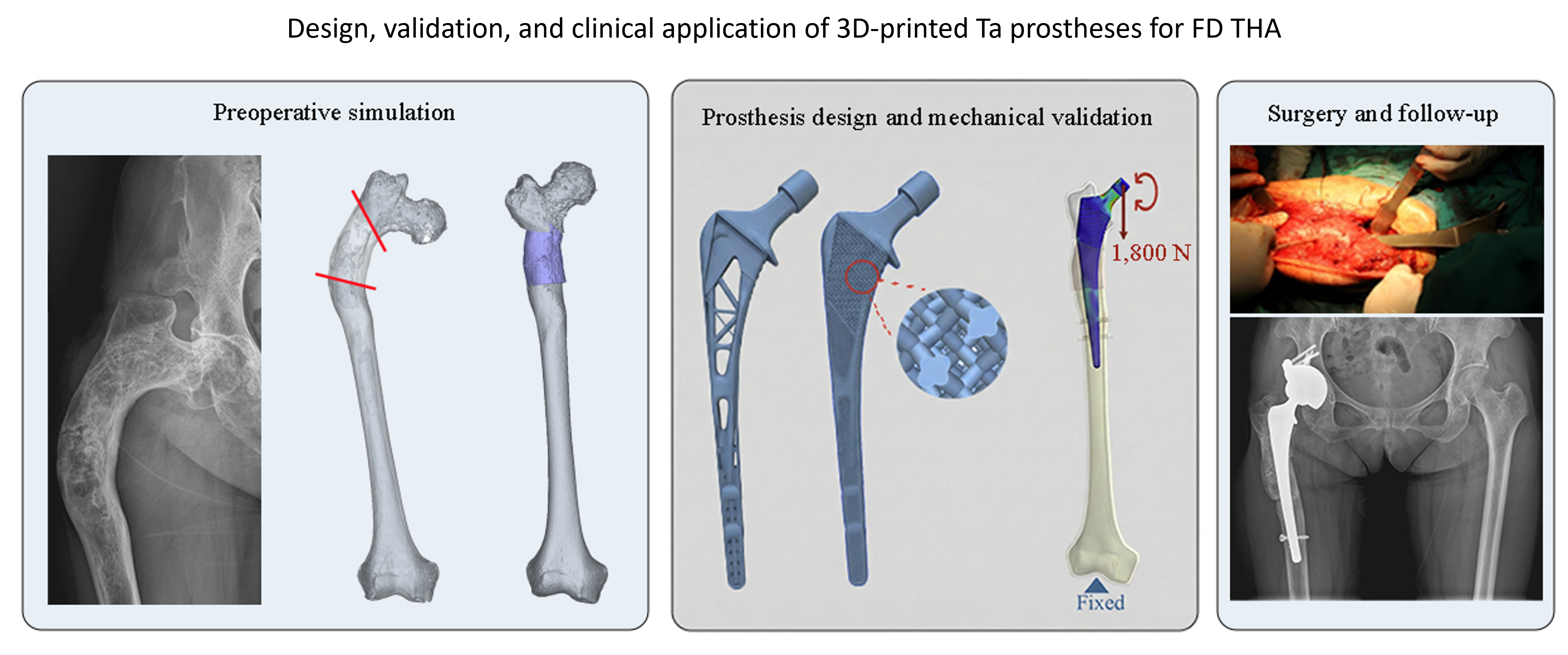
For patients with fibrous dysplasia and severe “shepherd’s crook” deformity, total hip arthroplasty presents substantial challenges because of complex anatomy, pathological bone changes, and prosthesis instability. This study reports an integrated clinical pathway encompassing digital virtual planning, three-dimensional (3D) printing customization, and biomechanical evaluation. Using the Mimics software, patient computed tomography data were reconstructed, and a biplanar oblique osteotomy below the greater trochanter was simulated to correct the deformity. An individualized cementless long-stem prosthesis was designed based on the corrected medullary canal, followed by topology optimization and construction of a 70% porosity biomimetic porous structure to induce bone ingrowth. Finite element analysis under 1,800 N axial load and ±10 N•m torque showed peak stresses of 183.7 MPa in the femoral stem and 316.92 MPa in locking screws, both below material yield limits. Interface micromotion ranged from 0.21 mm to 0.48 mm, within the 0.5 mm threshold for promoting bone ingrowth, confirming the superior stability of the 3D-printed customized porous tantalum prosthesis system. Clinical follow-up of two patients demonstrated improved Harris Hip Scores, with one case showing a stable prosthesis position without loosening or subsidence at five years postoperatively. These findings support the potential value of precisely tailored 3D-printed prostheses in managing complex femoral deformities and pathological bone defects.
- Liu H, Fang X, Yu Z, Lang Y, Xiong Y, Duan H. Surgical strategy for benign lesions in proximal femur: Internal fixation or endoprosthetic replacement. Int Orthop. 2018;42(11):2691-2698. doi: 10.1007/s00264-018-3922-y
- Wan J, Zhang C, Liu YP, He HB. Surgical treatment for shepherd’s crook deformity in fibrous dysplasia: THERE IS NO BEST, ONLY BETTER. Int Orthop. 2019;43(3):719-726. doi: 10.1007/s00264-018-4074-9
- Sauhta R, Makkar D. A closer look at fibrous dysplasia femur fracture five-year follow-up: A unique case. J Orthop Case Rep. 2024;14(2):155-159. doi: 10.13107/jocr.2024.v14.i02.4254
- Johnson JL, Jacquez EA, Anderson JS, Adams BW. Surgical management of fibrous dysplasia and associated syndromes. J Am Acad Orthop Surg. 2025;33(15):e833-e840. doi: 10.5435/JAAOS-D-24-00717
- Liu R, Tong L, Wu H, et al. Osteofibrous dysplasia: a narrative review. J Orthop Surg Res. 2024;19(1):204. doi: 10.1186/s13018-024-04682-3
- Giles SN, Fernandes JA, Hampton MJ, Weston-Simmons S. Deformity correction, surgical stabilisation and limb length equalisation in patients with fibrous dysplasia: A 20-year experience. Strateg Trauma Limb Reconstr. 2021;16(1):41- 45. doi: 10.5005/jp-journals-10080-1523
- Jamshidi K, Bagherifard A, Hamidzadah Khiavi A, Mirzaei A. One-stage surgical correction of shepherd’s crook deformity in fibrous dysplasia using fibular strut allograft augmentation: A retrospective case-series. Int Orthop. 2025;49(9):2069-2075. doi: 10.1007/s00264-025-06627-9
- Kim HS, Im SB, Han I. Osteoarthritis of the hip in fibrous dysplasia of the proximal femur. Bone Joint J. 2015;97- B(7):1007-1011. doi: 10.1302/0301-620X.97B7.35828
- Garceau S, Warschawski Y, Safir O, Gross A, Wolfstadt J, Kuzyk P. Total hip arthroplasty in patients with fibrous dysplasia: A modern update. Can J Surg. 2020;63(3):E202-E207. doi: 10.1503/cjs.007219
- Soveral Pereira T, Malheiro N, Gonçalves D, Rodrigues C, Gonçalves PJ. Surgical treatment of fibrous dysplasia in the proximal femur: A literature review. Eur J Orthop Surg Traumatol. 2025;35(1):52. doi: 10.1007/s00590-025-04271-y
- Sierra RJ, Cabanela ME. Total hip arthroplasty in patients with underlying fibrous dysplasia. Orthopedics. 2009;32(5):320-325. doi: 10.3928/01477447-20090501-14
- Yao K, Min L, Tang F, et al. First application of three-dimensional designing total hip arthroplasty with long uncemented stem for fibrous dysplasia patients combined with hip joint osteoarthritis. BMC Musculoskelet Disord. 2019;20(1):204. doi: 10.1186/s12891-019-2608-y
- Jin J, Wang D, Qian H, et al. Precision pore structure optimization of additive manufacturing porous tantalum scaffolds for bone regeneration: A proof-of-concept study. Biomaterials. 2025;313:122756. doi: 10.1016/j.biomaterials.2024.122756
- Wang X, Zhang D, Peng H, Yang J, Li Y, Xu J. Optimize the pore size-pore distribution-pore geometry-porosity of 3D-printed porous tantalum to obtain optimal critical bone defect repair capability. Biomater Adv. 2023;154:213638. doi: 10.1016/j.bioadv.2023.213638
- Jiao J, Hong Q, Zhang D, et al. Influence of porosity on osteogenesis, bone growth and osteointegration in trabecular tantalum scaffolds fabricated by additive manufacturing. Front Bioeng Biotechnol. 2023;11:1117954. doi: 10.3389/fbioe.2023.1117954
- Yu H, Xu M, Duan Q, et al. 3D-printed porous tantalum artificial bone scaffolds: Fabrication, properties, and applications. Biomed Mater. 2024;19(4):042002. doi: 10.1088/1748-605X/ad46d2
- Hu X, Kenan S, Cheng M, Cai W, Huang W, Yan W. 3D-printed patient-customized artificial vertebral body for spinal reconstruction after total en bloc spondylectomy of complex multi-level spinal tumors. Int J Bioprint. 2022;8(3):576. doi: 10.18063/ijb.v8i3.576
- Zhao D, Cheng L, Lu F, et al. Design, fabrication and clinical characterization of additively manufactured tantalum hip joint prosthesis. Regen Biomater. 2024;11:rbae057. doi: 10.1093/rb/rbae057
- Wang F, Liu Y, Huo Y, et al. Biomechanical study of internal fixation methods for femoral neck fractures based on Pauwels angle. Front Bioeng Biotechnol. 2023;11:1143575. doi: 10.3389/fbioe.2023.1143575
- Liu Y, Wang F, Ying J, et al. Biomechanical analysis and clinical observation of 3D-printed acetabular prosthesis for the acetabular reconstruction of total hip arthroplasty in Crowe III hip dysplasia. Front Bioeng Biotechnol. 2023;11:1219745. doi: 10.3389/fbioe.2023.1219745
- Cha YH, Yoo JI, Hwang SY, et al. Biomechanical evaluation of internal fixation of Pauwels type III femoral neck fractures: A systematic review of various fixation methods. Clin Orthop Surg. 2019;11(1):1-14. doi: 10.4055/cios.2019.11.1.1
- Chen J, Chen J, Lu R, Liu Y, Huang J, Zhang C. Finite element analysis, biomechanics, and clinical advantages of percutaneous medial column screw reinforced locking plate in the treatment of complex distal femoral fractures. Bone Joint Res. 2026;15(1):73-87. doi: 10.1302/2046-3758.151.BJR-2025-0128.R2
- Guoqing Z, Junxin L, Xiaoyu Z, Yongsheng Z, Bai Y. The design and processing of a 3D-printed high-performance biological fixation plate. Int J Bioprint. 2023;9(2):658. doi: 10.18063/ijb.v9i2.658
- Mao S, Liu Y, Wang F, et al. Design and biomechanical analysis of patient-specific porous tantalum prostheses for knee joint revision surgery. Int J Bioprint. 2023;9(4):735. doi: 10.18063/ijb.735
- Bieger R, Ignatius A, Decking R, Claes L, Reichel H, Dürselen L. Primary stability and strain distribution of cementless hip stems as a function of implant design. Clin Biomech. 2012;27(2):158-164. doi: 10.1016/j.clinbiomech.2011.08.004
- Liu B, Wang H, Zhang M, et al. Capability of auxetic femoral stems to reduce stress shielding after total hip arthroplasty. J Orthop Transl. 2023;38:220-228. doi: 10.1016/j.jot.2022.11.001
- Fu G, Zhong G, Yang Z, Cheng S, Ma L, Zhang Y. Two cannulated screws provide sufficient biomechanical strength for prophylactic fixation in adult patients with an aggressive benign femoral neck lesion. Front Bioeng Biotechnol. 2022;10:891338. doi: 10.3389/fbioe.2022.891338
- Frost HM. Wolff ’s law and bone’s structural adaptations to mechanical usage: An overview for clinicians. Angle Orthod. 1994;64(3):175-188. doi:10.1043/0003-3219(1994)064<0175:WLABSA>2.0.CO;2
- Wolf S, Janousek A, Pfeil J, et al. The effects of external mechanical stimulation on the healing of diaphyseal osteotomies fixed by flexible external fixation. Clin Biomech. 1998;13(4-5):359-364. doi: 10.1016/s0268-0033(98)00097-7
- Bartonícek J. Pauwels’ classification of femoral neck fractures: Correct interpretation of the original. J Orthop Trauma. 2001;15(5):358-360. doi: 10.1097/00005131-200106000-00009
- Pan Y, Chen Y. Greater trochanteric osteotomy and subtrochanteric osteotomy in primary/revision total hip arthroplasty. Front Surg. 2023;10:1103689. doi: 10.3389/fsurg.2023.1103689
- Gallazzi E, Morelli I, Peretti G, Zagra L. What is the impact of a previous femoral osteotomy on THA? A systematic review. Clin Orthop Relat Res. 2019;477(5):1176-1187. doi: 10.1097/CORR.0000000000000659
- Vyas A, Godara A, Kumar N, Singhal S, Bhattacherjee D. Fibrous dysplasia of proximal femur: A case report of treatment with single-stage valgus osteotomy with dynamic hip screw and fibular strut graft. Cureus. 2022;14(1):e21496. doi: 10.7759/cureus.21496
- Singh AK, Srivastava S, Arunav A, Kumar A, Kumar A, Kumar M. A case report of bilateral shepherd crook deformity of proximal femur in an adolescent managed by corrective osteotomy, double angle blade plate and bone graft. J Orthop Case Rep. 2025;15(3):111-114. doi: 10.13107/jocr.2025.v15.i03.5352
- Harshavardhan JKG, Uppalapati BR, Menon PG. A case of fibrous dysplasia with bilateral shepherd crook deformity treated with dynamic hip screw fixation. J Orthop Case Rep. 2018;8(5):33-37. doi: 10.13107/jocr.2250-0685.1096
- Dheenadhayalan J, Avinash M, Lakhani A, Rajasekaran S. Shepherd’s crook deformity: how to set it straight. A five-step surgical guide. J Orthop Surg (Hong Kong). 2019;27(1):2309499019834362. doi: 10.1177/2309499019834362
- Ippolito E, Farsetti P, Boyce AM, Corsi A, De Maio F, Collins MT. Radiographic classification of coronal plane femoral deformities in polyostotic fibrous dysplasia. Clin Orthop Relat Res. 2014;472(5):1558-1567. doi: 10.1007/s11999-013-3380-1
- Dozo MA, Abrego MO, Comba F, Zanotti G, Buttaro MA, Slullitel PA. Late periprosthetic femoral stress fracture associated with extra-articular deformity in a patient with fibrous dysplasia: a case report. JBJS Case Connect. 2023;13(3):e23.00017. doi: 10.2106/JBJS.CC.23.00017
- Zhang X, Chen C, Duan H, Tu C. Radiographic classification and treatment of fibrous dysplasia of the proximal femur: 227 femurs with a mean follow-up of 6 years. J Orthop Surg Res. 2015;10(1):153. doi: 10.1186/s13018-015-0313-6
- Kandhari VK, Bava SS, Desai MM, Wade RN. Single stage treatment of non-union of transcervical neck femur fracture with shepherd crook deformity of proximal femur in a case of fibrous dysplasia using dynamic hip screw fixation. J Orthop Case Rep. 2015;5(7):41-44. doi: 10.13107/jocr.2250-0685.304
- Moharrami A, Mirghaderi P, Moazen-Jamshidi MM, Hoseini Zare N, Sharifpour S, Mortazavi SMJ. Bilateral total hip arthroplasty in a case with fibrous dysplasia: A case report. J Med Case Rep. 2023;17(1):371. doi: 10.1186/s13256-023-04084-9
- Jiang Z, Cheng R, Dimitriou D, Yang Y, Tsai TY, Wang L. The 3D-printed customized femoral short stem offers improved anatomical parameters restoration, fitness and biomechanical performance compared with traditional femoral stem. Orthop Surg. 2025;17(4):1220-1229. doi: 10.1111/os.70000
- Yang J, Gao H, Zhang D, et al. Static compressive behavior and material failure mechanism of trabecular tantalum scaffolds fabricated by laser powder bed fusion-based additive manufacturing. Int J Bioprint. 2022;8(1):438. doi: 10.18063/ijb.v8i1.438
- Mehboob A, Barsoum I, Mehboob H, Abu Al-Rub RK, Ouldyerou A. Topology optimization and biomechanical evaluation of bone plates for tibial bone fractures considering bone healing. Virtual Phys Prototyp. 2024;19(1):e2391475. doi: 10.1080/17452759.2024.2391475