

Construction of gelatin methacryloyl-based artificial skin substitutes with “small-micro” vascular networks via hybrid double-crosslinked coaxial and extrusion bioprinting

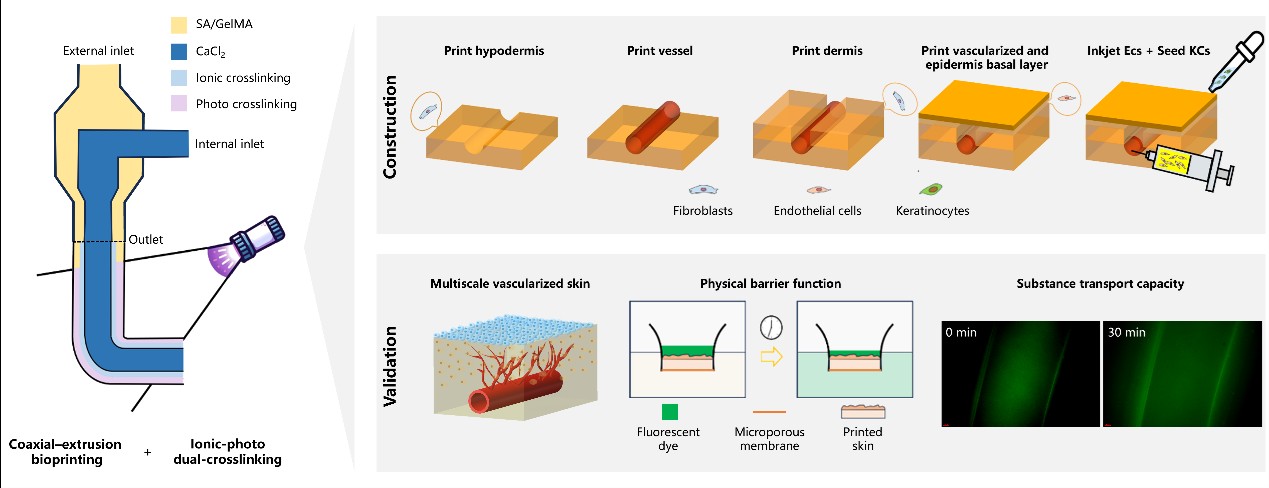
The repair of deep skin defects involving subcutaneous tissue urgently requires vascularized skin substitutes that can provide immediate blood perfusion. However, existing engineering strategies struggle to construct multi-level vascular networks in vitro. This study aims to develop a multi-layered skin substitute with both biomimetic structure and physiological function, incorporating a perfusable “small-micro” hierarchical vascular system. We employed a composite coaxial–extrusion bioprinting strategy. First, a composite bioink consisting of 2% sodium alginate and 5% gelatin methacryloyl was formulated and evaluated for its printability and biocompatibility. Subsequently, using an ionic-photo dual-crosslinking coaxial printing technique, we fabricated subcutaneous small vessels with controllable dimensions and adequate mechanical properties. Finally, small vessels were integrated with an extrusion bioprinted dermal microvascular network and an epidermal layer to form a complete “small-micro” vascular pathway. This multi-layered construct was designed to mimic the stratified characteristics of natural skin. In vitro functional experiments confirmed that the epidermis possesses an excellent barrier function, and the subcutaneous small vessels demonstrated an effective capability for delivering drug molecules. The dual-crosslinking coaxial printing and composite manufacturing strategy proposed in this proof-of-concept study successfully constructed vascularized skin with a hierarchical tubular structure, offering a new solution with clinical translation potential for treating full-thickness skin defects.
- Sen CK. Human wounds and its burden: updated 2020 compendium of estimates. Adv Wound Care. 2021;10(5):281-292. doi: 10.1089/wound.2021.0026
- Shlash SOA, Madani JOA, Deib JIE, et al. Demographic characteristics and outcome of burn patients requiring skin grafts: a tertiary hospital experience. Int J Burns Trauma. 2015;6(2):30-36.
- Halim AS, Khoo TL, Yussof SJM. Biologic and synthetic skin substitutes: an overview. Indian J Plast Surg. 2010;43(Suppl):S23-S28. doi: 10.4103/0970-0358.70712
- Böttcher-Haberzeth S, Biedermann T, Reichmann E. Tissue engineering of skin. Burns. 2010;36(4):450-460. doi: 10.1016/j.burns.2009.08.016
- Murphy SV, Atala A. 3D bioprinting of tissues and organs. Nat Biotechnol. 2014;32(8):773-785. doi: 10.1038/nbt.2958
- Kim BS, Kwon YW, Kong JS, et al. 3D cell printing of invitro stabilized skin model and invivo pre-vascularized skin patch using tissue-specific extracellular matrixbioink: a step towards advanced skin tissue engineering. Biomaterials. 2018;168:38-53. doi: 10.1016/j.biomaterials.2018.03.040
- Zhang J, Yun S, Karami A, et al. 3D printing of a thermosensitive hydrogel for skin tissue engineering: a proof of concept study. Bioprinting. 2020;19:e00089. doi: 10.1016/j.bprint.2020.e00089
- Abaci HE, Guo Z, Coffman A, et al. Human skin constructs with spatially controlled vasculature using primary and iPSC-derived endothelial cells. Adv Healthc Mater. 2016;5(14):1800-1807. doi: 10.1002/adhm.201500936
- Hao L, Zhao S, Hao S, et al. Functionalized gelatin-alginate based bioink with enhanced manufacturability and biomimicry for accelerating wound healing. Int J Biol Macromol. 2023;240:124364. doi: 10.1016/j.ijbiomac.2023.124364
- Maggiotto F, Valle ED, Fietta A, Visentin LM, Giomo M, Cimetta E. 3D bioprinting of a perfusable skin-on-chip model suitable for drug testing and wound healing studies. Mater Today Bio. 2025;33:101974. doi: 10.1016/j.mtbio.2025.101974
- Yue K, Santiago TD, Alvarez MM, Tamayol A, Annabi N, Khademhosseini A. Synthesis, properties, and biomedical applications of gelatin methacryloyl (GelMA) hydrogels. Biomaterials. 2015;73:254-271. doi: 10.1016/j.biomaterials.2015.08.045
- Choi KY, Ajiteru O, Hong H, et al. A digital light processing 3D-printed artificial skin model and full-thickness wound models using silk fibroin bioink. Acta Biomater. 2023;164(000):16. doi: 10.1016/j.actbio.2023.04.034
- Daikuara L, Yue Z, Skropeta D, Wallace G. In vitro characterisation of 3D printed platelet lysate-based bioink for potential application in skin tissue engineering. Acta Biomater. 2021;123:286-297. doi: 10.1016/j.actbio.2021.01.021
- Lee KY, Mooney DJ. Alginate: properties and biomedical applications. Prog Polym Sci. 2012;37(1):106-126. doi: 10.1016/j.progpolymsci.2011.06.003
- Lee SJ, Lee JH, Park J, Kim WD, Park SA. Fabrication of 3D printing scaffold with porcine skin decellularized bio-ink for soft tissue engineering. Materials (Basel). 2020;13(16):3522. doi: 10.3390/ma13163522
- Hakimi N, Cheng R, Leng L, et al. Handheld skin printer: in situ formation of planar biomaterials and tissues. Lab Chip. 2018;18(10):1440-1451. doi: 10.1039/c7lc01236e
- Gungor-Ozkerim PS, Inci I, Zhang YS, Khademhosseini A, Dokmeci MR. Bioinks for 3D bioprinting: an overview. Biomater Sci. 2018;6(5):915-946. doi: 10.1039/C7BM00765E
- Rúben P, Aureliana S, Barrias CC, Paulo B, Granja PL. A single-component hydrogel bioink for bioprinting of bioengineered 3D constructs for dermal tissue engineering. Mater Horiz. 2018;5(6):1100-1111. doi: 10.1039/C8MH00525G
- Hafa L, Breideband L, Ramirez Posada L, et al. Light sheet-based laser patterning bioprinting produces long-term viable full-thickness skin constructs. Adv Mater. 2024;36(8):e2306258. doi: 10.1002/adma.202306258
- Pontiggia L, Van Hengel IA, Klar A, et al. Bioprinting and plastic compression of large pigmented and vascularized human dermo-epidermal skin substitutes by means of a new robotic platform. J Tissue Eng. 2022;13:2 0417314221088513. doi: 10.1177/20417314221088513
- Kim BS, Gao G, Kim JY, Cho DW. 3D cell printing of perfusable vascularized human skin equivalent composed of epidermis, dermis, and hypodermis for better structural recapitulation of native skin. Adv Healthc Mater. 2019;8(7):e1801019. doi: 10.1002/adhm.201801019
- Huyan Y, Lian Q, Zhao T, Li D, He J. Pilot study of the biological properties and vascularization of 3D printed bilayer skin grafts. Int J Bioprint. 2020;6(1):246. doi: 10.18063/ijb.v6i1.246
- Ma J, Qin C, Wu J, et al. 3D Printing of strontium silicate microcylinder-containing multicellular biomaterial inks for vascularized skin regeneration. Adv Healthc Mater. 2021;10(16):e2100523. doi: 10.1002/adhm.202100523
- Nuutila K, Samandari M, Endo Y, et al. In vivo printing of growth factor-eluting adhesive scaffolds improves wound healing. Bioact Mater. 2022;8:296-308. doi: 10.1016/j.bioactmat.2021.06.030
- Kolesky DB, Truby RL, Gladman AS, Busbee TA, Homan KA, Lewis JA. 3D bioprinting of vascularized, heterogeneous cell-laden tissue constructs. Adv Mater. 2014;26(19):3124-3130. doi: 10.1002/adma.201305506
- Kim BS, Ahn M, Cho WW, Gao G, Jang J, Cho DW. Engineering of diseased human skin equivalent using 3D cell printing for representing pathophysiological hallmarks of type 2 diabetes in vitro. Biomaterials. 2021;272:120776. doi: 10.1016/j.biomaterials.2021.120776
- Thomas A, Orellano I, Lam T, et al. Vascular bioprinting with enzymatically degradable bioinks via multi-material projection-based stereolithography. Acta Biomater. 2020;117:121-132. doi: 10.1016/j.actbio.2020.09.033
- Ramasamy S, Davoodi P, Vijayavenkataraman S, et al. Optimized construction of a full thickness human skin equivalent using 3D bioprinting and a PCL/collagen dermal scaffold. Bioprinting. 2020;21:e00123. doi: 10.1016/j.bprint.2020.e00123
- Luo Y, Li D, Lin C, Zhou X, Ma J, Zhang B. Three-dimensional bioprinting of gelatin methacryloyl hydrogel with a tri-layered vascularized architecture for full-thickness skin regeneration. Int J Bioprint. 2025;11(4):328-349. doi: 10.36922/IJB025090069
- Zhang B, Gao L, Gu L, Yang H, Luo Y, Ma L. High-resolution 3D bioprinting system for fabricating cell-laden hydrogel scaffolds with high cellular activities. Procedia CIRP. 2017;65:219-224. doi: 10.1016/j.procir.2017.04.017
- Shao L, Gao Q, Zhao H, et al. Fiber‐based mini tissue with morphology‐controllable GelMA microfibers. Small. 2018;14(44):e1802187. doi: 10.1002/smll.201802187
- Gao Q, He Y, Fu J-z, Liu A, Ma L. Coaxial nozzle-assisted 3D bioprinting with built-in microchannels for nutrients delivery. Biomaterials. 2015;61:203-215. doi: 10.1016/j.biomaterials.2015.05.031
- Jia W, Gungor-Ozkerim PS, Zhang YS, et al. Direct 3D bioprinting of perfusable vascular constructs using a blend bioink. Biomaterials. 2016;106:58-68. doi: 10.1016/j.biomaterials.2016.07.038
- Riley WA, Barnes RW, Evans GW, Burke GL. Ultrasonic measurement of the elastic modulus of the common carotid artery. The Atherosclerosis Risk in Communities (ARIC) Study. Stroke. 1992;23(7):952-956. doi: 10.1161/01.str.23.7.952
- Yen RT, Fung YC, Bingham N. Elasticity of small pulmonary arteries in the cat. J Biomech Eng. 1980;102(2):170-177. doi: 10.1115/1.3138218
- Humphrey JD, Schwartz MA. Vascular mechanobiology: homeostasis, adaptation, and disease. Annu Rev Biomed Eng. 2021;23:1-27. doi: 10.1146/annurev-bioeng-092419-060810
- Fick A. On liquid diffusion. J Membr Sci. 1995;100(1):33-38. doi: 10.1016/0376-7388(94)00230-V
- Merlot AM, Kalinowski DS, Richardson DR. Unraveling the mysteries of serum albumin-more than just a serum protein. Front Physiol. 2014;5:299. doi: 10.3389/fphys.2014.00299
- Stewart MW. Aflibercept (VEGF Trap-eye): the newest anti- VEGF drug. Br J Ophthalmol. 2012;96(9):1157-1158. doi: 10.1136/bjophthalmol-2011-300654