

Structural design and multiphase biomechanical evaluation of a topology-optimized metal 3D-printed dual-compression plate for patellar fractures

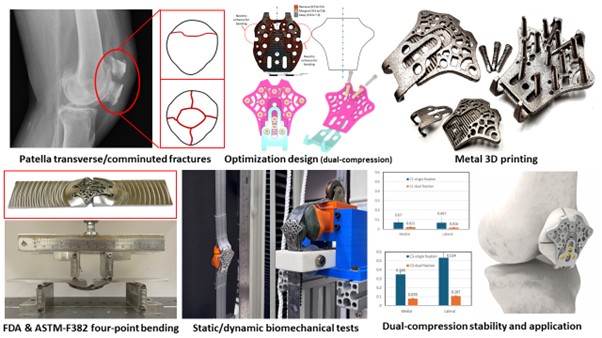
Patellar fractures, especially transverse and comminuted types, often present mechanical challenges that exceed the capabilities of conventional fixation constructs. This study develops a topology-optimized metal three-dimensional-printed dual-compression patellar plate designed to improve fragment stability while maintaining appropriate intraoperative rigidity. The plate design was first refined using an original anatomically assembled thin bone plate, which underwent finite element analysis and topology optimization to preserve primary load-bearing paths and reduce excessive stiffness. The optimized structure was subsequently fabricated using selective laser melting with Ti-6Al-4V and mechanically evaluated in accordance with American Society for Testing and Materials F382 standards. Static four-point bending tests demonstrated a proof load (P) of 257.31 ± 5.40 N and structural bending stiffness of 1.10 ± 0.01 N·m². Fatigue testing revealed runout at 15% P, while failure occurred at higher load levels (25% P & 30% P), revealing two distinct modes: plate fracture at topology-optimized transition zones and locking-screw shear failure. Static tensile testing revealed that dual-compression fixation significantly (p<0.05) enhanced load-bearing capacity compared with single-compression fixation for both C1 (712 N vs. 517.5 N) and C3 (253.75 N vs. 205.25 N) fracture models. Dynamic knee-extension testing demonstrated that dual compression markedly reduced medial–lateral fracture micromotion, decreasing C3 gaps from 0.348–0.534 mm to 0.078–0.107 mm without increasing quadriceps reaction force. Overall, the topology-optimized dual-compression patellar plate provides mechanically validated interfragmentary stability, effective micromotion control, and a well-defined fatigue performance envelope, supporting its potential as an advanced fixation solution for clinically challenging patellar fractures.
- Schmidt V, Möller Rydberg E, Krause M, Wolf O. Patient-reported outcomes following patella fractures: a nationwide observational study of 8,726 patients from the Swedish Fracture Register. Bone Jt Open. 2025;6(9):1080-1089. doi: 10.1302/2633-1462.69.BJO-2025-0141.R1
- Larsen P, Court-Brown CM, Vedel JO, Vistrup S, Elsoe R. Incidence and epidemiology of patellar fractures. Orthopedics. 2016;39(6):e1154-e1158. doi: 10.3928/01477447-20160811-01
- Larsen P, Vedel JO, Vistrup S, Elsoe R. Long-lasting hyperalgesia is common in patients following patella fractures. Pain Med. 2018;19(3):429-437. doi: 10.1093/pm/pnx144
- Fehske K, Berninger MT, Alm L, et al. Current treatment standard for patella fractures in Germany. Unfallchirurg. 2021;124(10):832-838. doi: 10.1007/s00113-020-00939-8
- Gwinner C, Märdian S, Schwabe P, Schaser KD, Krapohl BD, Jung TM. Fractures of the patella: current concepts review. GMS Interdiscip Plast Reconstr Surg DGPW. 2016; 5:Doc01. doi: 10.3205/iprs000080
- Singh S, Surana R, Rai A, Sharma D. Outcome analysis of fixed angle locking plate in patella fractures: a single centre experience from North India. Indian J Orthop. 2021;55(3):655-661. doi: 10.1007/s43465-020-00302-4
- Neumann-Langen MV, Sontheimer V, Näscher J, Izadpanah Z, Schmal H, Kubosch EJ. Incidence of postoperative complications in patellar fractures related to different osteosynthesis procedures. BMC Musculoskelet Disord. 2023;24(1):871. doi: 10.1186/s12891-023-06998-3
- Stoffel K, Zderic I, Pastor T, et al. Anterior variable-angle locked plating versus tension band wiring of simple and complex patella fractures: a biomechanical investigation. BMC Musculoskelet Disord. 2023;24(1):279. doi: 10.1186/s12891-023-06394-x
- Hung LK, Chan KM, Chow YN, Leung PC. Fractured patella: operative treatment using the tension band principle. Injury. 1985;16(5):343-347. doi: 10.1016/0020-1383(85)90144-5
- Dy CJ, Little MTM, Berkes MB, et al. Meta-analysis of re-operation, nonunion, and infection after open reduction and internal fixation of patella fractures. J Trauma Acute Care Surg. 2012;73(4):928-932. doi: 10.1097/TA.0b013e31825168b6
- Larsen P, Rathleff MS, Østgaard SE, Johansen MB, Elsøe R. Patellar fractures are associated with an increased risk of total knee arthroplasty: a matched cohort study with 14.3-year follow-up. Bone Joint J. 2018;100-B(11): 1477-1481. doi: 10.1302/0301-620X.100B11.BJJ-2018-0472.R1
- Garner MR, Homcha B, Cowman T, Goss M, Reid JS, Lewis GS. Transverse patella fracture fixation: a cadaveric biomechanical comparison of cannulated screws and anterior tension band versus low-profile multiplanar mesh plating. Injury. 2024;55(6):111574. doi: 10.1016/j.injury.2024.111574
- Gibert S, Kowaleski MP, Matthys R, Nützi R, Serck B, Boudrieau RJ. Biomechanical comparison of pin and tension-band wire fixation with a prototype locking plate fixation in a transverse canine patellar fracture model. Vet Comp Orthop Traumatol. 2016;29(1):20-28. doi: 10.3415/VCOT-15-07-0115
- Wild M, Fischer K, Hilsenbeck F, Hakimi M, Betsch M. Treating patella fractures with a fixed-angle patella plate: a prospective observational study. Injury. 2016;47(8):1737-1743. doi: 10.1016/j.injury.2016.06.018
- Siljander MP, Vara AD, Koueiter DM, Wiater BP, Wiater PJ. Novel anterior plating technique for patella fracture fixation. Orthopedics. 2017;40(4):e739-e743. doi: 10.3928/01477447-20170615-02
- Lee KH, Lee Y, Lee YH, Cho BW, Kim MB, Baek GH. Biomechanical comparison of three tension band wiring techniques for transverse fracture of patella. J Orthop Surg (Hong Kong). 2019;27(3):2309499019882140. doi: 10.1177/2309499019882140
- Wagner FC, Neumann MV, Wolf S, et al. Biomechanical comparison of a 3.5-mm anterior locking plate to cannulated screws with tension band wiring in comminuted patellar fractures. Injury. 2020;51(6):1281-1287. doi: 10.1016/j.injury.2020.03.030
- Kfuri M, Escalante I, Schopper C, et al. Comminuted patellar fractures: the role of biplanar fixed-angle plate constructs. J Orthop Translat. 2021;27:17-24. doi: 10.1016/j.jot.2020.09.003
- Berninger MT, Frosch KH. Change in the treatment of patellar fractures. Unfallchirurgie (Heidelb). 2022;125(7):518-526. doi: 10.1007/s00113-022-01167-y
- Moore TB, Sampathi BR, Zamorano DP, Tynan MC, Scolaro JA. Fixed angle plate fixation of comminuted patellar fractures. Injury. 2018;49(6):1203-1207. doi: 10.1016/j.injury.2018.03.030
- Wurm S, Augat P, Bühren V. Biomechanical assessment of locked plating for fixation of patella fractures. J Orthop Trauma. 2015;29(9):e305-e308. doi: 10.1097/BOT.0000000000000309
- Ellwein A, Lill H, DeyHazra RO, Smith T, Katthagen JC. Outcomes after locked plating of displaced patella fractures: a prospective case series. Int Orthop. 2019;43(12): 2807-2815. doi: 10.1007/s00264-019-04337-7
- Elsoe R, Thorninger R, Severinsen R, et al. Tension band versus locking plate fixation for patella fractures: protocol for a randomized controlled trial. Dan Med J. 2024;71(5):A12230753. doi: 10.61409/A12230753
- Liao CY, Huang SF, Tsai WC, Zeng YH, Li CH, Lin CL. Biomechanical evaluation of an anatomical bone plate assembly for thin patella fracture fixation fabricated by titanium alloy 3D printing. Int J Bioprint. 2023;9(6):0117. doi: 10.36922/ijb.0117
- Liao CY, Huang SF, Tsai WC, et al. Biomechanical comparison of traditional and 3D-printed titanium alloy anatomical anterior plating under three patellar fracture conditions. Virtual Phys Prototyp. 2024;19(1):e2404982. doi: 10.1080/17452759.2024.2404982
- ASTM International. ASTM F382-24: Standard Specification and Test Method for Metallic Bone Plates. West Conshohocken, PA: ASTM International; 2024. doi: 10.1520/F0382-24
- Chang CW, Chen CH, Li CT, et al. Role of an additional third screw in fixation of transverse patellar fracture with two parallel cannulated screws and anterior wire. BMC Musculoskelet Disord. 2020;21(1):752. doi: 10.1186/s12891-020-03744-x
- Chen CH, Chen YN, Li CT, Chang CW, Chang CH, Peng YT. Roles of the screw types, proximity and anterior band wiring in the surgical fixation of transverse patellar fractures: a finite element investigation. BMC Musculoskelet Disord. 2019;20(1):99. doi: 10.1186/s12891-019-2474-7
- Wang HW, Chen CH, Chen KH, Zeng YH, Lin CL. Designing a 3D-printed medical implant with macrostructural topology and microbionic lattices: a novel wedge-shaped spacer for high tibial osteotomy and biomechanical study. Int J Bioprint. 2024;10(1):1584.doi: 10.36922/ijb.1584
- Wen J, Zeng Y, Su S, et al. Magnesium degradation-induced variable fixation plates promote bone healing in rabbits. J Orthop Traumatol. 2024;25:56. doi: 10.1186/s10195-024-00803-0
- Huxman C, Lewis G, Armstrong A, Updegrove G, Koroneos Z, Butler J. Mechanically compliant locking plates for diaphyseal fracture fixation: a biomechanical study. J Orthop Res. 2025;43(1):217-227. doi: 10.1002/jor.25968
- Nägl K, Reisinger A, Pahr DH. The biomechanical behavior of 3D-printed human femoral bones based on generic and patient-specific geometries. 3D Print Med. 2022;8(1):35. doi: 10.1186/s41205-022-00162-8