

Design and performance evaluation of a 3D-printed transoral tracheal intubation fixation device

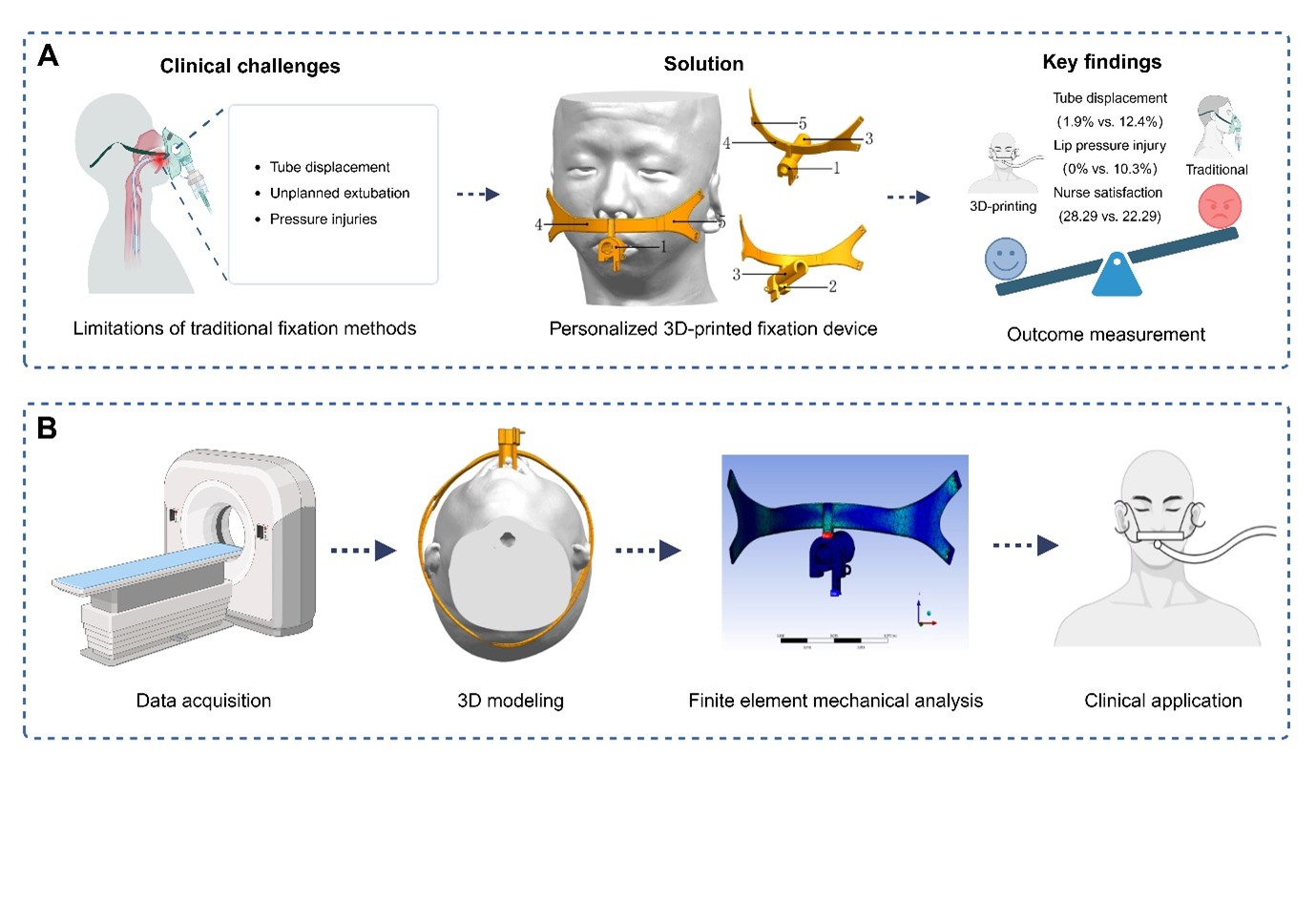
Effective fixation of the endotracheal tube is essential to prevent displacement, unplanned extubation, and pressure injuries (PIs), which remain common complications with traditional fixation methods. Advances in three-dimensional (3D) printing technology offer opportunities to design personalized devices that may improve airway security and patient outcomes. However, no prior study has evaluated the use of 3D-printed fixation devices as an alternative to traditional methods. We aim to design and evaluate the effectiveness of an endotracheal tube fixation device produced using 3D printing technology in patients receiving mechanical ventilation. In a single-center, prospective, non-concurrent, controlled cohort trial, patients with an expected duration of mechanical ventilation exceeding 24 hours were stratified into an observation group (using a 3D-printed device; n = 51) and a control group (using a traditional device; n = 97). The primary endpoints were tracheal tube displacement and unplanned endotracheal extubation (UEE). The incidence of endotracheal tube displacement was 1/51 (1.9%) in the observation group vs. 12/97 (12.4%) in the control group (odds ratio [OR]: 6.28, 95% confidence interval [CI]: 1.91–21.05), yielding a 99% probability of benefit (POB). UEE incidence was 0/51 in the observation group, whereas it was 4/97 (4.1%) in the control group (OR: 5.26, 95% CI: 1.08–26.31), yielding a 98% POB. Lip PI occurred in 0/51 patients in the observation group vs. 10/97 (10.3%) patients in the control group (OR: 8.72, 95% CI: 2.11–35.98), yielding a 99% POB. The observation group exhibited significantly higher nurse satisfaction scores compared to the control group (p = 0.015). There were no significant differences in facial PI between the two groups. These findings suggest that the 3D-printed device reduced the incidence of tracheal tube displacement, UEE, and lip PI, while improving nurse satisfaction.
- Long B, Gottlieb M. Emergency medicine updates: endotracheal intubation. Am J Emerg Med. 2024;85:108-116. doi: 10.1016/j.ajem.2024.08.042.
- Amrani G, Gefen A. Which endotracheal tube location minimises the device-related pressure ulcer risk: the centre or a corner of the mouth. Int Wound J. 2020;17(2):268-276. doi: 10.1111/iwj.13267.
- Kaplow R, Bookbinder M. A comparison of four endotracheal tube holders. Heart Lung. 1994;23(1):59-66.
- Wagner JL, Shandas R, Lanning CJ. Extubation force depends upon angle of force application and fixation technique: a study of 7 methods. BMC Anesthesiol. 2014;14:74. doi: 10.1186/1471-2253-14-74.
- Anis A, Patel R, Tanios MA. Analytical review of unplanned extubation in intensive care units and recommendation on multidisciplinary preventive approaches. J Intensive Care Med. 2024;39(6):507-513. doi: 10.1177/08850666231199055.
- Zhang P, Liu LP. Design of assessment tool for unplanned endotracheal extubation of artificial airway patients. Nurs Open. 2021;8(4):1696-1703. doi: 10.1002/nop2.807.
- Zuo M, Chu H, Qian X. Protective restraint nursing interventions in ICU patients: assessing their influence on unplanned extubation and skin injury incidence. Altern Ther Health Med. 2024;30(5):264-269.
- Li P, Sun Z, Xu J. Unplanned extubation among critically ill adults: a systematic review and meta-analysis. Intensive Crit Care Nurs. 2022;70:103219. doi: 10.1016/j.iccn.2022.103219.
- Kantaros A. 3D printing in regenerative medicine: technologies and resources utilized. Int J Mol Sci. 2022;23(23):14621. doi: 10.3390/ijms232314621.
- Shim KW. Medical applications of 3D printing and standardization issues. Brain Tumor Res Treat. 2023;11(3):159-165. doi: 10.14791/btrt.2023.0001.
- Lee K, Park JS, Kim MS, Tae N, Lee D, Oh YJ. Impact of obesity on double-lumen endobronchial tube displacement after lateral decubitus positioning. Korean J Anesthesiol. 2023;76(3):227-234. doi: 10.4097/kja.22493.
- Sturgess DJ, Greenland KB, Senthuran S, Ajvadi FA, van Zundert A, Irwin MG. Tracheal extubation of the adult intensive care patient with a predicted difficult airway — a narrative review. Anaesthesia. 2017;72(2): 248-261. doi: 10.1111/anae.13668.
- Torrini F, Gendreau S, Morel J, et al. Prediction of extubation outcome in critically ill patients: a systematic review and meta-analysis. Crit Care. 2021;25(1):391. doi: 10.1186/s13054-021-03802-3.
- Herway ST, Benumof JL. The tracheal accordion and the position of the endotracheal tube. Anaesth Intensive Care. 2017;45(2):177-188. doi: 10.1177/0310057X1704500207.
- Minda Z, Samuel H, Aweke S, Mekete G, Seid A, Eshetie D. Magnitude and associated factors of unplanned extubation in intensive care unit: a multi-center prospective observational study. Ann Med Surg (Lond). 2022;79:103936. doi: 10.1016/j.amsu.2022.103936.
- Zhang Y, Liu L, Hu J, et al. Assessing nursing quality in paediatric intensive care units: a cross-sectional study in China. Nurs Crit Care. 2017;22(6):355-361. doi: 10.1111/nicc.12246.
- Zhang Q, Zhang X, Han C, et al. Successful treatment of endotracheal intubation-related lip pressure injury using a self-developed fixation device. Crit Care. 2023; 27(1):298. doi: 10.1186/s13054-023-04577-5.
- Hajhosseini B, Longaker MT, Gurtner GC. Pressure injury. Ann Surg. 2020;271(4):671-679. doi: 10.1097/SLA.0000000000003567.
- Arundel L, Irani E, Barkema G. Reducing the incidence of medical device-related pressure injuries from use of CPAP/BiPAP masks: a quality improvement project. J Wound Ostomy Continence Nurs. 2021;48(2): 108-114. doi: 10.1097/WON.0000000000000742.