

AI-enhanced magnetically controlled 4D printing: Reshaping the future of medical robotics

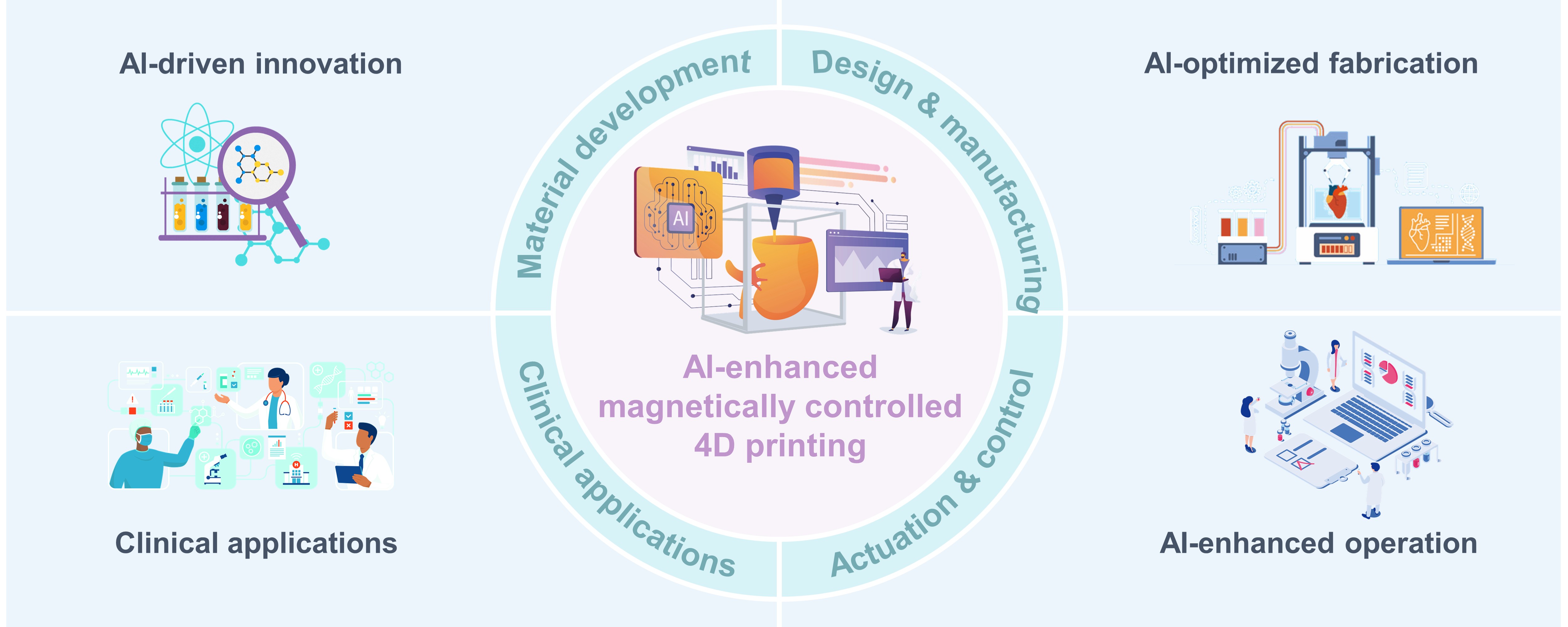
As a frontier interdisciplinary breakthrough, magnetically controlled 4D printing integrates smart materials, additive manufacturing, and magnetic actuation, and is contributing considerably to healthcare practices. By introducing time as the fourth dimension, magnetic 4D-printed devices can dynamically transform their structure and function in response to physiological or external magnetic stimuli, enabling minimally invasive interventions with enhanced adaptability and precision. Integrating artificial intelligence (AI) into magnetically controlled 4D printing accelerates material discovery, optimizes design and manufacturing, and enables intelligent navigation and control in complex in vivo environments. Recent advances highlight promising applications in interventional therapy, targeted drug delivery, and tissue repair, yet challenges remain in achieving biocompatible multifunctional materials, scalable fabrication, and safe clinical translation. Looking ahead, synergistic integration of AI with multimodal actuation, digital twins, and biomimetic systems may unlock unprecedented opportunities for personalized, adaptive, and intelligent medical robots. This perspective outlines current progress, key challenges, and future directions of AI-enhanced magnetically controlled 4D printing, underscoring its transformative potential in redefining next-generation medical robotics.
- Tibbits S. 4D printing: multi-material shape change. Archit Des. 2014;84(1):116-121. doi: 10.1002/ad.1710
- Chen S, Li J, Zheng L, Huang J, Wang M. Biomimicking trilayer scaffolds with controlled estradiol release for uterine tissue regeneration. Exploration. 2024;4(5): 20230141. doi: 10.1002/EXP.20230141
- Su L, Jin D, Wang Y, et al. Modularized microrobot with lock-and-detachable modules for targeted cell delivery in bile duct. Sci Adv. 2023;9(50):eadj0883. doi: 10.1126/sciadv.adj0883
- Iacovacci V, Diller E, Ahmed D, Menciassi A. Medical microrobots. Annu Rev Biomed Eng. 2024;26(1):561-591. doi: 10.1146/annurev-bioeng-081523-033131
- Pugliese R, Regondi S. Artificial intelligence-empowered 3D and 4D printing technologies toward smarter biomedical materials and approaches. Polymers. 2022;14(14):2794. doi: 10.3390/POLYM14142794
- Zhang L, Huang X, Cole T, et al. 3D-printed liquid metal polymer composites as NIR-responsive 4D printing soft robot. Nat Commun. 2023;14(1):7815. doi: 10.1038/s41467-023-43667-4
- Ge Q, Qi HJ, Dunn ML. Active materials by four-dimension printing. Appl Phys Lett. 2013;103(13):131901. doi: 10.1063/1.4819837
- Bai Y, Zhu S, Liang J, Xing R, Kong J. 4D printing of magnetically responsive materials and their applications. Research. 2025;8:0847. doi: 10.34133/research.0847
- Bao X, Wang F, Zhang J, et al. Real-time in situ magnetization reprogramming for soft robotics. Nature. 2025;645(8080):375-384. doi: 10.1038/s41586-025-09459-0
- Engler AJ, Sen S, Sweeney HL, Discher DE. Matrix elasticity directs stem cell lineage specification. Cell 2006;126(4):677-689. doi: 10.1016/j.cell.2006.06.044
- Smith AN, Ulsh JB, Gupta R, et al. Characterization of degradation kinetics of additively manufactured PLGA under variable mechanical loading paradigms. J Mech Behav Biomed Mater. 2024;153:106457. doi: 10.1016/j.jmbbm.2024.106457
- Yue K, Trujillo-de Santiago G, Alvarez MM, Tamayol A, Annabi N, Khademhosseini A. Synthesis, properties, and biomedical applications of gelatin methacryloyl (GelMA) hydrogels. Biomaterials. 2015;73:254-271. doi: 10.1016/j.biomaterials.2015.08.045
- Bose S, Roy M, Bandyopadhyay A. Recent advances in bone tissue engineering scaffolds. Trends Biotechnol. 2012;30(10):546-554. doi: 10.1016/j.tibtech.2012.07.005
- Gao Y, Liu W, Zhu S. Thermoplastic polyolefin elastomer blends for multiple and reversible shape memory polymers. Ind Eng Chem Res. 2019;58(42):19495-19502. doi: 10.1021/acs.iecr.9b03979
- Xia Y, He Y, Zhang F, Liu Y, Leng J. A review of shape memory polymers and composites: mechanisms, materials, and applications. Adv Mater. 2021;33(6): 2000713. doi: 10.1002/adma.202000713
- Kim Y, Yuk H, Zhao R, Chester SA, Zhao X. Printing ferromagnetic domains for untethered fast-transforming soft materials. Nature. 2018;558(7709):274-279. doi: 10.1038/s41586-018-0185-0
- Deng C, Qu J, Dong J, et al. 4D printing of magnetic smart structures based on light-cured magnetic hydrogel. Chem Eng J. 2024;494:152992. doi: 10.1016/j.cej.2024.152992
- Espíndola-Pérez ER, Campo J, Sánchez-Somolinos C. Multimodal and multistimuli 4D-printed magnetic composite liquid crystal elastomer actuators. ACS Appl Mater Interfaces. 2024;16(2):2704-2715. doi: 10.1021/acsami.3c14607
- Zhao R, Kim Y, Chester SA, Sharma P, Zhao X. Mechanics of hard-magnetic soft materials. J Mech Phys Solids. 2019;124:244-263. doi: 10.1016/j.jmps.2018.10.008
- Silveyra JM, Ferrara E, Huber DL, Monson TC. Soft magnetic materials for a sustainable and electrified world. Science. 2018;362(6413):eaao0195. doi: 10.1126/science.aao0195
- Liu J, Yu S, Xu B, et al. Magnetically propelled soft microrobot navigating through constricted microchannels. Appl Mater Today. 2021;25:101237. doi: 10.1016/j.apmt.2021.101237
- Lin C, Liu L, Liu Y, Leng J. 4D printing of bioinspired absorbable left atrial appendage occluders: a proof-of-concept study. ACS Appl Mater Interfaces. 2021;13(11):12668-12678. doi: 10.1021/acsami.0c17192
- Wang H, Yue M, Sun X, Zhao X. Cooperative formation control strategy for multi-robot system based on APF algorithm and sliding mode estimator. Robot Auton Syst. 2025;193:105075. doi: 10.1016/j.robot.2025.105075
- Wei T, Hu Y, Yang M, Shi C, Hu C. A magnetic patch robot with photothermal-activated multi-modality for targeted anti-postoperative adhesion. Int J Extreme Manuf. 2025;7(5):055502. doi: 10.1088/2631-7990/add2de
- Sun X, Yue L, Yu L, et al. Machine learning-enabled forward prediction and inverse design of 4D-printed active plates. Nat Commun. 2024;15(1):5509. doi: 10.1038/s41467-024-49775-z
- Salehi A, Hosseinpour S, Tabatabaei N, Soltani Firouz M, Yu T. Intelligent navigation of a magnetic microrobot with model-free deep reinforcement learning in a real-world environment. Micromachines. 2024;15(1):112. doi: 10.3390/mi15010112
- Meng X, Li S, Shen X, Tian C, Mao L, Xie H. Programmable spatial magnetization stereolithographic printing of biomimetic soft machines with thin-walled structures. Nat Commun. 2024;15(1):10442. doi: 10.1038/s41467-024-54773-2
- Huang X, Wong YX, Goh GL, Gao X, Lee JM, Yeong WY. Machine learning-driven prediction of gel fraction in conductive gelatin methacryloyl hydrogels. Int J AI Mater Des. 2024;1(2):61-75. doi: 10.36922/ijamd.3807
- Abbasi SA, Ahmed A, Noh S, et al. Autonomous 3D positional control of a magnetic microrobot using reinforcement learning. Nat Mach Intell. 2024;6(1):92-105.
doi: 10.1038/s42256-023-00779-2
- Yang Y, Bevan MA, Li B. Efficient navigation of colloidal robots in an unknown environment via deep reinforcement learning. Adv Intell Syst. 2020;2(1):1900106. doi: 10.1002/aisy.201900106
- Heuthe V-L, Panizon E, Gu H, Bechinger C. Counterfactual rewards promote collective transport using individually controlled swarm microrobots. Sci Robot. 2024;9(97):eado5888. doi: 10.1126/scirobotics.ado5888
- Acosta JN, Falcone GJ, Rajpurkar P, Topol EJ. Multimodal biomedical AI. Nat Med. 2022;28(9):1773-1784. doi: 10.1038/s41591-022-01981-2
- Katsoulakis E, Wang Q, Wu H, et al. Digital twins for health: a scoping review. NPJ Digit Med. 2024;7(1):77. doi: 10.1038/s41746-024-01073-0
- Lai J, Liu Y, Lu G, et al. 4D bioprinting of programmed dynamic tissues. Bioact Mater. 2024;37:348-377. doi: 10.1016/j.bioactmat.2024.03.033
- Zhu Y-X, Jia H-R, Jiang Y-W, et al. A red blood cell-derived bionic microrobot capable of hierarchically adapting to five critical stages in systemic drug delivery. Exploration. 2024;4(2):20230105. doi: 10.1002/EXP.20230105