

Intelligent bioprinting: Smart bioinks, closed-loop biofabrication, and precision therapeutics

Three-dimensional bioprinting is moving beyond anatomical fabrication toward systems that can respond to biological cues, use process data to guide manufacturing, and support patient-specific applications. Rather than treating every responsive material, artificial-intelligence model, or sensor-equipped platform as intelligent, this review uses four descriptive functions—responsiveness, observability, decision capability, and actuation—to compare the field across three operational categories: responsive components, intelligence-assisted systems, and validated closed-loop systems. These functions are not cumulative prerequisites: responsiveness can exist without sensing, and closed-loop control can operate without a responsive bioink. We synthesize smart bioinks and printing quality, intelligent strategy selection, data-driven monitoring and feedback, post-printing maturation, and regenerative or precision-therapeutic applications. Representative evidence indicates that the most credible closed loops currently address fast manufacturing variables such as extrusion and geometry, whereas biological feedback over hours to weeks, continuously updated digital twins, and high-level autonomy remain early. We also distinguish the evidence needs of implantable regenerative constructs from those of patient-derived drug-testing models. The contribution of this review is therefore a cross-domain functional classification and translational evidence hierarchy, rather than a claim that smart materials, AI-assisted design, or closed-loop bioprinting are themselves new.
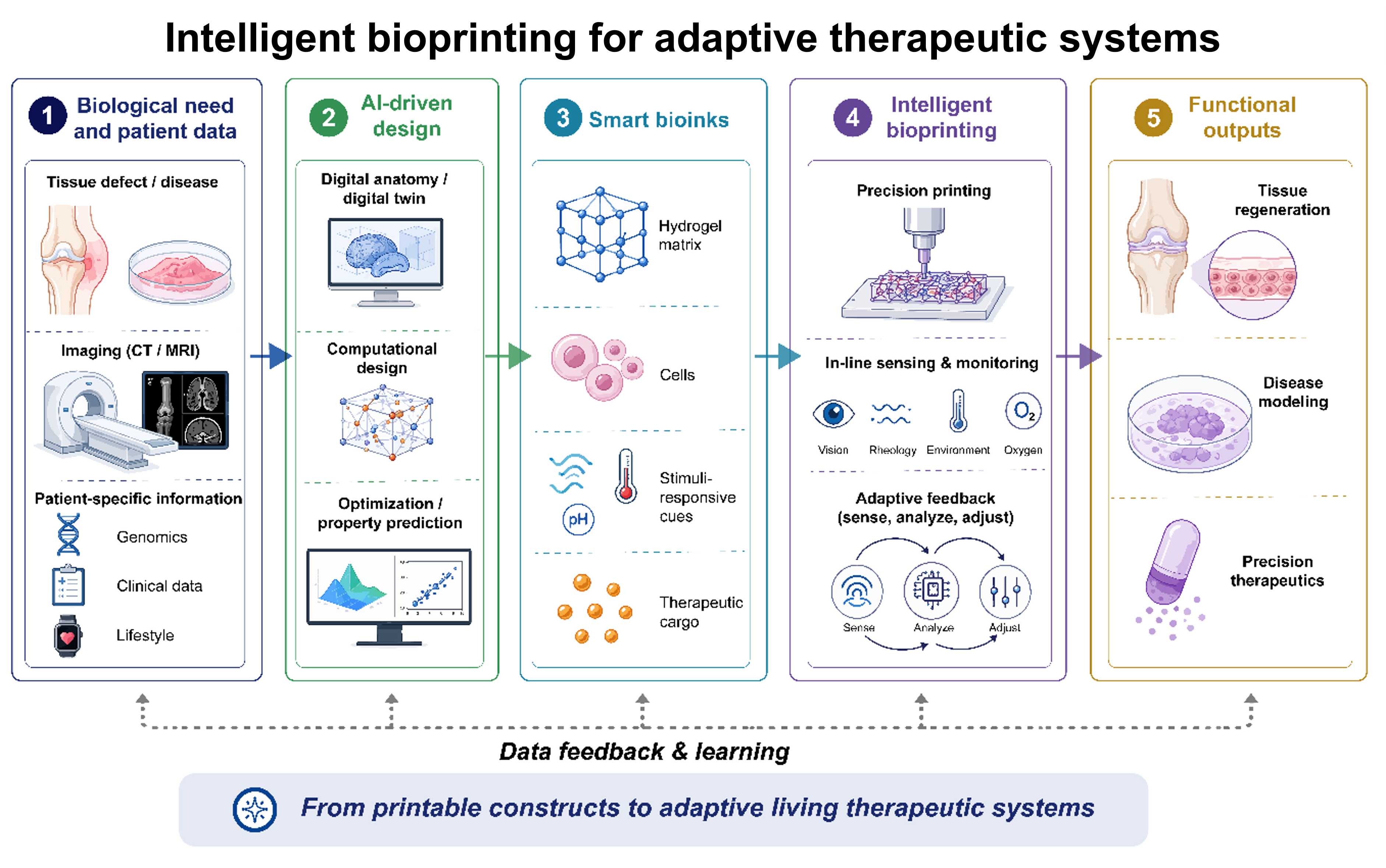
- Ng WL, Bartolo P. 3D bioprinting of tissues and organs for systemic diseases and localized injuries. Mil Med Res. 2026;13(1):100006. doi: 10.1016/j.mmr.2026.100006
- Agarwal T, Onesto V, Banerjee D, et al. 3D bioprinting in tissue engineering: current state-of-the-art and challenges towards system standardization and clinical translation. Biofabrication. 2025;17(4):042003. doi: 10.1088/1758-5090/ade47a
- Murphy SV, Atala A. 3D bioprinting of tissues and organs. Nat Biotechnol. 2014;32(8):773-785. doi: 10.1038/nbt.2958
- Moroni L, Burdick JA, Highley C, et al. Biofabrication strategies for 3D in vitro models and regenerative medicine. Nat Rev Mater. 2018;3(5):21-37. doi: 10.1038/s41578-018-0006-y
- Heinrich MA, Liu W, Jimenez A, et al. 3D bioprinting: from benches to translational applications. Small. 2019;15(23):e1805510. doi: 10.1002/smll.201805510
- Zhang YS, Haghiashtiani G, Hübscher T, et al. 3D extrusion bioprinting. Nat Rev Methods Primers. 2021;1(1):75. doi: 10.1038/s43586-021-00073-8
- Levato R, Jungst T, Scheuring RG, Blunk T, Groll J, Malda J. From shape to function: the next step in bioprinting. Adv Mater. 2020;32(12):1906423. doi: 10.1002/adma.201906423
- Sun W, Starly B, Daly AC, et al. The bioprinting roadmap. Biofabrication. 2020;12(2):022002. doi: 10.1088/1758-5090/ab5158
- Matai I, Kaur G, Seyedsalehi A, McClinton A, Laurencin CT. Progress in 3D bioprinting technology for tissue/organ regenerative engineering. Biomaterials. 2020;226:119536. doi: 10.1016/j.biomaterials.2019.119536
- Chiesa I, Batoni E, Bonatti AF, et al. New frontiers in bioengineering: a perspective on the open challenges in bioprinting. Int J Bioprint. 2026;12(2):025500517. doi: 10.36922/IJB025500517
- An J, Chua CK, Mironov V. Application of machine learning in 3D bioprinting: focus on development of big data and digital twin. Int J Bioprint. 2021;7(1):342. doi: 10.18063/ijb.v7i1.342
- Chen H, Zhang B, Huang J. Recent advances and applications of artificial intelligence in 3D bioprinting. Biophys Rev (Melville). 2024;5(3):031301. doi: 10.1063/5.0190208
- Ke D. AI-driven closed-loop extrusion-based bioprinting system: from dynamic regulation to medical translation. Bioprinting. 2026;54:e00459. doi: 10.1016/j.bprint.2025.e00459
- Tănase M, Veres C, Szabo DA. Artificial intelligence in biomedical 3D printing: mapping the evidence. J Manuf Mater Process. 2025;9(12):407. doi: 10.3390/jmmp9120407
- Zhu Z, Ng DWH, Park HS, McAlpine MC. 3D-printed multifunctional materials enabled by artificial-intelligence-assisted fabrication technologies. Nat Rev Mater. 2021;6(1):27-47. doi: 10.1038/s41578-020-00235-2
- Amukarimi S, Rezvani Z, Eghtesadi N, Mozafari M. Smart biomaterials: from 3D printing to 4D bioprinting. Methods. 2022;205:191-199. doi: 10.1016/j.ymeth.2022.07.006
- Zhang Z, Zhou X, Fang Y, et al. AI-driven 3D bioprinting for regenerative medicine: from bench to bedside. Bioact Mater. 2025;45:201-230. doi: 10.1016/j.bioactmat.2024.11.021
- Liu S, Kaur N, Song DH, Moses JC, Ozbolat IT. Self-driving bioprinting laboratories. Biofabrication. 2026;18(1):013001. doi: 10.1088/1758-5090/ae3645
- Jergitsch M, Mateos-Timoneda MA. 3D extrusion bioprinting: rational bioink design and advanced fabrication techniques. Trends Biotechnol. 2026;44(2):378-388. doi: 10.1016/j.tibtech.2025.06.008
- Ng WL, Shkolnikov V. Jetting-based bioprinting: process, dispense physics, and applications. Bio-Des Manuf. 2024;7:771-799. doi: 10.1007/s42242-024-00285-3
- Ng WL, Paula CTB, Serra AC, Coelho JFJ, Bartolo P. Vat photopolymerization-based bioprinting: shaping next-generation tissues with light. Interdiscip Med. 2026;4(1):e70078. doi: 10.1002/inmd.70078
- Ozbolat IT, Hospodiuk M. Current advances and future perspectives in extrusion-based bioprinting. Biomaterials. 2016;76:321-343. doi: 10.1016/j.biomaterials.2015.10.076
- Schwab A, Levato R, D'Este M, Piluso S, Eglin D, Malda J. Printability and shape fidelity of bioinks in 3D bioprinting. Chem Rev. 2020;120(19):11028-11055. doi: 10.1021/acs.chemrev.0c00084
- Lui YS, Sow WT, Tan LP, Wu Y, Lai Y, Li H. 4D printing and stimuli-responsive materials in biomedical aspects. Acta Biomater. 2019;92:19-36. doi: 10.1016/j.actbio.2019.05.005
- Rahimnejad M, Jahangiri S, Kiadeh SZH, et al. Stimuli-responsive biomaterials: smart avenue toward 4D bioprinting. Crit Rev Biotechnol. 2024;44(5):860-891. doi: 10.1080/07388551.2023.2213398
- Waidi YO, Gugulothu SB. 4D bioprinting of protein-based bioinks for tissue engineering and disease models. Biomater Sci. 2026;14:356-376. doi: 10.1039/D5BM01284H
- Luo Y, Lin X, Chen B, Wei X. Cell-laden four-dimensional bioprinting using near-infrared-triggered shape-morphing alginate/polydopamine bioinks. Biofabrication. 2019;11(4):045019. doi: 10.1088/1758-5090/ab39c5
- Freeman S, Calabro S, Williams R, Jin S, Ye K. Bioink formulation and machine learning-empowered bioprinting optimization. Front Bioeng Biotechnol. 2022;10:913579. doi: 10.3389/fbioe.2022.913579
- Limon SM, Sarah R, Habib A. Integrating decision trees and clustering for efficient optimization of bioink rheology and 3D bioprinted construct microenvironments. J Manuf Sci Eng. 2025;147(9):091003. doi: 10.1115/1.4068429
- Sarah R, Rohauer R, Schimmelpfennig K, Limon SM, Lewis CL, Habib A. Data-driven optimization of bioink formulations for extrusion-based bioprinting: a predictive modeling approach. J Manuf Sci Eng. 2025;147(10):101001. doi: 10.1115/1.4069041
- Sarah R, Schimmelpfennig K, Rohauer R, Lewis CL, Limon SM, Habib A. Characterization and machine learning-driven property prediction of a novel hybrid hydrogel bioink considering extrusion-based 3D bioprinting. Gels. 2025;11(1):45. doi: 10.3390/gels11010045
- Sergis V, Kelly D, Pramanick A, Britchfield G, Mason K, Daly AC. In-situ quality monitoring during embedded bioprinting using integrated microscopy and classical computer vision. Biofabrication. 2025;17(2):025004. doi: 10.1088/1758-5090/adaa22
- Gugliandolo SG, Prioglio E, Moscatelli D, Colosimo BM. A new solution for in situ monitoring of shape fidelity in extrusion-based bioprinting via thermal imaging. Int J Bioprint. 2024;10(3):2021. doi: 10.36922/ijb.2021
- Kelly D, Sergis V, Ventura i Blanco L, Mason K, Daly AC. Autonomous control of extrusion bioprinting using convolutional neural networks. Adv Funct Mater. 2025;35(30):2424553. doi: 10.1002/adfm.202424553
- Wang L, Xu ME, Luo L, Zhou Y, Si P. Iterative feedback bio-printing-derived cell-laden hydrogel scaffolds with optimal geometrical fidelity and cellular controllability. Sci Rep. 2018;8(1):2802. doi: 10.1038/s41598-018-21274-4
- Wang H, Yu H, Zhou X, et al. An overview of extracellular matrix-based bioinks for 3D bioprinting. Front Bioeng Biotechnol. 2022;10:905438. doi: 10.3389/fbioe.2022.905438
- Rastin H, Zhang B, Bi J, Hassan K, Tung TT, Losic D. 3D printing of cell-laden electroconductive bioinks for tissue engineering applications. J Mater Chem B. 2020;8(27):5862-5876. doi: 10.1039/D0TB00627K
- Almeida D, Küppers F, Gusmão A, et al. Design of magnetic kappa-carrageenan-collagen bioinks for 3D bioprinting. J Mater Sci. 2024;59(31):14573-14592. doi: 10.1007/s10853-024-10021-y
- Ng WL, Yeow CHE, Huang X, Lee S, Yeong WY. Physically crosslinked gelatin bio-inks with enhanced printability, degradation and mechanical robustness for multi-modal bioprinting. Interdiscip Med. 2025;3(4):e20250058. doi: 10.1002/INMD.20250058
- Yadav J, Chahal S, Kumar P, Kumar C. Thermo-responsive smart hydrogels: molecular engineering, dynamic cross-linking strategies, and therapeutics applications. Gels. 2026;12(1):12. doi: 10.3390/gels12010012
- Pu M, Cao H, Zhang H, et al. ROS-responsive hydrogels: from design and additive manufacturing to biomedical applications. Mater Horiz. 2024;11(16):3721-3746. doi: 10.1039/D4MH00289J
- Jongprasitkul H, Parihar VS, Turunen S, Kellomäki M. pH-responsive gallol-functionalized hyaluronic acid-based tissue adhesive hydrogels for injection and three-dimensional bioprinting. ACS Appl Mater Interfaces. 2023;15(28):33972-33984. doi: 10.1021/acsami.3c02961
- Zhang Z, Tao ZZ, Du R, Huo R, Zheng X. Artificial intelligence informed hydrogel biomaterials in additive manufacturing. Gels. 2025;11(12):981. doi: 10.3390/gels11120981
- Morgan FLC, Moroni L, Baker MB. Dynamic bioinks to advance bioprinting. Adv Healthc Mater. 2020;9(15):1901798. doi: 10.1002/adhm.201901798
- Morgan FLC, Fernández-Pérez J, Moroni L, Baker MB. Tuning hydrogels by mixing dynamic cross-linkers: enabling cell-instructive hydrogels and advanced bioinks. Adv Healthc Mater. 2022;11(1):e2101576. doi: 10.1002/adhm.202101576
- Tournier P, Saint-Pé G, Lagneau N, et al. Clickable dynamic bioinks enable post-printing modifications of construct composition and mechanical properties controlled over time and space. Adv Sci (Weinh). 2023;10(30):e2300055. doi: 10.1002/advs.202300055
- Ning L, Gil CJ, Hwang B, et al. Biomechanical factors in three-dimensional tissue bioprinting. Appl Phys Rev. 2020;7(4):041319. doi: 10.1063/5.0023206
- Chakraborty A, Roy A, Ravi SP, Paul A. Exploiting the role of nanoparticles for use in hydrogel-based bioprinting applications: concept, design, and recent advances. Biomater Sci. 2021;9(19):6337-6354. doi: 10.1039/D1BM00605C
- Chen P, Zheng L, Wang Y, et al. Desktop-stereolithography 3D printing of a radially oriented extracellular matrix/mesenchymal stem cell exosome bioink for osteochondral defect regeneration. Theranostics. 2019;9(9):2439-2459. doi: 10.7150/thno.31017
- Han P, Ivanovski S. 3D bioprinted extracellular vesicles for tissue engineering—a perspective. Biofabrication. 2023;15(1):013001. doi: 10.1088/1758-5090/ac9809
- Elkhoury K, Chen M, Koçak P, et al. Hybrid extracellular vesicles-liposome incorporated advanced bioink to deliver microRNA. Biofabrication. 2022;14(4):045008. doi: 10.1088/1758-5090/ac8621
- Bar A, Kryukov O, Etzion S, Cohen S. Engineered extracellular vesicle-mediated delivery of miR-199a-3p increases the viability of 3D-printed cardiac patches. Int J Bioprint. 2023;9(2):670. doi: 10.18063/ijb.v9i2.670
- Bakht SM, Pardo A, Gómez-Florit M, Reis RL, Domingues RMA, Gomes ME. Engineering next-generation bioinks with nanoparticles: moving from reinforcement fillers to multifunctional nanoelements. J Mater Chem B. 2021;9(25):5025-5038. doi: 10.1039/D1TB00717C
- Zhang J, Ren F, Bu F, Yao Y, Li M. 3D bioprinting-driven strategies for tissue regeneration and controlled immune modulation. Int J Bioprint. 2026;12(1):173-198. doi: 10.36922/IJB025460474
- Peng YH, Hsiao SK, Gupta K, et al. Dynamic matrices with DNA-encoded viscoelasticity for cell and organoid culture. Nat Nanotechnol. 2023;18(12):1463-1473. doi: 10.1038/s41565-023-01483-3
- Xu Y, Sarah R, Habib A, Liu Y, Khoda B. Constraint based Bayesian optimization of bioink precursor: a machine learning framework. Biofabrication. 2024;16(4):045031. doi: 10.1088/1758-5090/ad716e
- Wu C, Xu Y, Fang J, Li Q. Machine learning in biomaterials, biomechanics/mechanobiology, and biofabrication: state of the art and perspective. Arch Comput Methods Eng. 2024;31(7):3699-3765. doi: 10.1007/s11831-024-10100-y
- Law ACW, Wang R, Chung J, et al. Process parameter optimization for reproducible fabrication of layer porosity quality of 3D-printed tissue scaffold. J Intell Manuf. 2024;35(4):1825-1844. doi: 10.1007/s10845-023-02141-0
- Ng WL, Vyas C, Huang B, Yeong WY, Bartolo P. Advanced bioprinting strategies for fabrication of biomimetic tissues and organs. Int J Extrem Manuf. 2025;7(6):062006. doi: 10.1088/2631-7990/adeee0
- Lamberger Z, Schubert DW, Buechner M, et al. Advanced optical assessment and modeling of extrusion bioprinting. Sci Rep. 2024;14(1):13972. doi: 10.1038/s41598-024-64039-y
- Wang B, Sanli A, Lai Z, et al. Next-generation biosensing for in situ monitoring. Nat Sens. 2026;1:111-130. doi: 10.1038/s44460-025-00016-w
- Byrne R, Carrico A, Lettieri M, et al. Bioinks and biofabrication techniques for biosensors development: a review. Mater Today Bio. 2024;28:101185. doi: 10.1016/j.mtbio.2024.101185
- Trampe E, Koren K, Akkineni AR, et al. Functionalized bioink with optical sensor nanoparticles for O2 imaging in 3D-bioprinted constructs. Adv Funct Mater. 2018;28(45):1804411. doi: 10.1002/adfm.201804411
- Haring AP, Jiang S, Barron C, et al. 3D bioprinting using hollow multifunctional fiber impedimetric sensors. Biofabrication. 2020;12(3):035026. doi: 10.1088/1758-5090/ab94d0
- Lee J, Maji S, Lee H. Fabrication and integration of a low-cost 3D printing-based glucose biosensor for bioprinted liver-on-a-chip. Biotechnol J. 2023;18(12):e2300154. doi: 10.1002/biot.202300154
- Marzi J, Fuhrmann E, Brauchle E, et al. Non-invasive three-dimensional cell analysis in bioinks by Raman imaging. ACS Appl Mater Interfaces. 2022;14(27):30455-30465. doi: 10.1021/acsami.1c24463
- Fitzgerald S, Akhtar J, Schartner E, Ebendorff-Heidepriem H, Mahadevan-Jansen A, Li J. Multimodal Raman spectroscopy and optical coherence tomography for biomedical analysis. J Biophotonics. 2023;16(3):e202200231. doi: 10.1002/jbio.202200231
- Bergholt MS, Serio A, Albro MB. Raman spectroscopy: guiding light for the extracellular matrix. Front Bioeng Biotechnol. 2019;7:303. doi: 10.3389/fbioe.2019.00303
- Zhu Z, Guo SZ, Hirdler T, et al. 3D printed functional and biological materials on moving freeform surfaces. Adv Mater. 2018;30(23):e1707495. doi: 10.1002/adma.201707495
- Strauß S, Schroth B, Hubbuch J. Evaluation of the reproducibility and robustness of extrusion-based bioprinting processes applying a flow sensor. Front Bioeng Biotechnol. 2022;10:831350. doi: 10.3389/fbioe.2022.831350
- Bradshaw TM, Johnson CR, Broberg CA, et al. Sterilization effects on nitric oxide-releasing glucose sensors. Sens Actuators B Chem. 2024;405:135311. doi: 10.1016/j.snb.2024.135311
- Ben-Aissa S, Tripathy S, Cass AEG. Implantable electrochemical biosensors: challenges, strategies, and applications. Curr Opin Electrochem. 2025;54:101745. doi: 10.1016/j.coelec.2025.101745
- Thangadurai M, Srinivasan SS, Sekar MP, Sethuraman S, Sundaramurthi D. Emerging perspectives on 3D printed bioreactors for clinical translation of engineered and bioprinted tissue constructs. J Mater Chem B. 2024;12:350-381. doi: 10.1039/D3TB01847D
- Xia X, Leng T, Garcia AJ, et al. Machine learning for biomaterials design. Nat Rev Bioeng. Published online August 25, 2026. doi: 10.1038/s44222-026-00476-w
- Ding C, Luo Y, Yu X, et al. Recent advances in multimodal foundation model-enabled peptide screening and optimization for smart biomaterials and functional tissue engineering. Front Bioeng Biotechnol. 2026;14:1884032. doi: 10.3389/fbioe.2026.1884032
- Daly AC, Cunniffe GM, Sathy BN, Jeon O, Alsberg E, Kelly DJ. 3D bioprinting of developmentally inspired templates for whole bone organ engineering. Adv Healthc Mater. 2016;5(18):2353-2362. doi: 10.1002/adhm.201600182
- Oliveira JM, Ribeiro VP, Reis RL. Advances on gradient scaffolds for osteochondral tissue engineering. Prog Biomed Eng. 2021;3(3):033001. doi: 10.1088/2516-1091/abfc2c
- Lesage C, Lafont M, Guihard P, et al. Material-assisted strategies for osteochondral defect repair. Adv Sci (Weinh). 2022;9(16):2200050. doi: 10.1002/advs.202200050
- Li H, Yang Y, Wang C, et al. Analysis of three-dimensional printing strategies for meniscus/articular disc repair and regeneration. Tissue Eng Part B Rev. 2025;31(5):446-465. doi: 10.1089/ten.teb.2024.0233
- Yang Z, Cao F, Li H, et al. Microenvironmentally optimized 3D-printed TGFβ-functionalized scaffolds facilitate endogenous cartilage regeneration in sheep. Acta Biomater. 2022;150:181-198. doi: 10.1016/j.actbio.2022.07.029
- Yang Z, Zhao T, Gao C, et al. 3D-bioprinted difunctional scaffold for in situ cartilage regeneration based on aptamer-directed cell recruitment and growth factor-enhanced cell chondrogenesis. ACS Appl Mater Interfaces. 2021;13(20):23369-23383. doi: 10.1021/acsami.1c01844
- Rhee S, Puetzer JL, Mason BN, Reinhart-King CA, Bonassar LJ. 3D bioprinting of spatially heterogeneous collagen constructs for cartilage tissue engineering. ACS Biomater Sci Eng. 2016;2(10):1800-1805. doi: 10.1021/acsbiomaterials.6b00288
- Ji Y, Lv Z, Jin H, Chen J, Tang X. Three-dimensional bioprinting in tendon/ligament-bone interface regeneration: from design innovations to performance enhancement. Int J Bioprint. 2026;12(1):1-18. doi: 10.36922/IJB025410419
- Koffler J, Zhu W, Qu X, et al. Biomimetic 3D-printed scaffolds for spinal cord injury repair. Nat Med. 2019;25(2):263-269. doi: 10.1038/s41591-018-0296-z
- Hakimi N, Cheng R, Leng L, et al. Handheld skin printer: in situ formation of planar biomaterials and tissues. Lab Chip. 2018;18(10):1440-1451. doi: 10.1039/C7LC01236E
- Albanna M, Binder KW, Murphy SV, et al. In situ bioprinting of autologous skin cells accelerates wound healing of extensive excisional full-thickness wounds. Sci Rep. 2019;9(1):1856. doi: 10.1038/s41598-018-38366-w
- Zheng Z, Tan X, Liang H, Li L, Jiang Q, Shi J. In situ bioprinting: control strategies, bioinks, applications, challenges, and future perspectives. Int J Bioprint. 2026;12(3):026200196. doi: 10.36922/IJB026200196
- Bejleri D, Streeter BW, Nachlas ALY, et al. A bioprinted cardiac patch composed of cardiac-specific extracellular matrix and progenitor cells for heart repair. Adv Healthc Mater. 2018;7(23):e1800672. doi: 10.1002/adhm.201800672
- Kong M, Wu Z, Zheng Z, et al. Construction strategies for 3D printed cardiac tissue repair materials and their application potential. Interdiscip Med. 2025;3(3):e20240085. doi: 10.1002/INMD.20240085
- Kolesky DB, Truby RL, Gladman AS, Busbee TA, Homan KA, Lewis JA. 3D bioprinting of vascularized, heterogeneous cell-laden tissue constructs. Adv Mater. 2014;26(19):3124-3130. doi: 10.1002/adma.201305506
- Grigoryan B, Paulsen SJ, Corbett DC, et al. Multivascular networks and functional intravascular topologies within biocompatible hydrogels. Science. 2019;364(6439):458-464. doi: 10.1126/science.aav9750
- Skylar-Scott MA, Uzel SGM, Nam LL, et al. Biomanufacturing of organ-specific tissues with high cellular density and embedded vascular channels. Sci Adv. 2019;5(9):eaaw2459. doi: 10.1126/sciadv.aaw2459
- Skardal A, Aleman J, Forsythe S, et al. Drug compound screening in single and integrated multi-organoid body-on-a-chip systems. Biofabrication. 2020;12(2):025017. doi: 10.1088/1758-5090/ab6d36
- De Spirito M, Palmieri V, Perini G, Papi M. Bridging the gap: integrating 3D bioprinting and microfluidics for advanced multi-organ models in biomedical research. Bioengineering (Basel). 2024;11(7):664. doi: 10.3390/bioengineering11070664
- Ma W, Lu H, Xiao Y, Wu C. Advancing organoid development with 3D bioprinting. Organoid Res. 2025;1(1):025040004. doi: 10.36922/OR025040004
- Neufeld L, Yeini E, Pozzi S, Satchi-Fainaro R. 3D bioprinted cancer models: from basic biology to drug development. Nat Rev Cancer. 2022;22(12):679-692. doi: 10.1038/s41568-022-00514-w
- Napoli GC, Figg WD, Chau CH. Functional drug screening in the era of precision medicine. Front Med (Lausanne). 2022;9:912641. doi: 10.3389/fmed.2022.912641
- Yi HG, Jeong YH, Kim Y, et al. A bioprinted human-glioblastoma-on-a-chip for the identification of patient-specific responses to chemoradiotherapy. Nat Biomed Eng. 2019;3(7):509-519. doi: 10.1038/s41551-019-0363-x
- Neufeld L, Yeini E, Reisman N, et al. Microengineered perfusable 3D-bioprinted glioblastoma model for in vivo mimicry of tumor microenvironment. Sci Adv. 2021;7(34):eabi9119. doi: 10.1126/sciadv.abi9119
- Sun H, Sun L, Ke X, et al. Prediction of clinical precision chemotherapy by patient-derived 3D bioprinting models of colorectal cancer and its liver metastases. Adv Sci (Weinh). 2024;11(2):e2304460. doi: 10.1002/advs.202304460
- Alhattab DM, Isaioglou I, Alshehri S, et al. Fabrication of a three-dimensional bone marrow niche-like acute myeloid leukemia disease model by an automated and controlled process using a robotic multicellular bioprinting system. Biomater Res. 2023;27(1):111. doi: 10.1186/s40824-023-00457-9
- Shukla P, Bera AK, Yeleswarapu S, Pati F. High throughput bioprinting using decellularized adipose tissue-based hydrogels for 3D breast cancer modeling. Macromol Biosci. 2024;24(8):2400035. doi: 10.1002/mabi.202400035
- Zhao J, Shen F, Sheng S, et al. Cartilage-on-chip for osteoarthritis drug screening. Organoid Res. 2025;1(1):8461. doi: 10.36922/or.8461
- Sarkar N, Bhumiratana S, Geris L, Papantoniou I, Grayson WL. Bioreactors for engineering patient-specific tissue grafts. Nat Rev Bioeng. 2023;1(5):361-377. doi: 10.1038/s44222-023-00036-6
- Perin F, Ouyang L, Lim KS, et al. Bioprinted constructs in the regulatory landscape: current state and future perspectives. Adv Mater. 2026;38(4):e04037. doi: 10.1002/adma.202504037
- ASTM International. ASTM F3659-24: Standard Guide for Bioinks Used in Bioprinting. ASTM International; 2024. doi: 10.1520/F3659-24
- US Food and Drug Administration. Technical Considerations for Additive Manufactured Medical Devices: Guidance for Industry and Food and Drug Administration Staff. US Food and Drug Administration; 2017. Accessed August 2, 2026. https://www.fda.gov/regulatory-information/search-fda-guidance-documents/technical-considerations-additive-manufactured-medical-devices
- European Parliament and Council. Regulation (EC) No 1394/2007 of the European Parliament and of the Council of 13 November 2007 on advanced therapy medicinal products and amending Directive 2001/83/EC and Regulation (EC) No 726/2004. Off J Eur Union. 2007;L324:121-137. Accessed August 2, 2026. https://eur-lex.europa.eu/eli/reg/2007/1394/oj/eng
- 109. European Commission. EudraLex Volume 4: Good Manufacturing Practice Guidelines, Part IV: GMP Requirements for Advanced Therapy Medicinal Products. European Commission. Accessed August 2, 2026. https://health.ec.europa.eu/medicinal-products/eudralex/eudralex-volume-4_en