
3D-bioprinted skin-mimicking bilayer hydrogel dressing with compartmentalized antibacterial and pro-healing functions for diabetic wounds

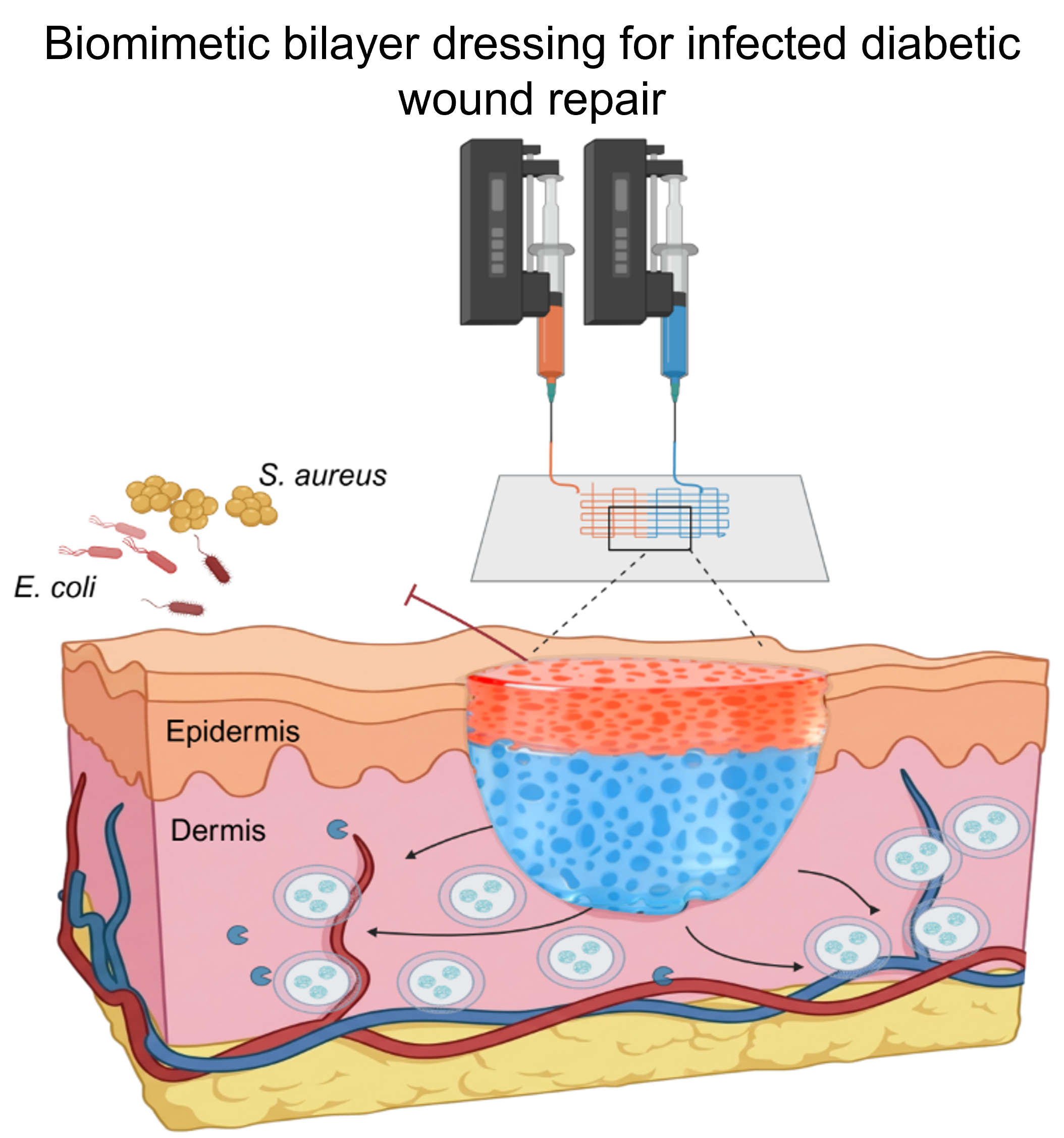
Diabetic wound healing remains a significant clinical challenge due to persistent infection and impaired tissue regeneration. This study presents a biomimetic, 3D-bioprinted bilayer hydrogel dressing with spatially compartmentalized functions to address these divergent requirements. The upper layer comprises chitosan hydrogel embedded with silver nanoparticles to provide rapid, broad-spectrum antibacterial activity against surface pathogens, and the lower layer consists of methacrylated silk fibroin hydrogel co-encapsulating epidermal stem cell-derived exosomes and metformin to create a pro-regenerative microenvironment in the deeper wound bed. Comprehensive in vitro characterization confirmed distinct physicochemical properties between the antibacterial upper layer and the porous, pro-healing lower layer. The upper layer exhibited synergistic bactericidal effects against Staphylococcus aureus and Escherichia coli, while the lower layer promoted M2 macrophage polarization, endothelial cell migration, and angiogenesis-related gene expression. In a diabetic mouse model of infected full-thickness wounds, compared to monolayer controls, the bilayer dressing significantly accelerated wound closure by increasing granulation tissue formation and neovascularization, while reducing bacterial burden. This compartmentalized design effectively integrates the complementary demands of infection control and tissue regeneration, offering a promising strategy for managing chronic diabetic ulcers.
- Shah J, McKnight G, Hargest R. Physiology of the skin. Surgery. 2024;42(11):788-792. doi: 10.1016/j.mpsur.2024.09.008
- Yadav JP, Singh AK, Grishina M, et al. Insights into the mechanisms of diabetic wounds: pathophysiology, molecular targets, and treatment strategies through conventional and alternative therapies. Inflammopharmacology. 2024;32(1):149-228. doi: 10.1007/s10787-023-01407-6
- Lin H, Wang Z, Li P, et al. Intelligent-responsive hydrogel synergistically mediates immune remodel-antibacterial-angiogenesis cascade for diabetic foot ulcer repair. Bioact Mater. 2026;62:508-525. doi: 10.1016/j.bioactmat.2026.03.034
- McDermott K, Fang M, Boulton AJM, Selvin E, Hicks CW. Etiology, Epidemiology, and Disparities in the Burden of Diabetic Foot Ulcers. Diabetes Care. 2023;46(1):209-221. doi: 10.2337/dci22-0043
- Armstrong DG, Tan T-W, Boulton AJM, Bus SA. Diabetic foot ulcers: a review. JAMA. 2023;330(1):62–75. doi: 10.1001/jama.2023.10578
- Han D, Ma C, Wang Y, et al. Application of one-step transplantation of acellular allogeneic dermis combined with autologous split-thickness skin graft in repairing deep burn wounds in functional areas of children. Burns. 2026;52(5):107914. doi: 10.1016/j.burns.2026.107914
- Fu M, Huang Z, Li J, et al. Approaching Scarless Wound Healing: From Passive Anti-Fibrotic to Proactive and Programmable Pro-Regenerative Strategies. Adv Sci. 2026;13(18):e21824. doi: 10.1002/advs.202521824
- Boyce ST, Simpson PS, Rieman MT, et al. Randomized, Paired-Site Comparison of Autologous Engineered Skin Substitutes and Split-Thickness Skin Graft for Closure of Extensive, Full-Thickness Burns. J Burn Care Res. 2017;38(2):61-70. doi: 10.1097/BCR.0000000000000401
- Qin X, Wang Y, Feng Y, et al. Potentiating Chemo- Immunotherapy via a Programmable Nanocapsule- Hydrogel Platform for Sequential Tumor Microenvironment Remodeling. Adv Mater. 2026;38(14):e22016. doi: 10.1002/adma.202522016
- Zheng B, Lu Z, Wang S, et al. Computational design of superstable proteins through maximized hydrogen bonding. Nat Chem. 2026;18(2):364-373. doi: 10.1038/s41557-025-01998-3
- Zhuo H, Liu Q, Dong X, Zheng H, Hong L, Zhai W. Superior Impact-Resistant Composite Hydrogels Through an Ionic Coupling Strategy. Adv Mater. 2026;38(26). doi: 10.1002/adma.73010
- Zhao X, Jiang X, Liang B, et al. A Bio-Orthogonal Engineered Chitosan Platform for Enhanced Mesenchymal Stem Cells Delivery and Function in Peripheral Nerve Repair. Adv Mater. 2026;38(13):e23237. doi: 10.1002/adma.202523237
- Elajaili H, Lyttle BD, Lewis CV, et al. Increased ROS and Persistent Pro-Inflammatory Responses in a Diabetic Wound Healing Model (db/db): Implications for Delayed Wound Healing. Int J Mol Sci. 2025;26(10):4884. 2025;26(10):4884. doi: 10.3390/ijms26104884
- Lin S, Wang Q, Huang X, et al. Wounds under diabetic milieu: The role of immune cellar components and signaling pathways. Biomed Pharm. 2023;157:114052. doi: 10.1016/j.biopha.2022.114052
- Murali N, Aastha, Das SB, et al. Magnetoelectrically Enhanced Molecular Recognition on Plasmonic Surfaces. Small. 2026;22(27). doi: 10.1002/smll.202510657
- Liu X, Meng L, Deng W, et al. Photo-induced in-situ synthesized nanocellulose-based SERS substrate integrated with molecularly imprinted polymer for selective detection of pesticide residues. Carbohydr Polym. 2026;380:125050. doi: 10.1016/j.carbpol.2026.125050
- Akter M, Sikder MT, Rahman MM, et al. A systematic review on silver nanoparticles-induced cytotoxicity: Physicochemical properties and perspectives. J Adv Res. 2017;9:1-16. doi: 10.1016/j.jare.2017.10.008
- Wong TY, Wang Y, Kwan KKL, et al. Exploring the Potentials of Silver Nanoparticles in Overcoming Cisplatin Resistance in Lung Adenocarcinoma: Insights from Proteomic and Xenograft Mice Studies. ACS Nano. 2025;19(39):34708- 34723. doi: 10.1021/acsnano.5c09056
- Shin KO, Lee JH, Chae S, et al. Small EVs From Adipose- Derived MSCs Modulate Epidermal Barrier and Inflammation Via Sphingosine-1-Phosphate Signaling Pathway. J Extracell Vesicles. 2025;14(7):e70121. doi: 10.1002/jev2.70121
- Zhao S, Kong H, Qi D, et al. Epidermal stem cell derived exosomes-induced dedifferentiation of myofibroblasts inhibits scarring via the miR-203a-3p/PIK3CA axis. J Nanobiotechnol. 2025;23(1):56. doi: 10.1186/s12951-025-03157-9
- Duan M, Zhang Y, Zhang H, Meng Y, Qian M, Zhang G. Epidermal stem cell-derived exosomes promote skin regeneration by downregulating transforming growth factor-β1 in wound healing. Stem Cell Res Ther. 2020;11(1):452. doi: 10.1186/s13287-020-01971-6
- Tan F, Li X, Wang Z, Li J, Shahzad K, Zheng J. Clinical applications of stem cell-derived exosomes. Signal Transduct Target Ther. 2024;9(1):17. doi: 10.1038/s41392-023-01704-0
- Zhou C, Zhang B, Yang Y, et al. Stem cell-derived exosomes: emerging therapeutic opportunities for wound healing. Stem Cell Res Ther. 2023;14(1):107. doi: 10.1186/s13287-023-03345-0
- Luong JHT. Chitosan nanocrystals as next-generation antimicrobials: Mechanistic insights, antibiotic synergy, and biomedical potential. Biotechnol Adv. 2026;90:108879. doi: 10.1016/j.biotechadv.2026.108879
- Kim SH, Hong H, Ajiteru O, et al. 3D bioprinted silk fibroin hydrogels for tissue engineering. Nat Protoc. 2021;16(12):5484-5532. doi: 10.1038/s41596-021-00622-1
- Zheng Z, Yang X, Liu X, et al. A multifunctional hyaluronic acid hydrogel with pH-responsive metformin release for accelerated healing of diabetic infected wounds. Mater Today Bio. 2025;36:102755. doi: 10.1016/j.mtbio.2025.102755
- Xue Y, Fan L, Liu H, et al. Photo-crosslinkable hydrogel with programmable dual time-phase drug release for accelerated healing of infected diabetic wounds. J Adv Res. 2025. doi: 10.1016/j.jare.2025.11.015
- Nascimbene A, Bark D, Smadja DM. Hemocompatibility and biophysical interface of left ventricular assist devices and total artificial hearts. Blood. 2024;143(8):661-672. doi: 10.1182/blood.2022018096
- Licini C, Morroni G, Lucarini G, et al. ER-mitochondria association negatively affects wound healing by regulating NLRP3 activation. Cell Death Dis. 2024;15(6):407. doi: 10.1038/s41419-024-06765-9
- Qin H, Xie Z, Wang Y, et al. A hierarchical dexamethasone-loaded zeolitic imidazolate framework-8 hybrid coating on biodegradable ZnCu alloys for coordinated immuno-angiogenic-osteogenic and antibacterial regulation in inflammation-impaired fracture healing. Biomaterials. 2026;328:123875. doi: 10.1016/j.biomaterials.2025.123875
- Shen Z, Du L, Fang X, et al. Nanozyme Cryogel Accelerates Diabetic Wound Healing by Targeting Biofilms and Inflammations of the Wound Bed. ACS Nano. 2025;19(39):35081-35101. doi: 10.1021/acsnano.5c12513
- Adeshara K, Di Marco E, Bordino M, et al. Altered oxidant and antioxidant levels are associated with vascular stiffness and diabetic kidney disease in type 1 diabetes after exposure to acute and chronic hyperglycemia. Cardiovasc Diabetol. 2024;23(1):350. doi: 10.1186/s12933-024-02427-4
- Kang HJ, Kumar S, D’Elia A, et al. Self-assembled elastin-like polypeptide fusion protein coacervates as competitive inhibitors of advanced glycation end-products enhance diabetic wound healing. J Control Release. 2021;333:176- 187. doi: 10.1016/j.jconrel.2021.03.032
- Zhang YQ, Nie R, Feng ZY, et al. Activating the cellular scavenger: A bioactive hydrogel promotes diabetic wounds via plant exosome-like nanovesicles enhanced macrophage efferocytosis. Bioact Mater. 2026;62:669-685. doi: 10.1016/j.bioactmat.2026.03.039
- Shi Y, Guo S, Tian J, et al. Biomaterials-mediated sequential drug delivery: Emerging trends for wound healing. Asian J Pharm Sci. 2025;20(6):101088. doi: 10.1016/j.ajps.2025.101088
- Agramunt J, Kang Y, Rinkevich Y. Spatiotemporal dynamics of mammalian wound healing. Cell Discov. 2026;12(1):4. doi: 10.1038/s41421-025-00865-2
- Thau H, Gerjol BP, Hahn K, et al. Senescence as a molecular target in skin aging and disease. Ageing Res Rev. 2025;105:102686. doi: 10.1016/j.arr.2025.102686
- Wang L, Pang Y, Xin M, Li M, Shi L, Mao Y. Effect of the structure of chitosan quaternary ammonium salts with different spacer groups on antibacterial and antibiofilm activities. Int J Biol Macromol. 2024;276(Pt 1):133777. doi: 10.1016/j.ijbiomac.2024.133777
- Huang WC, Ying R, Wang W, et al. A macroporous hydrogel dressing with enhanced antibacterial and anti-inflammatory capabilities for accelerated wound healing. Adv Funct Mater. 2020;30(21). doi: 10.1002/adfm.202000644
- Li Y, Yong D, Shen J, Bian R, Wang Y. Silver nanoparticle-loaded konjac glucomannan/silk fibroin composite hydrogels for enhanced wound healing. Int J Biol Macromol. 2025;300:140199. doi: 10.1016/j.ijbiomac.2025.140199
- Zhu J, Zeng Q, Liu Y, et al. Smart nanosilver strikes twice: precision bacteria killing meets autophagy-boosted healing for infected wounds. Adv Funct Mater. 2025;35(48). doi: 10.1002/adfm.202507797
- He X, Wang R, Zhou F, Liu H. Recent advances in photo-crosslinkable methacrylated silk (Sil-MA)-based scaffolds for regenerative medicine: A review. Int J Biol Macromol. 2024;256(Pt 1):128031. doi: 10.1016/j.ijbiomac.2023.128031
- Jun I, Ahn JY, Ahn G, et al. Exosome immobilization of 3D-printed polycaprolactone scaffolds for bone tissue engineering. Int J Bioprinting. 2026;12(2):026030021. doi: 10.36922/IJB026030021
- Kulkarni AS, Gubbi S, Barzilai N. Benefits of Metformin in Attenuating the Hallmarks of Aging. Cell Metab. 2020;32(1):15-30. doi: 10.1016/j.cmet.2020.04.001
- Packer M. Autophagy-dependent and -independent modulation of oxidative and organellar stress in the diabetic heart by glucose-lowering drugs. Cardiovasc Diabetol. 2020;19(1):62. doi: 10.1186/s12933-020-01041-4
- Wang YR, Zhang XX, Chen XX, et al. Enhancement of Bone Repair in Diabetic Rats with Metformin-Modified Silicified Collagen Scaffolds. Adv Healthc Mater. 2025;14(3):e2401430. doi: 10.1002/adhm.202401430