

Application and prospects of chitosan-based 3D-printed scaffolds in the repair of osteochondral defects

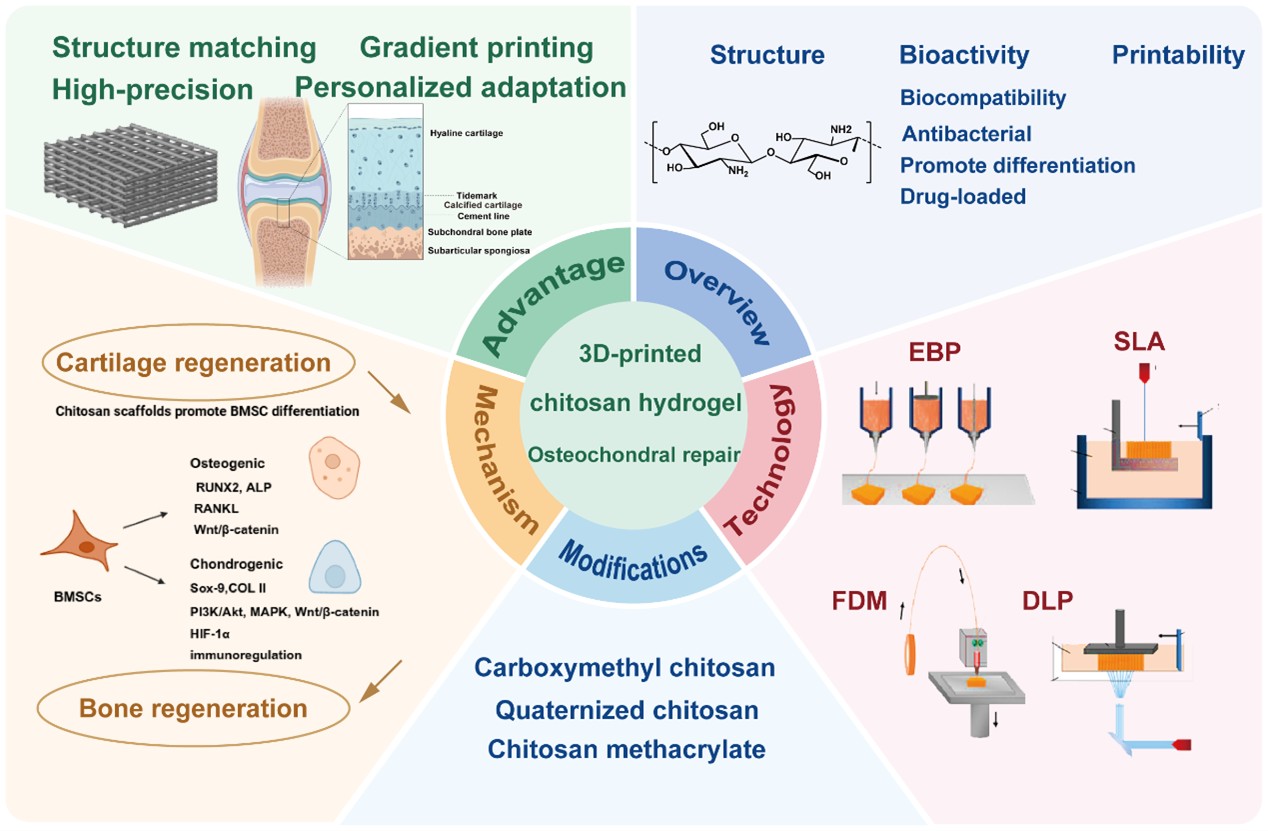
Osteochondral defects, which involve injury to both the articular cartilage and the underlying subchondral bone, present a considerable therapeutic challenge due to cartilage’s poor intrinsic capacity for regeneration and the intricate, gradient structure of the osteochondral junction. Tissue engineering offers a promising strategy for regenerating this biphasic tissue. Chitosan has attracted significant research interest due to its favorable biocompatibility, controlled degradability, natural antibacterial activity, and structural resemblance to endogenous glycosaminoglycans. Integrating chitosan with 3D printing allows the production of scaffolds with customizable structures, porosity, and mechanical properties tailored to patient needs. Moreover, chitosan can easily be blended with various natural polymers to develop composite bioinks that improve osteogenic and chondrogenic potential, thereby enhancing the functional performance of scaffolds. This review examines research literature spanning January 2020 to October 2025. Recent advances include the development of functionalized chitosan derivatives for improved printability and crosslinking, as well as the incorporation of cells and growth factors to create bioactive, cell-laden constructs. This review provides an extensive overview of the physicochemical and biological characteristics of chitosan pertinent to osteochondral regeneration, discusses diverse 3D printing strategies utilized to construct chitosan-based composite scaffolds, and emphasizes their demonstrated potential in improving cellular responses, stimulating bone and cartilage formation, supporting biomineralization, and achieving controlled delivery of bioactive agents. Finally, we discuss current challenges, such as optimizing scaffold degradation kinetics and vascularization, and future perspectives on the clinical translation of these innovative constructs for effective osteochondral regeneration.
- Lu J, Gao Y, Cao C, et al. 3D bioprinted scaffolds for osteochondral regeneration: advancements and applications. Mater Today Bio. 2025;32:101834. doi: 10.1016/j.mtbio.2025.101834
- Taghizadeh M, Taghizadeh A, Yazdi MK, et al. Chitosan-based inks for 3D printing and bioprinting. Green Chem. 2022; 24(1), 62-101. doi: 10.1039/D1GC01799C
- Lin X, Zhang Y, Li J, et al. Biomimetic multizonal scaffolds for the reconstruction of zonal articular cartilage in chondral and osteochondral defects. Bioact Mater. 2025;43: 510-549. doi: 10.1016/j.bioactmat.2024.10.001
- Zhang G, He S, He X, et al. Local Recruitment of Autologous Stem Cells via a Targeting Microgel for Precise Cartilage Repair without Surgery. Adv Mater. 2025;37(33):e2505544. doi: 10.1002/adma.202505544
- Zhang B, Zhang M, Jiang C, Yan W, Pan Y, Meng F. Engineered polysaccharide scaffolds for cartilage regeneration: Mechanisms, functionalization, and clinical prospects. Colloids Surf B Biointerfaces. 2025;257:115134. doi: 10.1016/j.colsurfb.2025.115134
- Kunze KN, Persaud S, Briano J, et al. Outcomes of Revision Cartilage Restoration Surgery for Failed Primary Treatment of Chondral or Osteochondral Defects of the Knee: A Systematic Review. Am J Sports Med. 2025;53(6): 1515-1523. doi: 10.1177/03635465241260271
- Nguyen MN, Vu BT, Truong DM, et al. Fabrication of 3-Dimensional-Printed Bilayered Scaffold Carboxymethyl Chitosan/Oxidized Xanthan Gum, Biphasic Calcium Phosphate for Osteochondral Regeneration. Biomater Res. 2025;29:0186. doi: 10.34133/bmr.0186
- Wang X, Wu S, Li R, et al. ROS-Activated Nanohydrogel Scaffolds with Multi-Factors Controlled Release for Targeted Dual-Lineage Repair of Osteochondral Defects. Adv Sci (Weinh). 2025;12(20):e2412410. doi: 10.1002/advs.202412410
- Koh RH, Kim J, Kim JU, et al. Bioceramic-mediated chondrocyte hypertrophy promotes calcified cartilage formation for rabbit osteochondral defect repair. Bioact Mater. 2024;40:306-317. doi: 10.1016/j.bioactmat.2024.06.018
- Wu Z, Yao H, Sun H, et al. Enhanced hyaline cartilage formation and continuous osteochondral regeneration via 3D-Printed heterogeneous hydrogel with multi-crosslinking inks. Mater Today Bio. 2024;26:101080. doi: 10.1016/j.mtbio.2024.101080
- Wu H, Chen C, Li J, et al. Engineered Magneto-Piezoelectric Nanoparticles-Enhanced Scaffolds Disrupt Biofilms and Activate Oxidative Phosphorylation in Icam1(+) Macrophages for Infectious Bone Defect Regeneration. ACS Nano. 2024;18(52):35575-35594. doi: 10.1021/acsnano.4c13562
- Wang Y, Zhou X, Jiang J, et al. Carboxymethyl chitosan-enhanced multi-level microstructured composite hydrogel scaffolds for bone defect repair. Carbohydr Polym. 2025;348(Pt B):122847. doi: 10.1016/j.carbpol.2024.122847
- Wei P, Zhou J, Xiong S, et al. Chestnut-Inspired Hollow Hydroxyapatite 3D Printing Scaffolds Accelerate Bone Regeneration by Recruiting Calcium Ions and Regulating Inflammation. ACS Appl Mater Interfaces. 2024;16(8):9768-9786. doi: 10.1021/acsami.3c17087
- Ngau SM, Cheah KH, Wong VL, Khiew PS, Lim SS. 3D-printed poly(ethylene) glycol diacrylate (PEGDA)- chitosan-nanohydroxyapatite scaffolds: Structural characterization and cellular response. Int J Biol Macromol. 2025;296:139652. doi: 10.1016/j.ijbiomac.2025.139652
- Hu X, Man Y, Li W, et al. 3D Bio-Printing of CS/Gel/HA/ Gr Hybrid Osteochondral Scaffolds. Polymers (Basel). 2019;11(10). doi: 10.3390/polym11101601
- Xu J, Su Y, Yang J, et al. A 3D bioprinted gelatin/quaternized chitosan/decellularized extracellular matrix based hybrid bionic scaffold with multifunctionality for infected full-thickness skin wound healing. Int J Biol Macromol. 2025;309(Pt 1):142816. doi: 10.1016/j.ijbiomac.2025.142816
- Zhang W, Shi K, Yang J, et al. 3D printing of recombinant collagen/chitosan methacrylate/nanoclay hydrogels loaded with Kartogenin nanoparticles for cartilage regeneration. Regen Biomater. 2024;11:rbae097. doi: 10.1093/rb/rbae097
- Corrado F, Di Maio L, Palmero P, et al. Vat photo-polymerization 3D printing of gradient scaffolds for osteochondral tissue regeneration. Acta Biomater. 2025;200:67-86. doi: 10.1016/j.actbio.2025.05.042
- Jacob G, Shimomura K, Nakamura N. Osteochondral Injury, Management and Tissue Engineering Approaches. Front Cell Dev Biol. 2020;8:580868. doi: 10.3389/fcell.2020.580868
- Wu H, Wang X, Wang G, et al. Advancing Scaffold- Assisted Modality for In Situ Osteochondral Regeneration: A Shift From Biodegradable to Bioadaptable. Adv Mater. 2024;36(47):e2407040. doi: 10.1002/adma.202407040
- Kwon H, Brown WE, Lee CA, et al. Surgical and tissue engineering strategies for articular cartilage and meniscus repair. Nat Rev Rheumatol. 2019;15(9):550-570. doi: 10.1038/s41584-019-0255-1
- Gao F, Xu Z, Liang Q, et al. Direct 3D Printing of High Strength Biohybrid Gradient Hydrogel Scaffolds for Efficient Repair of Osteochondral Defect. Adv Funct Mater. 2018;28(13):1706644. doi: 10.1002/adfm.201706644
- Gu Y, Zou Y, Huang Y, et al. 3D-printed biomimetic scaffolds with precisely controlled and tunable structures guide cell migration and promote regeneration of osteochondral defect. Biofabrication. 2023;16(1):015003. doi: 10.1088/1758-5090/ad0071
- Qu H, Gao C, Liu K, et al. Gradient matters via filament diameter-adjustable 3D printing. Nat Commun. 2024;15(1):2930. doi: 10.1038/s41467-024-47360-y
- Li CJ, Park JH, Jin GS, et al. Strontium/Silicon/Calcium- Releasing Hierarchically Structured 3D-Printed Scaffolds Accelerate Osteochondral Defect Repair. Adv Healthc Mater. 2024;13(20):e2400154. doi: 10.1002/adhm.202400154
- Li Q, Yu H, Zhao F, et al. 3D Printing of Microenvironment- Specific Bioinspired and Exosome-Reinforced Hydrogel Scaffolds for Efficient Cartilage and Subchondral Bone Regeneration. Adv Sci (Weinh). 2023;10(26):e2303650. doi: 10.1002/advs.202303650
- Li C, Wang K, Li T, et al. Patient-specific Scaffolds with a Biomimetic Gradient Environment for Articular Cartilage- Subchondral Bone Regeneration. ACS Appl Bio Mater. 2020;3(8):4820-4831. doi: 10.1021/acsabm.0c00334
- Jahani A, Nourbakhsh MS, Moradi A, Mohammadi M, Tayebi L. Incorporating insulin into alginate-chitosan 3D-printed scaffolds: A comprehensive study on structure, mechanics, and biocompatibility for cartilage tissue engineering. Carbohydr Polym Technol Appl. 2025;9:100696. doi: 10.1016/j.carpta.2025.100696
- Kang Y, Xu J, Meng L, et al. 3D bioprinting of dECM/Gel/ QCS/nHAp hybrid scaffolds laden with mesenchymal stem cell-derived exosomes to improve angiogenesis and osteogenesis. Biofabrication. 2023;15(2):024103. doi: 10.1088/1758-5090/acb6b8
- Wang W, Zheng L, Liu W, et al. Enhanced efficacy of 3D architectural glass–ceramic scaffolds in vertical bone augmentation compared with conventional bone-block grafts of different origins. Mater Des. 2025;253,113989. doi: 10.1016/j.matdes.2025.113989
- Sun Q, Qiu T, Liu X, Wei Q. Cellular Spatial Sensing Determines Cell Mechanotransduction Activity on the Aligned Nanofibers. Small. 2025;21(13):e2410351. doi: 10.1002/smll.202410351
- Cho S, Lee KS, Lee K, et al. Surface Crystal and Degradability of Shape Memory Scaffold Essentialize Osteochondral Regeneration. Small. 2024;20(40):e2401989. doi: 10.1002/smll.202401989
- Tang W, Pan P, Chen T, et al. 3D chitosan scaffolds loaded with ZnO nanoparticles for bone tissue engineering. Colloids Surf B Biointerfaces. 2025;245:114199. doi: 10.1016/j.colsurfb.2024.114199
- Zhao W, Chen H, Zhang Y, et al. Adaptive multi-degree-of-freedom in situ bioprinting robot for hair-follicle-inclusive skin repair: A preliminary study conducted in mice. Bioeng Transl Med. 2022;7(3):e10303. doi: 10.1002/btm2.10303
- Lipskas J, Deep K, Yao W. Robotic-Assisted 3D Bio-printing for Repairing Bone and Cartilage Defects through a Minimally Invasive Approach. Sci Rep. 2019;9(1):3746. doi: 10.1038/s41598-019-38972-2
- Shariatinia Z. Carboxymethyl chitosan: Properties and biomedical applications. Int J Biol Macromol. 2018;120(Pt B):1406-1419. doi: 10.1016/j.ijbiomac.2018.09.131
- Liu Y, Yuan K, Lin Y, et al. Directional Freeze-Casting Cryogel Loaded with Quaternized Chitosan Modified Gallium Metal-Organic Frameworks to Capture and Eradicate the Resistant Bacteria for Guided Regeneration in Infected Bone Defects. Adv Mater. 2025;37(9):e2414437. doi: 10.1002/adma.202414437
- Chen YR, Yan X, Yuan FZ, et al. Kartogenin-Conjugated Double-Network Hydrogel Combined with Stem Cell Transplantation and Tracing for Cartilage Repair. Adv Sci (Weinh). 2022;9(35):e2105571. doi: 10.1002/advs.202105571
- Islam MM, Shahruzzaman M, Biswas S, Nurus Sakib M, Rashid TU. Chitosan based bioactive materials in tissue engineering applications-A review. Bioact Mater. 2020;5(1):164-183. doi: 10.1016/j.bioactmat.2020.01.012
- Furuike T, Komoto D, Hashimoto H, Tamura H. Preparation of chitosan hydrogel and its solubility in organic acids. Int J Biol Macromol. 2017;104(Pt B):1620-1625. doi: 10.1016/j.ijbiomac.2017.02.099
- Jirofti N, Hashemi M, Moradi A, Kalalinia F. Fabrication and characterization of 3D printing biocompatible crocin-loaded chitosan/collagen/hydroxyapatite-based scaffolds for bone tissue engineering applications. Int J Biol Macromol. 2023;252:126279. doi: 10.1016/j.ijbiomac.2023.126279
- Kumi M, Wang T, Ejeromedoghene O, Wang J, Li P, Huang W. Exploring the Potentials of Chitin and Chitosan- Based Bioinks for 3D-Printing of Flexible Electronics: The Future of Sustainable Bioelectronics. Small Methods. 2024;8(9):e2301341. doi: 10.1002/smtd.202301341
- Jiang T, Yang Y, Lin Z, Hong Y, Luo Z. Modified Polysaccharides: Potential Biomaterials for Bioprinting. J Funct Biomater. 2025;16(9):338. doi: 10.3390/jfb16090338
- Qin S, Wang W, Chen L, et al. 3D printed osteochondral lineage-specific biphasic scaffolds for functional repair of full-thickness articular cartilage defects in weight-bearing area. Biofabrication. 2025;17(3):035025. doi: 10.1088/1758-5090/ade8a9
- Liu K, Zhang Y, Huang L, et al. Enhanced printability of high-viscosity chitosan/acrylamide inks via aluminum ions coordination for precision 3D bioprinting of scaffolds. Carbohydr Polym. 2025;355:123359. doi: 10.1016/j.carbpol.2025.123359
- Chang HK, Yang DH, Ha MY, et al. 3D printing of cell-laden visible light curable glycol chitosan bioink for bone tissue engineering. Carbohydr Polym. 2022;287:119328. doi: 10.1016/j.carbpol.2022.119328
- Lin M, Stehle Y, Chen L, et al. A 3D-printed chitosan-based pH-responsive dual functional scaffold for osteomyelitis: synergistic antibacterial and osteogenic treatment. Carbohydr Polym. 2025;366:123866. doi: 10.1016/j.carbpol.2025.123866
- Liu X, Wang Y, Zhang W, et al. Caffeic acid and adenine modified chitosan dual-network hydrogel with antioxidant and pro-proliferative properties for diabetic wound healing. Carbohydr Polym. 2025;369:124290. doi: 10.1016/j.carbpol.2025.124290
- Wang X, Zhang J, Shan J, et al. Polypyrrole-Modified Triple- Responsive Hydrogel Dressing Based on Bacterial Cellulose and Quaternary Ammonium Chitosan and Its Synergistic Antibacterial Mechanism. ACS Appl Mater Interfaces. 2025;17(36):50417-50431. doi: 10.1021/acsami.5c12061
- Liu Y, Zhou C, Zhang X, Liu W. Chirality Hydroxyapatite Gradient Scaffold Drives Osteochondral Regeneration via YAP/TAZ-Mediated Mechanotransduction. Adv Healthc Mater. 2025;14(22):e2501668. doi: 10.1002/adhm.202501668
- Pitrolino KA, Felfel RM, Pellizzeri LM, et al. Development and in vitro assessment of a bi-layered chitosan-nano-hydroxyapatite osteochondral scaffold. Carbohydr Polym. 2022;282:119126. doi: 10.1016/j.carbpol.2022.119126
- Cui R, Lu Q, Teng Y, Li K, Li N. Chitosan Promoted the Corneal Epithelial Wound Healing via Activation of ERK Pathway. Curr Eye Res. 2017;42(1):21-27. doi: 10.3109/02713683.2016.1145235
- Hoemann CD, Rodríguez González J, Guzmán-Morales J, Chen G, Jalali Dil E, Favis BD. Chitosan coatings with distinct innate immune bioactivities differentially stimulate angiogenesis, osteogenesis and chondrogenesis in poly-caprolactone scaffolds with controlled interconnecting pore size. Bioact Mater. 2022;10:430-442. doi: 10.1016/j.bioactmat.2021.09.012
- Olza S, Hadj Bouzidi NM, Rubatat L, et al. Mineralized chitin nanocrystals enhance osteoinductive ability of chitosan 3D porous biohybrid scaffolds for bone tissue regeneration. Carbohydr Polym. 2025;366:123911. doi: 10.1016/j.carbpol.2025.123911
- Tu C, Gao X, Zheng H, et al. Innovative injectable, self-healing, exosome cross-linked biomimetic hydrogel for cartilage regeneration. J Control Release. 2025;381:113608. doi: 10.1016/j.jconrel.2025.113608
- Tikakosol P, Topham PD, Derry MJ, et al. Kartogenin-encapsulated self-healing injectable hydrogel based on hyaluronic acid and chitosan derivative for use as viscosupplementation in knee osteoarthritis. Int J Biol Macromol. 2025;328(Pt 1):147304. doi: 10.1016/j.ijbiomac.2025.147304
- Li P, Fu L, Liao Z, et al. Chitosan hydrogel/3D-printed poly(ε-caprolactone) hybrid scaffold containing synovial mesenchymal stem cells for cartilage regeneration based on tetrahedral framework nucleic acid recruitment. Biomaterials. 2021;278:121131. doi: 10.1016/j.biomaterials.2021.121131
- Xu J, Ji J, Jiao J, et al. 3D Printing for Bone-Cartilage Interface Regeneration. Front Bioeng Biotechnol. 2022;10:828921. doi: 10.3389/fbioe.2022.828921
- Fan D, Liu Y, Wang Y, et al. 3D printing of bone and cartilage with polymer materials. Front Pharmacol. 2022;13:1044726. doi: 10.3389/fphar.2022.1044726
- Pourfaraj A, Najmoddin N, Behzadnasab M, Pedram MS, Pezeshki-Modaress M. Rapid continuous 3D printed multi-channel poly(ethylene glycol) diacrylate/chitosan nerve guidance conduit: In vivo study. Int J Biol Macromol. 2025;321(Pt 4):146491. doi: 10.1016/j.ijbiomac.2025.146491
- Wang Z, Sun Y, Li C. Advances in 3D printing technology for preparing bone tissue engineering scaffolds from biodegradable materials. Front Bioeng Biotechnol. 2024;12:1483547. doi: 10.3389/fbioe.2024.1483547
- Liu G, Wei X, Zhai Y, et al. 3D printed osteochondral scaffolds: design strategies, present applications and future perspectives. Front Bioeng Biotechnol. 2024;12: 1339916. doi: 10.3389/fbioe.2024.1339916
- Novotná R, Franková J. Materials Suitable for Osteochondral Regeneration. ACS Omega. 2024;9(28):30097-30108. doi: 10.1021/acsomega.4c04789
- Li S, Liu J, Liu S, Jiao W, Wang X. Chitosan oligosaccharides packaged into rat adipose mesenchymal stem cells-derived extracellular vesicles facilitating cartilage injury repair and alleviating osteoarthritis. J Nanobiotechnology. 2021;19(1):343. doi: 10.1186/s12951-021-01086-x
- Chen Y, Mehmood K, Chang YF, Tang Z, Li Y, Zhang H. The molecular mechanisms of glycosaminoglycan biosynthesis regulating chondrogenesis and endochondral ossification. Life Sci. 2023;335:122243. doi: 10.1016/j.lfs.2023.122243
- Mochizuki M, Yamagata N, Philp D, et al. Integrin-dependent cell behavior on ECM peptide-conjugated chitosan membranes. Biopolymers. 2007;88(2):122-30. doi: 10.1002/bip.20684
- Yeh HY, Liu BH, Sieber M, Hsu SH. Substrate-dependent gene regulation of self-assembled human MSC spheroids on chitosan membranes. BMC Genomics. 2014;15(1):10. doi: 10.1186/1471-2164-15-10
- Xu B, Ye J, Song S, et al. Inherently bioactive iron-chelating Poly (N-acryloyl 2-glycine)/chitosan hydrogel scaffolds orchestrating dual hypoxic-immune microenvironment for functional meniscus regeneration. Bioact Mater. 2025;54:492-508. doi: 10.1016/j.bioactmat.2025.08.028
- Liu H, Liu S, Liao L, Liao H, Pan W, Hu J. Dual stimulus-responsive dECM cryogel sequentially regulate bone microenvironment for one-step surgical therapy of chronic osteomyelitis. Mater Today Bio. 2025;34:102243. doi: 10.1016/j.mtbio.2025.102243
- He S, Lin B, Zhang C, et al. Injectable chitosan-based thermosensitive hydrogel loaded with adipose-derived mesenchymal stem cells promotes pressure ulcer healing. Colloids Surf B Biointerfaces. 2025;256(Pt 2):115089. doi: 10.1016/j.colsurfb.2025.115089
- Hia EM, Park J, Suh IW, Park CH. Synergistic effects of modified zinc oxide nanoparticle in a hybrid chitosan-gelatin hydrogel for bone regeneration. Int J Biol Macromol. 2025;315(Pt 2):144490. doi: 10.1016/j.ijbiomac.2025.144490
- Mokhtari H, Bahari M, Yeganeh F. Chitosan-based Biomaterials in Regenerative Medicine: Optimizing Mesenchymal Stem Cell Viability and Function. Stem Cell Rev Rep. 2025;21(7):2010-2030. doi: 10.1007/s12015-025-10901-z
- Liu XL, Zhang CJ, Shi JJ, et al. Nacre-mimetic cerium-doped nano-hydroxyapatite/chitosan layered composite scaffolds regulate bone regeneration via OPG/RANKL signaling pathway. J Nanobiotechnology. 2023;21(1):259. doi: 10.1186/s12951-023-01988-y
- Pahlevanzadeh F, Emadi R, Kharaziha M, et al. Amorphous magnesium phosphate-graphene oxide nano particles laden 3D-printed chitosan scaffolds with enhanced osteogenic potential and antibacterial properties. Biomater Adv. 2024;158:213760. doi: 10.1016/j.bioadv.2024.213760
- Duan X, Hu K, Wang J, et al. Core-shell engineered Col/Cs@ ECM microspheres for macrophage-targeted intracellular drug release in RA therapy. Bioact Mater. 2025;54:715-729. doi: 10.1016/j.bioactmat.2025.08.043
- Klak M, Kosowska K, Czajka M, et al. The Impact of the Methacrylation Process on the Usefulness of Chitosan as a Biomaterial Component for 3D Printing. J Funct Biomater. 2024;15(9):251. doi: 10.3390/jfb15090251
- Chen XD, Zhang XY, Zhu HQ, Lu HH, Wang M. Three- Dimensional Printing of Hydrogel Blend Tissue Engineering Scaffolds with In Situ Delivery of Anticancer Drug for Treating Melanoma Resection-Induced Tissue Defects. J Funct Biomater. 2024;15(12). doi: 10.3390/jfb15120381
- Ding Y, Zhu J, Guan X, et al. Photocrosslinkable hydrogel of kartogenin functionalized chitosan methacrylate preserves chondrogenesis. Int J Biol Macromol. 2025;321(Pt 3):146378. doi: 10.1016/j.ijbiomac.2025.146378
- Liu Y, Du L, Zhang H, et al. Bioprinted biomimetic hydrogel matrices guiding stem cell aggregates for enhanced chondrogenesis and cartilage regeneration. J Mater Chem B. 2024;12(22):5360-5376. doi: 10.1039/d4tb00323c
- Lingait D, Rahagude R, Gaharwar SS, et al. A review on versatile applications of biomaterial/polycationic chitosan: An insight into the structure-property relationship. Int J Biol Macromol. 2024;257(Pt 2):128676. doi: 10.1016/j.ijbiomac.2023.128676
- Tomal W, Ortyl J. Water-Soluble Photoinitiators in Biomedical Applications. Polymers (Basel). 2020;12(5). doi: 10.3390/polym12051073
- Wang L, Huang P, Huang J, et al. Modeling of molecular weight changes of polysaccharides subjected to irradiation. Carbohydr Polym Technol Appl. 2025;10(000):100815. doi: 10.1016/j.carpta.2025.100815
- Torgal S, Subramani G, Manian R. Comprehensive insights into chitosan hydrogels: from crosslinking and characterization to immunomodulation, microbiome interactions and biomedical uses. Biomass Convers Biorefin. 2025;(9):15. doi: 10.1007/s13399-024-06350-2
- Taghizadeh M, Taghizadeh A, Yazdi MK, et al. Chitosan-based inks for 3D printing and bioprinting (vol 24, pg 62, 2022). Green Chem. 2025;(18):27. doi: 10.1039/d5gc90073e
- Afra S, Samadi A, Asadi P, et al. Chitosan crosslinkers and their functionality in 3D bioprinting to produce chitosan-based bioinks. Inorg Chem Commun. 2024;168(000):12. doi: 10.1016/j.inoche.2024.112842
- Williams CG, Malik AN, Kim TK, Manson PN, Elisseeff JH. Variable cytocompatibility of six cell lines with photoinitiators used for polymerizing hydrogels and cell encapsulation. Biomaterials. 2005;26(11):1211-8. doi: 10.1016/j.biomaterials.2004.04.024
- Pitrolino K, Felfel R, Roberts G, Scotchford C, Grant D, Sottile V. In vitrodegradation of a chitosan-based osteochondral construct points to a transient effect on cellular viability. Biomed Mater. 2024;19(5):055025. doi: 10.1088/1748-605X/ad6547
- Rahayu DP, Yunus AL, Yunus MY, et al. Study the effect of gamma-irradiation on the physical properties of Chitosan powder with the presence of water. AIP Conf Proc. 2024;3074(1):5. doi: 10.1063/5.0211274
- Cowie RM, Macri-Pellizzeri L, Mclaren J, et al. Functional performance of a bi-layered chitosan-nano-hydroxyapatite osteochondral scaffold: a pre-clinical in vitro tribological study. R Soc Open Sci. 2024;11(1):13. doi: 10.1098/rsos.230431
- Andreica BI, Cheng X, Marin L. Quaternary ammonium salts of chitosan. A critical overview on the synthesis and properties generated by quaternization. Eur Polym J. 2022;(164-):164. doi: 10.1016/j.eurpolymj.2020.110016
- Jergitsch M, Mateos-Timoneda MA. 3D extrusion bioprinting: rational bioink design and advanced fabrication techniques. Trends Biotechnol. 2025; S0167-7799(25)00223-9. doi: 10.1016/j.tibtech.2025.06.008
- Agarwal T, Chiesa I, Costantini M, et al. Chitosan and its derivatives in 3D/4D (bio) printing for tissue engineering and drug delivery applications. Int J Biol Macromol. 2023;246:125669. doi: 10.1016/j.ijbiomac.2023.125669
- Chen XB, Fazel Anvari-Yazdi A, Duan X, et al. Biomaterials / bioinks and extrusion bioprinting. Bioact Mater. 2023;28:511-536. doi: 10.1016/j.bioactmat.2023.06.006
- Sonaye SY, Bohara S, Welsh BL, et al. Extrusion-Based 3D Bioprinting of Bioactive and Piezoelectric Scaffolds as Potential Therapy for Treating Critical Soft Tissue Wounds. Adv Wound Care (New Rochelle). 2025;14(3):143-158. doi: 10.1089/wound.2024.0073
- Che QT, Seo JW, Charoensri K, Nguyen MH, Park HJ, Bae H. 4D-printed microneedles from dual-sensitive chitosan for non-transdermal drug delivery. Int J Biol Macromol. 2024;261(Pt 2):129638. doi: 10.1016/j.ijbiomac.2024.129638
- Li W, Wang M, Ma H, Chapa-Villarreal FA, Lobo AO, Zhang YS. Stereolithography apparatus and digital light processing-based 3D bioprinting for tissue fabrication. iScience. 2023;26(2):106039. doi: 10.1016/j.isci.2023.106039
- Zhou X, Zou B, Chen Q, Yang G, Lai Q, Wang X. Construction of bilayer biomimetic periosteum based on SLA-3D printing for bone regeneration. Colloids Surf B Biointerfaces. 2025;246:114368. doi: 10.1016/j.colsurfb.2024.114368
- Risangud N, Lertwimol T, Sitthisang S, Wongvitvichot W, Uppanan P, Tanodekaew S. The preparation of 3D-printed self-healing hydrogels composed of carboxymethyl chitosan and oxidized dextran via stereolithography for biomedical applications. Int J Biol Macromol. 2025;292:139251. doi: 10.1016/j.ijbiomac.2024.139251
- Zhang X, Cheng F, Islam MR, Li H. The fabrication of the chitosan-based bioink for in vitro tissue repair and regeneration: A review. Int J Biol Macromol. 2024;257(Pt 2):128504. doi: 10.1016/j.ijbiomac.2023.128504
- Singh S, GurminderPrakash, ChanderRamakrishna, SeeramLamberti, LucianoPruncu, Catalin, I. 3D printed biodegradable composites: An insight into mechanical properties of PLA/chitosan scaffold. Polym Test. 2020;89(1):106722. doi: 10.1016/j.polymertesting.2020.106722
- Guo W, Peng Z, Ning D, et al. Chitosan microporous foam filled 3D printed polylactic acid-pearl macroporous scaffold: Dual-scale porous structure, biological and mechanical properties. Int J Biol Macromol. 2025;303:140508. doi: 10.1016/j.ijbiomac.2025.140508
- Ye X, Li L, Lin Z, et al. Integrating 3D-printed PHBV/ Calcium sulfate hemihydrate scaffold and chitosan hydrogel for enhanced osteogenic property. Carbohydr Polym. 2018;202:106-114. doi: 10.1016/j.carbpol.2018.08.117
- Hui I, Pasquier E, Solberg A, Agrenius K, Håkansson J, Chinga-Carrasco G. Biocomposites containing poly(lactic acid) and chitosan for 3D printing - Assessment of mechanical, antibacterial and in vitro biodegradability properties. J Mech Behav Biomed Mater. 2023;147:106136. doi: 10.1016/j.jmbbm.2023.106136
- Bera T, Vincent S, Mohanty S. Mechanical Properties of Polylactic Acid/Chitosan Composites by Fused Deposition Modeling. J Mater Eng Perform. 2025;34(16):17106-17120. doi: 10.1007/s11665-024-10506-6
- Blanzeanu E, Marin M, Verziu MN, et al. Chitosan-polylactic acid composites: from seafood waste to advanced functional materials for 3D printing. Adv Compos Hybrid Mater. 2025;8(1). doi: 10.1007/s42114-024-01131-x
- Alparslan C, Bayraktar Ş. Advances in Digital Light Processing (DLP) Bioprinting: A Review of Biomaterials and Its Applications, Innovations, Challenges, and Future Perspectives. Polymers (Basel). 2025;17(9). doi: 10.3390/polym17091287
- Shen Y, Tang H, Huang X, et al. DLP printing photocurable chitosan to build bio-constructs for tissue engineering. Carbohydr Polym. 2020;235:115970. doi: 10.1016/j.carbpol.2020.115970
- Zanon M, Cue-López R, Martínez-Campo E, et al. Bioderived dyes-mediated vat photopolymerization 3D printing of chitosan hydrogels for tissue engineering. Addit Manuf. 2023;69(c):103553. doi: 10.1016/j.addma.2023.103553
- He Y, Wang F, Wang X, Zhang J, Wang D, Huang X. A photocurable hybrid chitosan/acrylamide bioink for DLP based 3D bioprinting. Mater Des. 2021;202(1):109588. doi: 10.1016/j.matdes.2021.109588
- García-García A, Pérez-Álvarez L, Ruiz-Rubio L, Larrea- Sebal A, Martin C, Vilas-Vilela JL. Extrusion-Based 3D Printing of Photocrosslinkable Chitosan Inks. Gels. 2024;10(2):126. doi: 10.3390/gels10020126
- Banigo AT, Nauta L, Zoetebier B, Karperien M. Hydrogel- Based Bioinks for Coaxial and Triaxial Bioprinting: A Review of Material Properties, Printing Techniques, and Applications. Polymers (Basel). 2025;17(7):917. doi: 10.3390/polym17070917
- Mccauley PJ, Fromen CA, Bayles AV. Cell viability in extrusion bioprinting: the impact of process parameters, bioink rheology, and cell mechanics. Rheol Acta. 2025; 64(9-10):497-515. doi: 10.1007/s00397-025-01504-z
- Rossi A, Pescara T, Gambelli AM, et al. Biomaterials for extrusion-based bioprinting and biomedical applications. Front Bioeng Biotechnol. 2024;12:1393641. doi: 10.3389/fbioe.2024.1393641
- Rajabi M, McConnell M, Cabral J, Ali MA. Chitosan hydrogels in 3D printing for biomedical applications. Carbohydr Polym. 2021;260:117768. doi: 10.1016/j.carbpol.2021.117768
- Elango J, Zamora-Ledezma C. Rheological, Structural, and Biological Trade-Offs in Bioink Design for 3D Bioprinting. Gels. 2025;11(8):659. doi: 10.3390/gels11080659
- Hirami R, Sakai S. Freeze-dryable inks combining chitosan nanofibers and hyaluronic acid for extrusion bioprinting. Int J Biol Macromol. 2025;322(Pt 1):146679. doi: 10.1016/j.ijbiomac.2025.146679