

3D bioprinting–microfluidics technology: Pioneering advances in tumor microenvironment modeling, cancer treatment optimization, and diagnostic biomarker discovery

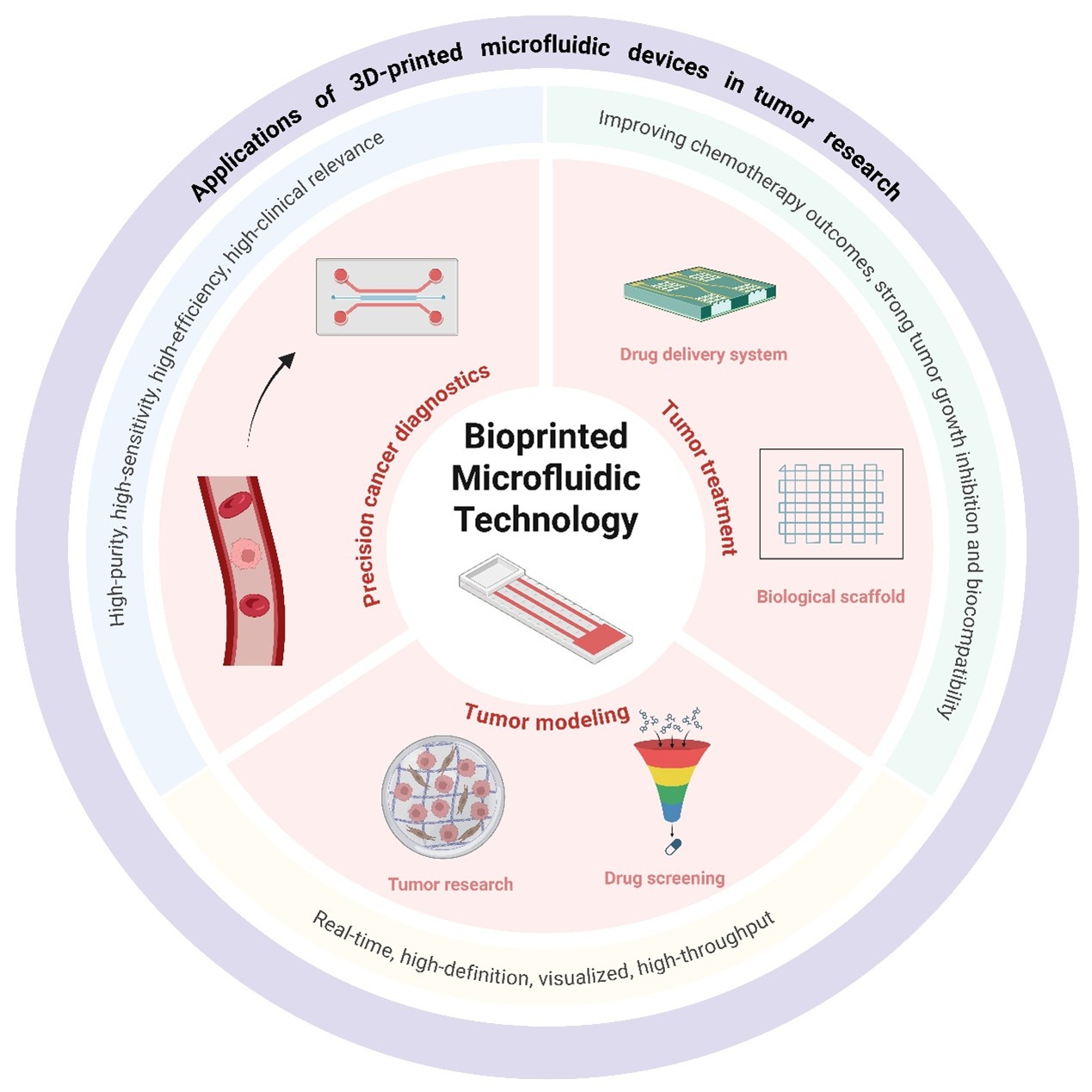
Conventional tumor models have historically failed to fully recapitulate the intricate pathophysiological complexity and dynamic microenvironment of human malignancies, significantly limiting their translational potential. The recent convergence of microfluidic technology and 3D bioprinting has ushered in a paradigm shift in oncology research, enabling more physiologically relevant models. This review provides a comprehensive analysis of the limitations inherent in traditional tumor modeling platforms and elaborates on the fundamental principles underlying microfluidics and additive manufacturing. It systematically explores the integrated applications of 3D-bioprinting–microfluidics systems across three core domains: engineering pathomimetic tumor models, advancing therapeutic screening platforms, and developing high-sensitivity diagnostic tools. This interdisciplinary synergy allows for unprecedented spatiotemporal control over the tumor microenvironment, precise biochemical gradient formation, and seamless integration of functional biosensors. The review further discusses persistent challenges—such as material biocompatibility, fabrication scalability, and the need for standardized validation—and proposes future directions—including the development of multiorgan-on-chip systems, stimuli-responsive biomaterials, and artificial intelligence-enhanced analytical frameworks. The continued integration of 3D bioprinting and microfluidics holds transformative potential for accelerating precision oncology and improving clinical outcomes.
- Day CP, Merlino G, Van Dyke T. Preclinical mouse cancer models: a maze of opportunities and challenges. Cell. 2015;163(1):39-53. doi: 10.1016/j.cell.2015.08.068
- Kim JW, Ho WJ, Wu BM. The role of the 3D environment in hypoxia-induced drug and apoptosis resistance. Anticancer Res. 2011;31(10):3237-3245.
- Loessner D, Stok KS, Lutolf MP, Hutmacher DW, Clements JA, Rizzi SC. Bioengineered 3D platform to explore cell– ECM interactions and drug resistance of epithelial ovarian cancer cells. Biomaterials. 2010;31(32):8494-8506. doi: 10.1016/j.biomaterials.2010.07.064
- Katt ME, Placone AL, Wong AD, Xu ZS, Searson PC. In vitro tumor models: advantages, disadvantages, variables, and selecting the right platform. Front Bioeng Biotechnol. 2016;4:12. doi: 10.3389/fbioe.2016.00012
- Trujillo-de Santiago G, Flores-Garza BG, Tavares-Negrete JA, et al. The tumor-on-chip: recent advances in the development of microfluidic systems to recapitulate the physiology of solid tumors. Materials. 2019;12(18):2945. doi: 10.3390/ma12182945
- Winters IP, Murray CW, Winslow MM. Towards quantitative and multiplexed in vivo functional cancer genomics. Nat Rev Genet. 2018;19(12):741-755. doi: 10.1038/s41576-018-0053-7
- Yoshida GJ. Applications of patient-derived tumor xenograft models and tumor organoids. J Hematol Oncol. 2020; 13(1):4. doi: 10.1186/s13045-019-0829-z
- Abdolahi S, Ghazvinian Z, Muhammadnejad S, Saleh M, Asadzadeh Aghdaei H, Baghaei K. Patient-derived xenograft (PDX) models, applications and challenges in cancer research. J Transl Med. 2022;20(1):206. doi: 10.1186/s12967-022-03405-8
- James Kirkpatrick C, Fuchs S, Iris Hermanns M, Peters K, Unger RE. Cell culture models of higher complexity in tissue engineering and regenerative medicine. Biomaterials. 2007;28(34):5193-5198. doi: 10.1016/j.biomaterials.2007.08.012
- Nolan J, Pearce OMT, Screen HRC, Knight MM, Verbruggen SW. Organ-on-a-chip and microfluidic platforms for oncology in the UK. Cancers. 2023;15(3):635. doi: 10.3390/cancers15030635
- Li Z, Li Q, Zhou C, et al. Organoid-on-a-chip: current challenges, trends, and future scope toward medicine. Biomicrofluidics. 2023;17(5):51505. doi: 10.1063/5.0171350
- Drost J, Clevers H. Organoids in cancer research. Nat Rev Cancer. 2018;18(7):407-418. doi: 10.1038/s41568-018-0007-6
- Xu R, Zhou X, Wang S, Trinkle C. Tumor organoid models in precision medicine and investigating cancer-stromal interactions. Pharmacol Ther. 2021;218:107668. doi: 10.1016/j.pharmthera.2020.107668
- Quintard C, Tubbs E, Jonsson G, et al. A microfluidic platform integrating functional vascularized organoids-on-chip. Nat Commun. 2024;15(1):1452. doi: 10.1038/s41467-024-45710-4
- Yu F, Hunziker W, Choudhury D. Engineering microfluidic organoid-on-a-chip platforms. Micromachines. 2019;10(3):165. doi: 10.3390/mi10030165
- Zhang J, Tavakoli H, Ma L, Li X, Han L, Li X. Immunotherapy discovery on tumor organoid-on-a-chip platforms that recapitulate the tumor microenvironment. Adv Drug Deliv Rev. 2022;187:114365. doi: 10.1016/j.addr.2022.114365
- Li C, Holman JB, Shi Z, Qiu B, Ding W. On-chip modeling of tumor evolution: advances, challenges and opportunities. Mater Today Bio. 2023;21:100724. doi: 10.1016/j.mtbio.2023.100724
- Shirure VS, Hughes CCW, George SC. Engineering vascularized organoid-on-a-chip models. Annu Rev Biomed Eng. 2021;23:141-167. doi: 10.1146/annurev-bioeng-090120-094330
- Zou Z, Lin Z, Wu C, et al. Micro-engineered organoid-on-a-chip based on mesenchymal stromal cells to predict immunotherapy responses of HCC patients. Adv Sci (Weinh). 2023;10(27):e2302640. doi: 10.1002/advs.202302640
- Du Y, Wang YR, Bao QY, et al. Personalized vascularized tumor organoid-on-a-chip for tumor metastasis and therapeutic targeting assessment. Adv Mater. 2025;37(6):e2412815. doi: 10.1002/adma.202412815
- Ayuso JM, Rehman S, Virumbrales-Munoz M, et al. Microfluidic tumor-on-a-chip model to evaluate the role of tumor environmental stress on NK cell exhaustion. Sci Adv. 2021;7(8):eabc2331. doi: 10.1126/sciadv.abc2331
- Gil JF, Moura CS, Silverio V, Gonçalves G, Santos HA. Cancer models on chip: paving the way to large-scale trial applications. Adv Mater. 2023;35(35):e2300692. doi: 10.1002/adma.202300692
- Ju M, Jin Z, Yu X, et al. Gastric cancer models developed via GelMA 3D bioprinting accurately mimic cancer hallmarks, tumor microenvironment features, and drug responses. Small. 2025;21(8):e2409321. doi: 10.1002/smll.202409321
- R N, Aggarwal A, Sravani AB, Mallya P, Lewis S. Organ-on-a-chip: an emerging research platform. Organogenesis. 2023;19(1):2278236. doi: 10.1080/15476278.2023.2278236
- Ko J, Park D, Lee S, Gumuscu B, Jeon NL. Engineering organ-on-a-chip to accelerate translational research. Micromachines. 2022;13(8):1200. doi: 10.3390/mi13081200
- Kimura H, Sakai Y, Fujii T. Organ/body-on-a-chip based on microfluidic technology for drug discovery. Drug Metab Pharmacokinet. 2018;33(1):43-48. doi: 10.1016/j.dmpk.2017.11.003
- Mehta G, Hsiao AY, Ingram M, Luker GD, Takayama S. Opportunities and challenges for use of tumor spheroids as models to test drug delivery and efficacy. J Control Release. 2012;164(2):192-204. doi: 10.1016/j.jconrel.2012.04.045
- El Harane S, Zidi B, El Harane N, Krause KH, Matthes T, Preynat-Seauve O. Cancer spheroids and organoids as novel tools for research and therapy: state of the art and challenges to guide precision medicine. Cells. 2023;12(7):1001. doi: 10.3390/cells12071001
- Li W, Zhou Z, Zhou X, et al. 3D biomimetic models to reconstitute tumor microenvironment In vitro: spheroids, organoids, and tumor-on-a-chip. Adv Healthc Mater. 2023;12(18):e2202609. doi: 10.1002/adhm.202202609
- Mehta V, Vilikkathala Sudhakaran S, Nellore V, Madduri S, Rath SN. 3D stem-like spheroids-on-a-chip for personalized combinatorial drug testing in oral cancer. J Nanobiotechnology. 2024;22(1):344. doi: 10.1186/s12951-024-02625-y
- Nayak P, Bentivoglio V, Varani M, Signore A. Three-dimensional in vitro tumor spheroid models for evaluation of anticancer therapy: recent updates. Cancers. 2023;15(19):4846. doi: 10.3390/cancers15194846
- Torisawa YS, Takagi A, Shiku H, Yasukawa T, Matsue T. A multicellular spheroid-based drug sensitivity test by scanning electrochemical microscopy. Oncol Rep. 2005;13(6):1107-1112. doi: 10.3892/or.13.6.1107
- Kelm JM, Fussenegger M. Microscale tissue engineering using gravity-enforced cell assembly. Trends Biotechnol. 2004;22(4):195-202. doi: 10.1016/j.tibtech.2004.02.002
- Banerjee D, Singh YP, Datta P, et al. Strategies for 3D bioprinting of spheroids: a comprehensive review. Biomaterials. 2022;291:121881. doi: 10.1016/j.biomaterials.2022.121881
- O’Neill PF, Ben Azouz A, Vázquez M, et al. Advances in three-dimensional rapid prototyping of microfluidic devices for biological applications. Biomicrofluidics. 2014;8(5): 52112. doi: 10.1063/1.4898632
- Gallegos-Martínez S, Choy-Buentello D, Pérez-Álvarez KA, et al. A 3D-printed tumor-on-chip: user-friendly platform for the culture of breast cancer spheroids and the evaluation of anti-cancer drugs. Biofabrication. 2024;16(4). doi: 10.1088/1758-5090/ad5765
- Auricchio F. The magic world of 3D printing. In: 2017 IEEE MTT-S International Microwave Workshop Series on Advanced Materials and Processes for RF and Thz Applications (IMWS-AMP). 2017:1-1. doi: 10.1109/IMWS-AMP.2017.8247328
- Dong T, Hu J, Dong Y, et al. Advanced biomedical and electronic dual-function skin patch created through microfluidic-regulated 3D bioprinting. Bioact Mater. 2024;40:261-274. doi: 10.1016/j.bioactmat.2024.06.015
- Joseph A, Rajendran A, Karthikeyan A, Nair BG. Implantable microfluidic device: an epoch of technology. Curr Pharm Des. 2022;28(9):679-689. doi: 10.2174/1381612827666210825114403
- Whitesides GM. The origins and the future of microfluidics. Nature. 2006;442(7101):368-373. doi: 10.1038/nature05058
- Sackmann EK, Fulton AL, Beebe DJ. The present and future role of microfluidics in biomedical research. Nature. 2014;507(7491):181-189. doi: 10.1038/nature13118
- Tien J, Dance YW. Microfluidic biomaterials. Adv Healthc Mater. 2021;10(4):e2001028. doi: 10.1002/adhm.202001028
- Bischel LL, Lee SH, Beebe DJ. A practical method for patterning lumens through ECM hydrogels via viscous finger patterning. J Lab Autom. 2012;17(2):96. doi: 10.1177/2211068211426694
- Zhang AP, Qu X, Soman P, et al. Rapid fabrication of complex 3D extracellular microenvironments by dynamic optical projection stereolithography. Adv Mater. 2012;24(31):4266-4270. doi: 10.1002/adma.201202024
- Wu W, DeConinck A, Lewis JA. Omnidirectional printing of 3D microvascular networks. Adv Mater. 2011;23(24):H178-183. doi: 10.1002/adma.201004625
- Gong L, Cretella A, Lin Y. Microfluidic systems for particle capture and release: a review. Biosens Bioelectron. 2023;236:115426. doi: 10.1016/j.bios.2023.115426
- Gharib G, Bütün İ, Muganlı Z, et al. Biomedical applications of microfluidic devices: a review. Biosensors. 2022;12(11):1023. doi: 10.3390/bios12111023
- Waheed S, Cabot JM, Macdonald NP, et al. 3D printed microfluidic devices: enablers and barriers. Lab Chip. 2016;16(11):1993-2013. doi: 10.1039/c6lc00284f
- Zhang N, Wang Z, Zhao Z, et al. 3D printing of micro-nano devices and their applications. Microsyst Nanoeng. 2025;11(1):35. doi: 10.1038/s41378-024-00812-3
- Logunov L, Ulesov A, Khramenkova V, et al. 3D and inkjet printing by colored mie-resonant silicon nanoparticles produced by laser ablation in liquid. Nanomaterials. 2023;13(6):965. doi: 10.3390/nano13060965
- Sagot M, Derkenne T, Giunchi P, et al. Functionality integration in stereolithography 3D printed microfluidics using a “print-pause-print” strategy. Lab Chip. 2024;24(14):3508-3520. doi: 10.1039/D4LC00147H
- Su R, Wang F, McAlpine MC. 3D printed microfluidics: advances in strategies, integration, and applications. Lab Chip. 2023;23(5):1279-1299. doi: 10.1039/D2LC01177H
- Groll J, Burdick JA, Cho DW, et al. A definition of bioinks and their distinction from biomaterial inks. Biofabrication. 2018;11(1):13001. doi: 10.1088/1758-5090/aaec52
- Coates IA, Pan W, Saccone MA, et al. High-resolution stereolithography: negative spaces enabled by control of fluid mechanics. Proc Natl Acad Sci U S A. 2024;121(37):e2405382121. doi: 10.1073/pnas.2405382121
- Randhawa A, Dutta SD, Ganguly K, Patel DK, Patil TV, Lim KT. Recent advances in 3D printing of photocurable polymers: types, mechanism, and tissue engineering application. Macromol Biosci. 2023;23(1):e2200278. doi: 10.1002/mabi.202200278
- Shahrubudin N, Koshy P, Alipal J, Kadir MHA, Lee TC. Challenges of 3D printing technology for manufacturing biomedical products: a case study of Malaysian manufacturing firms. Heliyon. 2020;6(4):e03734. doi: 10.1016/j.heliyon.2020.e03734
- Naderi A, Bhattacharjee N, Folch A. Digital manufacturing for microfluidics. Annu Rev Biomed Eng. 2019;21:325-364. doi: 10.1146/annurev-bioeng-092618-020341
- Karamzadeh V, Sohrabi-Kashani A, Shen M, Juncker D. Digital manufacturing of functional ready-to-use microfluidic systems. Adv Mater. 2023;35(47):2303867. doi: 10.1002/adma.202303867
- Shafique H, Karamzadeh V, Kim G, et al. High-resolution low-cost LCD 3D printing for microfluidics and organ-on-a-chip devices. Lab Chip. 2024;24(10):2774-2790. doi: 10.1039/D3LC01125A
- Steinberg E, Friedman R, Goldstein Y, et al. A fully 3D-printed versatile tumor-on-a-chip allows multi-drug screening and correlation with clinical outcomes for personalized medicine. Commun Biol. 2023;6(1):1-14. doi: 10.1038/s42003-023-05531-5
- Ong LJY, Islam A, DasGupta R, Iyer NG, Leo HL, Toh YC. A 3D printed microfluidic perfusion device for multicellular spheroid cultures. Biofabrication. 2017;9(4):045005. doi: 10.1088/1758-5090/aa8858
- Chen J, Liu CY, Wang X, et al. 3D printed microfluidic devices for circulating tumor cells (CTCs) isolation. Biosens Bioelectron. 2020;150:111900. doi: 10.1016/j.bios.2019.111900
- Wang S, Chen X, Han X, et al. A review of 3D printing technology in pharmaceutics: technology and applications, now and future. Pharmaceutics. 2023;15(2):416. doi: 10.3390/pharmaceutics15020416
- Han C, Zhang R, He X, et al. A digital manufactured microfluidic platform for flexible construction of 3D co-culture tumor model with spatiotemporal resolution. Biofabrication. 2024;17(1). doi: 10.1088/1758-5090/ad9636
- Moghimi N, Hosseini SA, Dalan AB, Mohammadrezaei D, Goldman A, Kohandel M. Controlled tumor heterogeneity in a co-culture system by 3D bio-printed tumor-on-chip model. Sci Rep. 2023;13:13648. doi: 10.1038/s41598-023-40680-x
- Schuster B, Junkin M, Kashaf SS, et al. Automated microfluidic platform for dynamic and combinatorial drug screening of tumor organoids. Nat Commun. 2020;11(1):5271. doi: 10.1038/s41467-020-19058-4
- Prince E, Kheiri S, Wang Y, et al. Microfluidic arrays of breast tumor spheroids for drug screening and personalized cancer therapies. Adv Healthc Mater. 2022;11(1):e2101085. doi: 10.1002/adhm.202101085
- Ayuso JM, Gong MM, Skala MC, Harari PM, Beebe DJ. Human tumor-lymphatic microfluidic model reveals differential conditioning of lymphatic vessels by breast cancer cells. Adv Healthc Mater. 2020;9(3):1900925. doi: 10.1002/adhm.201900925
- Mehta P, Rahman Z, Ten Dijke P, Boukany PE. Microfluidics meets 3D cancer cell migration. Trends Cancer. 2022;8(8):683-697. doi: 10.1016/j.trecan.2022.03.006
- Morshed A, Dutta P. Hypoxic behavior in cells under controlled microfluidic environment. Biochim Biophys Acta Gen Subj. 2017;1861(4):759-771. doi: 10.1016/j.bbagen.2017.01.017
- Ao Z, Cai H, Wu Z, et al. Evaluation of cancer immunotherapy using mini-tumor chips. Theranostics. 2022;12(8):3628-3636. doi: 10.7150/thno.71761
- Ruzycka M, Cimpan MR, Rios-Mondragon I, Grudzinski IP. Microfluidics for studying metastatic patterns of lung cancer. J Nanobiotechnology. 2019;17(1):71. doi: 10.1186/s12951-019-0492-0
- Behroodi E, Latifi H, Bagheri Z, Ermis E, Roshani S, Salehi Moghaddam M. A combined 3D printing/ CNC micro-milling method to fabricate a large-scale microfluidic device with the small size 3D architectures: an application for tumor spheroid production. Sci Rep. 2020; 10(1):22171. doi: 10.1038/s41598-020-79015-5
- Silvani G, Bradbury P, Basirun C, et al. Testing 3D printed biological platform for advancing simulated microgravity and space mechanobiology research. NPJ Microgravity. 2022;8(1):19. doi: 10.1038/s41526-022-00207-6
- Jubelin C, Muñoz-Garcia J, Griscom L, et al. Three-dimensional in vitro culture models in oncology research. Cell Biosci. 2022;12(1):155. doi: 10.1186/s13578-022-00887-3
- Vitale S, Calapà F, Colonna F, et al. Advancements in 3D in vitro models for colorectal cancer. Adv Sci. 2024;11(32):2405084. doi: 10.1002/advs.202405084
- Yi HG. Introduction to bioprinting of in vitro cancer models. Essays Biochem. 2021;65(3):603-610. doi: 10.1042/EBC20200104
- Yang R, Zhan M, Shen S, et al. Microfluidic synthesis of carrier-free full-active metal-phenolic nanocapsules for tumor chemo-chemodynamic-immune therapy. Adv Funct Mater. 2025;35(11):2417070. doi: 10.1002/adfm.202417070
- Sontheimer-Phelps A, Hassell BA, Ingber DE. Modelling cancer in microfluidic human organs-on-chips. Nat Rev Cancer. 2019;19(2):65-81. doi: 10.1038/s41568-018-0104-6
- Yang R, Ouyang Z, Guo H, et al. Microfluidic synthesis of intelligent nanoclusters of ultrasmall iron oxide nanoparticles with improved tumor microenvironment regulation for dynamic MR imaging-guided tumor photothermo-chemo-chemodynamic therapy. Nano Today. 2022; 46:101615. doi: 10.1016/j.nantod.2022.101615
- Oh HJ, Kim J, Kim H, Choi N, Chung S. Microfluidic reconstitution of tumor microenvironment for nanomedical applications. Adv Healthc Mater. 2021;10(9): 2002122. doi: 10.1002/adhm.202002122
- Lim W, Park S. A microfluidic spheroid culture device with a concentration gradient generator for high-throughput screening of drug efficacy. Molecules. 2018;23(12):3355. doi: 10.3390/molecules23123355
- Komar ZM, van Gent DC, Chakrabarty S. Establishing a microfluidic tumor slice culture platform to study drug response. Curr Protoc. 2023;3(3):e693. doi: 10.1002/cpz1.693
- Du Z, Mi S, Yi X, Xu Y, Sun W. Microfluidic system for modelling 3D tumour invasion into surrounding stroma and drug screening. Biofabrication. 2018;10(3):034102. doi: 10.1088/1758-5090/aac70c
- Pavesi A, Tan AT, Chen MB, Adriani G, Bertoletti A, Kamm RD. Using microfluidics to investigate tumor cell extravasation and T-cell immunotherapies. In: 2015 37th Annual International Conference of the IEEE Engineering in Medicine and Biology Society (EMBC). 2015: 1853-1856. doi: 10.1109/EMBC.2015.7318742
- Sano E, Deguchi S, Matsuoka N, et al. Generation of tetrafluoroethylene-propylene elastomer-based microfluidic devices for drug toxicity and metabolism studies. ACS Omega. 2021;6(38):24859-24865. doi: 10.1021/acsomega.1c03719
- Rahimifard M, Bagheri Z, Hadjighassem M, et al. Investigation of anti-cancer effects of new pyrazino[1,2-a] benzimidazole derivatives on human glioblastoma cells through 2D in vitro model and 3D-printed microfluidic device. Life Sci. 2022;302:120505. doi: 10.1016/j.lfs.2022.120505
- Li Y, Zhang T, Pang Y, Li L, Chen ZN, Sun W. 3D bioprinting of hepatoma cells and application with microfluidics for pharmacodynamic test of Metuzumab. Biofabrication. 2019;11(3):034102. doi: 10.1088/1758-5090/ab256c
- Moroni L, Boland T, Burdick JA, et al. Biofabrication: a guide to technology and terminology. Trends Biotechnol. 2018;36(4):384-402. doi: 10.1016/j.tibtech.2017.10.015
- Benien P, Swami A. 3D tumor models: history, advances and future perspectives. Future Oncol. 2014;10(7): 1311-1327. doi: 10.2217/fon.13.274
- Jaiswal C, Dey S, Prasad J, Gupta R, Agarwala M, Mandal BB. 3D bioprinted microfluidic based osteosarcoma-on-a chip model as a physiomimetic pre-clinical drug testing platform for anti-cancer drugs. Biomaterials. 2025;320:123267. doi: 10.1016/j.biomaterials.2025.123267
- Xie H, Appelt JW, Jenkins RW. Going with the flow: modeling the tumor microenvironment using microfluidic technology. Cancers. 2021;13(23):6052. doi: 10.3390/cancers13236052
- Gunti S, Hoke ATK, Vu KP, London NR. Organoid and spheroid tumor models: techniques and applications. Cancers. 2021;13(4):874. doi: 10.3390/cancers13040874
- Swartz MA, Iida N, Roberts EW, et al. Tumor microenvironment complexity: emerging roles in cancer therapy. Cancer Res. 2012;72(10):2473-2480. doi: 10.1158/0008-5472.CAN-12-0122
- Han J, Jeong HJ, Choi J, et al. Bioprinted patient-derived organoid arrays capture intrinsic and extrinsic tumor features for advanced personalized medicine. Adv Sci (Weinh). 2025;12(20):e2407871. doi: 10.1002/advs.202407871
- Xu K, Huang Y, Wu M, Yin J, Wei P. 3D bioprinting of multi-cellular tumor microenvironment for prostate cancer metastasis. Biofabrication. 2023;15(3). doi: 10.1088/1758-5090/acd960
- Xiong Q, Liu T, Ying Y, et al. Establishment of bladder cancer spheroids and cultured in microfluidic platform for predicting drug response. Bioeng Transl Med. 2024;9(2):e10624. doi: 10.1002/btm2.10624
- Skubal M, Larney BM, Phung NB, et al. Vascularized tumor on a microfluidic chip to study mechanisms promoting tumor neovascularization and vascular targeted therapies. Theranostics. 2025;15(3):766-783. doi: 10.7150/thno.95334
- G P, Singh M, Gupta PK, Shukla R. Synergy of microfluidics and nanomaterials: a revolutionary approach for cancer management. ACS Appl Bio Mater. 2025;8(4):2716-2734. doi: 10.1021/acsabm.5c00123
- Goel HL, Mercurio AM. VEGF targets the tumour cell. Nat Rev Cancer. 2013;13(12):871-882. doi: 10.1038/nrc3627
- Abdalla AME, Xiao L, Ullah MW, Yu M, Ouyang C, Yang G. Current challenges of cancer anti-angiogenic therapy and the promise of nanotherapeutics. Theranostics. 2018;8(2):533-548. doi: 10.7150/thno.21674
- Chen X, Qian H, Qiao H, et al. Tumor-adhesive and pH-degradable microgels by microfluidics and photo-cross-linking for efficient antiangiogenesis and enhanced cancer chemotherapy. Biomacromolecules. 2020;21(3):1285-1294. doi: 10.1021/acs.biomac.0c00049
- Huang K, He Y, Zhu Z, et al. Small, traceable, endosome-disrupting, and bioresponsive click nanogels fabricated via microfluidics for CD44-targeted cytoplasmic delivery of therapeutic proteins. ACS Appl Mater Interfaces. 2019;11(25):22171-22180. doi: 10.1021/acsami.9b05827
- Arduino I, Di Fonte R, Sommonte F, et al. Fabrication of biomimetic hybrid liposomes via microfluidic technology: homotypic targeting and antitumor efficacy studies in glioma cells. Int J Nanomedicine. 2024;19:13217-13233. doi: 10.2147/IJN.S489872
- Wei W, Sun J, Guo XY, et al. Microfluidic-based holonomic constraints of siRNA in the kernel of lipid/polymer hybrid nanoassemblies for improving stable and safe in vivo delivery. ACS Appl Mater Interfaces. 2020;12(13):14839-14854. doi: 10.1021/acsami.9b22781
- Balachandran YL, Li X, Jiang X. Integrated microfluidic synthesis of aptamer functionalized biozeolitic imidazolate framework (BioZIF-8) targeting lymph node and tumor. Nano Lett. 2021;21(3):1335-1344. doi: 10.1021/acs.nanolett.0c04053
- Yan J, Xu X, Zhou J, et al. Fabrication of a pH/redox-triggered mesoporous silica-based nanoparticle with microfluidics for anticancer drugs doxorubicin and paclitaxel codelivery. ACS Appl Bio Mater. 2020;3(2):1216-1225. doi: 10.1021/acsabm.9b01111
- Han X, Zhang G, Wu X, et al. Microfluidics-enabled fluorinated assembly of EGCG-ligands-siTOX nanoparticles for synergetic tumor cells and exhausted t cells regulation in cancer immunotherapy. J Nanobiotechnology. 2024;22(1):90. doi: 10.1186/s12951-024-02328-4
- Zhang Q, Wang X, Kuang G, Yu Y, Zhao Y. Photopolymerized 3D printing scaffolds with Pt(IV) prodrug initiator for postsurgical tumor treatment. Research (Wash DC). 2022;2022:9784510. doi: 10.34133/2022/9784510
- Li J, Zhu T, Jiang Y, Zhang Q, Zu Y, Shen X. Microfluidic printed 3D bioactive scaffolds for postoperative treatment of gastric cancer. Mater Today Bio. 2024;24:100911. doi: 10.1016/j.mtbio.2023.100911
- Xu Y, Zhu S, Xia C, et al. Liquid biopsy-based multi-cancer early detection: an exploration road from evidence to implementation. Sci Bull. 2025;70(17):2852-2867. doi: 10.1016/j.scib.2025.06.030
- Sun H, Yao X, Jiao Y, et al. DNA remnants in red blood cells enable early detection of cancer. Cell Res. 2025;35(8): 568-587. doi: 10.1038/s41422-025-01122-7
- Abusara OH, Agha ASAA, Bardaweel SK. Advancements and innovations in liquid biopsy through microfluidic technology for cancer diagnosis. Analyst. 2025;150(9):1711-1725. doi: 10.1039/d5an00105f
- Xie Y, Xu X, Wang J, Lin J, Ren Y, Wu A. Latest advances and perspectives of liquid biopsy for cancer diagnostics driven by microfluidic on-chip assays. Lab Chip. 2023;23(13):2922-2941. doi: 10.1039/d2lc00837h
- Marassi V, Giordani S, Placci A, et al. Emerging microfluidic tools for simultaneous exosomes and cargo biosensing in liquid biopsy: new integrated miniaturized FFF-assisted approach for colon cancer diagnosis. Sensors. 2023;23(23):9432. doi: 10.3390/s23239432
- Asleh K, Dery V, Taylor C, Davey M, Djeungoue-Petga MA, Ouellette RJ. Extracellular vesicle-based liquid biopsy biomarkers and their application in precision immuno-oncology. Biomark Res. 2023;11(1):99. doi: 10.1186/s40364-023-00540-2
- Hou Y, Lin J, Yao H, Wu Z, Lin Y, Lin JM. Linking metastatic behavior and metabolic heterogeneity of circulating tumor cells at single-cell level using an integrative microfluidic system. Adv Sci (Weinh). 2025;12(14):e2413978. doi: 10.1002/advs.202413978
- Sollier E, Go DE, Che J, et al. Size-selective collection of circulating tumor cells using Vortex technology. Lab Chip. 2013;14(1):63-77. doi: 10.1039/C3LC50689D
- Fachin F, Spuhler P, Martel-Foley JM, et al. Monolithic chip for high-throughput blood cell depletion to sort rare circulating tumor cells. Sci Rep. 2017;7(1):10936. doi: 10.1038/s41598-017-11119-x
- Stiefel J, Freese C, Sriram A, et al. Characterization of a novel microfluidic platform for the isolation of rare single cells to enable CTC analysis from head and neck squamous cell carcinoma patients. Eng Life Sci. 2022; 22(5):391-406. doi: 10.1002/elsc.202100133
- Tan SJ, Yobas L, Lee GYH, Ong CN, Lim CT. Microdevice for the isolation and enumeration of cancer cells from blood. Biomed Microdevices. 2009;11(4):883-892. doi: 10.1007/s10544-009-9305-9
- Wang S, Liu K, Liu J, et al. Highly efficient capture of circulating tumor cells using nanostructured silicon substrates with integrated chaotic micromixers. Angew Chem Int Ed Engl. 2011;50(13):3084-3088. doi: 10.1002/anie.201005853
- Wang S, Wang H, Jiao J, et al. Three-dimensional nanostructured substrates toward efficient capture of circulating tumor cells. Angew Chem Int Ed Engl. 2009;48(47):8970-8973. doi: 10.1002/anie.200901668
- Cohen EN, Jayachandran G, Hardy MR, Venkata Subramanian AM, Meng X, Reuben JM. Antigen-agnostic microfluidics-based circulating tumor cell enrichment and downstream molecular characterization. PLoS One. 2020;15(10):e0241123. doi: 10.1371/journal.pone.0241123
- Leitão TP, Corredeira P, Kucharczak S, et al. Clinical validation of a size-based microfluidic device for circulating tumor cell isolation and analysis in renal cell carcinoma. Int J Mol Sci. 2023;24(9):8404. doi: 10.3390/ijms24098404
- Law KS, Huang CE, Chen SW. Detection of circulating tumor cell-related markers in gynecologic cancer using microfluidic devices: a pilot study. Int J Mol Sci. 2023;24(3):2300. doi: 10.3390/ijms24032300
- Ayuso JM, Virumbrales-Muñoz M, Lang JM, Beebe DJ. A role for microfluidic systems in precision medicine. Nat Commun. 2022;13:3086. doi: 10.1038/s41467-022-30384-7
- Xu J, Wan R, Cai Y, et al. Circulating tumor DNA-based stratification strategy for chemotherapy plus PD-1 inhibitor in advanced non-small-cell lung cancer. Cancer Cell. 2024;42(9):1598-1613.e4. doi: 10.1016/j.ccell.2024.08.013
- Jamshidi A, Liu MC, Klein EA, et al. Evaluation of cell-free DNA approaches for multi-cancer early detection. Cancer Cell. 2022;40(12):1537-1549.e12. doi: 10.1016/j.ccell.2022.10.022
- Pantel K, Alix-Panabières C. Liquid biopsy and minimal residual disease — latest advances and implications for cure. Nat Rev Clin Oncol. 2019;16(7): 409-424. doi: 10.1038/s41571-019-0187-3
- Chen H, Zhou Q. Detecting liquid remnants of solid tumors treated with curative intent: circulating tumor DNA as a biomarker of minimal residual disease (review). Oncol Rep. 2023;49(5):1-13. doi: 10.3892/or.2023.8543
- Gauri S, Ahmad MR. ctDNA detection in microfluidic platform: a promising biomarker for personalized cancer chemotherapy. J Sens. 2020;2020(1):8353674. doi: 10.1155/2020/8353674
- Wan JCM, Massie C, Garcia-Corbacho J, et al. Liquid biopsies come of age: towards implementation of circulating tumour DNA. Nat Rev Cancer. 2017;17(4):223-238. doi: 10.1038/nrc.2017.7
- Pekin D, Skhiri Y, Baret JC, et al. Quantitative and sensitive detection of rare mutations using droplet-based microfluidics. Lab Chip. 2011;11(13):2156-2166. doi: 10.1039/C1LC20128J
- He M, Crow J, Roth M, Zeng Y, Godwin AK. Integrated immunoisolation and protein analysis of circulating exosomes using microfluidic technology. Lab Chip. 2014;14(19):3773-3780. doi: 10.1039/C4LC00662C
- Das J, Ivanov I, Sargent EH, Kelley SO. DNA clutch probes for circulating tumor DNA analysis. J Am Chem Soc. 2016;138(34):11009-11016. doi: 10.1021/jacs.6b05679
- Im YR, Tsui DWY, Diaz LA, Wan JCM. Next-generation liquid biopsies: embracing data science in oncology. Trends Cancer. 2021;7(4):283-292. doi: 10.1016/j.trecan.2020.11.001
- Simpson RJ, Lim JW, Moritz RL, Mathivanan S. Exosomes: proteomic insights and diagnostic potential. Expert Rev Proteomics. 2009;6(3):267-283. doi: 10.1586/epr.09.17
- Wang Y, Wang S, Li L, Zou Y, Liu B, Fang X. Microfluidics-based molecular profiling of tumor-derived exosomes for liquid biopsy. View. 2023;4(2):20220048. doi: 10.1002/VIW.20220048
- Reátegui E, van der Vos KE, Lai CP, et al. Engineered nanointerfaces for microfluidic isolation and molecular profiling of tumor-specific extracellular vesicles. Nat Commun. 2018;9(1):175. doi: 10.1038/s41467-017-02261-1
- Dorayappan KDP, Gardner ML, Hisey CL, et al. A microfluidic chip enables isolation of exosomes and establishment of their protein profiles and associated signaling pathways in ovarian cancer. Cancer Res. 2019;79(13):3503-3513. doi: 10.1158/0008-5472.CAN-18-3538
- Barbosa AI, Reis NM. A critical insight into the development pipeline of microfluidic immunoassay devices for the sensitive quantitation of protein biomarkers at the point of care. Analyst. 2017;142(6):858-882. doi: 10.1039/C6AN02445A
- Emde B, Niehaus K, Tickenbrock L. Evaluation of 3D-printed microfluidic structures for use in AML-specific biomarker detection of PML::RARA. Int J Mol Sci. 2025; 26(2):497. doi: 10.3390/ijms26020497
- Sharafeldin M, Chen T, Ozkaya GU, et al. Detecting cancer metastasis and accompanying protein biomarkers at single cell levels using a 3D-printed microfluidic immunoarray. Biosens Bioelectron. 2021;171:112681. doi: 10.1016/j.bios.2020.112681
- Chen C, Ran B, Liu B, et al. Development of a novel microfluidic biosensing platform integrating micropillar array electrode and acoustic microstreaming techniques. Biosens Bioelectron. 2023;223:114703. doi: 10.1016/j.bios.2022.114703
- Lee D, Tran HQ, Sharma NS, et al. 3D-printed microfluidic platform for creating porous nanofibrous microspheres to regulate cell response and enhance tissue regeneration. Small. 2025:e2502033. doi: 10.1002/smll.202502033
- Nielsen AV, Beauchamp MJ, Nordin GP, Woolley AT. 3D printed microfluidics. Annu Rev Anal Chem (Palo Alto Calif). 2020;13(1):45-65. doi: 10.1146/annurev-anchem-091619-102649
- Barbosa F, Coutinho P, Ribeiro MP, Moreira AF, Lourenço LM, Miguel SP. Advancements and challenges in SLA-based microfluidic devices for organ-on-chip applications. Mater Des. 2025;256:114254. doi: 10.1016/j.matdes.2025.114254
- Lui YS, Sow WT, Tan LP, Wu Y, Lai Y, Li H. 4D printing and stimuli-responsive materials in biomedical aspects. Acta Biomater. 2019;92:19-36. doi: 10.1016/j.actbio.2019.05.005
- Loo JFC, Ho AHP, Turner APF, Mak WC. Integrated printed microfluidic biosensors. Trends Biotechnol. 2019;37(10):1104-1120. doi: 10.1016/j.tibtech.2019.03.009
- Ding A, Tang F, Alsberg E. 4D printing: a comprehensive review of technologies, materials, stimuli, design, and emerging applications. Chem Rev. 2025;125(7):3663-3771. doi: 10.1021/acs.chemrev.4c00070
- Zhang C, Cai D, Liao P, et al. 4D printing of shape-memory polymeric scaffolds for adaptive biomedical implantation. Acta Biomater. 2021;122:101-110. doi: 10.1016/j.actbio.2020.12.042
- Gara DK, Gujjala R, Prasad PS, Madaboosi N, Ojha S. 4D bioprinting: a review on smart bio-adaptable technology to print stimuli-responsive materials. Prog Addit Manuf. 2024;10:4375-4417. doi: 10.1007/s40964-024-00876-7
- Kalogeropoulou M, Diaz-Payno PJ, Mirzaali MJ, van Osch GJVM, Fratila-Apachitei LE, Zadpoor AA. 4D printed shape-shifting biomaterials for tissue engineering and regenerative medicine applications. Biofabrication. 2024;16(2):22002. doi: 10.1088/1758-5090/ad1e6f
- Maidin S, Wee KJ, Sharum MA, Rajendran TK, Ali LM, Ismail S. A review on 4d additive manufacturing the applications, smart materials & effect of various stimuli on 4d printed objects. J Teknol Sci Eng. 2023;85(5): 63-71. doi: 10.11113/jurnalteknologi.v85.19889
- Lai J, Wang M. Developments of additive manufacturing and 5D printing in tissue engineering. J Mater Res. 2023;38(21):4692-4725. doi: 10.1557/s43578-023-01193-5
- Cheng YJ, Wu TH, Tseng YS, Chen WF. Development of hybrid 3D printing approach for fabrication of high-strength hydroxyapatite bioscaffold using FDM and DLP techniques. Biofabrication. 2024;16(2). doi: 10.1088/1758-5090/ad1b20
- Han X, Saiding Q, Cai X, et al. Intelligent vascularized 3D/4D/5D/6D-printed tissue scaffolds. Nano Micro Lett. 2023;15(1):239. doi: 10.1007/s40820-023-01187-2
- Peng S, Yan Y, Ogino K, Ma G, Xia Y. Spatiotemporal coordination of antigen presentation and co-stimulatory signal for enhanced anti-tumor vaccination. J Control Release. 2024;374:312-324. doi: 10.1016/j.jconrel.2024.08.025
- Boussommier-Calleja A, Li R, Chen MB, Wong SC, Kamm RD. Microfluidics: a new tool for modeling cancer-immune interactions. Trends Cancer. 2016;2(1):6-19. doi: 10.1016/j.trecan.2015.12.003
- Kolesky DB, Homan KA, Skylar-Scott MA, Lewis JA. Three-dimensional bioprinting of thick vascularized tissues. Proc Natl Acad Sci U S A. 2016;113(12):3179-3184. doi: 10.1073/pnas.1521342113
- Zielke C, Pan CW, Gutierrez Ramirez AJ, et al. Microfluidic platform for the isolation of cancer-cell subpopulations based on single-cell glycolysis. Anal Chem. 2020;92(10):6949-6957. doi: 10.1021/acs.analchem.9b05738
- Wang M, Xiao Y, Lin L, Zhu X, Du L, Shi X. A microfluidic chip integrated with hyaluronic acid-functionalized electrospun chitosan nanofibers for specific capture and nondestructive release of CD44-overexpressing circulating tumor cells. Bioconjug Chem. 2018;29(4):1081-1090. doi: 10.1021/acs.bioconjchem.7b00747