

AutoGen-Insight: Translating consumer reviews into probabilistic visual design parameters for generative electric vehicle concept generation

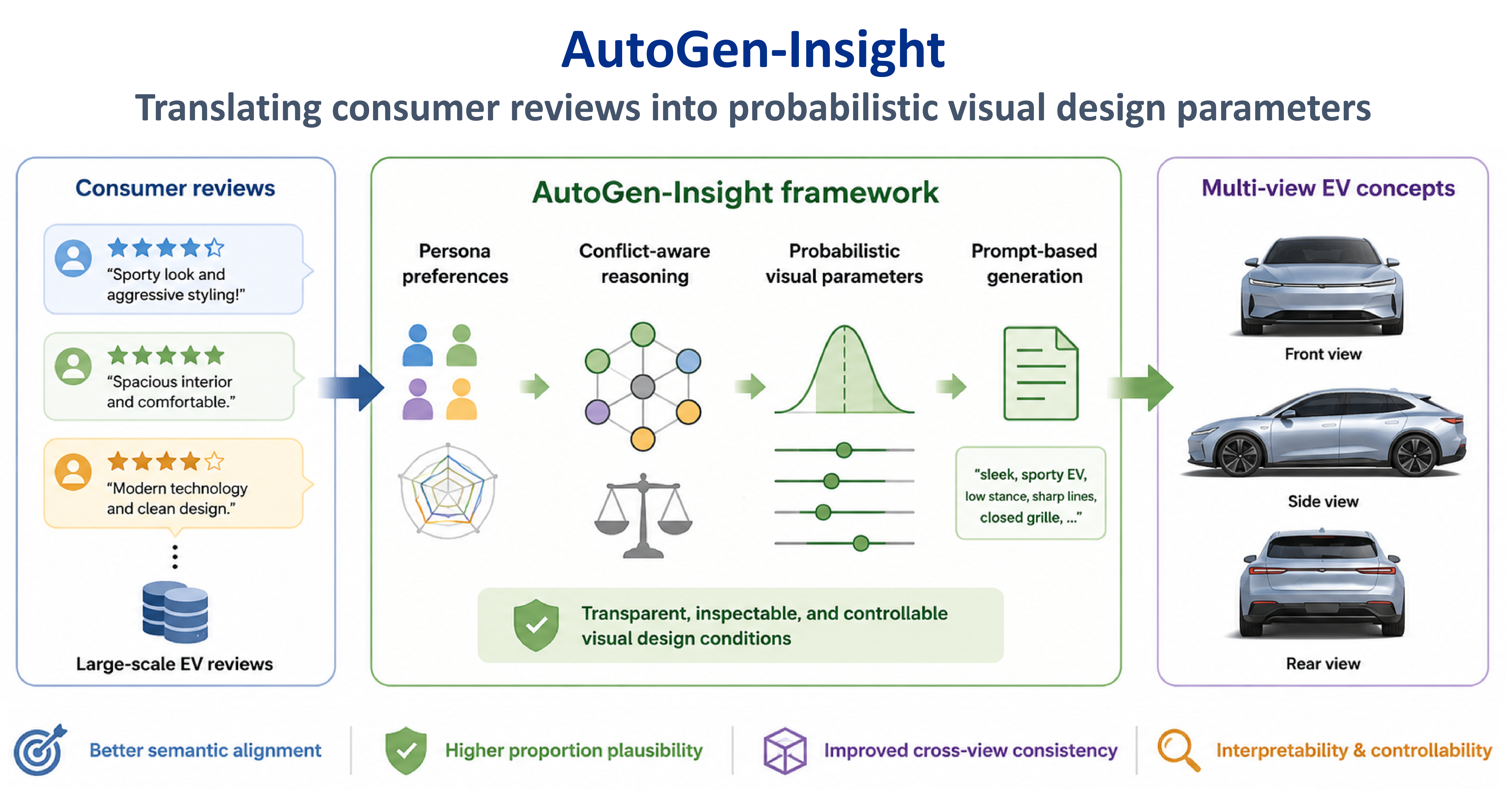
Large-scale consumer reviews provide a valuable but weakly structured source of market insight for early-stage automotive design. However, existing generative design workflows often rely on direct prompting or manual interpretation, making it difficult to translate heterogeneous consumer preferences into inspectable visual design conditions. This paper presents AutoGen-Insight, a probabilistic semantic-to-visual parameter mapping framework for consumer-driven electric vehicle concept generation. Building on a retained corpus of 14,153 high-confidence electric vehicle reviews, the proposed framework reorganizes consumer feedback into four representative persona-level semantic preference profiles. These profiles are further transformed into probabilistic design vectors that encode both central tendencies and uncertainty across visually observable exterior concept descriptors, including vehicle proportion, styling, color, lighting, wheel design, and surface-finish parameters. A conflict-aware reasoning module integrates knowledge graph traversal with parameter-level trade-off aggregation to handle competing perceptual requirements, such as sportiness, comfort, compactness, and spatial utility. The resulting probabilistic design vectors are used to construct parameterized prompts for diffusion-based multi-view concept image generation, while the intermediate reasoning chains and parameter vectors remain available for inspection. The framework is evaluated through quantitative metrics, focused ablation analysis, qualitative conflict-resolution analysis, and expert/user assessment. Compared with direct prompting, keyword-based prompting, and large language model-generated prompting baselines, AutoGen-Insight achieves higher semantic alignment, plausibility of visual proportions, and cross-view consistency. The results suggest that probabilistic intermediate representations can improve the controllability and interpretability of early-stage image-based design exploration. This study contributes a structured and extensible approach for transforming large-scale consumer feedback into inspectable visual design knowledge for early-stage electric vehicle concept development.
- Bilgram V, Laarmann F. Accelerating innovation with generative AI: AI-augmented digital prototyping and innovation methods. IEEE Eng Manag Rev. 2023;51(2):18- 25. doi: 10.1109/EMR.2023.3272799
- Channi HK, Kaur A, Kaur S. AI-driven generative design redefines the engineering process. In: Generative Artificial Intelligence in Finance. Hoboken, NJ, USA: Wiley; 2025:327- 359. doi: 10.1002/9781394271078.ch17
- Xiang Y, Wu Y, Song J, Gong Y, Liang P. Generative AI in industrial revolution: a comprehensive research on transformations, challenges, and future directions. J Knowl Learn Sci Technol. 2024;3(2):11–20. doi: 10.60087/jklst.vol.3n2.p20
- Gupta R, Kyaw AH. Insights informed generative AI for design: incorporating real-world data for text-to-image output. arXiv. Preprint posted online 2025. doi: 10.48550/arXiv.2506.15008
- Uusitalo S, Salovaara A, Jokela T, Salmimaa M. “Clay to play with”: generative AI tools in UX and industrial design practice. In: Proceedings of the 2024 ACM Designing Interactive Systems Conference. New York, NY, USA; Association for Computing Machinery; 2024:1566-1578. doi: 10.1145/3643834.3661624
- Demirel HO, Goldstein MH, Li X, Sha Z. Human-centered generative design framework: an early design framework to support concept creation and evaluation. Int J Hum Comput Interact. 2024;40(4):933–944. doi: 10.1080/10447318.2023.2171489
- Rege A, Kim E, Kim S, Sirkin D, Currano R. Designing generative AI user interfaces for automobiles. In: Adjunct Proceedings of the 16th International Conference on Automotive User Interfaces and Interactive Vehicular Applications. New York, NY, USA; Association for Computing Machinery; 2024:264–267. doi: 10.1145/3641308.3677393
- Jin Q, Wang L, Yuan W, Chang D. Mapping consumer voice into engineering insight: a structured language model-driven design support framework for electric vehicles. J Eng Des. 2026:1–40. doi: 10.1080/09544828.2026.2639933
- Park S, Lin K, Joung J, Kim H. An automated data-driven approach for product design strategies to respond to market disruption following COVID-19. J Mech Des. 2025;147(3):031402. doi: 10.1115/1.4066684
- Yu Y, Wang B, Zheng S. Data-driven product design and assortment optimization. Transp Res Part E Logist Transp Rev. 2024;182:103413. doi: 10.1016/j.tre.2024.103413
- Tian D, Li Q, Liu F, Khan J, Abbas MQ, Du Z. VOC data-driven evaluation of vehicle cabin odor: from ANN to CNN-BiLSTM. Environ Sci Pollut Res Int. 2024;31(22):32826–32841. doi: 10.1007/s11356-024-33293-y
- Wang Z, Liu W, Yang M. Data-driven affective product design using complete three-dimensional surface data. J Intell Fuzzy Syst. 2022;42(6):5437-5455. doi: 10.3233/JIFS-211947
- Briard T, Jean C, Aoussat A, Véron P. Challenges for data-driven design in early physical product design: a scientific and industrial perspective. Comput Ind. 2023;145:103814. doi: 10.1016/j.compind.2022.103814
- Liu X, Yang, S. Study on product form design via Kansei engineering and virtual reality. J Eng Des. 2022;33(6):412– 440. doi: 10.1080/09544828.2022.2078660
- Lian W, Wang KC, Li Y, Chen HY, Yang CH, Bahubalendruni MVAR. Affective-blue design methodology for product design based on integral Kansei engineering. Math Probl Eng. 2022;2022:5019588. doi: 10.1155/2022/5019588
- Jin J, Jia D, Chen K. Mining online reviews with a Kansei-integrated Kano model for innovative product design. Int J Prod Res. 2022;60(22):6708-6727. doi: 10.1080/00207543.2021.1949641
- Bing Y, Yu L, Li S, Cho Y, Li C. A novel product shape innovation design method based on Kansei Engineering and GAN model with limited sample data. J Eng Des. 2026;37(3):981-1006. doi: 10.1080/09544828.2025.2515553
- Yang C, Liu F, Ye J. A product form design method integrating Kansei engineering and diffusion model. Adv Eng Inform. 2023;57:102058. doi: 10.1016/j.aei.2023.102058
- Huang Z, Guo X, Liu Y, Zhao W, Zhang K. A smart conflict resolution model using multi-layer knowledge graph for conceptual design. Adv Eng Inform. 2023;55:101887. doi: 10.1016/j.aei.2023.101887
- Peng C, Xia F, Naseriparsa M, Osborne F. Knowledge graphs: opportunities and challenges. Artif Intell Rev. 2023;56(11):13071–13102. doi: 10.1007/s10462-023-10465-9
- Xue B, Zou L. Knowledge graph quality management: a comprehensive survey. IEEE Trans Knowl Data Eng. 2023;35(5):4969–4988. doi: 10.1109/TKDE.2022.3150080
- Peng H, Zhang P, Tang J, Xu H, Zeng W. Detect-then-resolve: enhancing knowledge graph conflict resolution with large language model. Mathematics. 2024;12(15):2318. doi: 10.3390/math12152318
- Li C, Wu R, Yang W. Optimization and selection of the multi-objective conceptual design scheme for considering product assembly, manufacturing and cost. SN Appl Sci. 2022;4:91. doi: 10.1007/s42452-022-04973-6
- Marler RT, Arora JS. Survey of multi-objective optimization methods for engineering. Struct Multidisc Optim. 2004;26(6):369–395. doi: 10.1007/s00158-003-0368-6
- Harkare V, Mangrulkar R, Thorat O, Jain SR. Evolutionary approaches for multi-objective optimization and Pareto-optimal solution selection in data analytics. In: Applied Multi-objective Optimization. Springer; 2024:67–94. doi: 10.1007/978-981-97-0353-1_4
- Rashed NA, Ali YH, Rashid TA, Salih A. Unraveling the versatility and impact of multi-objective optimization: algorithms, applications, and trends for solving complex real-world problems. arXiv. Preprint posted online 2024. doi: 10.48550/arXiv.2407.08754
- Dharma IGSS, Setiawan R, Mahardika M, Prabowo AR. Comparative review of multi-objective optimization algorithms for design and safety optimization in electric vehicles. IEEE Access. 2024;12:152738–152768. doi: 10.1109/ACCESS.2024.3475032
- Zhang X, Tian Y, Wang H, Song Y. Training data selection with gradient orthogonality for efficient domain adaptation. arXiv. Preprint posted online 2026. doi: 10.48550/arXiv.2602.06359
- Zeng D, Li T, Yang J, et al. Expert-inspired multi-agent coordination for multi-objective molecular optimization. In: Proceedings of the AAAI Conference on Artificial Intelligence. Washington, DC, USA: AAAI Press; 2026;40(41):34575-34583. doi: 10.1609/aaai.v40i41.40757
- Lu P, Hsiao SW, Tang J, Wu F. A generative-AI-based design methodology for car frontal forms design. Adv Eng Inform. 2024;62:102835. doi: 10.1016/j.aei.2024.102835
- Wu Y, Ma L, Yuan X, Li Q. Human-machine hybrid intelligence for the generation of car frontal forms. Adv Eng Inform. 2023;55:101906. doi: 10.1016/j.aei.2023.101906
- Elrefaie M, Qian J, Wu R, Chen Q, Dai A, Ahmed F. AI agents in engineering design: a multi-agent framework for aesthetic and aerodynamic car design. In: Proceedings of the ASME 2025 International Design Engineering Technical Conferences and Computers and Information in Engineering Conference. New York, NY, USA: American Society of Mechanical Engineers; 2025:V03BT03A048. doi: 10.1115/DETC2025-169682
- Fang YM. The role of generative AI in industrial design: enhancing the design process and education. IET Conf Proc. 2023;2023(45):135–136. doi: 10.1049/icp.2024.0303
- Süner-Pla-Cerdà S, Şen G, Kumbasar E, Şahin B, Ünlü CE. Designer experiences and perspectives on the role of generative AI in industrial design. AI Soc. 2026;41:2361– 2384. doi: 10.1007/s00146-025-02504-6
- Zheng G, Zhou X, Li X, Qi Z, Shan Y, Li X. LayoutDiffusion: controllable diffusion model for layout-to-image generation. In: Proceedings of the IEEE/CVF Conference on Computer Vision and Pattern Recognition. IEEE/CVF; 2023:22490- 22499. doi: 10.48550/arXiv.2303.17189
- Lian L, Li B, Yala A, Darrell T. LLM-grounded diffusion: enhancing prompt understanding of text-to-image diffusion models with large language models. arXiv. Preprint posted online 2023. doi: 10.48550/arXiv.2305.13655
- Jiang R, Zheng GC, Li T, Yang TR, Wang JD, Li X. A survey of multimodal controllable diffusion models. J Comput Sci Technol. 2024;39(3):509–541. doi: 10.1007/s11390-024-3814-0
- Hartwig S, Engel D, Sick L, et al. A survey on quality metrics for text-to-image generation. IEEE Trans Vis Comput Graph. 2025;31(10):9464-9483. doi: 10.1109/TVCG.2025.3585077
- Lin Z, Pathak D, Li B, et al. Evaluating text-to-visual generation with image-to-text generation. In: Computer Vision–ECCV 2024. Springer; 2024. doi: 10.1007/978-3-031-72673-6_20
- Tian Y, Liu Y, Wang S, Kwong S. Quality assessment for text-to-image generation: a survey. IEEE MultiMedia. 2025;32(2):44–52. doi: 10.1109/MMUL.2025.3538862
- Asperti A. Does CLIP perceive art the same way we do? arXiv. Preprint posted online 2025. doi: 10.48550/arXiv.2505.05229
- Kang R, Song Y, Gkioxari G, Perona P. Is CLIP ideal? No. Can we fix it? Yes! In: Proceedings of the IEEE/CVF International Conference on Computer Vision. IEEE/CVF; 2025:22436–22446.