
Distinct phenotypes, shared etiology: Dissociation of absence epilepsy, audiogenic seizures, and anhedonia in a genetic rat model

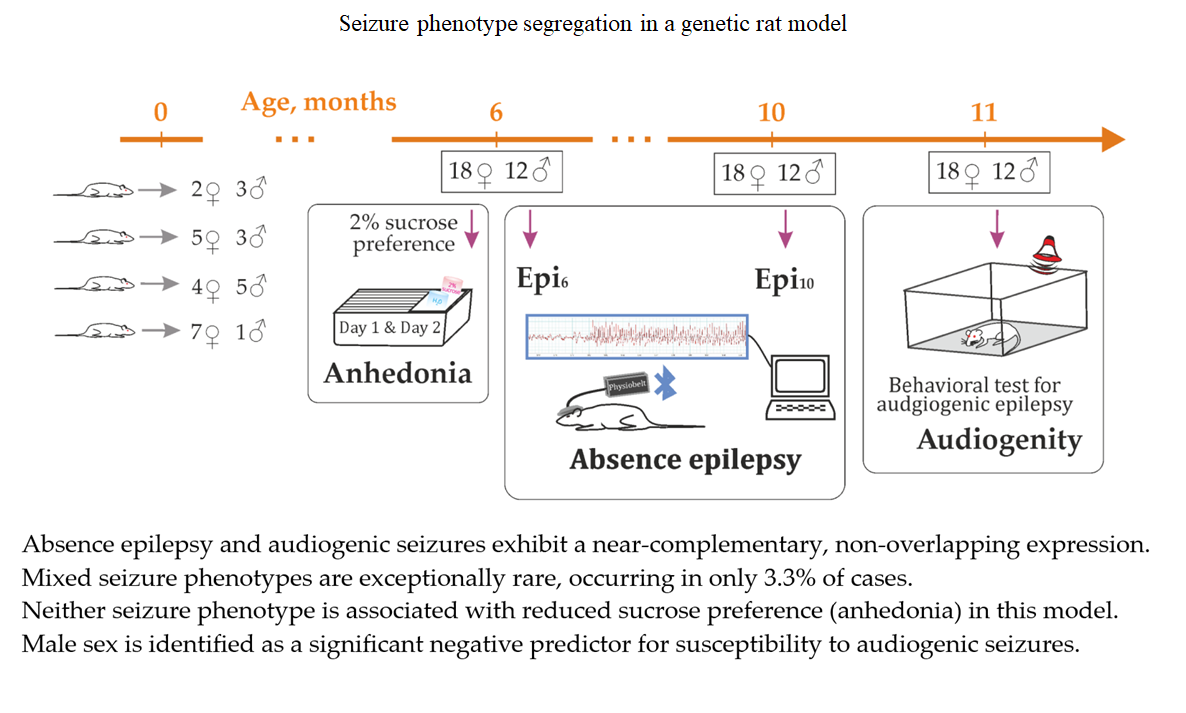
Epilepsy is a heterogeneous neurological disorder, characterized by distinct seizure phenotypes. We examined the phenotypic expression of seizures in genetically predisposed rats, focusing on the relationship between absence epilepsy (AE), audiogenic seizures (AGS), and anhedonia. Thirty rats were assessed longitudinally for AE at 6 and 10 months and for AGS susceptibility. Anhedonia was measured using 2% sucrose preference test. Statistical analysis revealed a striking mutual exclusivity between seizure types: only 1 male among 11 AE-positive rats developed AGS, whereas 10 of 19 AE-negative rats (all females) developed AGS. Seizure manifestations in these rats exhibited a binary pattern, with a shared genetic predisposition affecting either corticothalamic or brainstem neural circuits, resulting in either AE or AGS, respectively. No association was found between either seizure phenotypes and anhedonia, as sucrose preference remained uniformly high across all groups. Logistic regression identified male sex as a negative predictor of AGS risk and confirmed the suppressive effect of AE on AGS susceptibility, although the models were limited by small sample size and strong collinearity between sex and sucrose preference. These results demonstrate circuit-specific phenotypic divergence in genetic epilepsy, with important implications for understanding seizure network development and comorbidity profiles.
- Devinsky O, Elder C, Sivathamboo S, Scheffer IE, Koepp MJ. Idiopathic Generalized Epilepsy. Neurology. 2024;102(3). doi: 10.1212/WNL.0000000000208076
- Hirsch E, French J, Scheffer IE, Bogacz A, Alsaadi T, Sperling MR, et al. ILAE definition of the Idiopathic Generalized Epilepsy Syndromes: Position statement by the ILAE Task Force on Nosology and Definitions. Epilepsia. 2022;63(6):1475-1499. doi: 10.1111/epi.17236
- Crunelli V, Lőrincz ML, McCafferty C, et al. Clinical and experimental insight into pathophysiology, comorbidity and therapy of absence seizures. Brain. 2020;143(8):2341-2368. doi: 10.1093/brain/awaa072
- Crunelli V, Leresche N. Childhood absence epilepsy: Genes, channels, neurons and networks. Nat Rev Neurosci. 2002;3(5):371-382. doi: 10.1038/nrn811
- Mishra PK, Dailey JW, Reigel CE, Jobe PC. Audiogenic convulsions in moderate seizure genetically epilepsy-prone rats (GEPR-3s). Epilepsy Res. 1989;3(3):191-198. doi: 10.1016/0920-1211(89)90023-5
- Poletaeva II, Surina NM, Kostina ZA, Perepelkina O V., Fedotova IB. The Krushinsky-Molodkina rat strain: The study of audiogenic epilepsy for 65 years. Epilepsy Behav. 2017;71. doi: 10.1016/j.yebeh.2015.04.072
- Ross KC, Coleman JR. Developmental and genetic audiogenic seizure models: Behavior and biological substrates. Neurosci Biobehav Rev. 2000;24(6). doi: 10.1016/S0149-7634(00)00029-4
- Marescaux C, Vergnes M, Kiesmann M, Depaulis A, Micheletti G, Warter JM. Kindling of audiogenic seizures in Wistar rats: An EEG study. Exp Neurol. 1987;97(1). doi: 10.1016/0014-4886(87)90290-1
- Romanova LG, Zorina ZA, Korochkin LI. A genetic, physiological, and biochemical investigation of audiogenic seizures in rats. Behav Genet. 1993;23(5). doi: 10.1007/BF01067984
- Midzyanovskaya IS, Kuznetsova GD, Vinogradova L V., Shatskova AB, Coenen AML, van Luijtelaar G. Mixed forms of epilepsy in a subpopulation of WAG/Rij rats. Epilepsy Behav. 2004;5(5). doi: 10.1016/j.yebeh.2004.06.021
- Sarkisova K, van Luijtelaar G. The WAG/Rij strain: A genetic animal model of absence epilepsy with comorbidity of depressiony. Prog Neuro-Psychopharmacol Biol Psychiatry. 2011;35(4):854-876. doi: 10.1016/j.pnpbp.2010.11.010
- Sarkisova KY, Kuznetsova GD, Kulikov MA, Van Luijtelaar G. Spike–wave discharges are necessary for the expression of behavioral depression‐like symptoms. Epilepsia. 2010;51(1):146-160. doi: 10.1111/j.1528-1167.2009.02260.x
- Sarkisova KY, Midzianovskaia I., Kulikov M. Depressivelike behavioral alterations and c-fos expression in the dopaminergic brain regions in WAG/Rij rats with genetic absence epilepsy. Behav Brain Res. 2003;144(1-2):211-226. doi: 10.1016/S0166-4328(03)00090-1
- van Luijtelaar G, van Oijen G. Establishing Drug Effects on Electrocorticographic Activity in a Genetic Absence Epilepsy Model: Advances and Pitfalls. Front Pharmacol. 2020;11:395. doi: 10.3389/fphar.2020.00395
- Coenen AML, van Luijtelaar ELJM. Genetic animal models for absence epilepsy: a review of the WAG/Rij strain of rats. Behav Genet. 2003;33(6):635-655. doi: 10.1023/a:1026179013847
- Sitnikova E, Pupikina M. Behavioral Phenotyping of WAG/Rij Rat Model of Absence Epilepsy: The Link to Anxiety and Sex Factors. Biomedicines. 2025;13(9):2075. doi: 10.3390/biomedicines13092075
- Pupikina M, Sitnikova E. Reassessing anhedonia in Genetic Absence Epilepsy: Sucrose preference unaltered by spike-wave discharges in WAG/Rij rats. Epilepsy Res. 2025;218:107683. doi: 10.1016/j.eplepsyres.2025.107683
- Roberts-West L, Vivekananda U, Baxendale S. Anhedonia in epilepsy. Epilepsy Behav. 2023;140:108966. doi: 10.1016/j.yebeh.2022.108966
- Pupikina M, Sitnikova E. Non-invasive electroencephalography-based technique for rapid diagnostics of absence epilepsy in rats. Adv Neurol. 2024;3(4):4464. doi: 10.36922/an.4464
- Sarkisova KY, Kulikov MA. Behavioral characteristics of WAG/Rij rats susceptible and non-susceptible to audiogenic seizures. Behav Brain Res. 2006;166(1):9-18. doi: 10.1016/j.bbr.2005.07.024
- de Azevedo BA, Fontana P. Audiogenic seizures and the pineal gland. Biol Psychiatry. 1988;23(7):734-740. doi: 10.1016/0006-3223(88)90058-3
- Meeren HKM, Van Cappellen van Walsum AM, Van Luijtelaar ELJM, Coenen AML. Auditory evoked potentials from auditory cortex, medial geniculate nucleus, and inferior colliculus during sleep–wake states and spike-wave discharges in the WAG/Rij rat. Brain Res. 2001;898(2):321-331. doi: 10.1016/S0006-8993(01)02209-0
- Garcia-Cairasco N. A critical review on the participation of inferior colliculus in acoustic-motor and acoustic-limbic networks involved in the expression of acute and kindled audiogenic seizures. Hear Res. 2002;168(1-2). doi: 10.1016/S0378-5955(02)00371-4
- Mishra PK, Dailey JW, Reigel CE, Tomsic ML, Jobe PC. Sexspecific distinctions in audiogenic convulsions exhibited by severe seizure genetically epilepsy-prone rats (GEPR-9S). Epilepsy Res. 1988;2(5):309-316. doi: 10.1016/0920-1211(88)90039-3
- Lazarini-Lopes W, Campos-Rodriguez C, Palmer D, N’Gouemo P, Garcia-Cairasco N, Forcelli PA. Absence epilepsy in male and female WAG/Rij rats: A longitudinal EEG analysis of seizure expression. Epilepsy Res. 2021;176:106693. doi: 10.1016/j.eplepsyres.2021.106693