

From readmission prediction to clinical decision support: A hybrid AI framework with prespecified calibration and explainability for diabetes hospital readmission risk stratification

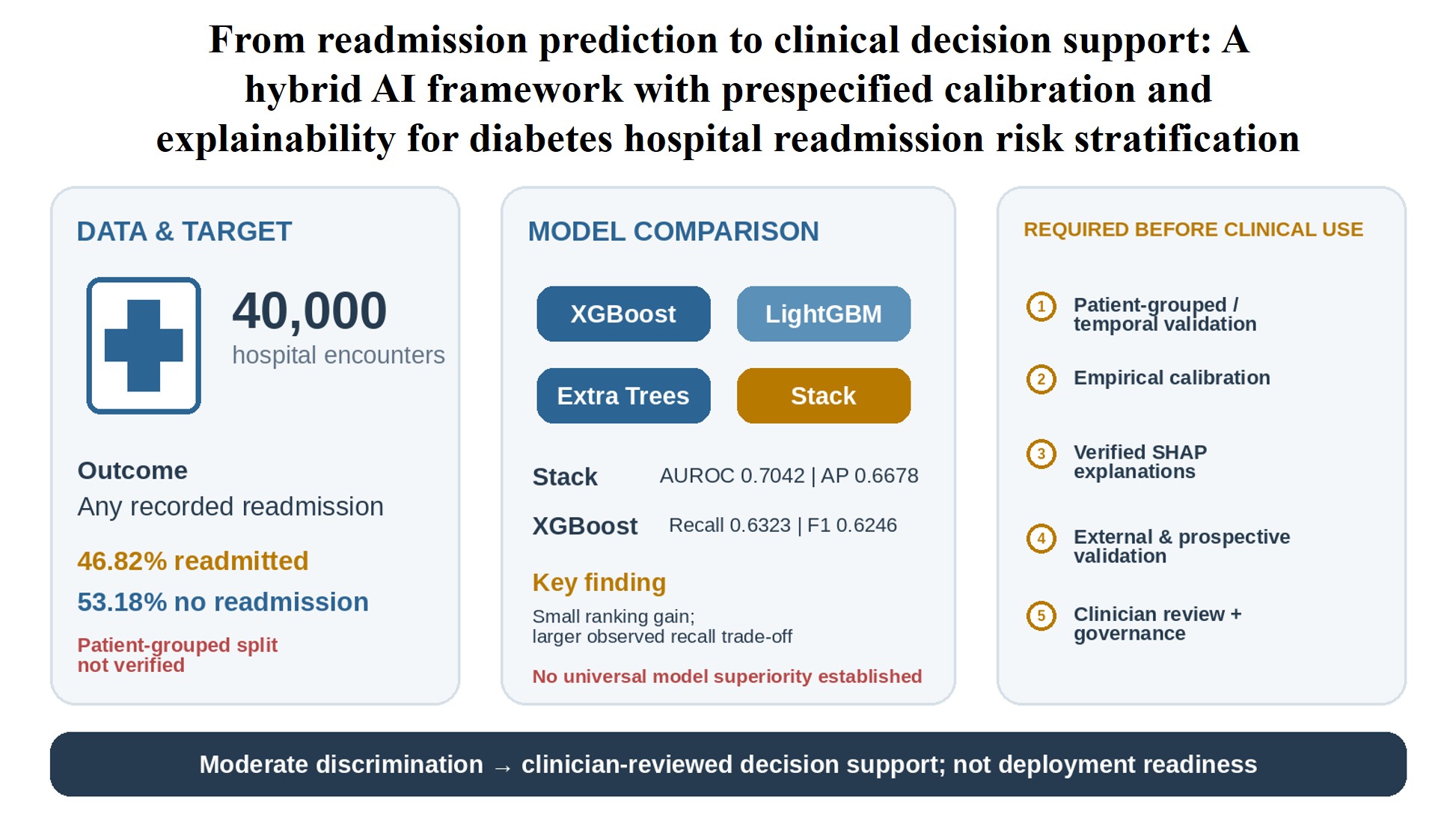
Hospital readmission among people with diabetes creates substantial clinical and resource burdens, but prediction alone is insufficient for decision support. This study reports a preliminary retrospective evaluation of a hybrid artificial-intelligence framework and prespecifies the calibration, explainability, and clinical-validation analyses required for translation. A total of 40,000 encounters from the Diabetes 130-US Hospitals dataset were analysed. Twenty utilisation, treatment-intensity, diagnostic, and demographic features were engineered. Logistic regression, random forest, extra trees, XGBoost, and LightGBM were compared using a stratified 80/20 encounter-level split, and a heterogeneous stack combined XGBoost, LightGBM, and extra trees through a logistic-regression meta-learner. The stack achieved the highest area under the receiver operating characteristic curve (AUROC; 0.7042) and average precision (0.6678), narrowly exceeding XGBoost (0.7037 and 0.6664, respectively), whereas XGBoost achieved higher recall (0.6323 vs. 0.5650 of the stack) and F1-score (0.6246 vs. 0.5992 of the stack). The stack correctly classified 5,169 of 8,000 test encounters. These findings indicate moderate discrimination and a clinically relevant precision–recall trade-off rather than universal model superiority. Empirical calibration metrics, verified SHapley Additive exPlanations attributions, paired model-comparison tests, and prospective clinical evaluation were not available in the archived analysis and are therefore presented as prespecified next-stage analyses, not completed findings. Patient-grouped or temporal validation, empirical calibration, full-pipeline explainability, uncertainty analysis, and external prospective evaluation remain necessary before clinical use.
- International Diabetes Federation. IDF Diabetes Atlas. 11th ed. International Diabetes Federation; 2025. Accessed XXX. https://diabetesatlas.org/resources/idf-diabetes-atlas-2025/
- American Diabetes Association Professional Practice Committee for Diabetes. 16. Diabetes care in the hospital: Standards of Care in Diabetes—2026. Diabetes Care. 2026;49(Suppl 1):S339-S355. doi: 10.2337/dc26-S016
- Collins GS, Moons KGM, Dhiman P, et al. TRIPOD+AI statement: updated guidance for reporting clinical prediction models that use regression or machine learning methods. BMJ. 2024;385:e078378. doi: 10.1136/bmj-2023-078378
- Moons KGM, Damen JAAG, Kaul T, et al. PROBAST+AI: an updated quality, risk of bias, and applicability assessment tool for prediction models using regression or artificial intelligence methods. BMJ. 2025;388:e082505. doi: 10.1136/bmj-2024-082505
- Lekadir K, Frangi AF, Porras AR, et al. FUTURE-AI: international consensus guideline for trustworthy and deployable artificial intelligence in healthcare. BMJ. 2025;388:e081554. doi: 10.1136/bmj-2024-081554
- Clore J, Cios K, DeShazo J, Strack B. Data from: Diabetes 130-US Hospitals for Years 1999-2008. UCI Mach Learn Repos. 2014. doi: 10.24432/C5230J
- Strack B, DeShazo JP, Gennings C, et al. Impact of HbA1c measurement on hospital readmission rates: analysis of 70,000 clinical database patient records. Biomed Res Int. 2014;2014:781670. doi: 10.1155/2014/781670
- Van Calster B, McLernon DJ, van Smeden M, Wynants L, Steyerberg EW. Calibration: the Achilles heel of predictive analytics. BMC Med. 2019;17(1):230. doi: 10.1186/s12916-019-1466-7
- Lundberg SM, Lee SI. A unified approach to interpreting model predictions. Adv Neural Inf Process Syst. 2017;30:4765-4774. https://proceedings.neurips.cc/paper/2017/hash/8a20a8621978632d76c43dfd28b67767-Abstract.html
- Rudin C. Stop explaining black box machine learning models for high stakes decisions and use interpretable models instead. Nat Mach Intell. 2019;1(5):206-215. doi: 10.1038/s42256-019-0048-x
- Breiman L. Random forests. Mach Learn. 2001;45(1):5-32. doi: 10.1023/A:1010933404324
- Chen T, Guestrin C. XGBoost: a scalable tree boosting system. In: Proceedings of the 22nd ACM SIGKDD International Conference on Knowledge Discovery and Data Mining. Association for Computing Machinery; 2016:785-794. doi: 10.1145/2939672.2939785
- Ke G, Meng Q, Finley T, et al. LightGBM: a highly efficient gradient boosting decision tree. Adv Neural Inf Process Syst. 2017;30:3146-3154. https://proceedings.nips.cc/paper/2017/hash/6449f44a102fde848669bdd9eb6b76fa-Abstract.html
- Wolpert DH. Stacked generalization. Neural Netw. 1992;5(2):241-259. doi: 10.1016/S0893-6080(05)80023-1
- Akiba T, Sano S, Yanase T, Ohta T, Koyama M. Optuna: a next-generation hyperparameter optimization framework. In: Proceedings of the 25th ACM SIGKDD International Conference on Knowledge Discovery & Data Mining. Association for Computing Machinery; 2019:2623-2631. doi: 10.1145/3292500.3330701
- Saito T, Rehmsmeier M. The precision-recall plot is more informative than the ROC plot when evaluating binary classifiers on imbalanced datasets. PLoS ONE. 2015;10(3):e0118432. doi: 10.1371/journal.pone.0118432
- Steyerberg EW. Clinical Prediction Models: A Practical Approach to Development, Validation, and Updating. 2nd ed. Springer; 2019. doi: 10.1007/978-3-030-16399-0
- Pedregosa F, Varoquaux G, Gramfort A, et al. Scikit-learn: machine learning in Python. J Mach Learn Res. 2011;12(85):2825-2830. https://www.jmlr.org/papers/v12/pedregosa11a.html
- Harris CR, Millman KJ, van der Walt SJ, et al. Array programming with NumPy. Nature. 2020;585(7825):357-362. doi: 10.1038/s41586-020-2649-2
- McKinney W. Data structures for statistical computing in Python. In: Proceedings of the 9th Python in Science Conference. SciPy; 2010:56-61. doi: 10.25080/Majora-92bf1922-00a
- Hunter JD. Matplotlib: a 2D graphics environment. Comput Sci Eng. 2007;9(3):90-95. doi: 10.1109/MCSE.2007.55
- Masnoon N, Shakib S, Kalisch-Ellett L, Caughey GE. What is polypharmacy? A systematic review of definitions. BMC Geriatr. 2017;17(1):230. doi: 10.1186/s12877-017-0621-2
- Riley RD, Ensor J, Snell KIE, et al. Calculating the sample size required for developing a clinical prediction model. BMJ. 2020;368:m441. doi: 10.1136/bmj.m441
- Pencina MJ, D’Agostino RB Sr. Evaluating discrimination of risk prediction models: the C statistic. JAMA. 2015;314(10):1063-1064. doi: 10.1001/jama.2015.11082
- DeLong ER, DeLong DM, Clarke-Pearson DL. Comparing the areas under two or more correlated receiver operating characteristic curves: a nonparametric approach. Biometrics. 1988;44(3):837-845. doi: 10.2307/2531595
- Efron B, Tibshirani RJ. An Introduction to the Bootstrap. Chapman & Hall/CRC; 1993. doi: 10.1201/9780429246593
- Niculescu-Mizil A, Caruana R. Predicting good probabilities with supervised learning. In: Proceedings of the 22nd International Conference on Machine Learning. Association for Computing Machinery; 2005:625-632. doi: 10.1145/1102351.1102430
- Platt JC. Probabilities for SV Machines. In: Smola AJ, Bartlett P, Schölkopf B, Schuurmans D, eds. Advances in Large-Margin Classifiers. The MIT Press; 2000:61-74. doi: 10.7551/mitpress/1113.003.0008
- Vickers AJ, Elkin EB. Decision curve analysis: a novel method for evaluating prediction models. Med Decis Making. 2006;26(6):565-574. doi: 10.1177/0272989X06295361
- Wolff RF, Moons KGM, Riley RD, et al. PROBAST: a tool to assess the risk of bias and applicability of prediction model studies. Ann Intern Med. 2019;170(1):51-58. doi: 10.7326/M18-1376
- Collins GS, Reitsma JB, Altman DG, Moons KGM. Transparent reporting of a multivariable prediction model for individual prognosis or diagnosis (TRIPOD). Ann Intern Med. 2015;162(1):55-63. doi: 10.7326/M14-0697
- World Health Organization. Ethics and Governance of Artificial Intelligence for Health: WHO Guidance. World Health Organization; 2021. https://www.who.int/publications/i/item/9789240029200
- Ghassemi M, Oakden-Rayner L, Beam AL. The false hope of current approaches to explainable artificial intelligence in health care. Lancet Digit Health. 2021;3(11):e745-e750. doi: 10.1016/S2589-7500(21)00208-9
- Kelly CJ, Karthikesalingam A, Suleyman M, Corrado G, King D. Key challenges for delivering clinical impact with artificial intelligence. BMC Med. 2019;17(1):195. doi: 10.1186/s12916-019-1426-2
- Vollmer S, Mateen BA, Bohner G, et al. Machine learning and artificial intelligence research for patient benefit: 20 critical questions on transparency, replicability, ethics, and effectiveness. BMJ. 2020;368:l6927. doi: 10.1136/bmj.l6927
- World Medical Association. World Medical Association Declaration of Helsinki: ethical principles for medical research involving human subjects. JAMA. 2013;310(20):2191-2194. doi: 10.1001/jama.2013.281053
- Lundberg SM, Erion G, Chen H, et al. From local explanations to global understanding with explainable AI for trees. Nat Mach Intell. 2020;2(1):56-67. doi: 10.1038/s42256-019-0138-9
- Ali S, Abuhmed T, El-Sappagh S, et al. Explainable artificial intelligence (XAI): what we know and what is left to attain trustworthy artificial intelligence. Inf Fusion. 2023;99:101805. doi: 10.1016/j.inffus.2023.101805