

A study on temporal consistency and comparative performance of a NASNet-based deep learning model for endoscopic video denoising

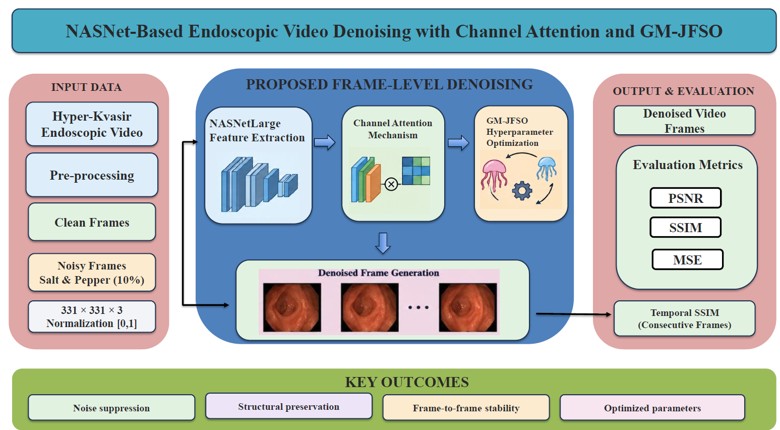
Image processing plays an important role in endoscopic diagnosis; noise introduced by low illumination, sensor limitations, motion artifacts, and endoscope movement within the human body can significantly reduce visual clarity. Image and video quality affect the visibility of fine structures, making diagnosis difficult. Deep learning-based methods have shown promising results, but many existing models struggle to maintain temporal consistency across consecutive frames. This paper presents an enhanced video denoising framework based on a neural architecture search network (NASNet) model with a channel attention mechanism. The proposed method was optimized using a genetically modified jellyfish search optimization (GM-JFSO) algorithm. The proposed framework was evaluated using the publicly available Hyper–Kvasir dataset. It aims to preserve spatial image quality and temporal consistency across consecutive video frames by effectively reducing noise while retaining structural details. Comparative evaluation against NASNet, GoogLeNet, DenseNet, and ResNet showed that the proposed method outperformed them, achieving a peak signal-to-noise ratio of 49.07 dB, a structural similarity index measure (SSIM) of 0.938, a mean squared error of 0.584, and a temporal SSIM of 0.8313 across the evaluated sequence. The GM-JFSO algorithm improves the proposed model’s performance through hyperparameter optimization, while the channel attention mechanism enhances feature representation and noise suppression. The experiment shows the effectiveness of integrating the optimization technique with the deep learning model for video denoising and highlights the importance of evaluating temporal consistency in medical imaging applications.
- Ko WJ, An P, Ko KH, Hahm KB, Hong SP, Cho JY. Image Quality Analysis of Various Gastrointestinal Endoscopes: Why Image Quality Is a Prerequisite for Proper Diagnostic and Therapeutic Endoscopy. Clin Endosc. 2015;48(5):374. doi: 10.5946/ce.2015.48.5.374
- Kim GH, Cho YK, Cha JM, Lee SY, Chung IK. Efforts to increase image quality during endoscopy: The role of pronase. WJGE. 2016;8(5):267. doi: 10.4253/wjge.v8.i5.267
- Nazir N, Sarwar A, Saini BS. Recent developments in denoising medical images using deep learning: an overview of models, techniques, and challenges. Micron. 2024;180:103615. doi: 10.1016/j.micron.2024.103615
- Lin J, Pan Y, Dang Y, Bao Y, Zhuo H. Blood-contaminated endoscopic image restoration based on residual VQ-VAE with cascaded structure. IET Image Process. 2022;16(13):3669-3683. doi: 10.1049/ipr2.12584
- Zhang K, Zuo W, Chen Y, Meng D, Zhang L. Beyond a Gaussian denoiser: residual learning of deep CNN for image denoising. IEEE Trans Image Process. 2017;26(7):3142-3155. doi: 10.1109/TIP.2017.2662206
- Zhang K, Zuo W, Zhang L. FFDNet: toward a fast and flexible solution for CNN-based image denoising. IEEE Trans Image Process. 2018;27(9):4608-4622. doi: 10.1109/TIP.2018.2839891
- Hu J, Shen L, Albanie S, Sun G, Wu E. Squeeze-and-excitation networks. IEEE Trans Pattern Anal Mach Intell. 2020;42(8):2011-2023. doi: 10.1109/TPAMI.2019.2913372
- Woo S, Park J, Lee JY, Kweon IS. CBAM: Convolutional Block Attention Module. In: Proceedings of the European Conference on Computer Vision (ECCV). Springer; 2018:3-19. doi: 10.1007/978-3-030-01234-2_1
- Tassano M, Delon J, Veit T. DVDNet: A fast network for deep video denoising. In: Proceedings of the IEEE International Conference on Image Processing (ICIP). IEEE; 2019:1805-1809. doi: 10.1109/ICIP.2019.8803136
- Tassano M, Delon J, Veit T. FastDVDNet: towards real-time deep video denoising without flow estimation. In: Proceedings of the IEEE/CVF Conference on Computer Vision and Pattern Recognition (CVPR). IEEE; 2020:1354-1363. doi: 10.1109/CVPR42600.2020.00143
- Chen H, Jin Y, Xu K, Yang G, Chen H. Multiframe-to-multiframe network for video denoising. IEEE Trans Multimed. 2022;23:2507-2519. doi: 10.1109/TMM.2021.3077140
- Maggioni M, Huang Y, Li C, Xiao S, Fu Z, Song F. Efficient multi-stage video denoising with recurrent spatio-temporal fusion. In: Proceedings of the IEEE/CVF Conference on Computer Vision and Pattern Recognition (CVPR). IEEE; 2021:3466-3475. doi: 10.1109/CVPR46437.2021.00347
- Song M, Zhang Y, Aydın TO. TempFormer: temporally consistent transformer for video denoising. In: Avidan S, Brostow G, Cissé M, Farinella GM, Hassner T, eds. Computer Vision – ECCV 2022. Springer; 2022:481-496. doi: 10.1007/978-3-031-19800-7_28
- Liang J, Cao J, Fan Y, et al. VRT: a video restoration transformer. IEEE Trans Image Process. 2024;33:2171-2182. doi: 10.1109/TIP.2024.3372454
- Yue H, Cao C, Liao L, Yang J. RViDeformer: Efficient Raw Video Denoising Transformer With a Larger Benchmark Dataset. IEEE Trans Circuits Syst Video Technol. 2025;35(9):8929-8944. doi: 10.1109/tcsvt.2025.3553160
- Ali S, Zhou F, Bailey A, et al. A deep learning framework for quality assessment and restoration in video endoscopy. Med Image Anal. 2021;68:101900. doi: 10.1016/j.media.2020.101900
- Gómez P, Semmler M, Schützenberger A, Bohr C, Döllinger M. Low-light image enhancement of high-speed endoscopic videos using a convolutional neural network. Med Biol Eng Comput. 2019;57(7):1451-1463. doi: 10.1007/s11517-019-01965-4
- Nie Z, Xu M, Wang Z, Lu X, Song W. A Review of Application of Deep Learning in Endoscopic Image Processing. J Imaging. 2024;10(11):275. doi: 10.3390/jimaging10110275
- An Z, Xu C, Qian K, et al. EIEN: Endoscopic image enhancement network based on retinex theory. Sensors. 2022;22(14):5464. doi: 10.3390/s22145464
- Moghtaderi S, Yaghoobian O, Wahid KA, Lukong KE. Endoscopic image enhancement: wavelet transform and guided filter decomposition-based fusion approach. J Imaging. 2024;10(1):28. doi: 10.3390/jimaging10010028
- Mou E, Wang H, Chen X, et al. Retinex theory-based nonlinear luminance enhancement and denoising for low-light endoscopic images. BMC Med Imaging. 2024;24:207. doi: 10.1186/s12880-024-01386-2
- Borgli H, Thambawita V, Smedsrud PH, et al. Hyper-Kvasir: A comprehensive multi-class image and video dataset for gastrointestinal endoscopy. Sci Data. 2020;7:283. doi: 10.1038/s41597-020-00622-y
- Zoph B, Vasudevan V, Shlens J, Le QV. Learning transferable architectures for scalable image recognition. In: Proceedings of the IEEE/CVF Conference on Computer Vision and Pattern Recognition (CVPR). IEEE; 2018:8697-8710. doi: 10.1109/CVPR.2018.00907
- Joy F, Vijayakumar V. A state-of-the-art methodology for real-time surveillance video denoising. In: Smys S, Tavares J, Balas V, Iliyasu A, eds. Computational Vision and Bio-Inspired Computing. ICCVBIC 2019. Springer; 2020:985-993. doi: 10.1007/978-3-030-37218-7_95
- Ramesh J, Logeshwaran J, Gowri J, Mathew A. The management and reduction of digital noise in video image processing by using transmission-based noise elimination scheme. ICTACT J Image Video Process. 2022;13(1):2797-2801. doi: 10.21917/ijivp.2022.0398
- Dabov K, Foi A, Katkovnik V, Egiazarian K. Image denoising by sparse 3-D transform-domain collaborative filtering. IEEE Trans Image Process. 2007;16(8):2080-2095. doi: 10.1109/TIP.2007.901238
- Anwar S, Barnes N. Real image denoising with feature attention. In: Proceedings of the IEEE/CVF International Conference on Computer Vision (ICCV). IEEE; 2019:3155-3164. doi: 10.1109/ICCV.2019.00325
- Guo S, Yan Z, Zhang K, Zuo W, Zhang L. Toward convolutional blind denoising of real photographs. In: Proceedings of the IEEE/CVF Conference on Computer Vision and Pattern Recognition (CVPR). IEEE; 2019:1712-1722. doi: 10.1109/CVPR.2019.00181
- Zamir SW, Arora A, Khan S, et al. Multi-stage progressive image restoration. In: Proceedings of the IEEE/CVF Conference on Computer Vision and Pattern Recognition (CVPR). IEEE; 2021:14816-14826. doi: 10.1109/CVPR46437.2021.01458
- Zamir SW, Arora A, Khan S, et al. Learning enriched features for real image restoration and enhancement. In: Vedaldi A, Bischof H, Brox T, Frahm JM, eds. Computer Vision – ECCV 2020. Springer; 2020:492-511. doi: 10.1007/978-3-030-58595-2_30
- Liang J, Cao J, Sun GL, Zhang K, Van Gool L, Timofte R. SwinIR: image restoration using swin transformer. In: Proceedings of the IEEE/CVF International Conference on Computer Vision Workshops (ICCVW). IEEE; 2021:1833-1844. doi: 10.1109/ICCVW54120.2021.00210
- Zamir SW, Arora A, Khan S, Hayat M, Khan FS, Yang MH. Restormer: efficient transformer for high-resolution image restoration. In: Proceedings of the IEEE/CVF Conference on Computer Vision and Pattern Recognition (CVPR). IEEE; 2022:5718-5727. doi: 10.1109/CVPR52688.2022.00564
- Wang ZD, Cun X, Bao JM, Zhou WG, Liu J, Li HQ. Uformer: a general u-shaped transformer for image restoration. In: Proceedings of the IEEE/CVF Conference on Computer Vision and Pattern Recognition (CVPR). IEEE; 2022:17683-17693. doi: 10.1109/CVPR52688.2022.01716
- Jaspers TJM, Boers TGW, Kusters CHJ, et al. Robustness evaluation of deep neural networks for endoscopic image analysis: Insights and strategies. Med Image Anal. 2024;94:103157. doi: 10.1016/j.media.2024.103157
- Chan KCK, Wang X, Yu K, Dong C, Loy CC. BasicVSR: the search for essential components in video super-resolution and beyond. In: Proceedings of the IEEE/CVF Conference on Computer Vision and Pattern Recognition (CVPR). IEEE; 2021:4947-4956. doi: 10.1109/CVPR46437.2021.00491
- Chan KCK, Zhou SC, Xu X, Loy CC. BasicVSR++: improving video super-resolution with enhanced propagation and alignment. In: Proceedings of the IEEE/CVF Conference on Computer Vision and Pattern Recognition (CVPR). IEEE; 2022:5972-5981. doi: 10.1109/CVPR52688.2022.00588
- Shokeen V, Kumar S, Mathur V, Sharma A, Gupta I, Jain P. ClearNet: auto-encoder based denoising model for endoscopy images. Indonesian J Elec Eng Comp Sci. 2025;38(3):1990-2000. doi: 10.11591/ijeecs.v38.i3.pp1990-2000
- Jha D, Smedsrud PH, Riegler M, et al. Kvasir-SEG: a segmented polyp dataset. In: Ro YM, Cheng W-H, Kim J, et al., eds. MultiMedia Modeling. MMM 2020. Springer; 2020:451-462. doi: 10.1007/978-3-030-37734-2_37
- Wang Z, Bovik AC, Sheikh HR, Simoncelli EP. Image quality assessment: from error visibility to structural similarity. IEEE Trans Image Process. 2004;13(4):600-612. doi: 10.1109/TIP.2003.819861
- Rota C, Buzzelli M, Bianco S, Schettini R. Video restoration based on deep learning: a comprehensive survey. Artif Intell Rev. 2023;56(6):5317-5364. doi: 10.1007/s10462-022-10302-5