

Advances in artificial intelligence for precision pathology: Deep learning models, clinical applications, and translational challenges in cancer diagnosis

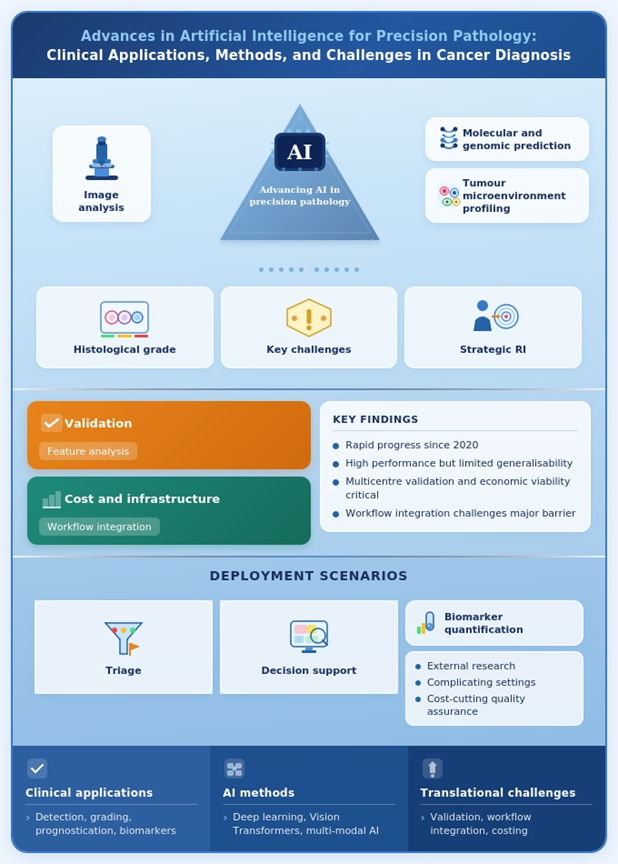
Artificial intelligence (AI) in pathology has become a revolutionary paradigm in emerging modalities for cancer detection and screening. This progress represents a major departure from conventional, often subjective and interobserver-dependent manual assessment to computational approaches that afford higher accuracy and reproducibility. Using advanced algorithms, particularly deep learning models, AI allows the automated evaluation of histopathological images to assist with the identification of malignant changes to cytology in a more precise and standardised manner. It is therefore becoming evident that AI-based tools are helping pathologists diagnose more efficiently, leading to quicker diagnoses and ultimately better patient outcomes. This scoping review discusses studies from 2020 onwards, with a focus on AI-based image analysis methods for automated pathology in the historical development of digital pathology. Today’s approaches are driven by deep learning methods, especially convolutional neural networks and their more general variants, which are used across a wide range of cancers. The review covers applications in breast, gastrointestinal, and cervical cancers across clinical tasks such as detection, classification, grading, staging, and prognostication. While experimental results indicate promising outcomes in controlled environments, substantial challenges remain to routine clinical uptake, including a lack of external validation, data heterogeneity, workflow integration challenges, and regulatory compliance issues. This review encompasses existing technical strategies applied in real-world settings, the rationale for clinical trials, validation frameworks, translational challenges, and future prospects, thereby providing a comprehensive picture of the field’s development from experimental innovation to practical clinical application.
- Rojo MG, García GB, Mateos CP, García JG, Vicente MC. Critical comparison of 31 commercially available digital slide systems in pathology. Int J Surg Pathol. 2006;14(4):285- 305. doi: 10.1177/1066896906292274
- Dang C, Qi Z, Xu T, et al. Deep Learning-Powered Whole Slide Image Analysis in Cancer Pathology. Lab Invest. 2025;105(7):104186. doi: 10.1016/j.labinv.2025.104186
- Litjens G, Sánchez CI, Timofeeva N, et al. Deep learning as a tool for increased accuracy and efficiency of histopathological diagnosis. Sci Rep. 2016;6(1):26286. doi: 10.1038/srep26286
- Niazi MKK, Parwani AV, Gurcan MN. Digital pathology and artificial intelligence. Lancet Oncol. 2019;20(5):e253-e261. doi: 10.1016/S1470-2045(19)30154-8
- Giansanti D, Lastrucci A, Pirrera A, Villani S, Carico E, Giarnieri E. AI in Cervical Cancer Cytology Diagnostics: A Narrative Review of Cutting-Edge Studies. Bioengineering. 2025;12(7):769. doi: 10.3390/bioengineering12070769
- Kather JN, Heij LR, Grabsch HI, et al. Pan-cancer image-based detection of clinically actionable genetic alterations. Nat Cancer. 2020;1(8):789-799. doi: 10.1038/s43018-020-0087-6
- Nasir ES, Parvaiz A, Fraz MM. Nuclei and glands instance segmentation in histology images: a narrative review. Artif Intell Rev. 2022;56(8):7909-7964. doi: 10.1007/s10462-022-10372-5
- He W, Liu T, Han Y, et al. A review: The detection of cancer cells in histopathology based on machine vision. Comput Biol Med. 2022;146:105636. doi: 10.1016/j.compbiomed.2022.105636
- McGenity C, Clarke EL, Jennings C, et al. Artificial intelligence in digital pathology: a systematic review and meta-analysis of diagnostic test accuracy. NPJ Digit Med. 2024;7(1):114. doi: 0.1038/s41746-024-01106-8
- Osinski BL, BenTaieb A, Ho I, et al. Artificial intelligence-augmented histopathologic review using image analysis to optimize DNA yield from formalin-fixed paraffin-embedded slides. Mod Pathol. 2022;35(12):1791-1803. doi: 10.1038/s41379-022-01161-0
- Steiner DF, Nagpal K, Sayres R, et al. Evaluation of the use of combined artificial intelligence and pathologist assessment to review and grade prostate biopsies. JAMA Net Open. 2020;3(11):e2023267. doi: 10.1001/jamanetworkopen.2020.23267
- Fu Y, Jung AW, Torne RV, et al. Pan-cancer computational histopathology reveals mutations, tumor composition and prognosis. Nat Cancer. 2020;1(8):800-810 doi: 10.1038/s43018-020-0085-8
- Lu MY, Chen TY, Williamson DFK, et al. AI-based pathology predicts origins for cancers of unknown primary. Nature. 2021;594(7861):106-110. doi: 10.1038/s41586-021-03512-4
- Saltz J, Gupta R, Hou L, et al. Spatial Organization and Molecular Correlation of Tumor-Infiltrating Lymphocytes Using Deep Learning on Pathology Images. Cell Rep. 2018;23(1):181-193.e7. doi: 10.1016/j.celrep.2018.03.086
- Coudray N, Ocampo PS, Sakellaropoulos T, et al. Classification and mutation prediction from non-small cell lung cancer histopathology images using deep learning. Nat Med. 2018;24(10):1559-1567 doi: 10.1038/s41591-018-0177-5
- Nguyen MH, Do-Huu HH, Nguyen PT, et al. Translational deep learning models for risk stratification to predict prognosis and immunotherapy response in gastric cancer using digital pathology. J Transl Med. 2025;23(1):1419 doi: 10.1186/s12967-025-07416-z
- Nguyen MH, Le MHN, Bui AT, Le NQK. Artificial intelligence in predicting EGFR mutations from whole slide images in lung Cancer: A systematic review and Meta- Analysis. Lung Cancer. 2025;204:108577. doi: 10.1016/j.lungcan.2025.108577
- Litjens G, Kooi T, Bejnordi BE, et al. A survey on deep learning in medical image analysis. Med Image Anal. 2017;42:60-88. doi: 10.1016/j.media.2017.07.005
- Madabhushi A, Lee G. Image analysis and machine learning in digital pathology: Challenges and opportunities. Med Image Anal. 2016;33:170-175. doi: 10.1016/j.media.2016.06.037
- Holzinger A, Langs G, Denk H, Zatloukal K, Müller H. Causability and explainability of artificial intelligence in medicine. WIREs Data Min Knowl Discov. 2019;9(4):e1312. doi: 10.1002/widm.1312
- Amann J, Blasimme A, Vayena E, Frey D, Madai VI, Precise4Q Consortium. Explainability for artificial intelligence in healthcare: a multidisciplinary perspective. BMC Med Inform Decis Mak.. 2020;20(1):310. doi: 10.1186/s12911-020-01332-6
- Zhu J, Liu M, Li X. Progress on deep learning in digital pathology of breast cancer: a narrative review. Gland Surg. 2022;11(4):751-766. doi: 10.21037/gs-22-11
- U.S. Food and Drug Administration. Artificial intelligence and machine learning in software as a medical device. 2019. Available from: https://www.fda.gov/media/122535/ download [Last accessed on 10 February, 2026].
- Parikh RB, Obermeyer Z, Navathe AS. Regulation of predictive analytics in medicine. Science. 2019;363(6429):810-812. doi: 10.1126/science.aaw0029
- Xu J, Glicksberg BS, Su C, Walker P, Bian J, Wang F. Federated learning for healthcare informatics. J Healthc Inform Res. 2021;5(1):1-9. doi: 10.1007/s41666-020-00082-4
- Williams BJ, Lee J, Oien KA, Treanor D. Digital pathology access and usage in the UK: results from a national survey on behalf of the National Cancer Research Institute’s CM-Path initiative. J Clin Pathol. 2018;71(5):463-466. doi: 10.1136/jclinpath-2017-204808
- Abels E, Pantanowitz L, Aeffner F, Zarella MD, Van der Laak J, Bui MM, Vemuri VN, Parwani AV, Gibbs J, Agosto‐Arroyo E, Beck AH. Computational pathology definitions, best practices, and recommendations for regulatory guidance: a white paper from the Digital Pathology Association. J Pathol. 2019;249(3):286-294. doi: 10.1002/path.5331
- Rao A, Barkley D, França GS, Yanai I. Exploring tissue architecture using spatial transcriptomics. Nature. 2021;596(7871):211-20. doi: 10.1038/s41586-021-03634-9
- Heindl A, Nawaz S, Yuan Y. Mapping spatial heterogeneity in the tumor microenvironment: a new era for digital pathology. Lab Investig. 2015;95(4):377-384. doi: 10.1038/labinvest.2014.155