
Intermediality and cultural memory of the “wine code” in Eastern art: From Sogdian visual iconography to Persian-Tajik textual poetics

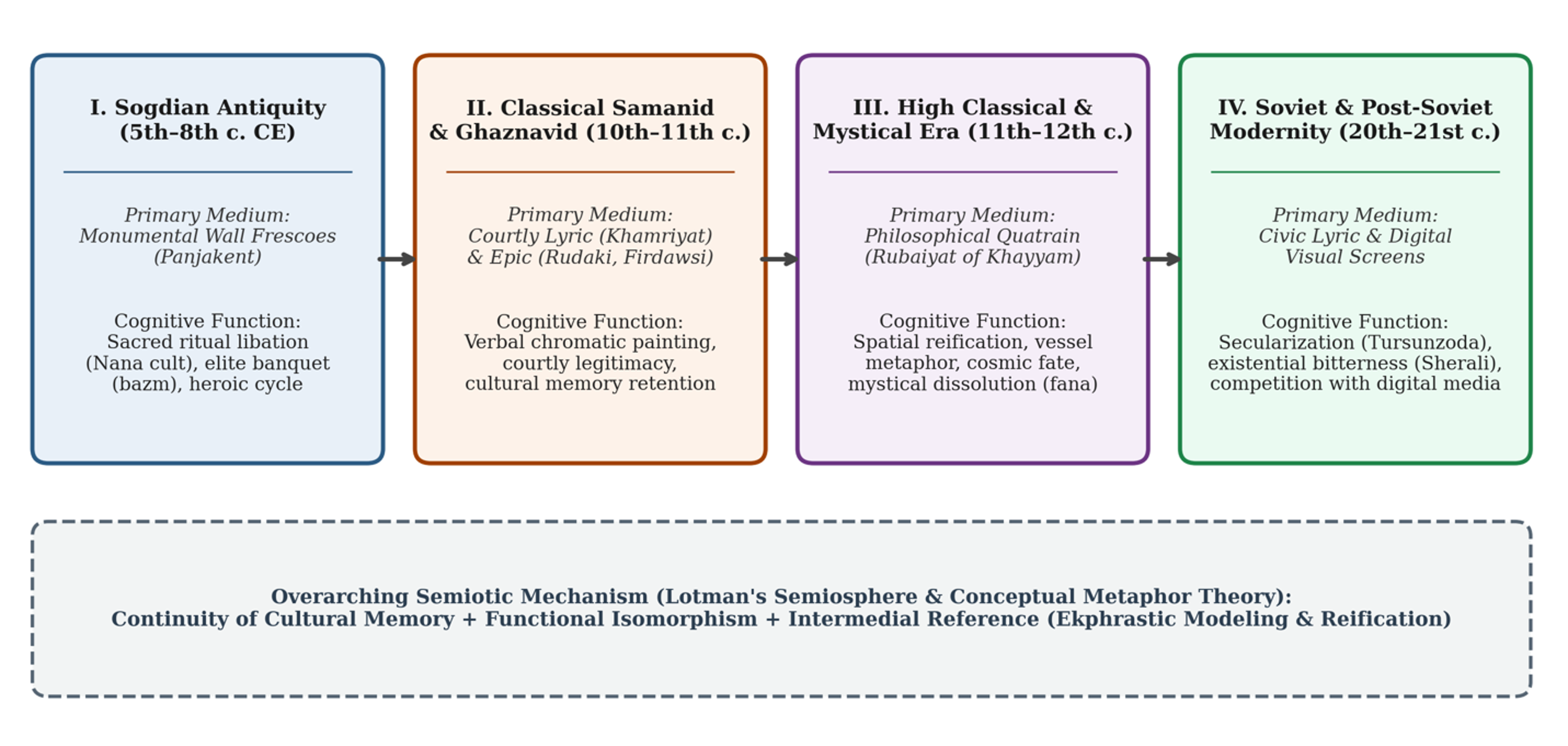
This paper explores the diachronic evolution and intermedial dynamics of the “wine code” (may and bazm) within the Persian-Tajik cultural tradition, examining its functional transformation across visual and textual media. Historically analyzed as a marker of hedonistic philosophy, the wine metaphor is reexamined here as a sophisticated semiotic and cognitive framework that adapted to shifting historical, aesthetic, and medial paradigms. The study begins by investigating the visual iconography of the feast in the monumental frescoes of ancient Sogdiana (fifth to eighth centuries), where ritual libations and banquet scenes functioned as visual media for sacred communion and social cohesion. Rather than positing a simplistic linear prohibition of visuality under Islam, the study traces how the cultural prestige of monumental wall painting gradually ceded primacy to courtly verbal arts during the Samanid and Ghaznavid eras, while figurative banquet motifs persisted in secular crafts and later miniature painting. The research demonstrates how early classical poets (Rudaki, Firdawsi) utilized ekphrastic verbal description to evoke the sensory grandeur of the royal bazm, which later evolved into the spatial-cognitive poetics of Omar Khayyam. By employing cognitive mechanisms of reification and personification, Khayyam’s quatrains construct vivid spatial-metaphorical scenarios—such as the Potter’s Workshop, the cosmic Game Board, and the Caravanserai—enabling the reader to conceptually navigate abstract categories of time, fate, and mortality. Furthermore, the paper examines 20th-century transformations, showing how Soviet ideological discourse secularized and reframed the traditional banquet motif into an emblem of collective solidarity in the civic poetry of Mirzo Tursunzoda. Finally, the study analyzes late and post-Soviet poetry (Loik Sherali), in which historical trauma undermines the traditional role of wine as a source of consolation, and reflects on how the classical text-centric code confronts the proliferation of contemporary digital visual media.
- Lotman YM. Universe of the Mind: A Semiotic Theory of Culture. Shukman A, trans. Indiana University Press; 2001. ISBN: 9780253214058
- Assmann J. Cultural Memory and Early Civilization: Writing, Remembrance, and Political Imagination. Cambridge University Press; 2011. doi: 10.1017/CBO9780511996306
- Iskandarova D. The philosophy of hedonism and the transformation of the “wine code” in Tajik poetic tradition. Quaestio Rossica. 2026;14(1):125-143. doi: 10.15826/qr.2026.1.1048
- Sufiev S. May va mayparasti dar she¡¯ri klassikii forsi-tojiki (X-XV) [Wine and Wine Drinking in Classical Persian-Tajik Poetry (10th-15th Centuries)]. Shujoiyon; 2010.
- Sufiev SZ. Vinnye motivy v persidsko-tadzhikskoy sufiyskoy poezii [Wine motifs in Persian-Tajik Sufi poetry]. Vestn Tadzhikskogo Gos Univ Prava Biznesa Polit Ser Gumanitarn Nauk. 2015;(1):102-111.
- Iskandarova DM. Korpusno-orientirovannye issledovaniya v tadzhikskoy lingvistike: ot modelirovaniya kontseptosfery k kognitivnoy grammatike [Corpus-Based Research in Tajik Linguistics: From Modeling the Conceptosphere to Cognitive Grammar]. Scientia. 2026. doi: 10.32415/scientia_978-5-908170-29-1
- Rajewsky IO. Intermediality, intertextuality, and remediation: a literary perspective on intermediality. Interm¨¦dialit¨¦s. 2005;(6):43-64. doi: 10.7202/1005505ar
- Lakoff G, Johnson M. Metaphors We Live By. University of Chicago Press; 1980. ISBN: 9780226468013
- Bartold VV. Otchet o poezdke v Srednyuyu Aziyu s nauchnoy tsel¡¯yu [Report on a Trip to Central Asia for Scientific Purposes]. Imperial Academy of Sciences; 1897.
- Bartold VV. Sochineniya. Tom 8. Raboty po istochnikovedeniyu [Works. Vol 8. Works on Source Study]. Nauka; 1973.
- Bertels EE. Istoriya persidsko-tadzhikskoy literatury [History of Persian-Tajik Literature]. Izdatel’stvo vostochnoy literatury; 1960.
- Gafurov BG. Tadzhiki: Drevneyshaya, drevnyaya i srednevekovaya istoriya [The Tajiks: Most Ancient, Ancient, and Medieval History]. Nashriyoti muosir; 2020.
- Shukurov M. Khuroson ast in jo: Maqolaho dar borai istiqloli farhangi va ma¡¯navi [Khurasan Is Here: Articles on Cultural and Spiritual Independence]. Oli Somon; 1997. OCLC/WorldCat: 38975676
- Iskandarova DM. Yazykovaya situatsiya v Tadzhikistane: etnokontaktnye zony [Language situation in Tajikistan: ethno-contact zones]. Rusin. 2023;(74):319-338. doi: 10.17223/18572685/74/16
- Belenitskiy AM. Monumental’noe iskusstvo Pendzhikenta: Zhivopis’, Skul’ptura [Monumental Art of Panjakent: Painting, Sculpture]. Iskusstvo; 1973.
- Marshak BI. Iskusstvo Sogda [Art of Sogdiana]. In: Istoriya tadzhikskogo naroda. Tom 2. Epokha formirovaniya tadzhikskogo naroda [History of the Tajik People. Vol 2]. Entsiklopediyai millii Tojik; 1999:225-289. ISBN: 5-89670-008-3
- Marshak BI. Legends, Tales, and Fables in the Art of Sogdiana. Bibliotheca Persica Press; 2002. ISBN: 9780933273610
- Grabar O. The Formation of Islamic Art. Rev ed. Yale University Press; 1987. ISBN: 9780300040463
- Blair SS, Bloom JM. The Art and Architecture of Islam 1250-1800. Yale University Press; 1994. ISBN: 9780300058888
- Brookshaw DP. Palaces, pavilions and pleasure-gardens: the context and setting of the medieval majlis. Middle East Lit. 2003;6(2):199-223. doi: 10.1080/14752620306890
- Rudaki A. Ash’or [Poems]. Adib; 2007.
- Firdavsi A. Shohnoma [Shahnameh]. Vol 1-2. Adib; 2007.
- Khayyam U. Ruboiyot [Rubaiyat]. Aini K, comp-ed. Irfon; 1983.
- Hedayat S. Pesni Khayyama [Songs of Khayyam]. Komissarov DP, trans. In: Izbrannye Proizvedeniya [Selected Works]. Khudozhestvennaya Literatura; 1969:261-320.
- Seyed-Gohrab AA, ed. The Great Umar Khayyam: A Global Reception of the Rubaiyat. Leiden University Press; 2012. ISBN: 9789087281571
- De Blois F. Persian Literature: A Bio-Bibliographical Survey. Vol V: Poetry of the Pre-Mongol Period. 2nd ed. Routledge; 2004. doi: 10.4324/9780203647493
- Schimmel A. Mystical Dimensions of Islam. University of North Carolina Press; 1975. ISBN: 9780807812716
- Tursunzoda M. Kulliyot [Complete Works]. Vol 1. Irfon; 1971.
- Akbarzoda Y. Mirzo Tursunzoda va bozsozii nazari va amalii adabiyot [Mirzo Tursunzoda and Theoretical and Practical Reconstruction of Literature]. Adib; 2011.
- Hodizoda R, Shukurov M, Abdujabborov T. Adabiyoti sovetii tojik [Soviet Tajik Literature]. Maarif; 1981.
- Sherali L. Ash’or [Poems]. In: Kulliyot [Complete Works]. Part 1. Adib; 2008.
- Nabavi A. Justorho va ibtikorot [Quests and Initiatives]. Dushanbe. Adib; 2009.