
The role of movement in the Džolomari ritual of North Macedonia

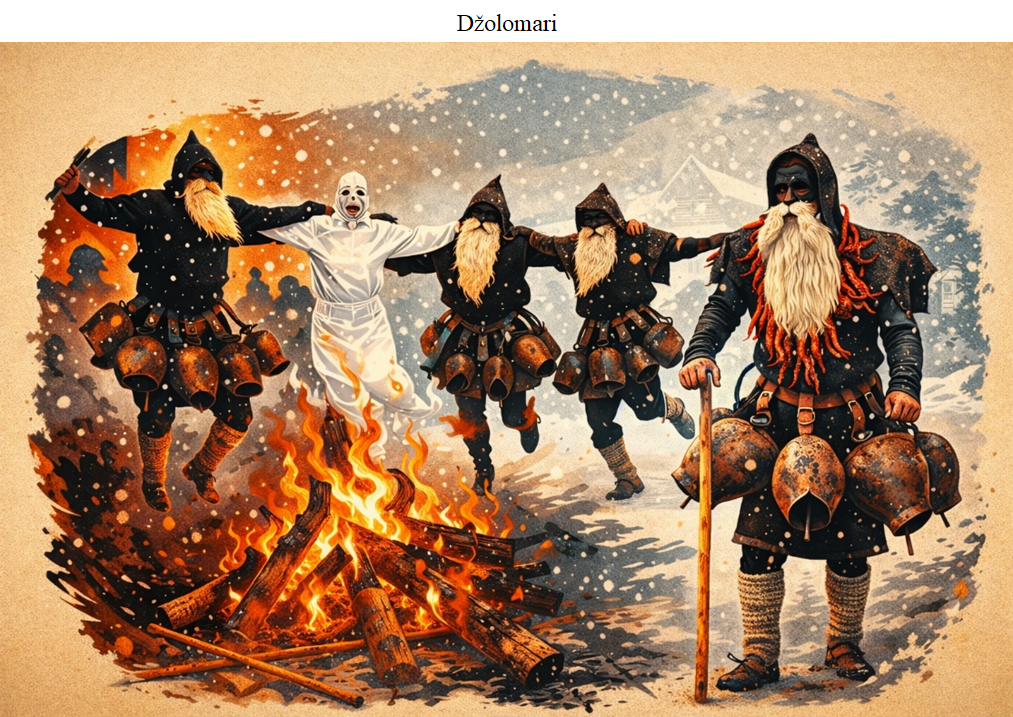
The Džolomari (Џоломари), or Džamalari (Џамалари), are masked pagan performers of the Kavadarci region in North Macedonia, traditionally active during the winter season to expel evil spirits and ensure fertility, health, and prosperity. The performers’ rhythmic and coordinated movements are considered the central point of this ritual, which gives the ceremony its structure and symbolic meaning. The present study examines the Džolomari ritual through these embodied actions, showing how movement transforms the ritual into a living form of dance. Fieldwork in the villages of Begnište and Rasava included participant observation and interviews with performers and residents, documenting not only the physical movements but also their cultural significance. The performers’ repeated jumps, rightward circles, bell-shaking, and symbolic fertility gestures are passed down through generations and recognized as essential to the ritual. Drawing on theoretical frameworks from dance anthropology, techniques of the body, symbolic anthropology, and performance theory, the present study shows that the ritual’s meaning emerges through the body rather than through words. Movement creates unity, expresses cultural values such as renewal and protection, and turns the village itself into a performance space. The Džolomari ritual can therefore be regarded as a ritual dance, in which rhythmic, symbolic, and structured movement tells a story of social, spiritual, and cultural continuity.
- Bjeljac Ž, Terzić A. Tourism valorization of carnival in Serbia. In: Rituals and festivals under masks on the Balkan: tradition, condition, tendention. Institute of Old Slavic Culture; Municipality of Prilep; 2019:177-194. Available from: https://www.researchgate.net/publication/330926768_turisticka_valorizacija_karnevala_u_srbiji_tourism_valorization_of_carnival_in_serbia [Last accessed on 2025 May 20].
- Vitanova-Ringaceva A. Функцијата на обредите со маски и нивна манифестација во тримерските празнувања и карневалот во Струмица [The function of masked rituals and their manifestation in the Trimer celebrations and the carnival in Strumica]. In: Zbornik na trudovi. 2014. Available from: https://eprints.ugd.edu.mk/29416/ [Last accessed on 2025 Aug 02]. [in Macedonian].
- Bočev V. Маскирањето и обичаите под маски во Македонија [Masking and masked customs in Macedonia]. Етнолог. 1993;3:114-124. Available from: https://share.google/mb1UuoMyqky5oWphk [Last accessed on 2025 May 26]. [in Macedonian].
- Fitch WT, Barnstaple R. Dance as mindful movement: a perspective from motor learning and predictive coding. BMC Neurosci. 2024;25(1). doi: 10.1186/s12868-024-00894-9
- Solomon F, Champion D, Steele M, Wright T. Embodied physics: utilizing dance resources for learning and engagement in STEM. J Learn Sci. 2022;31(1):73-106. doi: 10.1080/10508406.2021.2023543
- Bolya AM. Macedonian dance heritage: Twelfth day in Kičevo region (Macedonia). 2017. Available from: https://www.researchgate.net/publication/321836333 [Last accessed on 2025 Feb 10].
- Eriksen TH, Nielsen FS. A History of Anthropology. London: Pluto Press. 2013. Available from: https://www.researchgate.net/publication/353867250_A_History_of_Anthropology [Last accessed on 2025 Jul 16].
- Kaeppler AL. Dance ethnology and the anthropology of dance. Dance Res J. 2000;32(1):116–125. doi: 10.2307/1478285
- Kaeppler AL. The Mystique of Fieldwork. In: Dance in the Field. Palgrave Macmillan UK; 1999:13-25. doi: 10.1057/9780230375291_2
- Mauss M. Techniques of the body. In: Sociology and Psychology: Essays. London: Routledge. 1973:70–88. Available from: https://monoskop.org/images/c/c4/Mauss_Marcel_1935_1973_Techniques_of_the_Body.pdf [Last accessed on 2025 Jul 05].
- Turner V. The Ritual Process: Structure and Anti-Structure. Chicago: Aldine. 1969. Available from: https://www.academia.edu/11040678/Victor_Turner_The_Ritual_Process_Structure_and_Antisctructure [Last accessed on 2025 May 25].
- Geertz C. The Interpretation of Cultures. New York: Basic Books; 1973. Available from: https://web.mit.edu/allanmc/www/geertz.pdf [Last accessed on 2025 Sep 15].
- Bolya AM. Dionuszosz oroksege: A balkani maszkos szokasok es az angol masque műfaj elődjenek tekinthető mummer’s play [The mummer’s play can be considered the predecessor of Balkan masked customs and the English masque genre]. Tanctudomanyi Kozlemenyek. 2017;9(1):11-24. Available from: https://mte.eu/wp-content/uploads/2022/04/TTK_201701_vegso_0.pdf [Last accessed on 2025 Mar 11]. [in Hungarian].
- Bolya AM. Dionuszosz utazasai: Keresztenyseg előtti elemek a macedon es szlovak hagyomany teli alakoskodo unnepeiben [Pre-Christian elements in the winter transfiguration celebrations of Macedonian and Slovak tradition]. Acta Ethnographica Danubiana. 2017;18-19:55-72. https://mek.oszk.hu/24700/24743/24743.pdf [Last accessed on 2024 May 22]. [in Hungarian].