
Cracking mechanism in single-pass molten pool of laser-directed energy deposition-manufactured FeCoCrNiAl high-entropy alloy coatings

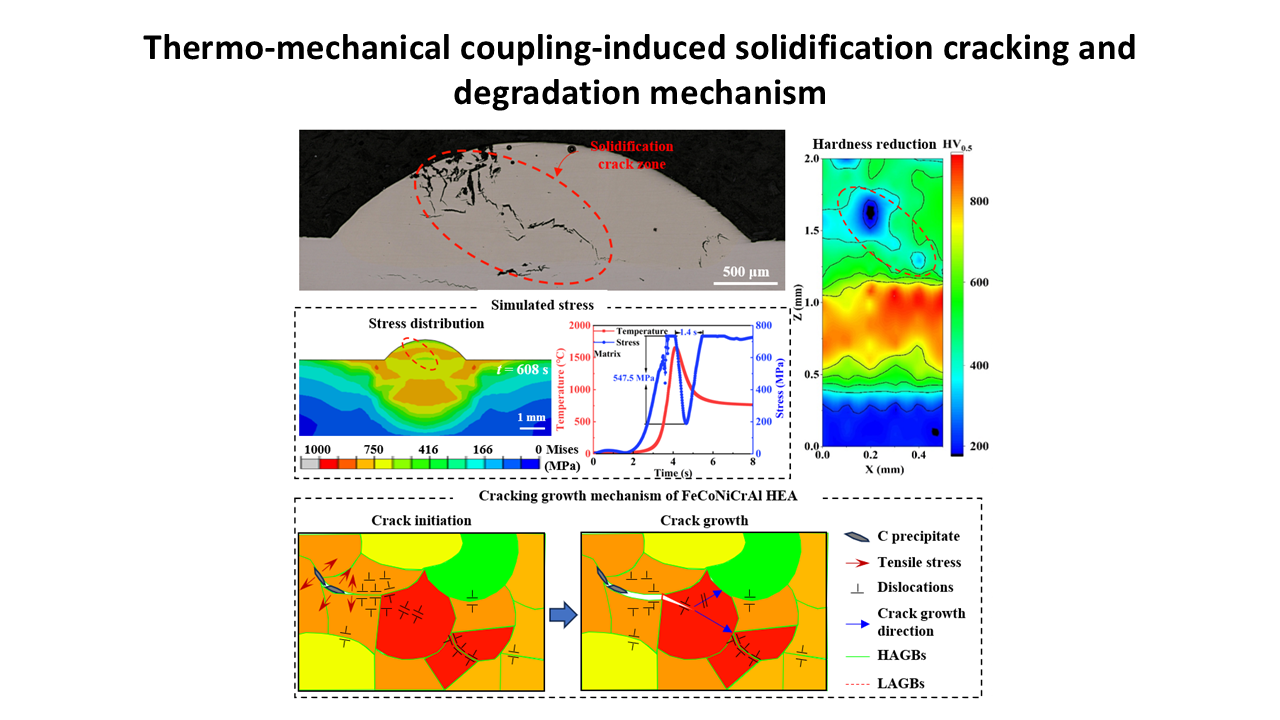
To meet the critical strategic demands of deep-sea and polar exploration, there is an urgent need to develop a new generation of marine exploration equipment with enhanced corrosion resistance, drag reduction, and ice prevention capabilities. High-entropy alloy (HEA) coatings are an effective way to address these problems, offering excellent corrosion resistance, high mechanical properties, and drag-reduction characteristics. Laser-directed energy deposition (LDED) additive manufacturing is an advanced manufacturing technique for fabricating HEA coatings, enabling the deposition of components on complex curved surfaces while delivering excellent overall performance. However, the inherent cracking problem in LDED-processed HEAs accelerates rapid damage and coating failure. In this work, the FeCoCrNiAl HEA coatings were fabricated on the GCr18Mo substrate using LDED. The crack types and underlying cracking mechanisms, as well as crack-induced hardness degradation mechanisms, are elucidated. The results show that the defect types include solidification cracks, heat-affected zone (HAZ) cracks, and gas pores, with solidification cracks accounting for a substantial proportion. The hot stress in the molten pool exceeds the coating strength. The residual tensile stress (~ 900 MPa) in the HAZ exceeds the yield strength of the matrix, while stress fluctuations in the molten pool during solidification triggered crack initiation. The cracking mechanism is closely related to grain orientation, dislocation accumulation, and carbide. The geometrically necessary dislocation density at the crack (~ 1.33 × 10¹⁴ m−2) is higher than that in the matrix. Hard carbide particles play a critical role in crack initiation. Moreover, solidification cracks are a mixture of trans-granular and inter-granular cracks. The hardness of the molten pool, HAZ, and interface zones is higher than that of the substrate, with the HAZ exhibiting a hardness 3.53 times higher. Cracks cause a localized reduction in hardness, with the most pronounced decrease occurring in the solidification crack region. Clarifying the cracking mechanism of the LDED-manufactured HEA coatings will contribute to breakthroughs in marine engineering equipment.
- Zhu D, Wang M, Liu Q, et al. A strategy for anti-icing and drag reduction in marine applications via in situ gas injection. Chem Eng J. 2025;503:158689. doi: 10.1016/j.cej.2024.158689
- Wang J, Li X, Zheng L, Li Y. Biofouling prevention and control technology for marine engineering equipment: From traditional methods to intelligent interface engineering. Mar Pollut Bull. 2026;223:118924. doi: 10.1016/j.marpolbul.2025.118924
- Zhang W, Wang X, Zhang F, et al. Frontiers in high entropy alloys and high entropy functional materials. Rare Met. 2024;43(10):4639-4776. doi: 10.1007/s12598-024-02852-0
- Liu J, Liu Q, Zhao L, Yang W, Wang X. Reducing pitting corrosion trend of cast GCr15 steel by inoculation: an in situ corrosion morphology study. Coatings. 2024;14(7):836. doi: 10.3390/coatings14070836
- Zhang X, Xia D, Sun Y, et al. Synergistic regulation of gradient nanostructure and properties in GCr18Mo bearing steel via ultrasonic surface rolling processing pretreatment and plasma nitriding. Surf Coat Technol. 2026;525:133320. doi: 10.1016/j.surfcoat.2026.133320
- Xu L, Sun S, Liu Z, et al. Post-treating LDED Ni40A/WC coatings on H13 steel with mechanical milling and laser polishing method. J Manuf Process. 2025;155:42-54. doi: 10.1016/j.jmapro.2025.10.022
- Ning J, Zhu L, Wang S, et al. Printability disparities in heterogeneous material combinations via laser directed energy deposition: A comparative study. Int J Extreme Manuf. 2024;6(2):025001. doi: 10.1088/2631-7990/ad172f
- Bhardwaj T, Shukla M, Paul CP, Bindra KS. Direct energy deposition - laser additive manufacturing of titanium-molybdenum alloy: parametric studies, microstructure and mechanical properties. J Alloys Compd. 2019;787:1238-1248. doi: 10.1016/j.jallcom.2019.02.121
- Li X, Zhu H, Cui X, et al. Enhanced oxidation and wear resistance of laser-clad FeCoCrNiAl high-entropy alloy coatings at 800 °C. Mater Chem Phys. 2026;349:131691. doi: 10.1016/j.matchemphys.2025.131691
- Cheng H, Pan Z, Fu Y, et al. Review corrosion-resistant high-entropy alloy coatings: A review. J Electrochem Soc. 2021;168(11):111502. doi: 10.1149/1945-7111/ac34d0
- Han F, Liu R, Wang K, et al. Achieving ultrahigh aluminum melt corrosion resistance via laser-induced nanoeutectic architectures in WMoTaNb high-entropy alloy coatings. Mater Des. 2026;261:115325. doi: 10.1016/j.matdes.2025.115325
- Zhang P, Li Z, Liu H, et al. Recent progress on the microstructure and properties of high entropy alloy coatings prepared by laser processing technology: A review. J Manuf Process. 2022;76:397-411. doi: 10.1016/j.jmapro.2022.02.006
- Liu Z, Liang B, Wang R, Zou T, Liang Z, Liu X. Microstructure, mechanical properties and corrosion resistance of laser direct energy deposited AlMo0.25FeCoCrNi2.1 high-entropy alloy: Adjusted by annealing heat treatment. Virtual Phys Prototyp. 2024;19(1):e2385569. doi: 10.1080/17452759.2024.2385569
- Wang Z, Zhu J, Guo Y, et al. Multi-effects of mo on enhancement of wear and corrosion resistances of FeCoNiCrMo high entropy alloys coatings prepared by laser powder directed energy deposition. Surf Coat Technol. 2024;477:130378. doi: 10.1016/j.surfcoat.2024.130378
- Zhang B, Li W, Zou S, Dong H, Liang Q, Cai Y. The regulation strategy, heterostructure characteristics, and strengthening-toughening mechanisms of functionally graded high-entropy alloy fabricated by LDED. Mater Sci Eng A. 2025;945:148981. doi: 10.1016/j.msea.2025.148981
- Xiao D, Jiang F, Song T, et al. Impact of dilution on the microstructural evolution and corrosion behavior in high-entropy alloy coatings applied via laser cladding on marine engineering equipment. Eng Fail Anal. 2025;171:109337. doi: 10.1016/j.engfailanal.2025.109337
- Mohammadnejad A, Sun M, Yarlapati NA, et al. Additive manufacturing of refractory high-entropy alloys: A critical review of fundamentals and advances. Mater Des. 2025;260:115261. doi: 10.1016/j.matdes.2025.115261
- Ye L, Xue H, Li Z, et al. Review of online quality control for laser directed energy deposition (LDED) additive manufacturing. Int J Extreme Manuf. 2025;7(6):062005. doi: 10.1088/2631-7990/aded4f
- Mooraj S, Dong X, Zhang S, et al. Crack mitigation in additively manufactured AlCrFe2Ni2 high-entropy alloys through engineering phase transformation pathway. Commun Mater. 2024;5(1):101. doi: 10.1038/s43246-024-00542-z
- Cui D, Zhang S, Wang S, et al. Processing defects and damage mechanisms in refractory high-entropy alloys additively manufactured via directed energy deposition. J Mater Sci Technol. 2026;258:170-186. doi: 10.1016/j.jmst.2025.09.034
- Zhang B, Mu W, Cai Y. Design, formability, and strengthening mechanism of CoCrFeNiTix high-entropy alloys fabricated using laser directed energy deposition. Intermetallics. 2025;181:108725. doi: 10.1016/j.intermet.2025.108725
- Zeng Y, Guan B, Yuan T, Chen H, Li L. Suppression of hot cracking in ni-based single-crystal superalloys fabricated by laser directed energy deposition through thermal cycle regulation. Int J Mach Tools Manuf. 2025;208:104283. doi: 10.1016/j.ijmachtools.2025.104283
- Li Y, Tang Y, Shi Y, et al. Cracking behaviour, microstructure evolution, and mechanical properties of GH4169/K477 by laser directed energy deposition. Virtual Phys Prototyp. 2025;20(1):e2449180. doi: 10.1080/17452759.2024.2449180
- Ouyang D, Zhang C, Chen R, Li N, Chan KC, Liu L. The microcrack inhibition and mechanical properties of an in-situ synthesized refractory high-entropy alloy fabricated by additive manufacturing. Mater Sci Eng A. 2024;913:147071. doi: 10.1016/j.msea.2024.147071
- Yang Z, Jian Y, Chen Z, et al. Microstructure, hardness and slurry erosion-wear behaviors of high-speed laser cladding Stellite 6 coatings prepared by the inside-beam powder feeding method. J Mater Res Technol. 2022;19:2596-2610. doi: 10.1016/j.jmrt.2022.06.025
- Liu W, Li H, Deng Z, et al. Simultaneous regulation of strength and ductility of laser powder bed fusion manufactured Haynes 230 alloy. J Alloys Compd. 2023;968:171777. doi: 10.1016/j.jallcom.2023.171777
- Wu D, Tian J, Liao M, Zhao M, Liu G. Study on the effect of variable laser power on residual stress distribution in laser directed energy deposition of Ti6Al4V. CIRP J Manuf Sci Technol. 2024;55:322-332. doi: 10.1016/j.cirpj.2024.10.011
- Zuo S, Wang Z, Wang D, et al. Numerical simulation and experimental research on temperature distribution of fillet welds. Materials. 2020;13(5):1222. doi: 10.3390/ma13051222
- Li Y, Chen K, Tamura N. Mechanism of heat affected zone cracking in ni-based superalloy DZ125L fabricated by laser 3D printing technique. Mater Des. 2018;150:171-181. doi: 10.1016/j.matdes.2018.04.032
- Zhou J, Shen L, Yang X, Li R, Pan K. Tuning pores and mechanical properties for the heterogeneous interface of laser directed energy deposited IN718/316L laminate via in-situ laser surface remelting. J Alloys Compd. 2025;1010:177872. doi: 10.1016/j.jallcom.2024.177872
- Mei X, Wang X, Peng Y, Gu H, Zhong G, Yang S. Interfacial characterization and mechanical properties of 316L stainless steel/inconel 718 manufactured by selective laser melting. Mater Sci Eng A. 2019;758:185-191. doi: 10.1016/j.msea.2019.05.011
- Zhou Q, Huang P, Guo N, Wang J, Pan Y, Lu X. Multiscale mechanisms of residual stress evolution and cyclic loading inspired cracking in laser additively manufactured TC11 large-scale components. Eng Fail Anal. 2026;183:110238. doi: 10.1016/j.engfailanal.2025.110238
- Zhu L, Geng K, Wang J, et al. Strain hardening and strengthening mechanism of laser melting deposition (LMD) additively manufactured FeCoCrNiAl0.5 high-entropy alloy. Mater Charact. 2022;194:112365. doi: 10.1016/j.matchar.2022.112365
- Jayasekaran R, Mahmoudi A, Narasimhan JSML, Sadeghi F, England RD, Ren N. Hydrogen Diffusion, Effusion, and tensile fatigue of AISI 52100 steel. Eng Fail Anal. 2025;179:109796. doi: 10.1016/j.engfailanal.2025.109796
- Xie Y, Gong M, Zhou Q, et al. Effect of microstructure on fatigue crack growth of wire arc additive manufactured Ti–6Al–4V. Mater Sci Eng A. 2021;826:141942. doi: 10.1016/j.msea.2021.141942
- Wang H, Li H, Wang J, Li F, Hu L. Microstructural evolution and strengthening mechanism in laser powder bed fusion 316L stainless steel with high strength and ductility. J Mater Eng Perform. 2025;34(9):7426-7436. doi: 10.1007/s11665-024-09727-6
- Lu J, Zheng H, Ji X, et al. Crack characteristics analysis and mechanisms in GH3536 alloy manufactured by laser powder bed fusion. Eng Fail Anal. 2024;162:108382. doi: 10.1016/j.engfailanal.2024.108382
- Ma M, Wang B, Liu H, Yi D, Shen F, Zhai T. Investigation of fatigue crack propagation behavior of 5083 aluminum alloy under various stress ratios: Role of grain boundary and Schmid factor. Mater Sci Eng A. 2020;773:138871. doi: 10.1016/j.msea.2019.138871
- Liu W, Shen S, Meng J, et al. Mechanical field assisted additive manufacturing of ultrahigh strength aluminum alloy. Int J Extreme Manuf. 2025;7(4):045008. doi: 10.1088/2631-7990/adbb95
- Liu W, Li H, Yin Q, Zhou X. Promoting densification and strengthening effect of ultrasonic impact treatment on Haynes 230 alloy manufactured by laser powder bed fusion. J Mater Sci Technol. 2025;216:226-240. doi: 10.1016/j.jmst.2024.07.036
- Konijnenberg PJ, Zaefferer S, Raabe D. Assessment of geometrically necessary dislocation levels derived by 3D EBSD. Acta Mater. 2015;99:402-414. doi: 10.1016/j.actamat.2015.06.051
- Sow MC, De Terris T, Castelnau O, et al. Influence of beam diameter on laser powder bed fusion (L-PBF) process. Addit Manuf. 2020;36:101532. doi: 10.1016/j.addma.2020.101532
- Mahmud A, Meher S, Renner P, et al. Optimizing laser powder directed energy deposition for Grade-91 and Grade-92 ferritic/martensitic steels for nuclear applications: linking process parameters to microstructure. Front Nucl Eng. 2025;4:1655503. doi: 10.3389/fnuen.2025.1655503
- Chen D, Guan Y, Jin G, et al. In-situ synthesis of a FeCoCrNiCu/FeCoCrNiAl composite high entropy alloy coating by laser cladding. Surf Coat Technol. 2023;461:129447. doi: 10.1016/j.surfcoat.2023.129447
- Cai Y, Li X, Xia H, et al. Fabrication of laminated high entropy alloys using differences in laser melting deposition characteristics of FeCoCrNi and FeCoCrNiAl. J Manuf Process. 2021;72:294-308. doi: 10.1016/j.jmapro.2021.10.022
- Niu P, Li R, Fan Z, et al. Inhibiting cracking and improving strength for additive manufactured AlxCoCrFeNi high entropy alloy via changing crystal structure from BCC-to-FCC. Addit Manuf. 2023;71:103584. doi: 10.1016/j.addma.2023.103584
- Liu C, Wu Y, Zhou J, Wen Y, Wang L, Xie L. Effect of in situ electromagnetic field manipulation on the microstructure and hardness of titanium alloy during laser melting deposition. Mater Sci Addit Manuf. 2025;4(1):8332. doi: 10.36922/msam.8332
- Yang J, Yu H, Wang Z, Zeng X. Effect of crystallographic orientation on mechanical anisotropy of selective laser melted Ti-6Al-4V alloy. Mater Charact. 2017;127:137-145. doi: 10.1016/j.matchar.2017.01.014
- Li Y, Gu D, Dai D, Shi K, Zhao W, Shi X. Prediction of crystal nucleation and growth behavior of Fe/Ni-based multi-materials deposited by laser directed energy deposition using a multi-area, multi-layer, and multi-scale phase field calculation (M3-PFC). Addit Manuf. 2024;79:103946. doi: 10.1016/j.addma.2023.103946
- Karma A. Phase-Field formulation for quantitative modeling of alloy solidification. Phys Rev Lett. 2001;87(11):115701. doi: 10.1103/PhysRevLett.87.115701
- Birosca S, Liu G, Ding R, et al. The dislocation behaviour and GND development in a nickel based superalloy during creep. Int J Plast. 2019;118:252-268. doi: 10.1016/j.ijplas.2019.02.015
- Mori T, Tanaka K. Average stress in matrix and average elastic energy of materials with misfitting inclusions. Acta Metall. 1973;21(5):571-574. doi: 10.1016/0001-6160(73)90064-3
- Holzapfel C, Schäf W, Marx M, Vehoff H, Mücklich F. Interaction of cracks with precipitates and grain boundaries: Understanding crack growth mechanisms through focused ion beam tomography. Scr Mater. 2007;56(8):697-700. doi: 10.1016/j.scriptamat.2006.12.025
- Saravanan N, Karamched PS, Liu J, Rainasse C, Scenini F, Lozano-Perez S. Using local GND density to study SCC initiation. Ultramicroscopy. 2020;217:113054. doi: 10.1016/j.ultramic.2020.113054
- Li R, Wang H, He B, et al. Effect of α texture on the anisotropy of yield strength in Ti–6Al–2Zr–1Mo–1V alloy fabricated by laser directed energy deposition technique. Mater Sci Eng A. 2021;824:141771. doi: 10.1016/j.msea.2021.141771
- Yang W, Liu C, Jin KH, et al. In-situ tensile study of Fe and trace B effects on deformation behavior and strengthening mechanisms in LDED-fabricated Ti-6Al-4V alloys. Mater Des. 2025;260:115043. doi: 10.1016/j.matdes.2025.115043
- Kim TG, Shim DS. Effect of laser power and powder feed rate on interfacial crack and mechanical/microstructural characterizations in repairing of 630 stainless steel using direct energy deposition. Mater Sci Eng A. 2021;828:142004. doi: 10.1016/j.msea.2021.142004
- Bi Y, Yuan X, Lv J, Bashir R, Wang S, Xue H. Effect of yield strength distribution welded joint on crack propagation path and crack mechanical tip field. Materials. 2021;14(17):4947. doi: 10.3390/ma14174947
- Pavlina EJ, Van Tyne CJ. Correlation of yield strength and tensile strength with hardness for steels. J Mater Eng Perform. 2008;17(6):888-893. doi: 10.1007/s11665-008-9225-5