
Environmental implications of feedback-controlled heat input in wire arc additive manufacturing of Invar 36 through online contact tip-to-workpiece distance adjustment

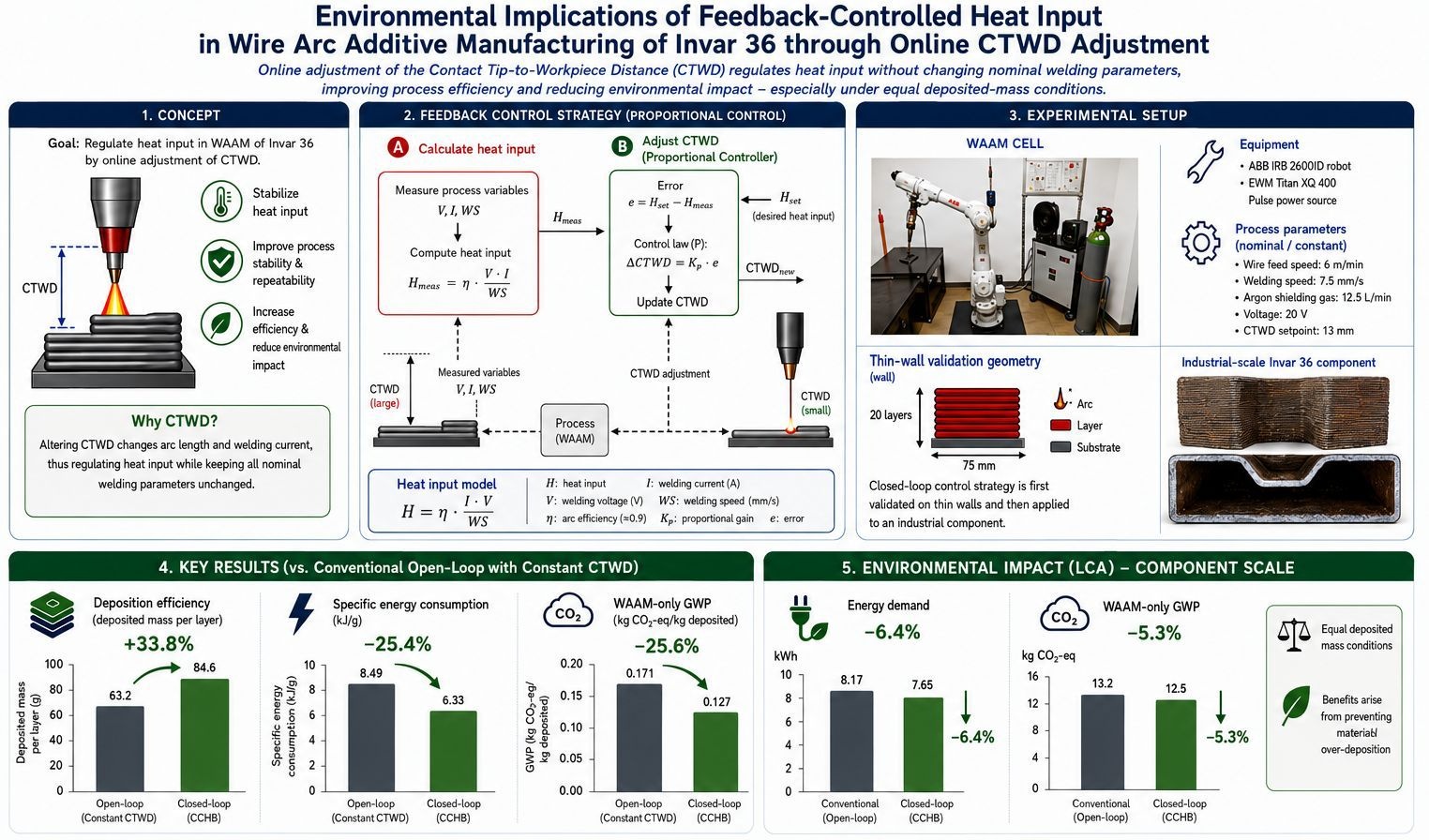
Wire arc additive manufacturing (WAAM) is attracting increasing interest for the production of large metallic components due to its high material efficiency and productivity. However, process instability and heat input fluctuations can compromise geometric consistency, process reliability, and compliance with qualification requirements, while also affecting energy consumption and environmental performance. This study investigates the environmental implications of feedback-controlled heat-input regulation in WAAM of Invar 36, with particular emphasis on carbon footprint through life cycle assessment (LCA). In contrast to conventional WAAM control strategies, which typically target bead geometry, the proposed approach regulates thermal input through online adjustment of the contact tip-to-workpiece distance (CTWD). This enables heat-input control while preserving the nominal welding parameters, which is particularly relevant for qualification-oriented manufacturing. By combining layer-wise thin-wall experiments with scale-up to an industrial Invar 36 component, the study shows that closed-loop heat-input control increased deposited mass per layer by up to 33.8%, while reducing specific energy consumption and WAAM-only global warming potential (GWP) by up to 25.4% and 25.6%, respectively. At the component scale, the measured energy demand decreased from 8.17 to 7.65 kWh and the WAAM-only GWP from 13.2 to 12.5 kg CO₂-eq. These findings confirm that heat-input regularisation improves WAAM process efficiency and process-related sustainability. However, because feedstock production dominates the total environmental impact, the full carbon-footprint benefit can only be achieved if geometry- or mass-based feedback prevents unnecessary material over-deposition. The results therefore indicate that closed-loop control provides the greatest environmental advantage under equal deposited-mass conditions.
- Xia C, Pan Z, Polden J, et al. A review on wire arc additive manufacturing: Monitoring, control and a framework of automated system. J Manuf Syst. 2020;57:31-45. doi: 10.1016/j.jmsy.2020.08.008
- Dinh DM, Le VT, Tran VC, et al. An experimental– numerical investigation on thermal cycles and their effects on microstructure and mechanical properties in wire arc additive manufacturing of Inconel 625 superalloy rectangular walls. Weld World. Published online March 29, 2026. doi: 10.1007/s40194-026-02440-z
- Gil Plazas AF, Amaya Villabón TA, Ramírez Vargas DA, Rubiano Buitrago JD, Herrera Quintero LK. Influence of interlayer thermal cycling on microstructural evolution in WAAM processed carbon steel. Weld World. 2026;70(2):471- 489. doi: 10.1007/s40194-025-02227-8
- Wu B, Pan Z, Ding D, Cuiuri D, Li H. Effects of heat accumulation on microstructure and mechanical properties of Ti6Al4V alloy deposited by wire arc additive manufacturing. Addit Manuf. 2018;23:151-160. doi: 10.1016/j.addma.2018.08.004
- Wu B, Pan Z, Ding D, et al. A review of the wire arc additive manufacturing of metals: properties, defects and quality improvement. J Manuf Process. 2018;35:127-139. doi: 10.1016/j.jmapro.2018.08.001
- Mattera G, Chozaki SP, Norrish J. Advances in machine learning for parameters optimisation and in-situ monitoring of wire arc additive manufacturing. Weld World. 2025;70(4):1173-1202. doi: 10.1007/s40194-025-02200-5
- Xia C, Pan Z, Zhang S, et al. Model predictive control of layer width in wire arc additive manufacturing. J Manuf Process. 2020;58:179-186. doi: 10.1016/j.jmapro.2020.07.060
- Xiong J, Zhang Y, Pi Y. Control of deposition height in WAAM using visual inspection of previous and current layers. J Intell Manuf. 2021;32(8):2209-2217. doi: 10.1007/s10845-020-01634-6
- Shi M, Xiong J. Controlling torch height and deposition height in robotic wire and arc additive manufacturing on uneven substrate. Weld World. 2024;68(4):765-779. doi: 10.1007/s40194-023-01633-0
- Chen D, Chen H, Zhang G, Xiong J. Towards automatic control of process stability for thick-wall parts in arc-directed energy deposition based on arc voltage sensing. J Manuf Process. 2025;141:250-262. doi: 10.1016/J.JMAPRO.2025.03.008
- Hölscher LV, Hassel T, Maier HJ. Development and evaluation of a closed-loop z-axis control strategy for wire-and-arc-additive manufacturing using the process signal. Int J Adv Manuf Technol. 2023;128(3-4):1725-1739. doi: 10.1007/s00170-023-12012-w
- Caggiano A, Mattera G, Zhang Y, Teti R. Heat input control and deep learning-based indirect measure of process and deposition stability in Wire Arc Additive Manufacturing. CIRP Ann. 2026;75. doi: 10.1016/j.cirp.2026.04.008
- Kokare S, Oliveira JP, Godina R. Life cycle assessment of additive manufacturing processes: A review. J Manuf Syst. 2023;68:536-559. doi: 10.1016/j.jmsy.2023.05.007
- Kokare S, Oliveira JP, Godina R. A LCA and LCC analysis of pure subtractive manufacturing, wire arc additive manufacturing, and selective laser melting approaches. J Manuf Process. 2023;101:67-85. doi: 10.1016/j.jmapro.2023.05.102
- Kokare S, Oliveira JP, Santos TG, Godina R. Environmental and economic assessment of a steel wall fabricated by wire-based directed energy deposition. Addit Manuf. 2023;61:103316. doi: 10.1016/j.addma.2022.103316
- Priarone PC, Pagone E, Martina F, Catalano AR, Settineri L. Multi-criteria environmental and economic impact assessment of wire arc additive manufacturing. CIRP Ann. 2020;69(1):37-40. doi: 10.1016/j.cirp.2020.04.010
- Reis RC, Kokare S, Oliveira JP, Matias JCO, Godina R. Life cycle assessment of metal products: A comparison between wire arc additive manufacturing and CNC milling. Adv Ind Manuf Eng. 2023;6:100117. doi: 10.1016/j.aime.2023.100117
- Abate R, Mattera G, Kokare S, Nele L, Guizzi G. Process Parameter Effects on the Environmental Performance of Wire Arc Additive Manufacturing of Invar 36 Alloy: A Life Cycle Assessment Approach. Sustainability. 2026;18(8):4106. doi: 10.3390/su18084106
- Aldalur E, Suárez A, Veiga F. Thermal expansion behaviour of Invar 36 alloy parts fabricated by wire-arc additive manufacturing. J Mater Res Technol. 2022;19:3634-3645. doi: 10.1016/j.jmrt.2022.06.114
- Huang G, He G, Gong X, He Y, Liu Y, Huang K. Additive manufacturing of Invar 36 alloy. J Mater Res Technol. 2024;30:1241-1268. doi: 10.1016/j.jmrt.2024.02.221
- Gil Del Val A, Cearsolo X, Suarez A, Veiga F, Altuna I, Ortiz M. Machinability characterization in end milling of Invar 36 fabricated by wire arc additive manufacturing. J Mater Res Technol. 2023;23:300-315. doi: 10.1016/J.JMRT.2022.12.182
- Khanna N, Gandhi A, Nakum B, Srivastava A. Optimization and analysis of surface roughness for INVAR-36 in end milling operations. Mater Today Proc. 2018;5(2):5281-5288. doi: 10.1016/j.matpr.2017.12.111
- Sood A, Schimmel J, Ferreira VM, et al. Directed energy deposition of Invar 36 alloy using cold wire pulsed gas tungsten arc welding: Effect of heat input on the microstructure and functional behaviour. J Mater Res Technol. 2023;25:6183-6197. doi: 10.1016/j.jmrt.2023.06.280
- Veiga F, Suárez A, Artaza T, Aldalur E. Effect of the Heat Input on Wire-Arc Additive Manufacturing of Invar 36 Alloy: Microstructure and Mechanical Properties. Weld World. 2022;66(6):1081-1091. doi: 10.1007/s40194-022-01295-4
- Iturrioz A, Ukar E, Pereira JC. Influence of the manufacturing strategy on the microstructure and mechanical properties of Invar 36 alloy parts manufactured by CMT-WAAM. Int J Adv Manuf Technol. 2025;136(2):729-744. doi: 10.1007/s00170-024-14853-5
- Ye S, Xu L, Guo Y, et al. Microstructure and mechanical properties of super-invar alloy fabricated by wire-arc additive manufacturing. Adv Manuf. Published online February 20, 2025. doi: 10.55092/am20250005
- Jiao G, Fang X, Zhang M, et al. Synergistic improvement of mechanical property and thermal expansion of Wire-arc DED Invar alloy enabled by a novel deposition strategy. J Manuf Process. 2024;121:121-135. doi: 10.1016/j.jmapro.2024.05.031
- Iturrioz A, Pereira JC, Ukar E. Application of CMT-Twin DED-Arc Process on the Fabrication of Invar 36 by In Situ Alloying. Materials. 2025;18(22):5146. doi: 10.3390/ma18225146
- Mattera G, Manoli E, Nele L. Study on the printing stability of Invar 36 alloy under different process parameter conditions in gas metal arc additive manufacturing. Mater Sci Addit Manuf. 2025;4(4):025220046. doi: 10.36922/MSAM025220046
- Zhao S, Qiu X, Burnett I, Rigby M, Lele A. A lumped-parameter model for sound generation in gas metal arc welding. Mech Syst Signal Process. 2021;147:107085. doi: 10.1016/j.ymssp.2020.107085
- Doodman Tipi AR, Pariz N. Improving the dynamic metal transfer model of gas metal arc welding (GMAW) process. Int J Adv Manuf Technol. 2015;76(1):657-668. doi: 10.1007/s00170-014-6307-4
- Teng S, Dehgahi S, Henein H, Wolfe T, Qureshi AJ. Sensor-fusion enabled inter-layer temperature control of nano-treated 7075 aluminum alloy produced through wire-arc directed energy deposition process. Prog Addit Manuf. 2025;10(2):1293-1314. doi: 10.1007/s40964-024-00707-9
- Klöpffer W. The critical review of life cycle assessment studies according to ISO 14040 and 14044. Int J Life Cycle Assess. 2012;17(9):1087-1093. doi: 10.1007/s11367-012-0426-7
- Acquesta A, Monetta T, Nele L, Mattera G. Process map, microstructure, hardness and corrosion properties of gas metal arc additive manufacturing (GMA-AM) of Invar 36 alloy. Next Mater. 2026;11:101839. doi: 10.1016/j.nxmate.2026.101839