
Recent advances in contaminant analysis in Coptidis rhizoma

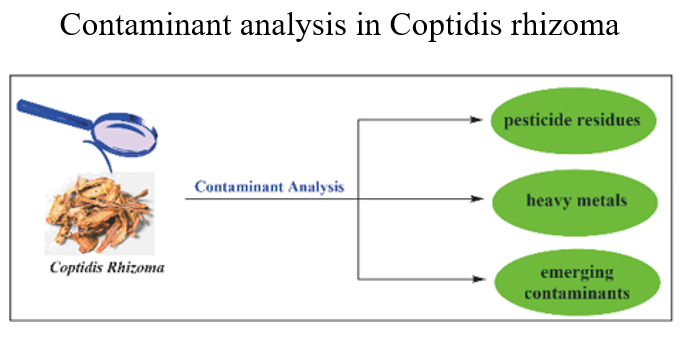
Given the clinical and international significance of Coptidis rhizoma, contaminant analysis is essential to meet evolving quality and safety requirements. This review summarizes research on pesticide residues, heavy metals, and emerging contaminants in Coptidis rhizoma. For pesticide residues, chromatography–mass spectrometry methods have been adopted for regulatory testing. For heavy metals, inductively coupled plasma mass spectrometry is widely used. However, regulatory limits and standardized detection methods for emerging contaminants in Coptidis rhizoma remain lacking. Overall, analytical advances have improved monitoring, but gaps remain in method harmonization, regulatory limits, and comprehensive risk assessment. Future efforts should focus on standardized multi-contaminant analytical platforms, science-based limits, international harmonization, and integrated risk assessment to support the quality, safety, and global competitiveness of Coptidis rhizoma.
- Wang J, Wang L, Lou GH, et al. Coptidis Rhizoma: a comprehensive review of its traditional uses, botany, phytochemistry, pharmacology and toxicology. Pharm Biol. 2019; 57(1):193–225. doi.org/10.1080/13880209.2019.1577466
- He L, Zhong Z, Chen M, Liang Q, Wang Y, Tan W. Current advances in Coptidis Rhizoma for gastrointestinal and other cancers. Front Pharmacol. 2022;12:775084. doi: 10.3389/fphar.2021.775084
- Ran Q, Wang J, Wang L, Zeng HR, Yang XB, Huang QW. Rhizoma coptidis as a potential treatment agent for type 2 diabetes mellitus and the underlying mechanisms: a review. Front Pharmacol. 2019;10:805. doi: 10.3389/fphar.2019.00805
- Xie Q, Chen J, Yang H, et al. A comprehensive review of Coptidis Rhizoma and Magnoliae Officinalis Cortex drug pair and their chemical composition, pharmacological effects and pharmacokinetics analysis. Drug Des Devel Ther. 2024;18:4413–4426. doi: 10.2147/DDDT.S477381
- Chen GM, Zhang C, Zou JY, et al. Coptidis rhizoma and berberine as anti-cancer drugs: a 10-year updates and future perspectives. Pharmacol Res. 2025;216:107742. doi: 10.1016/j.phrs.2025.107742
- Zhou R, Xiang P, Zhang J, Yang H. Research progress on chemical compositions of Coptidis Rhizoma and pharmacological effects of berberine. Zhongguo Zhong Yao Za Zhi. 2020; 45(19):4561–4573. [In Chinese]. doi: 10.19540/j.cnki.cjcmm.20200527.202
- Fan KQ, Zhang LM, Song FY, et al. Pharmacological properties and therapeutic potential of berberine: a comprehensive review. Front Pharmacol. 2025;16:1604071. doi: 10.3389/fphar.2025.1604071
- Zhang MF, Shen YQ. Research progress in antiviral pharmacological effects of berberine. Kang Gan Ran Yao Xue. 2023;20(3):223–227. [In Chinese]. doi: 10.13493/j.issn.1672-7878.2023.03-001
- Wang N, Tan HY, Li L, Yuen MF, Feng Y. Berberine and Coptidis Rhizoma as potential anticancer agents: recent updates and future perspectives. J Ethnopharmacol. 2015;176:35–48. doi: 10.1016/j.jep.2015.10.028
- Hua H, Tang JY, Zhao JN, et al. From traditional medicine to modern medicine: the importance of TCM regulatory science (TCMRS) as an emerging discipline. Chin Med. 2025; 20:92. doi: 10.1186/s13020-025-01152-8
- Tian Y, Yao J, Gao Q, et al. Holistic concept guided quality control of traditional Chinese medicines for optimizing bioavailability. Chin Med. 2025;20(1):202. doi: 10.1186/s13020-025-01269-w
- Huang Y, Huo P, Fan W, et al. Empowering Traditional Chinese Medicine with artificial intelligence: Innovations in quality control, therapeutic applications, and industrialization. TrAC Trends Anal Chem. 2026; 200:118856. doi: 10.1016/j.trac.2026.118856.
- Chen W, Luo H, Zhong Z, Wei J, Wang Y. The safety of Chinese medicine: a systematic review of endogenous substances and exogenous residues. Phytomedicine. 2023;108:154534. doi: 10.1016/j.phymed.2022.154534
- Liu YF, Wang B, Shu SH, et al. Analysis of the Coptis chinensis genome reveals the diversification of protoberberine-type alkaloids. Nat Commun. 2021;12(1):3276. doi: 10.1038/s41467-021-23611-0
- Meng FC, Wu ZF, Yin ZQ, Lin LG, Wang R, Zhang QW. Coptidis rhizoma and its main bioactive components: recent advances in chemical investigation, quality evaluation and pharmacological activity. Chin Med. 2018;13(1):13. doi: 10.1186/s13020-018-0171-3
- Wu L, Zhao B, Deng Z, Wang B, Yu Y. A biosynthetic network for protoberberine production in Coptis chinensis. Hortic Res. 2024; 11(1):uhad259. doi: 10.1093/hr/uhad259
- Phogat A, Singh J, Malik V. Pharmacological effects of berberine – a Chinese medicine, against xenobiotics toxicity. Pharmacol Res Mod Chin Med. 2024;13:100507. doi: 10.1016/j.prmcm.2024.100507
- Živančević K, Baralić K, Bozic D, et al. Involvement of environmentally relevant toxic metal mixture in Alzheimer’s disease pathway alteration and protective role of berberine: bioinformatics analysis and toxicogenomic screening. Food Chem Toxicol. 2022;161:112839. doi: 10.1016/j.fct.2022.112839
- Goudarzi M, Kalantar M, Malayeri A, Basir Z, Karamallah MH, Kalantar H. Berberine alleviates sodium arsenite-induced renal and liver toxicity by regulating oxidative stress and inflammation in rats. Toxicol Environ Health Sci. 2023;15(2):157–172. doi: 10.1007/s13530-023-00168-7
- Guo Z, Li J, Zeng L, Wang P, Li M, Su C, Wang S. Advances in research on novel technologies for the detection of exogenous contaminants in traditional Chinese medicine. Front Pharmacol. 2025;16:1658241. doi: 10.3389/fphar.2025.1658241
- Wong EL, Ho PK, Wan CH, Choi YY. Development of a modified QuEChERS extraction for the determination of organochlorine pesticide residues in Chinese herbal medicines using gas chromatography – tandem mass spectrometry (GC-MS/MS): method validation and measurement uncertainty evaluation. Pure Appl Chem. 2026;98(10):1597-1619. doi: 10.1515/pac-2025-0684
- Ham HJ, Sardar SW, Ishag AE, Choi JY, Hur JH. Optimization of an analytical method for indoxacarb residues in fourteen medicinal herbs using GC–μECD, GC–MS/MS and LC–MS/MS. Separations. 2022; 9(9):232. doi: 10.3390/separations9090232
- Yang Y, Liu L, Wang Z, Jin Y, Zhang Y. Simultaneous determination of protoberberine alkaloids derived from Coptidis Rhizoma and Phellodendri Cortex in pharmaceuticals by on-line solid-phase extraction (SPE)—high performance liquid chromatography with ultraviolet detection (HPLC-UV). Anal Lett. 2023;56(8):1256–1269. doi: 10.1080/00032719.2022.2125525
- Yang WX, Wang SM, Li YY, et al. A comprehensive review of detection and removal strategy for organic pesticide residues in Chinese herbal medicines. Talanta. 2026; 299:129098. doi: 10.1016/j.talanta.2025.129098
- Wu JL, Zou YH, Li LQ. Multi-residue analysis of fifteen organochlorine and pyrethroid insecticides in Radix paeoniae Alba and Rhizoma coptidis. Chin J Pestic Sci. 2006;8(1):65–70.
- Chinese Pharmacopeia Commission. Pharmacopeia of the People’s Republic of China: Part IV, General Chapter 2341. China Medical Science and Technology Press, Beijing. 2020.
- Chinese Pharmacopeia Commission. Pharmacopeia of the People’s Republic of China: Part IV, General Chapter 2341. China Medical Science and Technology Press, Beijing. 2025.
- Cao Y, Zhou H, Lan L, et al. A rapid screening method for 193 pesticide residues in 3 traditional Chinese medicines containing alkaloids by ultrahigh-performance liquid chromatography coupled to quadrupole-orbitrap high resolution mass spectrometry. Chin J Pestic Sci. 2022;24(4):859–871. [In Chinese]. doi: 10.16801/j.issn.1008-7303.2022.0035
- Asiminicesei DM, Fertu DI, Gavrilescu M. Impact of heavy metal pollution in the environment on the metabolic profile of medicinal plants and their therapeutic potential. Plants (Basel). 2024; 13(6):913. doi: 10.3390/plants13060913
- Zuo TT, Liu J, Zan K, et al. Bioaccessibility and bioavailability of exogenous and endogenous toxic substances in traditional Chinese medicine and their significance in risk assessment. Pharmacol Res. 2024; 208:107388. doi: 10.1016/j.phrs.2024.107388
- Yao T, Jiang S, Hou K, Sun H, Wang H. Cadmium (Cd) accumulation in traditional Chinese medicine materials (TCMMs): a critical review. Ecotoxicol Environ Saf. 2022; 242:113904. doi: 10.1016/j.ecoenv.2022.113904
- Rizwan A, Aqeel A, Idris A, Farooqi H. Heavy metals alter the anti-cancer potency of medicinal plants. Anticancer Agents Med Chem. 2025;25(8):544–554. doi: 10.2174/0118715206341220241120132600
- Joshi D, Choudhary P, Pandey VK, et al. Significance of essential nutrients and heavy metals in medicinal and aromatic plants for human health: a review on pharmacological importance. Pharmacol Res Nat Prod. 2025;9:100393. doi: 10.1016/j.prenap.2025.100393
- Lee KS, Lee DS, Hong BD, et al. Status and future perspective for soil contamination of arable land in China. Korean J Agric Sci. 2019;46(4):869-883. doi: 10.7744/kjoas.20190070
- Ren S, Song C, Ye S, Cheng C, Gao P. The spatiotemporal variation in heavy metals in China’s farmland soil over the past 20 years: a meta-analysis. Sci Total Environ. 2022; 806:150322. doi: 10.1016/j.scitotenv.2021.150322
- Cong X, Zhang HD, Zhang R, Zhao C, Chen K, Liu H. Pollution characteristics and risk analysis of heavy metal in farmland soils of China in recent 10 years based on meta analysis. Ecology and Environment. 2024;33(9):1451–1459. [In Chinese]. doi: 10.16258/j.cnki.1674-5906.2024.09.012
- Shi JD, Zhao D, Ren FT, Lei H. Spatiotemporal variation of soil heavy metals in China: the pollution status and risk assessment. Sci Total Environ. 2023;871:161768. doi: 10.1016/j.scitotenv.2023.161768
- Motrescu I, Luchian CE. Bioremediation of heavy metal-contaminated agricultural soils: mechanisms, emerging technologies, and pathways to field-scale application. Agriculture. 2026;16(11):1215. doi: 10.3390/agriculture16111215
- Hlihor RM, Roșca M, Hagiu-Zaleschi L, Simion IM, Daraban GM, Stoleru V. Medicinal plant growth in heavy metals contaminated soils: responses to metal stress and induced risks to human health. Toxics. 2022;10(9):499. doi: 10.3390/toxics10090499
- Bhattacharyya K, Sen D, Laskar P, et al. Pathophysiological effects of cadmium(II) on human health–a critical review. J Basic Clin Physiol Pharmacol. 2023;34(3):249–261. doi: 10.1515/jbcpp-2021-0173
- Zuo T T, Zhang L, Wang Y, et al. Technical guidelines for risk assessment of heavy metals in traditional Chinese medicines. Chin Med. 2023; 18(1):69. [In Chinese]. doi: 10.1186/s13020-023-00771-3
- Zeng TT, Fu TT, Huang YC, Zhang W, Yang X, Tang M. Analysis on character of mineral elements in Shizhu Coptis chinensis Franch. and rhizosphere soil. Chin J Inorg Anal Chem. 2022; 12(6):103–111. doi: 10.3969/j.issn.2095-1035.2022.06.016
- Li X, Xu B, Sahito ZA, Chen S, Liang Z. Transcriptome analysis reveals cadmium exposure enhanced the isoquinoline alkaloid biosynthesis and disease resistance in Coptis chinensis. Ecotoxicol Environ Saf. 2024;271:115940. doi: 10.1016/j.ecoenv.2024.115940
- Pan H, Zhao G, Tan Y, et al. Liquid chromatography coupled to high-resolution mass spectrometry for high-throughput pesticide residue detection: methodological advances and insights for herbal medicine analysis. Crit Rev Anal Chem. 2026;56(6):1897–1911. doi:10.1080/10408347.2025.2511140
- Hossain M, Engelhardt I. Global plastic footprint: unveiling property trends, environmental fate, and emerging threats of microplastic and nanoplastics pollution across ecosystems. Energy Ecol Environ. 2025;10(6):637–674. doi: 10.1007/s40974-025-00383-7
- Anić-Vučinić A, Turk D, Bek A. Macroissues with microplastics: a review on distribution, environmental impacts, pollutant interactions, toxicity, analytical methodology and mitigation strategies. Appl Sci. 2025;15(7):4057. doi: 10.3390/app15074057
- Chanda M, Bathi JR, Khan E, Katyal D, Danquah M. Microplastics in ecosystems: critical review of occurrence, distribution, toxicity, fate, transport, and advances in experimental and computational studies in surface and subsurface water. J Environ Manage. 2024;370:122492. doi: 10.1016/j.jenvman.2024.122492
- Devarajan Y, Raja T, Kumar M, et al. Micro and nanoplastics in terrestrial ecosystems: pathways, health implications, and mitigation strategies. Environ Pollut Bioavail. 2026; 38(1):2627065. doi: 10.1080/26395940.2026.2627065
- Tariq H, Shi R, Shi X, et al. Microplastics and co-contaminants in soil: a review of combined ecological impact and emerging remediation strategies. Land Degrad Dev. 2026; 37(8):3538-3560. doi: 10.1002/ldr.70327
- Wu L, Zhou X, Lai C, Ma M, Qin L, Wang W. Microplastics–pollutant interactions in environmental systems: mechanisms, ecological effects, and implications for sustainable management. Molecules. 2026;31(11):1852. doi: 10.3390/molecules31111852
- Xiao C, Zhou J, Xiong W, Ye X. Coexistence characteristics of microplastics and heavy metals in rhizomes of traditional Chinese medicine in mulch planting area. Environ Geochem Health. 2025;47:74. doi: 10.1007/s10653-025-02393-0
- Bao Y, Li F, Chen L, Mu Q, Huang B, Wen D. Fate of antibiotics in engineered wastewater systems and receiving water environment: a case study on the coast of Hangzhou Bay, China. Sci Total Environ. 2021;769:144642. doi: 10.1016/j.scitotenv.2020.144642
- Liu Y, Cai D, Li X, et al. Occurrence, fate, and risk assessment of antibiotics in typical pharmaceutical manufactories and receiving water bodies from different regions. PLoS ONE. 2023;18(1):e0270945. doi: 10.1371/journal.pone.0270945
- Hou J, Wang C, Mao D, Luo Y. The occurrence and fate of tetracyclines in two pharmaceutical wastewater treatment plants of Northern China. Environ Sci Pollut Res. 2016;23(2):1722–1731. doi: 10.1007/s11356-015-5431-5
- Zalewska M, Błażejewska A, Czapko A, Popowska M. Antibiotics and antibiotic resistance genes in animal manure – consequences of its application in agriculture. Front Microbiol. 2021; 12:610656. doi: 10.3389/fmicb.2021.610656
- Zhang S, Han W, Liu T, et al. Tetracycline inhibits the nitrogen fixation ability of soybean (Glycine max (L.) Merr.) nodules in black soil by altering the root and rhizosphere bacterial communities. Sci Total Environ. 2024;908:168047. doi: 10.1016/j.scitotenv.2023.168047
- Wu H, Zhao J, Zhang H, et al. Distribution characteristics and ecological risk assessment of emerging pharmaceutical contaminants in typical water bodies of the Lower Yellow River. Acta Scientiae Circumstantiae. 2024;44(9):293-301. [In Chinese]. doi: 10.13671/j.hjkxxb.2024.0145
- Mwankuna CJ, Uwamaliya GA, Mariki EE, et al. A HPLC-MS/MS method for screening of selected antibiotic adulterants in herbal drugs. Anal Methods. 2022; 14(10):1060–1068. doi: 10.1039/D1AY01966J
- Yan D, Wu S, Zhou S, et al. Characteristics, sources and health risk assessment of airborne particulate PAHs in Chinese cities: a review. Environ Pollut. 2019;248:804–814. doi: 10.1016/j.envpol.2019.02.068
- Feng Y, Li Z, Li W. Polycyclic aromatic hydrocarbons (PAHs): environmental persistence and human health risks. Nat Prod Commun. 2025;20(1):1-8. doi: 10.1177/1934578X241311451
- Abdel-Shafy HI, Mansour MSM. A review on polycyclic aromatic hydrocarbons: source, environmental impact, effect on human health and remediation. Egypt J Pet. 2016;25(1):107–123. doi: 10.1016/j.ejpe.2015.03.011
- Liu J, Jia J, Grathwohl P. Dilution of concentrations of PAHs from atmospheric particles, bulk deposition to soil: a review. Environ Geochem Health. 2022;44(12):4215–4233. doi: 10.1007/s10653-022-01216-w
- Bukowska B, Mokra K, Michałowicz J. Benzo[a]pyrene—environmental occurrence, human exposure, and mechanisms of toxicity. Int J Mol Sci. 2022;23(11):6348. doi: 10.3390/ijms23116348
- Chatterjee B, Bera S, Mondal D. Synthesis and biological perspectives on bay and fjord region polycyclic aromatic hydrocarbons and their metabolites. Chem Select. 2026;11(24):e07541. doi: 10.1002/slct.202507541
- Yu B, Zhang D, Tan L-H, et al. Polycyclic aromatic hydrocarbons in traditional Chinese medicines: An analytical method based on different medicinal parts, levels, distribution, and sources. RSC Adv. 2017;7(8):4671–4680. doi: 10.1039/c6ra24682f
- Liu L, Zuo TT, Jin H, Ke Z, Ma S. Analysis and preliminary risk assessment of polycyclic aromatic hydrocarbon pollution in root and rhizome Chinese medicinal herbs. Mod Chin Med. 2023; 25(10):2186–2194. [In Chinese]. doi: 10.13313/j.issn.1673-4890.20230404002
- Shi Z, Yan J, Ma Y, Zhang H. Cloud point extraction-HPLC determination of polycyclic aromatic hydrocarbons residues in traditional Chinese medicinal herbs. Procedia Environ Sci. 2011;10:1216–1221. doi: 10.1016/j.proenv.2011.09.195
- Aygün SF, Kabadayi F. Determination of benzo[a]pyrene in charcoal grilled meat samples by HPLC with fluorescence detection. Int J Food Sci Nutr. 2005;56(8):581-585. doi: 10.1080/09637480500465436.
- Zhang D, Yu B, Zhao SP, Li N, Guo JJ, Chao WG. Rapid determination of benzo[a]pyrene in Coptis chinensis Franch by high performance liquid chromatography-fluorescence. J Chin Med Mater. 2017; 40(4):890-892. [In Chinese]. doi: 10.13863/j.issn1001-4454.2017.04.031
- Park J, Kim K, Ryu D, Whang JH, Mah JH. GC-MS/MS method for determination of polycyclic aromatic hydrocarbons in herbal medicines. Molecules. 2023;28(9):3853. doi: 10.3390/molecules28093853